
✦ AI Summary
Table of Content
▲- What Is PMAY Subsidy and How Does It Work?
- Can You Claim PMAY Subsidy on an Existing Home Loan?
- How Much PMAY Subsidy Can You Get?
- What Is the Eligibility Criteria for PMAY Subsidy?
- What Documents Are Required to Claim PMAY Subsidy?
- Step-by-Step on How to Claim a PMAY Subsidy on a Home Loan?
- Common Reasons PMAY Subsidy Gets Rejected
- Tax Benefits You Can Still Claim After PMAY Subsidy
- How to Track Your PMAY Subsidy Application Status
- Common Mistakes to Avoid
- Conclusion
The PMAY subsidy is one of the most underutilized financial benefits available to Indian homebuyers today, and thousands of eligible borrowers miss it simply because they act too late or assume it cannot be claimed on a loan already taken. It depends on when your loan was sanctioned, which income category you belong to, and whether you have previously received any central government housing benefit.
This guide covers everything from how much you get, who qualifies, what documents you need, and the exact steps to claim the PMAY subsidy on an existing home loan in 2026.
What Is PMAY Subsidy and How Does It Work?
The Pradhan Mantri Awas Yojana (PMAY) provides an interest subsidy on home loans through the Credit-Linked Subsidy Scheme (CLSS).Your lender applies the subsidy directly to your loan account, which decreases your total outstanding principal balance. The Union Budget 2025 revived CLSS under PMAY Urban 2.0 with updated benefits for EWS, LIG, and MIG borrowers.
How the subsidy is applied:
- The full approved subsidy amount gets deducted from your current outstanding loan balance.
- Your EMI gets calculated using the new principal amount, which results from the subsidy, instead of using the full original loan amount.
- Your loan amount drops to ₹3.80 lakh because you have a loan of ₹6 lakh and a subsidy of ₹2.20 lakh, and you will pay EMI based on the reduced amount of ₹3.80 lakh.
- Subsidy processing happens through Central Nodal Agencies and National Housing Bank (NHB) and HUDCO and SBI, which send the approved funds to your lender.
- The existing scheme will accept applications until 31 December 2026 as its final date for submissions.
Also Read: Documents Required for Loan Against Property (LAP) on Old Residential Properties
Can You Claim PMAY Subsidy on an Existing Home Loan?
The PMAY subsidy for loans which received approval before 1st September 2024 remains unavailable according to the current PMAY Urban 2.0 framework. The application window remains open for you because your loan received approval and funds were disbursed after the specified date but you have not yet requested CLSS.
Three Scenarios Every Borrower Must Know
|
Scenario |
Loan Sanction Date |
PMAY Subsidy Claimable? |
|---|---|---|
|
Loan taken before 1 September 2024 |
Pre-September 2024 |
Not eligible under PMAY 2.0 |
|
Loan taken after 1 September 2024, CLSS not yet applied |
Post-September 2024 |
Eligible, apply immediately |
|
Loan transferred to another lender after subsidy availed |
Any date |
Permanently disqualified |
Important: PMAY is not automatic. Your bank will not apply CLSS on your behalf unless you explicitly request it. Always ask your lender; "Can you apply PMAY CLSS for my loan?"
How Much PMAY Subsidy Can You Get?
The subsidy amount will vary depending on which bracket your family falls:
|
Income Category |
Annual Income |
Interest Subsidy Rate |
Max Loan Eligible |
Max Carpet Area |
Max Subsidy Benefit |
|---|---|---|---|---|---|
|
EWS |
Up to ₹3 lakh |
6.5% |
₹6 lakh |
30 sq metres |
Up to ₹2.67 lakh |
|
LIG |
₹3 lakh – ₹6 lakh |
6.5% |
₹6 lakh |
60 sq metres |
Up to ₹2.67 lakh |
|
MIG-I |
₹6 lakh – ₹12 lakh |
4% |
₹9 lakh |
160 sq metres |
Up to ₹2.35 lakh |
|
MIG-II |
₹12 lakh – ₹18 lakh |
3% |
₹12 lakh |
200 sq metres |
Up to ₹2.30 lakh |
Key points:
- The subsidy amount is calculated through a 9% NPV discount rate calculation which extends over a 20-year maximum period.
- The PMAY 2.0 program provides a subsidy that reaches up to ₹1.80 lakh that gets paid through five annual installments of ₹36,000.
- The loan needs to maintain active status while more than 50% of its principal amount needs to remain unpaid at the time of release for each instalment to get issued.
- The loan amount which exceeds the maximum eligible limit gets treated with standard non-subsidized interest rates.
Also Read: Builder Not Giving Possession? How to File a RERA Complaint Online
What Is the Eligibility Criteria for PMAY Subsidy?
|
Eligibility Factor |
Requirement |
|---|---|
|
House ownership |
Neither you nor any family member should own a pucca house anywhere in India |
|
First-time benefit |
No prior central or state government housing scheme benefit in the last 20 years |
|
Property location |
City or town notified by Ministry of Housing and Urban Affairs |
|
Aadhaar |
Mandatory for all adult family members |
|
Female ownership |
Required for EWS and LIG; encouraged for MIG categories |
|
Loan sanction date |
On or after 1 September 2024 under PMAY Urban 2.0 |
|
Construction timeline |
House construction must be completed within 36 months of first disbursement |
Who Benefits the Most
- Salaried employees in EWS and LIG categories with annual income below ₹6 lakh
- First-time homebuyers in Tier 2 and Tier 3 cities purchasing within carpet area limits
- Self-employed applicants with documented income proof
- Families where the property is registered in a woman's name
Example: A salaried family in Pune with an annual income of ₹5 lakh, purchasing a first home with a carpet area of 55 sq metres, loan sanctioned in October 2024, and property registered jointly in the wife's name, would be directly eligible to claim PMAY subsidy under the LIG category.
What Documents Are Required to Claim PMAY Subsidy?
Identity and KYC Documents
- The Aadhaar Card serves as a compulsory requirement for all adult family members.
- The PAN card functions as an essential identification document.
- The identification documents include a voter ID, passport, and driver's license.
Financial and Property Documents
- The official bank statements from the past 6 months
- Salaried applicants must provide either ITR receipts or salary slips
- Self-employed applicants need to provide documentation of their business income
- The allotment letter must be submitted as a document
- The developer payment receipts must be submitted as a document
- The approved layout plan must be submitted according to State/UT guidelines
- The loan application form must include the PMAY-U 2.0 portal reference number
- The applicant must declare that they have never owned a pucca house
- The applicant must declare that they have never received housing benefits from the central government
Step-by-Step on How to Claim a PMAY Subsidy on a Home Loan?
- The first step for you to confirm your eligibility consists of verifying your income category and loan sanction date and house ownership status and Aadhaar details before you visit your lender. The main reason for rejections occurs when there are record discrepancies between two parties.
- You need to select a PMAY-registered lender to execute your home loan application at any bank or housing finance company that operates as a Primary Lending Institution (PLI) under PMAY regulations. All major banks, including SBI and HDFC and ICICI and others, maintain their registration status.
- You need to ask your lender for CLSS because the PMAY subsidy functions as a non-automatic process. The lender needs to submit your CLSS application which you must request from them. The process represents a common oversight among borrowers who meet the requirements.
- You need to give your lender complete documentation, which includes your Aadhaar and income proof and property documents and signed declarations. All details across documents must match exactly without any discrepancies.
- Your bank or HFC submits your CLSS application to the central nodal agency NHB or HUDCO for verification and approval. Your loan account receives the subsidy, which gets credited immediately after approval.
- The subsidy amount gets directly credited to your loan account after approval, which decreases your outstanding principal. The new EMI amount gets determined based on the decreased principal amount.
- You can monitor your subsidy disbursement through the CLSS Awas Portal (CLAP) by using your Assessment ID.
Common Reasons PMAY Subsidy Gets Rejected
|
Rejection Reason |
What It Means |
|---|---|
|
Pucca house ownership |
You or a family member owns a permanent house anywhere in India |
|
Aadhaar mismatch |
Name, date of birth, or mobile number does not match across loan records |
|
Duplicate claim |
Prior PMAY or central government housing benefit already availed |
|
Pre-September 2024 loan |
Loan sanctioned before 1 September 2024 falls outside PMAY 2.0 |
|
Balance transfer after subsidy |
Switching lenders permanently disqualifies further subsidy claim |
|
Construction delay |
Property not completed within 36 months of first disbursement |
|
Property size violation |
Carpet area exceeds prescribed limits for your income category |
Tax Benefits You Can Still Claim After PMAY Subsidy
The government housing subsidy you receive through PMAY program will not affect your current tax deduction rights. Eligible borrowers can continue to claim:
- Section 24 allows deduction of home loan interest payments up to ₹2 lakh per year for self-occupied property
- Section 80C allows deduction of principal repayment up to ₹1.5 lakh per year
- The entire PMAY subsidy amount remains tax-exempt because it does not qualify as taxable income under any category.
How to Track Your PMAY Subsidy Application Status
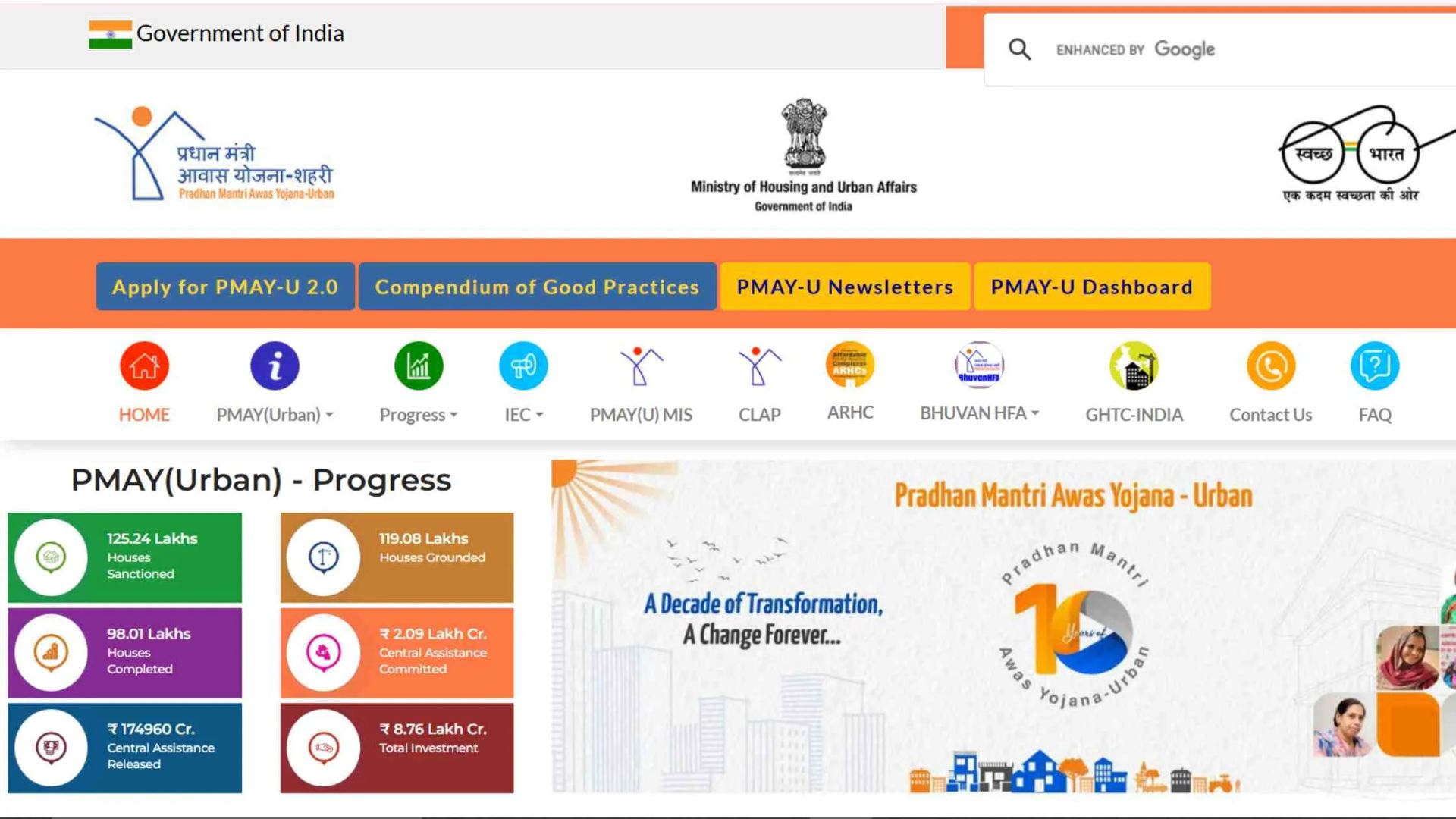
- Visit the official PMAY-Urban portal at pmay-urban.gov.in and use your Assessment ID or Aadhaar number to check status
- Contact your lender directly; banks handle real-time subsidy status updates on behalf of borrowers
- Use the CLSS Awas Portal (CLAP), the central web-based monitoring system integrating MoHUA, CNAs, PLIs, and beneficiaries in real time
- Call PMAY customer service at 1800-11-3377 or 1800-11-3388
- Write to NHB or HUDCO for escalations related to subsidy delays or unresolved disputes
Common Mistakes to Avoid
- Not requesting CLSS explicitly from your lender, PMAY is never applied automatically
- Applying without verifying your Aadhaar details match loan records exactly
- Assuming all home loans taken after 2024 are automatically eligible, sanction date, income category, and property limits all matter
- Doing a balance transfer after the subsidy has been applied, this results in full subsidy recovery
- Missing the 36-month construction completion deadline for under-construction properties
- Not checking whether your property's carpet area falls within the prescribed limit for your income category
Conclusion
PMAY subsidy on an existing home loan is claimable, but only if your loan was sanctioned on or after 1st September 2024 and you have not previously received any central government housing benefit. For EWS and LIG borrowers, the total saving can reach up to ₹2.67 lakh on the principal, directly reducing your EMI from day one. The last date to apply is 31 December 2026. Walk into your lender's branch today, request the CLSS application, and let them handle the rest.


Ans 1. Yes, but only if your loan was sanctioned and disbursed on or after 1st September 2024 under PMAY Urban 2.0. Loans taken before this date are not eligible. You must also meet all other conditions, no prior pucca house ownership, no previous central government housing benefit, and Aadhaar linked to your bank account.
Ans 2. No. The current PMAY Urban 2.0 scheme covers only home loans sanctioned on or after 1st September 2024. The original CLSS for EWS and LIG closed in March 2022 and for MIG in March 2021. Loans taken before September 2024 fall outside the active eligibility window entirely.
Ans 3. Under PMAY 2.0, the maximum subsidy is ₹1.80 lakh, disbursed in five annual installments of ₹36,000. Under the older CLSS structure, EWS and LIG borrowers could receive up to ₹2.67 lakh. The exact benefit depends on your income category, eligible loan amount, and tenure, capped at 20 years.
Ans 4. The last date to apply under the current PMAY Urban 2.0 scheme is 31 December 2026. Eligible borrowers should submit their CLSS request to their lender well before this deadline to allow sufficient time for verification and nodal agency processing.
Ans 5. Your chances reduce significantly after full disbursement. CLSS is ideally applied when disbursement is partial or ongoing. If the loan is fully disbursed, contact your lender immediately to check whether the subsidy window is still open. PMAY 2.0 requires more than 50% of the principal to remain outstanding for instalment releases.
Ans 6. You permanently lose all subsidy benefits. A borrower who switches to another lender after availing PMAY interest subvention is not eligible to claim it again. The subsidy already received may also be recovered and refunded to the Central Government.
Ans 7. No. The PMAY subsidy amount is completely exempt from income tax. It is not treated as taxable income under any head. Borrowers can continue to claim deductions under Section 24 on home loan interest and Section 80C on principal repayment even after the subsidy has been credited.
Ans 8. The required documents include Aadhaar Card for all adult family members, PAN Card, last 6 months bank statements, ITR receipts or salary slips, property allotment letter, developer payment receipts, approved layout plan, and two self-declarations, one confirming no prior pucca house ownership and one confirming no prior central government housing benefit.
Ans 9. After your lender submits your CLSS application and the Central Nodal Agency, NHB or HUDCO, approves it, the subsidy amount is credited directly to your loan account upfront. It is deducted from the outstanding principal, and your EMI is recalculated on the reduced amount.
Ans 10. The most common rejection reasons are pucca house ownership by self or a family member, Aadhaar details mismatching loan records, prior central or state government housing benefit, loan sanctioned before 1st September 2024, balance transfer to another lender, property carpet area exceeding the prescribed limit for your income category, and construction not completed within 36 months of first disbursement.