
✦ AI Summary
Table of Content
▲- What Is PM Surya Ghar Muft Bijli Yojana and How Does It Work?
- How Much Subsidy Do You Get Under PM Surya Ghar Yojana?
- What are the Eligibility Criteria for PM Surya Ghar Muft Bijli Yojana 2026?
- What Documents Are Required to Apply?
- How to Apply for PM Surya Ghar Yojana 2026?
- How Is the Solar Subsidy Credited to Your Account?
- PM Surya Ghar Yojana vs Other Solar Schemes
- How to Track Your PM Surya Ghar Application Status?
- Common Mistakes to Avoid
- Conclusion
The PM Surya Ghar Muft Bijli Yojana is recognized as India's largest domestic rooftop solar initiative, which provides government subsidies that reach up to ₹78,000 while delivering free electricity of 300 units every month to eligible households. The program, which Prime Minister Narendra Modi launched on February 13, 2024, through the Ministry of New and Renewable Energy (MNRE), plans to reach 1 crore households by March 2027 through its national digital portal.
The guide provides all information about solar subsidies because it shows the available subsidy amounts and eligibility criteria and required documents and shows customers how to claim their solar subsidy through the PM Surya Ghar Muft Bijli Yojana in 2026.
What Is PM Surya Ghar Muft Bijli Yojana and How Does It Work?
The PM Surya Ghar Yojana which people also know as PMSGMBY, delivers central financial assistance through Direct Benefit Transfer system that sends payments directly to beneficiaries' bank accounts after they complete their rooftop solar system installation and inspection and commissioning process. The system provides full subsidy benefits after verification process but installation time does not offer you any deduction, which exists in interest subsidy programs.
The scheme operates through DISCOM-registered empanelled vendors listed on the national portal. The subsidy program requires beneficiaries to choose installers who exist in the portal-approved list thus maintaining their eligibility.
Also Read: Solar Panel for Home: Tax Benefits and State Subsidy Guide
How Much Subsidy Do You Get Under PM Surya Ghar Yojana?
|
System Capacity |
Central Govt. Subsidy (CFA) |
Approx. Cost Coverage |
|---|---|---|
|
1 kW |
₹30,000 |
~60% |
|
2 kW |
₹60,000 |
~60% |
|
3 kW |
₹78,000 |
~40–60% |
|
Above 3 kW |
Capped at ₹78,000 |
Proportional |
Additional financial benefits include:
- Annual electricity bill savings of ₹15,000–₹18,000
- Income from selling surplus solar power back to the grid via net metering
- Subsidised home loans for solar installation are available through approved financial institutions
What are the Eligibility Criteria for PM Surya Ghar Muft Bijli Yojana 2026?
|
Eligibility Factor |
Requirement |
|---|---|
|
Property type |
Residential houses and apartments only |
|
Ownership |
Must be the registered property owner |
|
Electricity connection |
Active, grid-connected connection in applicant's name |
|
Rooftop condition |
Shadow-free space of ~100 sq. ft. per kW |
|
Roof strength |
Must support 28.5–32.5 kg per solar panel |
|
Prior subsidy |
No previous solar subsidy at the same address |
|
Property use |
Residential only; commercial/industrial not eligible |
Additional eligible categories:
- Group Housing Societies, for common area installations
- Residential Welfare Associations (RWAs), collective applications permitted
Example: A homeowner in Lucknow with a 300 sq. ft. shadow-free terrace, an active DISCOM connection in their name, and no prior solar subsidy at the same address is fully eligible to apply for a 3 kW system and claim ₹78,000 in central subsidy.
What Documents Are Required to Apply?
Identity and KYC Documents
- Aadhaar Card; mandatory for identity and address verification
- PAN Card; required by select states during application
- Passport-size photograph
Financial and Property Documents
- Latest electricity bill must display the consumer number
- Property ownership proof, sale deed, registry, or tax receipt
- Active bank account details with cancelled cheque
- A bank account must be in the applicant's name for DBT credit
How to Apply for PM Surya Ghar Yojana 2026?
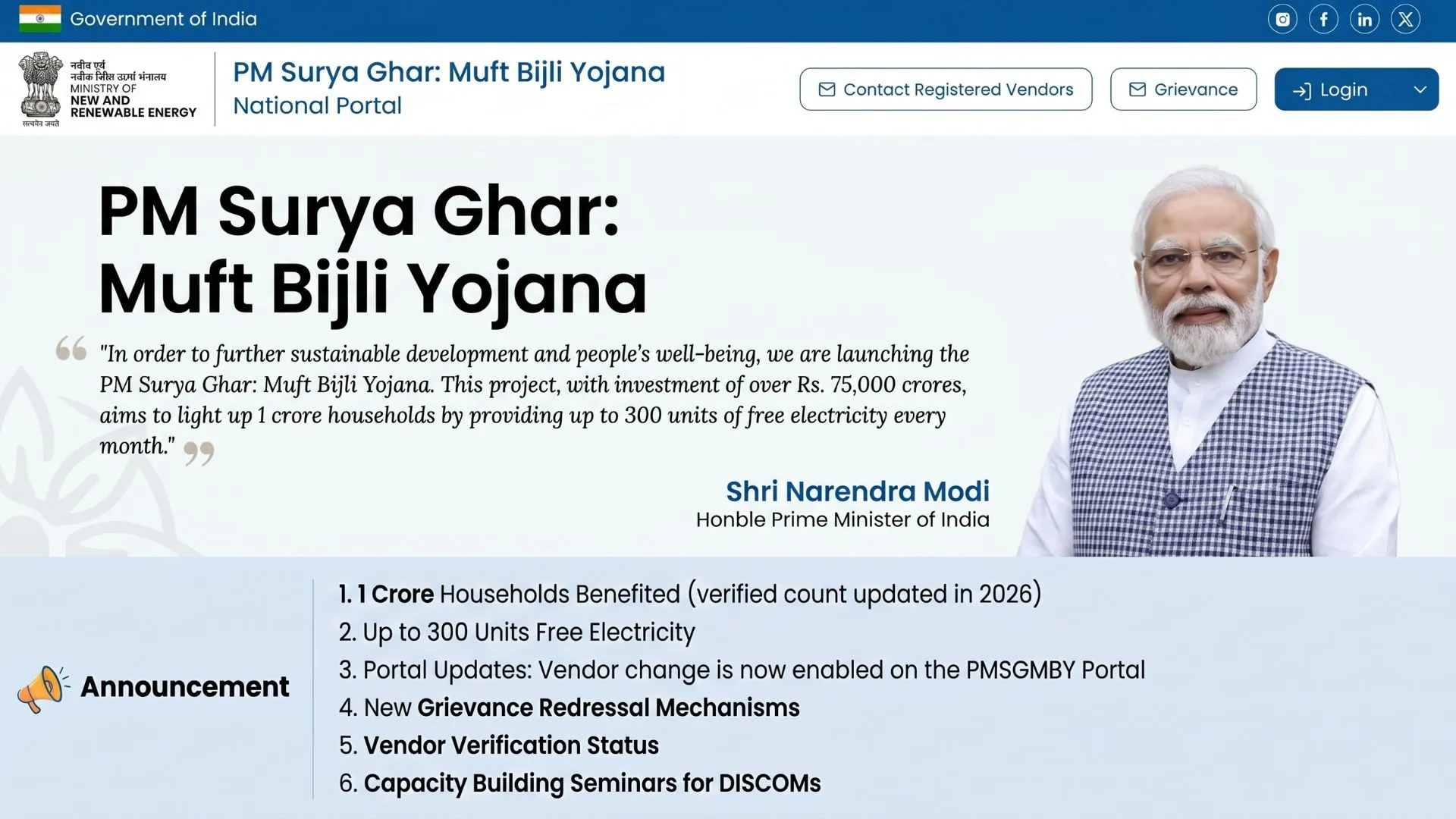
- Register on the Official Portal: Visit pmsuryaghar.gov.in and click Apply for Rooftop Solar. Register using your mobile number and verify via OTP.
- Submit Your Application: Enter your electricity consumer number, personal details, and address. Upload all required documents. Select your preferred system capacity, the portal displays your eligible subsidy amount instantly.
- Await DISCOM Feasibility Approval: Your local Distribution Company (DISCOM) evaluates the technical feasibility of the grid connection. Approval typically takes 3–7 working days.
- Select a Registered Vendor: Choose an MNRE-empanelled solar vendor from the portal's verified list. Only registered vendors ensure subsidy eligibility, never hire an unlisted installer.
- Site Visit and System Installation: Your vendor conducts a rooftop assessment, designs the system, and completes installation, typically within 2–3 days.
- DISCOM Inspection and Net Meter Setup: Post-installation, DISCOM conducts a technical inspection, installs a bi-directional net meter, and issues a commissioning certificate.
- Upload Bank Details and Receive Subsidy: Upload your bank account details and cancelled cheque on the portal. The subsidy is credited to your account within 30 days of commissioning certificate generation.
Also Read: PMAY Gramin 2026: Step-by-Step Guide to Claiming Your Home Loan Subsidy
How Is the Solar Subsidy Credited to Your Account?
The PM Surya Ghar Muft Bijli Yojana subsidy follows a post-installation DBT model:
- Installation is completed by an empanelled vendor
- DISCOM conducts a technical inspection and installs net meter
- A commissioning certificate is generated on the national portal
- Applicant uploads bank account details and cancelled cheque
- The subsidy is directly credited within 30 days, no intermediary is involved
|
Benefit |
Detail |
|---|---|
|
Free Electricity |
Up to 300 units/month |
|
Subsidy Amount |
Up to ₹78,000 (DBT) |
|
Annual Bill Savings |
₹15,000–₹18,000 |
|
Extra Income |
Sell surplus power via net metering |
|
Property Value |
Increases with solar installation |
|
Environmental Impact |
Reduces CO₂ emissions over 25-year system life |
PM Surya Ghar Yojana vs Other Solar Schemes
|
Feature |
PM Surya Ghar Yojana |
Other State Solar Schemes |
|---|---|---|
|
Governing body |
Central Govt. / MNRE |
Respective State Govts. |
|
Subsidy type |
Direct bank transfer (DBT) |
Varies, DBT or bill credit |
|
Maximum subsidy |
₹78,000 (3 kW cap) |
Additional top-up in select states |
|
Application portal |
pmsuryaghar.gov.in |
State DISCOM portals |
|
Vendor selection |
MNRE-empanelled list only |
State-approved list |
|
Stackable |
Yes, in most states |
Subject to state policy |
How to Track Your PM Surya Ghar Application Status?
- Visit pmsuryaghar.gov.in
- Log in with your registered mobile number
- Go to Track Application Status
- View DISCOM approval stage, installation status, commissioning, and subsidy disbursement history in real time
- SMS updates are sent to your registered mobile number at each milestone
Common Mistakes to Avoid
- Choosing a solar vendor not listed on the official portal directly disqualifies your subsidy claim
- Submitting an incorrect electricity consumer number, causes DISCOM rejection and delays
- Not uploading a cancelled cheque before the 30-day DBT window, subsidy disbursement will not proceed
- Applying for a system larger than 3 kW expecting higher subsidy, the central CFA is capped at ₹78,000 regardless
- Previously availed solar subsidy at the same address, this automatically disqualifies re-application
Conclusion
The PM Surya Ghar Muft Bijli Yojana remains India's most actionable and financially rewarding residential energy scheme in 2026. With a central subsidy of up to ₹78,000, 300 units of free electricity every month, and a fully digital seven-step application process, the barriers to solar adoption have never been lower. Applicants need to complete three critical steps, DISCOM approval, empaneled vendor selection, and post-installation bank detail submission, to receive the subsidy directly into their bank account.




Ans 1. PM Surya Ghar Muft Bijli Yojana is a central government scheme launched on 13 February 2024 under MNRE that provides rooftop solar subsidies of up to ₹78,000 and up to 300 units of free electricity per month to eligible residential households across India.
Ans 2. Indian residential property owners with an active DISCOM grid connection in their name, a shadow-free rooftop of at least 100 sq. ft. per kW, and no prior solar subsidy at the same address are eligible. Group Housing Societies and RWAs may also apply collectively.
Ans 3. The central government provides a direct subsidy of ₹78,000 for a 3 kW rooftop solar system. This is the maximum CFA available under the scheme, regardless of system size beyond 3 kW.
Ans 4. The official application portal is pmsuryaghar.gov.in. All registrations, vendor selection, document uploads, and application tracking are done through this national portal.
Ans 5. The subsidy is credited directly to the applicant's bank account within 30 days of the commissioning certificate being generated, provided the bank details and cancelled cheque have been uploaded on the portal.
Ans 6. No. Only residential property owners with an active electricity connection in their own name are eligible. Tenants do not qualify under the current scheme guidelines.
Ans 7. Yes. Only MNRE-empanelled vendors listed on pmsuryaghar.gov.in are eligible for subsidy-linked installations. Choosing an unlisted installer will disqualify the subsidy claim entirely.
Ans 8. Eligible households can generate up to 300 units of free electricity per month, depending on system capacity installed and local solar irradiance conditions.
Ans 9. Yes, in most states. Several states including Rajasthan, Gujarat, and Maharashtra offer additional top-up subsidies stackable with the central CFA under PM Surya Ghar Muft Bijli Yojana. Verify through your respective state DISCOM portal.
Ans 10. Surplus electricity is fed back to the grid through net metering. The bi-directional meter installed by DISCOM measures export units, and the applicant earns credits or direct income from their electricity distribution company based on applicable tariff rates.