
✦ AI Summary
Table of Content
▲- What Is UP Awas Vikas Parishad?
- Why Buyers Prefer UPAVP Plot Schemes
- Types of Schemes Offered by UP Awas Vikas Parishad
- Cities Where UPAVP Is Launching Projects in 2026
- Steps to Apply for UP Awas Vikas Parishad Plot Scheme
- Important Factors Buyers Should Check Before Applying
- Common Mistakes Buyers Should Avoid
- Final Thoughts
As the price of real estate in most major Indian cities continues to rise steadily, affordable residential land & house plans are becoming more desirable for middle income families & first-time home buyers alike. In Uttar Pradesh, the Awas Vikas Parishad of Uttar Pradesh has played an important part in providing the people of multiple UP cities with planned residential townships and plots, flats, and affordable housing.
In 2026, demand for UP Awas Vikas Parishad schemes has risen due to the fact that buyers are seeking legally approved plots with adequate infrastructure; a transparent allotment system; and a high likelihood to appreciate in value over time. The UP Awas Vikas Parishad often launches residential real estate projects in Lucknow, Kanpur, Ghaziabad, Prayagraj, Meerut, Agra, and Ayodhya. Therefore, it is critical for those who plan to purchase either residential land or affordable housing to have a clear understanding of just how to apply to the UP Awas Vikas Parishad.
What Is UP Awas Vikas Parishad?
Uttar Pradesh Awas Vikas Parishad commonly referred to as UPAVP is the state government housing authority established to plan and develop organised residential townships, plotted layouts, and affordable housing projects across Uttar Pradesh's major urban centres and growing cities.
The authority focuses on:
- Residential plot schemes
- Affordable housing projects
- MIG and LIG flats
- Commercial plots
- Township development
- Infrastructure planning
UPAVP projects are generally considered reliable because the authority develops legally approved layouts with roads, drainage, parks, water supply, and public infrastructure.
Also Read: YEIDA Plot Scheme 2026 Explained: Prices, Plot Sizes, Eligibility and How to Apply
Why Buyers Prefer UPAVP Plot Schemes
The growing popularity of UPAVP projects is linked to increasing trust in government-backed housing schemes. The advantages that consistently draw buyers to UPAVP over comparable private market options are real and specific:
1. Government-Backed Projects
Being a state housing authority, UPAVP projects usually offer better legal transparency and lower risk compared to unapproved private developments.
2. Affordable Pricing
Plots and flats are often priced lower than comparable private market developments.
3. Planned Infrastructure
Most schemes include:
- Roads
- Sewer systems
- Parks
- Water supply
- Street lighting
- Community infrastructure
4. Easy Financing
Many banks and housing finance companies provide easier loan approvals for government approved projects.
5. Long Term Appreciation
Plots in developing cities and suburban corridors often witness strong price appreciation over time.
Types of Schemes Offered by UP Awas Vikas Parishad
UPAVP launches multiple categories of housing and land schemes depending on city demand and urban expansion plans.
|
Scheme Type |
Purpose |
|
Residential Plots |
Future home construction |
|
Flats and Apartments |
Ready housing units |
|
MIG Housing |
Middle income group buyers |
|
LIG Housing |
Affordable housing segment |
|
Commercial Plots |
Shops and commercial use |
|
Mixed Use Developments |
Residential plus commercial projects |
Some projects also reserve units under government housing initiatives for economically weaker sections.
Cities Where UPAVP Is Launching Projects in 2026
The authority's project activity is concentrated in UP's most rapidly growing urban centres, with particular focus on cities benefiting from infrastructure investment that is actively driving residential demand:
Major Cities Covered
- Lucknow
- Kanpur
- Ghaziabad
- Prayagraj
- Agra
- Meerut
- Ayodhya
- Varanasi
Upcoming projects near new expressways and industrial corridors are also expected to be announced as these infrastructure investments generate new residential demand in previously peripheral locations.
Steps to Apply for UP Awas Vikas Parishad Plot Scheme
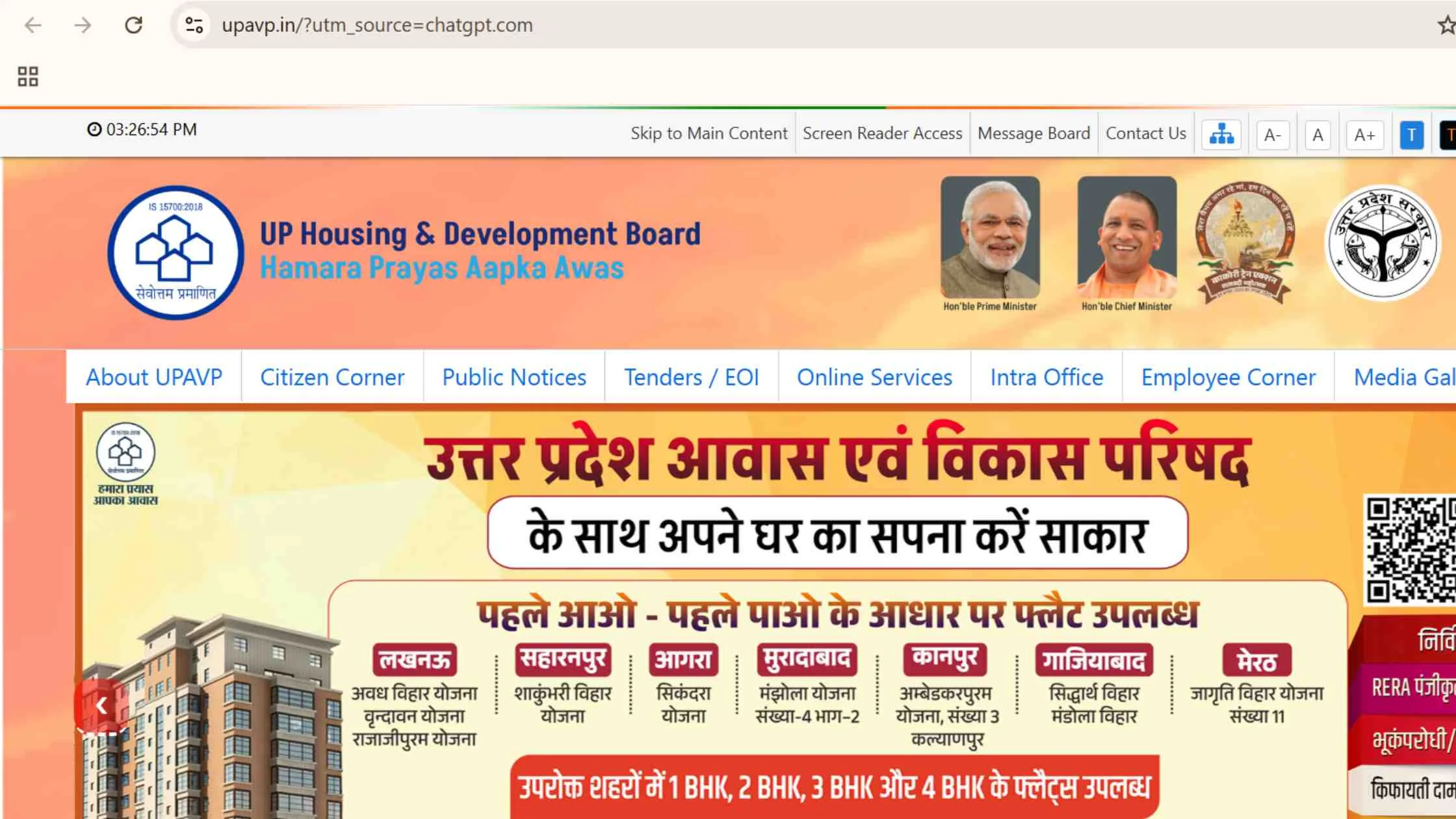
The application process has become largely digital, making it easier for buyers across India to participate.
Step 1: Visit Official UPAVP Portal
Applicants must first visit the official portal: UP Awas Vikas Parishad
The website publishes:
- New scheme announcements
- Brochures
- Plot availability
- Eligibility rules
- Application deadlines
Step 2: Check Eligibility Criteria
Different schemes may have different eligibility conditions based on:
- Income category
- Residential status
- Age requirements
- Property ownership rules
Common Eligibility Requirements
- Applicant must be an Indian citizen
- Valid identity proof required
- PAN and Aadhaar usually mandatory
- Income proof for reserved categories
- Applicant should not violate scheme conditions
Some affordable housing schemes may prioritize first time homebuyers.
Step 3: Register Online
Applicants usually need to create an online account.
Registration Process
- Enter mobile number
- Verify OTP
- Create login credentials
- Fill applicant details
- Upload documents
Digital application systems have reduced paperwork significantly compared to older manual allotment systems.
Step 4: Upload Required Documents
Documentation plays a major role in avoiding rejection or delays.
Common Documents Required
- Aadhaar card
- PAN card
- Passport size photo
- Income certificate
- Address proof
- Bank account details
- Category certificate if applicable
Incorrect or incomplete uploads can delay allotment processing.
Step 5: Pay Registration Amount
Applicants must pay the registration fee or earnest money deposit online.
Payment Modes Available
- Net banking
- UPI
- Debit card
- Credit card
The registration amount varies depending on:
- Plot size
- City
- Scheme category
- Income segment
Step 6: Allotment Process
UPAVP generally follows either:
- Lottery based allotment
- First come first serve allotment
The selection method depends on demand and project type.
Also Read: Auctioned Property in India 2026 The Smartest Buy or a Legal Minefield
Comparison of Allotment Methods
|
Allotment Type |
How It Works |
|
Lottery System |
Random computerized draw |
|
First Come First Serve |
Early applicants get priority |
|
Reserved Category Allotment |
Priority for eligible applicants |
Successful applicants receive allotment letters after verification.
Important Factors Buyers Should Check Before Applying
Government backing provides legal security; it doesn't eliminate the need for informed decision-making about whether a specific scheme fits your requirements and financial situation.
Verify Project Location
Visit the site physically whenever possible and assess:
- Connectivity
- Nearby infrastructure
- Road access
- Future growth potential
Understand Payment Schedule
- Initial deposit amount
- Installment timelines
- Interest penalties
- Possession schedule
Check Development Status
Different projects developed by UPAVP include both completely developed townships (those having roads, utilities, and parks already installed) and projects still being constructed with the installation of basic infrastructure completed. Knowing what the status is between these is important for assessing how long it will take to get your property ready for construction and if you will need to factor in improvements after you begin building and in the future.
Review Refund Policy
Understanding the terms and conditions that dictate when a consumer may cancel and how long it will take for refunds to process; also what type of deductions may be incurred as such is essential for both financial planning and knowing whether the ability to exit exists.
Common Mistakes Buyers Should Avoid
If you fail to read the application scheme brochure thoroughly, you could potentially overlook conditions and restrictions as it relates to your application and ultimately your financial commitment. Schemes have very specific terms and the brochure is the only authoritative representation of scheme terms and is not just a summary of the scheme's terms.
Missing payment deadlines after successful allotment. UPAVP scheme payment schedules are strict, and delayed payments attract penalty interest and in serious cases cancellation. Once allotted, calendar the payment dates immediately.
Uploading the wrong or inconsistent documents is one of the more common reasons applications get stuck in delays processing. So before you submit, just double-check that the names, dates and all little details on every uploaded file match up with each other, and are really consistent. It’s a small thing but it matters a lot, since even minor mismatches can create extra back-and-forth.
Applying without location analysis focused purely on the scheme's price and government backing without assessing whether the specific location serves your actual housing or investment needs. Price and legal security are necessary; they're not sufficient.
Final Thoughts
UP Awas Vikas Parishad plot schemes in 2026 offer an attractive opportunity for homebuyers and investors looking for legally approved residential land in growing Uttar Pradesh cities. With online application systems, planned infrastructure, and government backed transparency, these projects continue attracting strong buyer interest.
Before applying, buyers should carefully evaluate project location, pricing, payment terms, and long term growth potential. As infrastructure expansion continues across Uttar Pradesh, well located UPAVP projects may offer strong future appreciation and secure property ownership opportunities.


Ans 1. UP Awas Vikas Parishad (UPAVP) is the Uttar Pradesh state government housing authority that develops planned residential townships, plotted layouts, and affordable housing across UP's major cities. In 2026, UPAVP is actively offering residential plot schemes, affordable flats, MIG and LIG housing, commercial plots, and mixed-use developments across cities including Lucknow, Kanpur, Ghaziabad, Prayagraj, Meerut, Agra, Ayodhya, and Varanasi. New scheme announcements are regularly published on the official UPAVP portal as they are launched.
Ans 2. To apply for a UPAVP plot scheme online, visit the official UP Awas Vikas Parishad portal and check current scheme announcements. Verify your eligibility against the specific scheme's conditions. Register on the portal using your mobile number and OTP verification. Fill in the application form with accurate personal details and upload required documents including Aadhaar, PAN, photograph, and income proof if applicable. Pay the registration fee or earnest money deposit online through net banking, UPI, or card. After submission, retain your application reference number for tracking the allotment process.
Ans 3. Documents required for a UPAVP plot scheme application include Aadhaar card for identity and address verification, PAN card for financial compliance, a recent passport-size photograph in the specified format, income certificate for reserved category applications, current address proof, bank account details for refund processing, and category certificate (SC/ST/OBC/EWS) if applying under a reserved allocation. All documents must be current, clearly legible, and consistent with each other, discrepancies or poor-quality uploads are a common cause of application processing delays.
Ans 4. UPAVP allots plots through two primary methods. For oversubscribed schemes where applications exceed available plots, a computerised random lottery draw is conducted on a specified date with results published on the portal. For schemes with larger inventory or lower demand, first come first serve allocation gives priority based on application order. Reserved category applicants receive priority allocation in their respective categories across both methods. Successful applicants receive formal allotment letters that initiate the payment and documentation process. Refunds for unsuccessful lottery applicants are processed within a specified period after allotment completion.
Ans 5. UP Awas Vikas Parishad is active across UP's major urban centres in 2026 including Lucknow, Kanpur, Ghaziabad, Prayagraj, Agra, Meerut, Ayodhya, and Varanasi. Several upcoming projects are also expected near new expressways and industrial corridors where infrastructure investment is generating fresh residential demand. Ghaziabad and Meerut are particularly notable in 2026 given their RRTS connectivity to Delhi. Ayodhya has seen dramatically increased interest following religious tourism infrastructure investment. City-specific scheme availability changes with each launch cycle, check the UPAVP portal for currently active schemes.
Ans 6. UPAVP plots are generally considered safer from a legal and title perspective than comparable private plotted developments because the authority develops government-sanctioned layouts with verified land titles, approved development plans, and planned infrastructure. Banks and housing finance companies also extend loans more readily for UPAVP schemes than for private plots requiring more extensive title verification. However, UPAVP investment safety doesn't eliminate the need for location assessment, choosing a well-located scheme with good connectivity and infrastructure trajectory is still essential for strong long-term returns.
Ans 7. The registration fee or earnest money deposit for UPAVP plot schemes varies by plot size, city, scheme category, and income segment; there is no single fixed amount applicable across all schemes. Larger plots in premium city locations carry higher registration amounts, while LIG and EWS schemes have lower entry deposits. The registration amount is held during the allotment process and refunded to unsuccessful applicants. The specific registration fee for any current scheme is published in the scheme brochure available on the UPAVP portal.
Ans 8. Yes, UPAVP plot schemes are among the easiest government housing schemes to get home loans for. Most major banks and housing finance companies including SBI, HDFC Bank, Bank of Baroda, and others have established approval processes for UPAVP project loans because the legal title and development approvals are government-verified. The loan approval process for UPAVP plots is typically faster and involves less documentation burden than for private plotted developments. Contact your preferred lender directly to confirm their current terms for the specific scheme and city you're applying in.
Ans 9. MIG (Middle Income Group) and LIG (Low Income Group) housing in UPAVP schemes are income-based categories with different unit sizes, pricing, and in some cases eligibility conditions. LIG housing typically involves smaller units at more affordable prices designed for lower-income buyers, often with income ceiling eligibility conditions. MIG housing serves the broader middle-income market with larger units at moderately higher prices. Both categories may have connections to central government housing schemes and potentially subsidy eligibility. The specific income limits and unit specifications for MIG and LIG categories are defined in each scheme's brochure.
Ans 10. Missing payment deadlines after UPAVP plot allotment has financial consequences that escalate with the duration of the delay. Late payments typically attract penalty interest on the overdue amount at rates specified in the allotment letter and scheme terms. Persistent non-payment beyond specified periods can lead to allotment cancellation, with the scheme's cancellation policy determining what portion of amounts paid is refunded after deductions. Understanding the penalty structure and payment schedule completely before allotment, and having the financial arrangement confirmed in advance, is essential to avoid these consequences.