
✦ AI Summary
Table of Content
▲- What Is an EWS Certificate and How Does It Work?
- What Is the EWS Income Limit for PMAY 2026?
- What Is the Eligibility Criteria for EWS Certificate 2026?
- What Documents Are Required for EWS Certificate Application?
- How to Apply for EWS Certificate Online?
- How Long Does EWS Certificate Take to Process?
- How to Apply for PMAY 2026 Using Your EWS Certificate?
- Common Mistakes to Avoid
- Conclusion
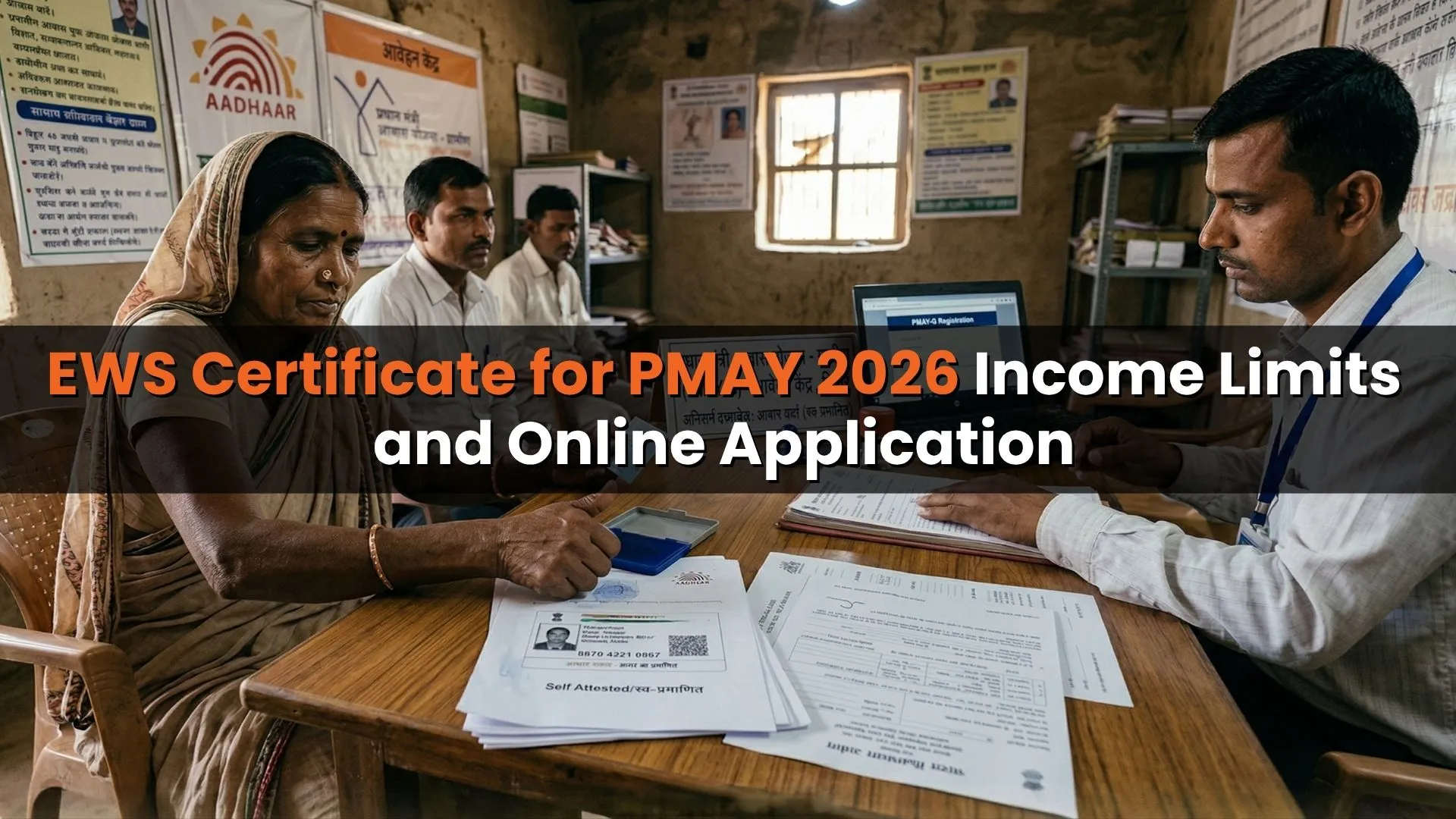
The EWS Certificate serves as the sole document which determines whether PMAY applicants meet eligibility requirements or not. The certificate becomes required for you to use home loan subsidies through Pradhan Mantri Awas Yojana 2026, if you belong to the economically weaker section. The Credit Linked Subsidy Scheme (CLSS) provides EWS households with home loan interest subsidies that reach a maximum of 6.5% for loans up to ₹6 lakh. The benefit will not proceed through processing without your application submission of a valid EWS certificate.
The EWS Certificate guide provides complete information about the certificate which includes its definition and eligibility requirements and income limit and required documents and the entire online application process for 2026.
What Is an EWS Certificate and How Does It Work?
The EWS Certificate is an official income asset certificate issued by a competent state revenue authority, typically a Tehsildar or Sub-Divisional Magistrate (SDM). It certifies that the holder belongs to the Economically Weaker Section of the General category and meets the income and property thresholds set by the central government.
The EWS classification system, which was established through the 103rd Constitutional Amendment in 2019, provides government job and higher education opportunities to economically disadvantaged general category applicants through a 10% reservation. The program serves its second essential function through its use as required income documentation for EWS housing subsidy applicants.
Also Read: PMAY Gramin 2026: Step-by-Step Guide to Claiming Your Home Loan Subsidy
What Is the EWS Income Limit for PMAY 2026?
Before applying, you need to determine your income bracket. The EWS Certificate and the PMAY EWS housing category both have separate income thresholds that need to be met.
|
Category |
Annual Household Income |
PMAY Subsidy Benefit |
|---|---|---|
|
EWS (Economically Weaker Section) |
Up to ₹3,00,000 |
Interest subsidy up to 6.5% on loan up to ₹6 lakh |
|
LIG (Low Income Group) |
₹3,00,001 – ₹6,00,000 |
Interest subsidy up to 6.5% |
|
MIG I (Middle Income Group) |
₹6,00,001 – ₹12,00,000 |
Interest subsidy up to 4% |
|
MIG II (Middle Income Group) |
₹12,00,001 – ₹18,00,000 |
Interest subsidy up to 3% |
Important: To qualify for PMAY housing subsidy your household income must not exceed ₹3 lakh annual income because the assessment requires your complete income before tax deductions. The ₹8 lakh ceiling for reservation-related benefits exists as a separate limit which requires you to keep both limits separate. Your family needs to earn exactly ₹3 lakh gross income to qualify for EWS subsidy under PMAY because any amount above this threshold will disqualify you.
Example: A family in Delhi with a combined annual gross income of ₹2.80 lakh, no pucca house in their name, and no prior housing assistance from the government qualifies directly for the PMAY EWS subsidy, provided they hold a valid EWS Certificate.
What Is the Eligibility Criteria for EWS Certificate 2026?
To qualify for an EWS Certificate, every single condition below must be met:
|
Eligibility Factor |
Requirement |
|---|---|
|
Category |
Must belong to the General category (not SC, ST, or OBC) |
|
Annual gross family income |
Below ₹8,00,000 from all sources |
|
Agricultural land |
Less than 5 acres |
|
Residential flat |
The area should not exceed 1,000 sq. ft. |
|
Plot in notified municipality |
Below 100 sq. yards |
|
Plot in non-notified area |
Below 240 sq. yards |
|
Prior housing scheme benefit |
Must not have received any central housing assistance |
|
Pucca house ownership |
The applicant or any family member must not own one anywhere in India |
Who counts as family under EWS?
The applicant, their parents, spouse, children, and siblings below 18 years of age.
Additional PMAY-Specific Conditions
- Aadhaar card is mandatory for PMAY registration and document verification
- Property must be in a statutory urban town as per Census 2011 or a subsequently notified planning area
- Construction must be completed within 36 months of the first loan disbursement
What Documents Are Required for EWS Certificate Application?
Identity and KYC Documents
- Aadhaar Card (mandatory for all applicants)
- PAN Card
- Voter ID or any valid government-issued photo ID
Income and Financial Documents
- Salaried applicants must provide their Form 16 documents and salary slips from the past 3 to 6 months.
- The applicant needs to submit their ITR documents, which include their Income Tax Return for the two most recent financial years.
- The self-employed applicant must provide their CA-certified income statement.
- The applicant needs to provide active bank account details which are linked to their Aadhaar account.
Address and Property Documents
- The domicile certificate (Niwas Praman Patra), electricity bill, and ration card serve as acceptable identity documents.
- The person needs to submit a self-signed affidavit which declares all his or her real estate and land ownership.
- The document provides permission for establishing a bank account which uses Aadhaar identification to receive Direct Benefit Transfer payments.
- The applicant must submit a recent passport-size photograph which needs to be scanned for online application purposes.
How to Apply for EWS Certificate Online?
The EWS certificate system in India requires applicants to use their state's e-District or Revenue portal because no central portal exists for this purpose. The process for most states operates according to these general steps:
- Visit Your State's e-District Portal: Go to your state's official e-District website (e.g., edistrict.delhi.gov.in for Delhi and edistrict.up.gov.in for Uttar Pradesh)
- Register or Log In: Create a citizen account using your Aadhaar-linked mobile number. Existing users can log in directly
- Select the Service: The user needs to access Revenue Department to find two services which are 'Income and Asset Certificate for EWS' and 'Issuance of Income Certificate for EWS'
- Fill the Application Form: You must provide your family information and total income from all sources and complete details about your assets and properties
- Upload Documents: You need to scan and upload all required documents which should not exceed 200KB per document
- Pay the Application Fee: You need to pay a fee which ranges between ₹15 and ₹50 through UPI or Net Banking. Applicants in states like Delhi may apply free of cost
- Submit and Note the Reference Number: You need to save your Application Reference Number after submission because it will help you monitor your application status online.
How Long Does EWS Certificate Take to Process?
|
State / Condition |
Processing Time |
|---|---|
|
Standard (all states) |
15–21 working days |
|
Delhi, Andhra Pradesh (documents clear) |
7–10 working days |
|
Certificate validity period |
One financial year only |
|
Applied after April 1, 2026 |
Valid for entire FY 2026-27 |
Note: EWS Certificates are not renewed, a fresh certificate must be obtained every financial year based on updated income. Your examination notification and PMAY application require you to request a certificate for FY 2025-26, so you must apply right away without delay.
How to Apply for PMAY 2026 Using Your EWS Certificate?
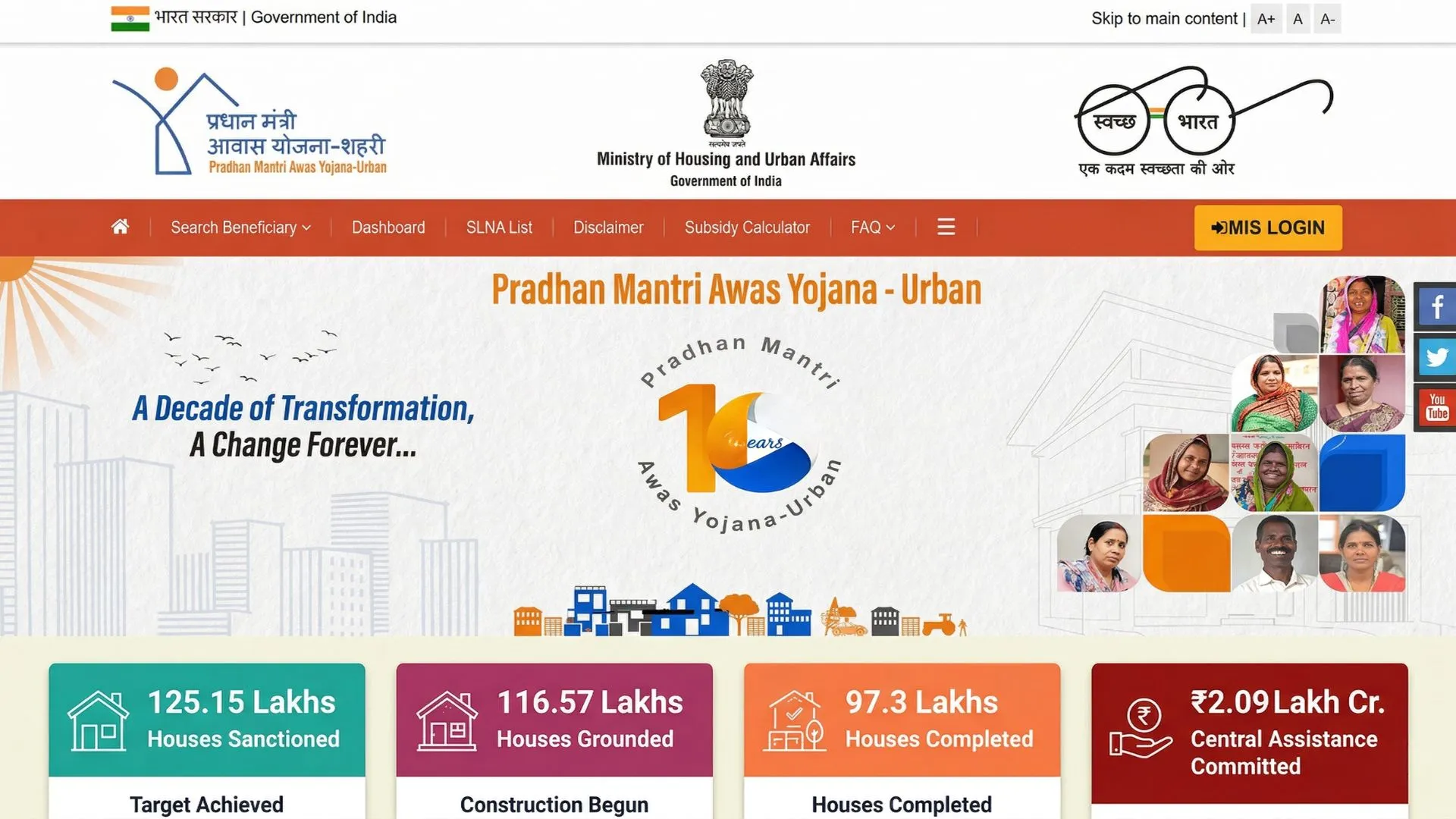
After your EWS Certificate has been obtained, you can start your PMAY application process according to these instructions.
- The official PMAY portal can be accessed through pmaymis.gov.in.
- You should choose 'Citizen Assessment' and then pick between 'For Slum Dwellers' and 'Benefits under other 3 components,' whichever applies to your situation.
- You need to provide your Aadhaar number so that they can verify your identity.
- You need to provide your name, address, bank account details, and income information.
- You need to upload your EWS Certificate together with all necessary documents that need to be submitted.
- You should click "Save" to enter the Captcha code before you submit your application.
- You need to print the completed application form to keep it as your personal record.
Also Read: Understanding the CLSS (Credit Linked Subsidy Scheme) in PMAY: How to Reduce Your Home Loan Burden
Common Mistakes to Avoid
- Declaring net or take-home salary instead of gross annual income in the affidavit
- Mismatch between ITR figures and the income declared in the EWS application form
- Applying in the state format instead of the Central Format (Annexure-1) for PMAY or central services
- Not linking Aadhaar to your active bank account before submitting the PMAY application
- Applying without first confirming that no family member owns a pucca house anywhere in India
- Missing the financial year window, an EWS certificate obtained in March 2026 is valid only until March 31, 2026
Conclusion
EWS Certificate is crucial for the PMAY 2026 application; without it, your interest subsidy is up to 6.5%. Head to your state's e-District portal, fill out the Central Format (Annexure-1), and make sure the income you declare matches what's on your ITR. Don't wait too long; submit it before the financial year ends. Once your papers are in order, getting a pucca home under PMAY 2026 is honestly much simpler than people assume.

Ans 1. The income limit for an EWS Certificate is ₹8 lakh per year (gross family income from all sources combined). For the PMAY EWS housing category specifically, the income must be ₹3 lakh or below annually to qualify for the maximum interest subsidy.
Ans 2. Individuals from the General category (not SC, ST, or OBC) with a gross annual family income below ₹8 lakh and assets within prescribed limits, less than 5 acres of agricultural land, no residential flat above 1,000 sq. ft., and no pucca house anywhere in India, are eligible.
Ans 3. Visit your state's e-District portal, register using your Aadhaar-linked mobile number, select 'Income and Asset Certificate for EWS' under the Revenue Department, fill in the form with accurate gross income details, upload documents, pay the fee (₹15–₹50), and submit. Note your reference number to track the application.
Ans 4. You need an Aadhaar Card (mandatory), PAN Card or Voter ID, a domicile certificate or utility bill for address proof, Form 16 and salary slips or ITR for income proof, a self-attested affidavit declaring property and land holdings, and a passport-size photograph.
Ans 5. Yes. The EWS Certificate or an income certificate from a competent authority is mandatory for the PMAY EWS and LIG category applications. Without it, your CLSS subsidy claim cannot be processed by the lender or the Ministry of Housing and Urban Affairs.
Ans 6. Under PMAY, EWS covers households with an annual income up to ₹3 lakh, while LIG covers ₹3 lakh to ₹6 lakh. Both categories receive a 6.5% interest subsidy under CLSS, but EWS applicants face stricter income and asset criteria and must submit an EWS Certificate as mandatory proof.
Ans 7. The standard processing time is 15–21 working days. In states like Delhi and Andhra Pradesh, well-documented applications are typically processed within 7–10 working days.
Ans 8. No. For EWS and LIG categories under PMAY, an income and asset certificate issued by a Tehsildar or SDM is mandatory. Applications submitted without it will be rejected during document scrutiny by the lender or urban local body.
Ans 9. For PMAY 2026, the EWS housing category income limit is ₹3 lakh per year (annual household gross income). This is separate from the general EWS Certificate ceiling of ₹8 lakh, which governs job and education reservation benefits.
Ans 10. The EWS Certificate is issued by the Tehsildar, Sub-Divisional Magistrate (SDM), or any other competent revenue authority designated by the state government. Applications are submitted and tracked through the state's official e-District or Revenue portal.