
✦ AI Summary
Table of Content
▲
Loan Against Property on an old residential house is not as straightforward as pledging a new flat and walking out with a cheque. The banks together with NBFCs conduct their evaluation process at a different level when they assess collateral that has reached its expiration date because missing a single essential document will result in a two-week delay for your approval process or it will completely reject your application.
The documentation burden is heavier for old properties because lenders need to verify an unbroken ownership chain which extends from 13 to 30 years back while they must also confirm building safety and check for any existing financial claims against the property. The only way to proceed through the process without facing unplanned costs requires you to understand your complete requirements and their specific purpose.
What Makes Old Residential Properties Different in a LAP Application?
Lenders treat old properties as higher-risk collateral for three core reasons:
- The title chain gaps exist because ownership records from 20 to 40 years ago are usually incomplete or lost or exist only in regional languages.
- The missing municipal approvals problems arise because properties constructed before the 1990s do not have either Occupancy Certificate or approved building plans.
- Structural uncertainty is directly related to loan-to-value ratios, which depend upon the usable life in the property.
The documentation requirement for an old residential property in a LAP is split across five distinct categories such as KYC, income, property title, municipal approvals, and legal-valuation. Each category carries specific documents that banks verify independently.
Also Read: SBI Realty vs. HDFC Plot Loan: Comparing Land Purchase Loans for Independent Homes
Complete Document Checklist for LAP on Old Residential Properties
1. KYC & Identity Documents
Required for the applicant and all co-applicants:
- You need to provide identity verification through one of these documents: Aadhaar Card, PAN Card, Passport, Voter ID, or Driving Licence.
- The following documents serve as proof of your address; Aadhaar Card, utility bills which include electricity and water services and Ration Card.
- You need to submit two to four current passport-size photographs.
2. Income & Financial Documents
|
Applicant Type |
Documents Required |
|---|---|
|
Salaried |
3–6 months salary slips, Form 16 (last 2–3 years), 6 months bank statements (salary account), employment letter |
|
Self-Employed / Business |
3 years ITR with computation, CA-certified P&L and Balance Sheet, 12 months bank statements, GST registration and returns |
|
Professionals (CA/Doctor/Architect) |
Professional qualification certificate, certificate of practice, 3 years ITR |
Key things to know about income documents:
- Lenders calculate your FOIR (Fixed Obligation to Income Ratio) from bank statements and existing EMIs, ensure your statements are clean and consistent
- Self-employed applicants are often asked for 12 months of both business and personal account statements, not just one
- GST returns serve as secondary income validation for business owners with declared turnover above Rs. 20 lakh
3. Property Title & Ownership Chain Documents
This is where LAP applications on old residential properties face the highest rejection risk. Lenders require a clear and unbroken chain of title, often tracing all transactions back 13 to 30 years.
|
Document |
Purpose |
|---|---|
|
Original Sale Deed / Conveyance Deed |
Primary proof of current ownership |
|
Previous Sale Deeds |
Establishes complete ownership chain, all past transactions |
|
Gift Deed / Will / Succession Certificate |
Required if property was inherited |
|
Partition Deed |
Required if property was received through family division |
|
Relinquishment Deed |
Required if any legal heir has surrendered their share |
Key things to know about title documents:
- For properties built before 1980, original deeds may be in regional languages, certified translations are required by most lenders
- A broken title chain, even a single missing intermediate sale deed, is the single most common reason LAP applications on old properties are rejected
- If original documents are lost, a court-registered indemnity bond or certified copy from the Sub-Registrar's office can substitute in many cases, subject to lender discretion
4. Municipal & Government Approval Documents
|
Document |
Relevance for Old Properties |
|---|---|
|
Approved Building Plan / Sanctioned Layout |
Confirms construction was legally authorised |
|
Commencement Certificate (CC) |
Pre-construction regulatory clearance |
|
Occupancy Certificate (OC) |
Confirms building was completed per approved plan |
|
Building Permit / Construction Licence |
Regulatory compliance document |
Key things to know about OC and old properties:
- Missing Occupancy Certificate (OC) is the most common reason LAP applications on old residential properties get delayed or rejected
- Some lenders accept old properties without OC against a legal indemnity bond and strong attorney opinion, but will reduce the LTV ratio by 10%–15%
- Unapproved additions or extensions to the original structure must be disclosed; concealment leads to post-disbursement recovery action
Also Read: Fixed vs. Floating Interest Rate: A 20-Year Cost Breakdown for 2026
5. Revenue Records & Land Documents
|
Document |
State Equivalent |
|---|---|
|
Khata Certificate & Extract |
Karnataka |
|
Patta Document |
Tamil Nadu |
|
7/12 Extract |
Maharashtra |
|
Jamabandi |
Punjab / Haryana |
|
Property Tax Receipts (last 3–5 years) |
All States |
|
Encumbrance Certificate (EC) |
All States, covering 13 to 30 years |
Key things to know about revenue records:
- For old properties, lenders prefer EC covering 30 years, request this from the Sub-Registrar's office even if the bank asks for only 13 years
- Khata or mutation discrepancies between revenue records and the sale deed are a common delay trigger. Resolve these before applying
- Property tax receipts establish your possession continuity and must match the name on the title documents
6. Society / Apartment-Specific Documents (For Flats)
- Share Certificate from Housing Society
- Society Registration Certificate
- NOC from the Housing Society
- Society maintenance paid receipts
7. Legal & Valuation Documents
|
Document |
Who Prepares It |
|---|---|
|
Title Search Report |
Lender-empanelled lawyer after Sub-Registrar search |
|
Legal Scrutiny Report |
Attorney's opinion confirming clear and marketable title |
|
Technical Valuation Report |
Bank-empanelled civil engineer or RICS-certified valuer |
|
Structural Stability Certificate |
Licensed structural engineer, mandatory for properties 25+ years old |
Key things to know about valuation for old properties:
- Lenders focus on remaining useful life, if the structural report estimates less than 10–15 years of life beyond the loan tenure, the application is typically declined or significantly downgraded
- Commission an independent structural report before approaching the bank, it helps you anticipate the lender's valuation outcome and negotiate better
What Banks Actually Offer
For properties more than 25 years old the LTV ratio usually falls in 50-60% and shrinks further depending on the condition of the construction.
|
Property Age |
Typical LTV Offered |
|---|---|
|
Up to 15 years |
70–75% |
|
15–25 years |
60–70% |
|
25–40 years |
50–60% |
|
40+ years |
40–50% (case-by-case basis) |
What the numbers actually mean: The bank will provide Rs. 55 lakh as a loan for a property which has a value of Rs. 1 crore and is 35 years old because the bank gives 55% LTV. That Rs. 15–20 lakh gap needs to be funded from your own sources. You need to include this information in your planning process before you submit your application.
5 Practical Tips Before You Apply
- Start document collection 60–90 days before applying: Old title chains and EC requests from the Sub-Registrar take time, do not begin this process after submitting your loan application
- Get EC for the maximum possible years: Lenders prefer 30-year EC for old properties; a 13-year EC is the minimum but often triggers additional queries that slow processing
- Commission a structural report independently first: Knowing your property's remaining life estimate before the bank's valuer arrives helps you approach the right lender with realistic expectations
- Check mutation and Khata records for discrepancies: Revenue records that do not match sale deed names are a top delay trigger; get corrections done before applying
- Approach NBFCs if banks decline on age grounds: NBFCs like Bajaj Finserv, Piramal Finance, and Tata Capital offer LAP on properties up to 50–60 years old with more document flexibility than scheduled commercial banks
AquireAcres EMI Calculator for Smart Home Loan Planning
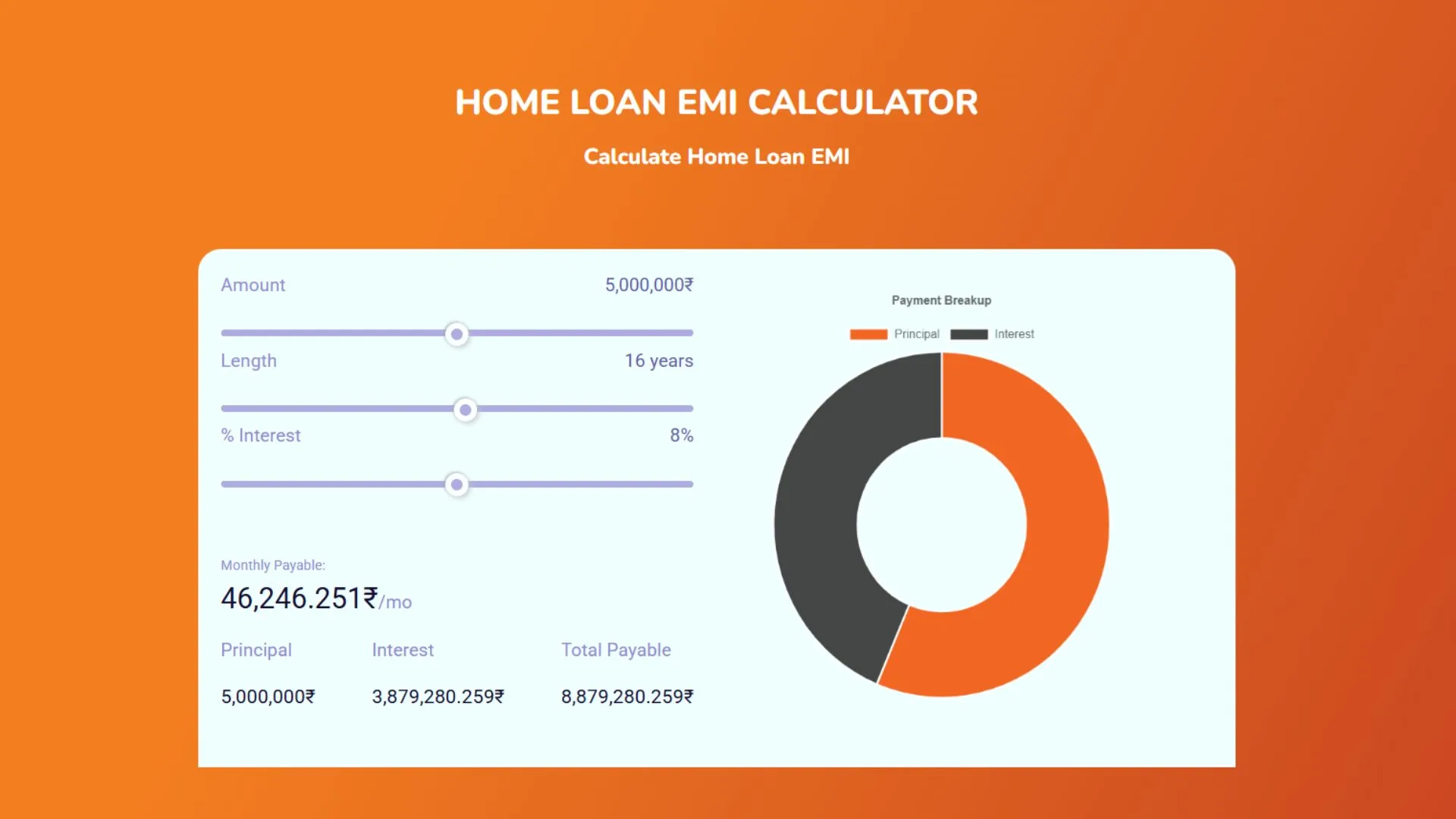
The AquireAcres EMI Calculator is a simple and reliable tool that helps you estimate your monthly home loan payments instantly. By entering your loan amount, interest rate, and tenure, you can understand your EMI, total interest payable, and overall cost of the loan, making it easier to plan your finances and make informed property decisions.
Conclusion
The process of obtaining a loan against property rights for an existing residential house becomes achievable when all necessary documents are both complete and legally valid and their submission occurs without any missing elements. The title chain and encumbrance certificate together with the structural report and municipal approvals function as essential elements which establish trust between lenders and your collateral. Start document collection early, address revenue record discrepancies before applying, and choose your lender based on their specific policy for aged properties, not just the headline interest rate.



Ans 1. You need KYC documents, income proofs (ITR, salary slips, bank statements), and property documents including original sale deed, previous title deeds, encumbrance certificate covering 13–30 years, building approval plan, property tax receipts, and a structural stability certificate for properties older than 25 years.
Ans 2. Most scheduled commercial banks fund properties up to 40–50 years old. NBFCs extend this to 60 years in select cases, provided the structural report confirms adequate remaining useful life beyond the proposed loan tenure.
Ans 3. Yes, but the LTV will be lower, typically 40%–50% of the current market value. A structural stability certificate from a licensed engineer becomes mandatory, and some lenders may also require an indemnity bond if the Occupancy Certificate is missing.
Ans 4. It is required per standard norms, but many lenders accept old residential properties without OC against a legal opinion and indemnity bond. The trade-off is usually a 10%–15% reduction in the LTV offered. NBFCs tend to be more flexible than banks on this.
Ans 5. An Encumbrance Certificate (EC) is an official record from the Sub-Registrar's office confirming the property has no pending dues, mortgages, or legal disputes. For old residential properties, lenders require EC covering 13 to 30 years, it is the primary document used to verify that the property is free of hidden liabilities.
Ans 6. Depending on the property's age, structural condition, and assessed market value, you can typically access 40%–70% of the property's current value. Properties between 25–40 years old generally attract 50%–60% LTV.
Ans 7. SBI, HDFC, Axis Bank, and ICICI Bank offer LAP on old residential properties with standard documentation and structural conditions. NBFCs, including Bajaj Finserv, Piramal Finance, and Tata Capital, are more accommodating on property age and missing documents.
Ans 8. The LTV ratio for properties older than 25 years generally ranges between 50%–60%. It can drop to 40%–50% for properties older than 40 years, depending on the structural engineer's assessment of remaining useful life.
Ans 9. The lender may reduce the sanctioned LTV, ask for a legal indemnity bond, require a stronger attorney opinion, or in some cases decline the application. NBFCs are generally more accommodating than banks. Proactively disclosing this to the lender before submission avoids mid-process complications.
Ans 10. Yes. LAP interest rates typically range from 9%–14% p.a., compared to 15%–24% p.a. for personal loans. The longer repayment tenure and higher loan amount also make LAP significantly more suitable when the funding requirement exceeds Rs. 10–15 lakh.