
✦ AI Summary
Table of Content
▲
The selection of appropriate cement for roof casting stands as the most vital decision in home building. However, most people dedicate only five minutes to this decision-making process. A roof slab endures overhead loads, scorching summers, and heavy monsoons. Pick the wrong cement, and the damage won't appear on Day 1, it shows up years later as seepage, hairline cracks, or corroded steel reinforcement that silently weakens your entire structure.
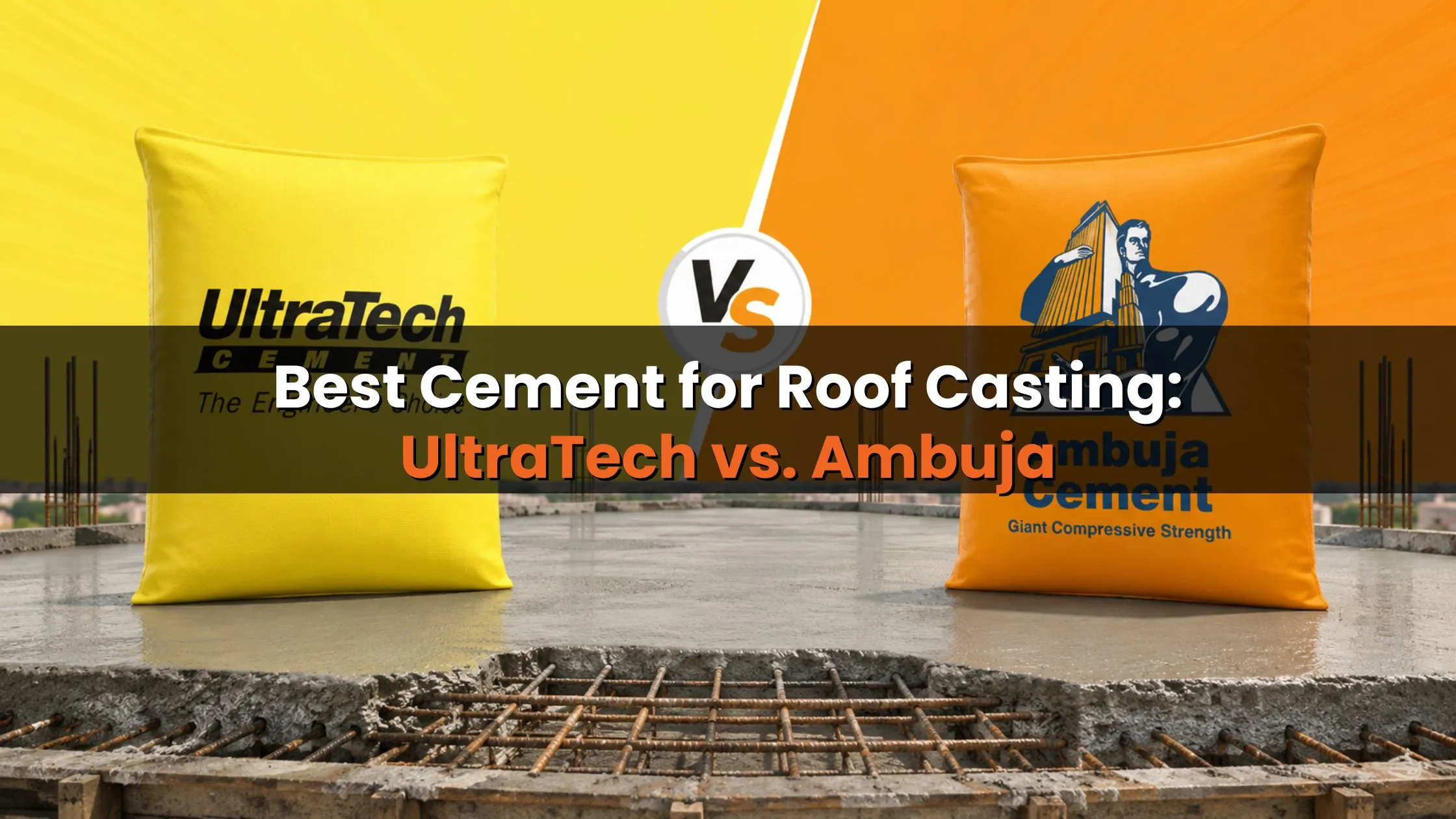
Two brands dominate this conversation for Indian homeowners and contractors alike, UltraTech and Ambuja. Both materials are trusted by users because they meet BIS standards and their availability extends from Tier 1 cities to the fastest-growing Tier 3 towns. The two things display different qualities. You need to understand the specifications of the products which include their strength, moisture resistance, grade suitability, and regional availability because it will help you avoid spending lakhs on future repairs. This guide cuts through the noise and gives you a clear, practical answer.
Which Cement Type Is Right for Your Roof?
Before making a comparison amongst different brands, it is essential to understand the meaning of cement grades. In India, three specific kinds are of relevance as far as roof casting is concerned.
OPC 53 Grade (Ordinary Portland Cement):
The strongest and fastest option. High early compressive strength means formwork can be removed sooner, keeping your construction timeline on track.
Key facts:
- The minimum required compressive strength at 28 days must reach 53 MPa.
- The solution operates most effectively in multi-storey buildings, commercial spaces and rapid residential development projects.
- Material exhibits increased hydration heat, which requires superplasticizer usage during hot weather concrete pours that occur in Delhi summers and Rajasthan.
- Recommended concrete grades for this project should either be M25 or M30.
PPC (Portland Pozzolana Cement):
Blends fly ash with a clinker. Slower to gain early strength but delivers superior crack resistance and long-term durability, the preferred choice for most residential roofs.
Key facts:
- The material produces 30% less heat through hydration which prevents thermal cracking.
- Material offers improved workability together with its self-curing capabilities.
- The system functions best in residential slabs which exist within areas of high humidity and frequent rainfall.
- The product shows improved environmental performance through its reduced carbon dioxide emissions.
PSC (Portland Slag Cement)
Specifically engineered cement, with greater resistance to sulphate-release environments and coastlines, where chemical attack is serious.
Also Read: PVC Wall Panels vs. Paint: Which is the Best Solution for Damp Walls in India?
UltraTech Cement: What You Need to Know
UltraTech which belongs to the Aditya Birla Group operates as India's leading cement manufacturer through its production facilities which have a total capacity of 152.7 MTPA spread throughout all principal Indian states. The company has established itself as the preferred brand among Agra contractors, Mumbai engineers and residents of Tier 2 & Tier 3 cities.
Key products for roof casting:
- UltraTech OPC 53 Grade
- UltraTech Super PPC / Premium PPC
- UltraTech Weather Shield
Key facts:
- The OPC 53 cement exhibits its maximum initial compressive strength together with its most consistent batch properties.
- Price range for the product extends from ₹390 to ₹430 for each 50 kg bag during the 2026 average period.
- The construction industry uses this material for major residential developments, commercial structures and infrastructure projects.
- The organization plans to reach its goal of 85 percent production using renewable energy by the year 2030.
Ambuja Cement: What You Need to Know
Ambuja commenced operations in 1983, established itself as a leader in moisture protection and fine particle performance which now belongs to the Adani Group. The distinction between these two products holds vital importance for roof slabs used in Patna, Bhopal, and Nagpur which experience heavy rainfall.
Key products for roof casting:
- Ambuja OPC 53 Grade (high C3S content)
- Ambuja Plus PPC
- Ambuja Compocem / Weather Plus
Key facts:
- The main benefit of the product for roof slabs exists because it provides superior protection against moisture and dampness.
- Finer particle grind delivers better workability, stronger bonding, and smoother slab finish
- The product price ranges from ₹370 to ₹420 per 50 kg bag during 2026.
- The company maintains a strong market presence throughout Gujarat Maharashtra Punjab and north-central India.
- The company leads the industry through its sustainable practices which include low CO₂ emissions, rainwater harvesting and fly ash utilisation.
Also Read: PVC Modular Kitchen Cabinets: Are They Really Termite-Proof and Water-Resistant?
Best Cement Grade by Climate and Location
|
Location / Condition |
Recommended Grade |
Best Brand Pick |
|---|---|---|
|
Hot & dry (Delhi, Rajasthan, UP) |
PPC, low heat of hydration |
UltraTech Super PPC / Ambuja Plus |
|
Standard residential (pan-India) |
OPC 53 or PPC |
Either brand |
|
Coastal / high-humidity zones |
PSC |
UltraTech PSC / Ambuja PSC |
|
Fast-track or multi-storey slab |
OPC 53 |
UltraTech OPC 53 |
|
Eco-conscious or green build |
PPC |
Ambuja Plus PPC |
5 Golden Rules for Roof Casting You Cannot Ignore
The process of establishing a brand requires correct handling of brand elements throughout its entirety. The following guidelines should be followed to create a slab which remains free of cracks and protects against water leaks.
- Use M25 or M30 grade concrete, never go below M25 for any residential roof slab
- The water-cement ratio should remain between 0.40 and 0.45 because any additional water decreases slab strength and increases slab vulnerability to leakage.
- The process of pouring requires mechanical vibration to remove air pockets and honeycombing defects.
- Cure for a minimum of 14 days, ideally 21 days, the ponding method is most effective; poor curing remains the single biggest cause of roof leakage across India
- Check cement freshness before purchase, use within 3 months of manufacture, verify the ISI mark, and reject any bag with lumps or moisture damage
UltraTech vs. Ambuja: Key Differences at a Glance
|
Factor |
UltraTech Cement |
Ambuja Cement |
|---|---|---|
|
Grades Available |
OPC 33/43/53, PPC, PSC |
OPC 33/43/53, PPC, PSC |
|
Initial Strength (OPC 53) |
Higher, slight edge |
Very good |
|
Moisture Resistance |
Very good |
Superior, clear winner |
|
Workability |
Very good |
Superior (finer particle grind) |
|
Price per 50 kg bag (2026) |
₹390 – ₹430 |
₹370 – ₹420 |
|
Pan-India Availability |
Strongest network |
Strong in North, West & Central |
|
Eco-Friendliness |
Good |
Excellent |
|
BIS Compliance |
Yes |
Yes |
|
Best For |
Large-scale, fast-track projects |
Residential, moisture-prone roofs |
Conclusion
Homeowners in India who construct their homes must choose roof designs which present difficult decision-making. The two companies UltraTech and Ambuja provide exceptional performance that meets all BIS standards and delivers the structural requirements needed for Indian residential buildings. Construction projects which require fast execution and large-scale infrastructure development should use UltraTech because it provides exceptional initial strength and nationwide availability.
Ambuja supplies superior moisture protection and workability together with sustainability features which provide the most essential benefits for residential roof slabs constructed in regions with heavy rainfall. The choice of your brand should reflect your specific location, climate and your construction schedule while you need to maintain proper curing time of 14 to 21 days for your slab.


_1792151285.webp)


Ans 1. Both are excellent. UltraTech edges ahead on early strength and pan-India availability, ideal for structural RCC and fast-track builds. Ambuja is the stronger pick for residential roofs in humid or high-rainfall regions due to its superior moisture resistance.
Ans 2. OPC 53 Grade is widely recommended for RCC roof slabs. PPC is preferred for residential slabs in hot or humid climates where crack resistance and long-term durability take priority over fast strength gain.
Ans 3. Yes. PPC generates less heat, resists shrinkage cracks better, and delivers superior long-term slab performance. Early strength gain is slower than OPC 53, but it is widely used and trusted for residential roofs across India.
Ans 4. Maintain a water-cement ratio between 0.40 and 0.45. Going beyond 0.45 increases porosity, weakens the slab, and raises the risk of roof seepage significantly.
Ans 5. Minimum 14 days; 21 days is the industry standard. The ponding method is the most effective. Poor curing is the single biggest cause of roof leakage in Indian homes.
Ans 6. M25 is the minimum standard for residential roofs. M30 is preferred for multi-storey structures or slabs bearing overhead water tanks and additional live loads.
Ans 7. UltraTech OPC 53 offers slightly higher early strength consistency. Ambuja OPC 53 performs exceptionally well in hot-weather pours across UP, MP, and Rajasthan, owing to its high C3S content and superior workability.
Ans 8. UltraTech is priced at ₹390–₹430 per 50 kg bag; Ambuja at ₹370–₹420 per 50 kg bag. Prices vary by city, dealer, and season.
Ans 9. Approximately 35–40 bags (50 kg each) for a 4–5 inch thick slab, based on an M25 or M30 mix design with standard wastage allowance.
Ans 10. Portland Slag Cement (PSC) is the go-to for coastal zones, sulphate-rich soils, or high-humidity regions. Both UltraTech and Ambuja offer reliable PSC variants suited for these conditions.