
✦ AI Summary
Table of Content
▲
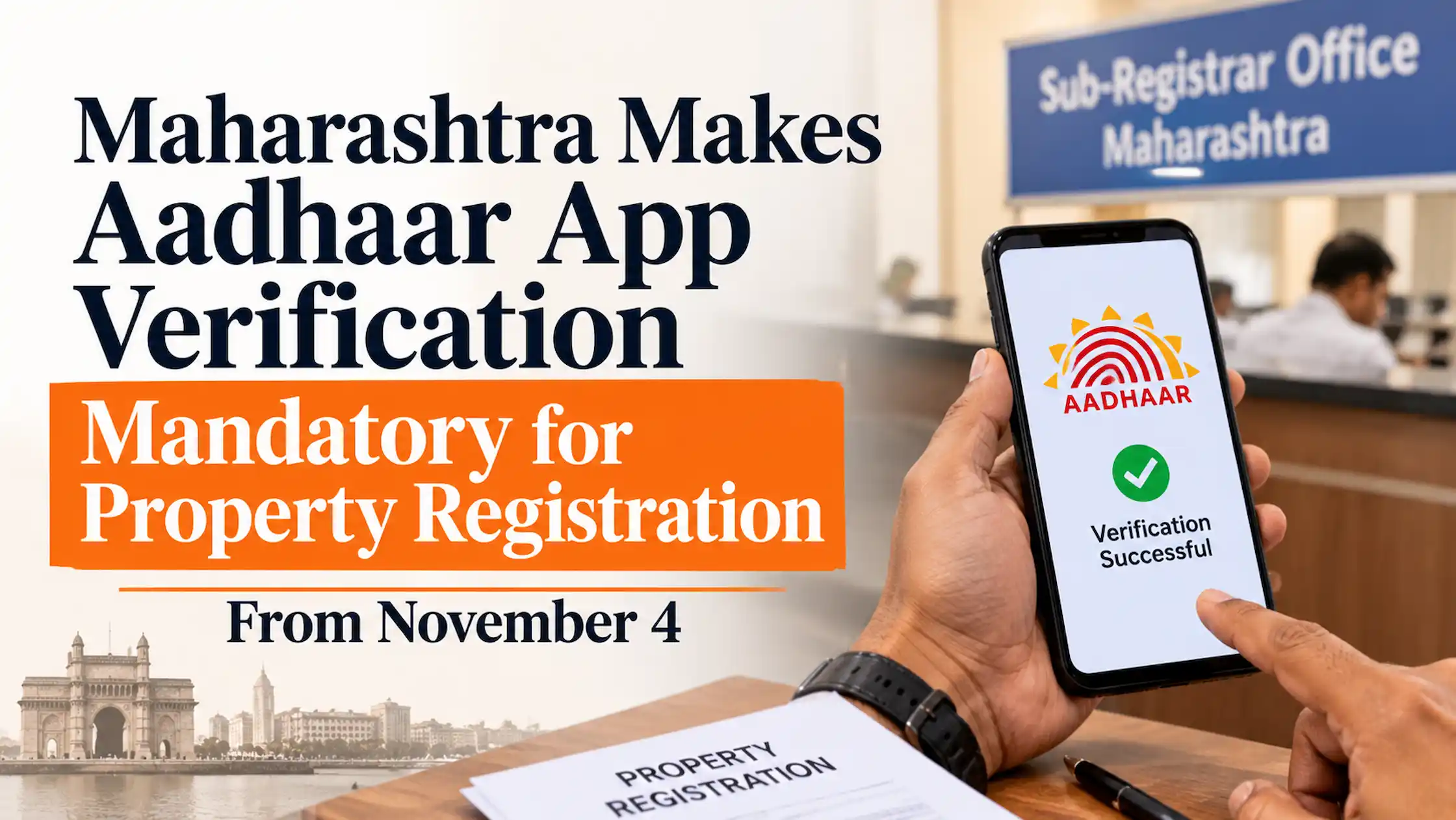
Anyone registering a property in Maharashtra now has to pass Aadhaar authentication through the UIDAI mobile app. The state’s Registration and Stamps Department made the app-based check mandatory for all property registrations from November 4. Every individual in the transaction must be physically present at the registration office with the mobile number linked to their Aadhaar.
The process is called online verification seeking entity (OVSE). It is built into iSARITA 1.9, the department’s registration system, and runs alongside the existing fingerprint and iris scans.
How Aadhaar app verification works for property registration
Under the revised guidelines, the earlier safety net is gone. Until now, a witness or “identifier” could vouch for a person whose Aadhaar authentication failed. That provision has been discontinued. Everyone involved in the transaction has to clear authentication on their own.
That makes the registered mobile phone essential. The Aadhaar holder must have it during verification, and the app needs an internet connection. It runs on Android 9.0 or iOS 16 and later, so people with older handsets should check compatibility before the appointment.
Biometric lock is another detail to sort out in advance. Anyone who has locked their Aadhaar biometrics must unlock them through the app at the time of registration, otherwise the check cannot go through. The department’s advice is to download the official Aadhaar app and complete the in-app setup before visiting the sub-registrar office.
How this fits with the October 1 rule
The app requirement follows an earlier change. From October 1, Aadhaar authentication became mandatory in Maharashtra for 63 categories of property-related documents, including sale, purchase, mortgage and partition deeds. Revenue Minister Chandrashekhar Bawankule said the aim was to curb fraud and impersonation, including the use of fake parties and witnesses, and to reduce human intervention in registration.
For more details, read Maharashtra's October 1 Aadhaar verification rule for property transactions.
That rule also set out what happens when a person has no Aadhaar number. They have to submit proof of Aadhaar enrolment, along with other government-issued identity documents and relationship proof, and registration stays subject to verification. Children and eligible beneficiaries cannot be denied registration benefits solely because they lack an Aadhaar number.
The November 4 change is about how the check is carried out. The department has said the mix of fingerprint, iris and app-based face authentication is meant to let verification continue when one method fails.
What it means for buyers, sellers and developers
The practical effect falls on the day of registration. With witness-based verification removed, a failed authentication can stall a transaction. Fixing a locked Aadhaar, an unreachable registered number or an incompatible phone on the spot is harder than doing it a week earlier.
Buyers and sellers should confirm that the mobile number on their Aadhaar is active and in their possession, install the app, and unlock biometrics before the appointment. Developers and brokers who book registration slots for several buyers may need to check each party’s readiness in advance, since every individual has to authenticate in person.
The new requirement adds an identity check to the wider property registration process, which also involves document submission, stamp duty and official recording of the transaction.
What is still unclear
Reports on the change leave a few points open:
-
App and biometrics: whether the app replaces fingerprint and iris scanning or sits beside them as an additional route.
-
Parties abroad: how the rule applies to someone who is outside India or signs through a power of attorney.
-
Fallback: what recourse exists when authentication fails repeatedly, now that the identifier route is closed.
The department’s circular or the iSARITA 1.9 guidelines should answer these. Until then, parties with an unusual situation can ask the sub-registrar office before booking a date.





Ans 1. Yes. From November 4, the Registration and Stamps Department requires Aadhaar-based authentication through the UIDAI app for all property registrations.
Ans 2. Every individual involved in the transaction must pass Aadhaar authentication in person, with the mobile number linked to their Aadhaar.