✦ AI Summary
Table of Content
▲
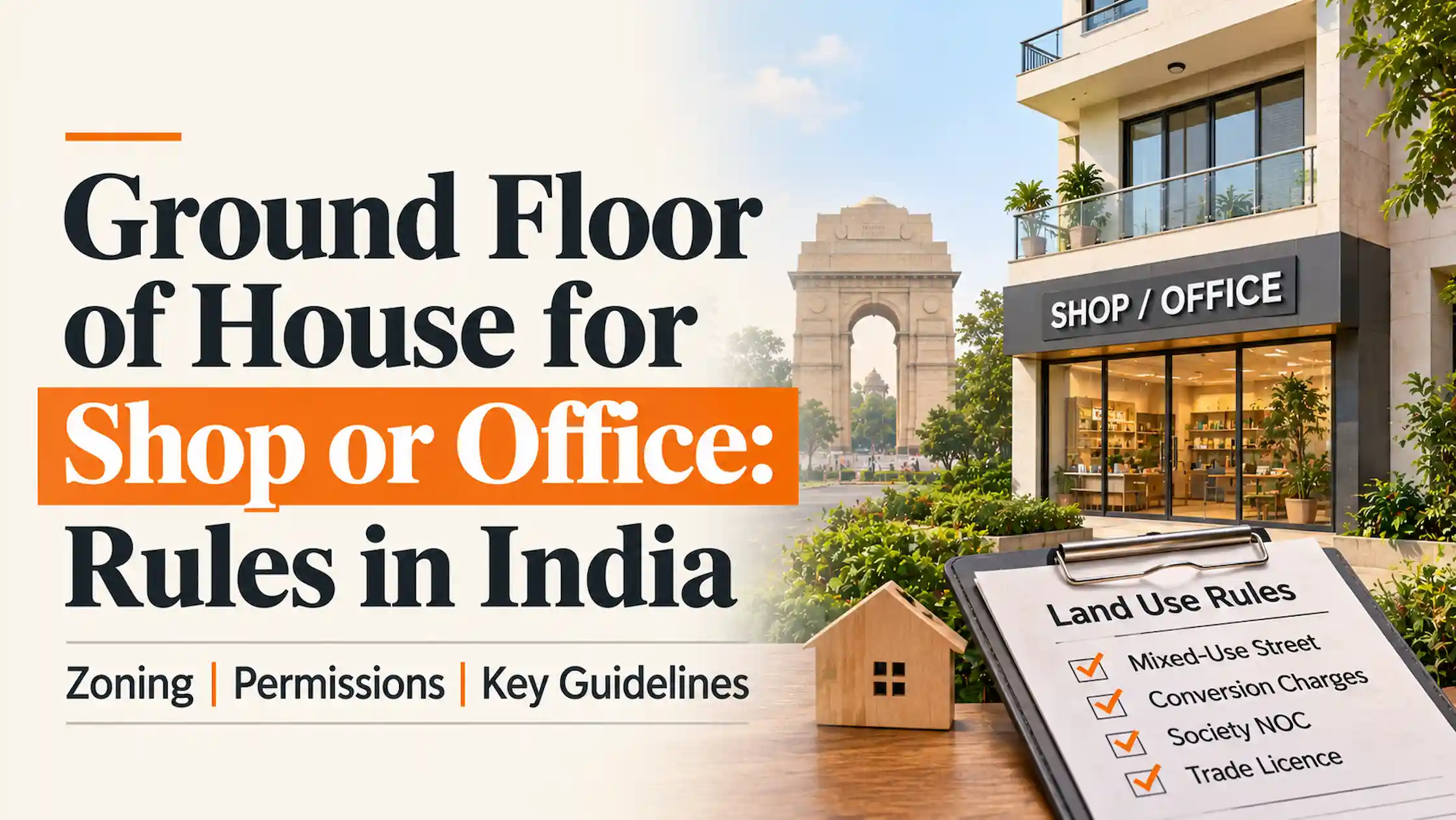
You can use the ground floor of a house for a shop or office only where local land-use rules allow it, and the answer depends on your city, your street and your colony category. Owning the house does not give you commercial rights.
Delhi changed its master plan in August 2026, and in September the Supreme Court told authorities to seal commercial use in residential-only areas. Checking before you open matters more than it did a year ago.
What decides whether you can open a shop at home?
Four things decide it: the land use in your city’s master plan, the road your house faces, the activity you plan, and any condition in your sanctioned building plan or society rules. A shop that fails any of these can be treated as misuse of the property.
“Mixed use” is the policy that allows limited commercial activity in residential areas. It is a conditional permission, not a right that comes with every residential plot.
How do Delhi’s rules work after MPD-2047?
The Master Plan for Delhi 2047 (MPD-2047) was notified on 20 August 2026 as an extensive modification of MPD-2021. Many online guides still describe the older plan.
- Notified mixed-use streets: Shops are allowed on the ground floor only. The plan freezes the list at 2,183 mixed-use streets and 355 commercial streets, and no new ones will be notified during the plan period.
- Roads of 30 m or more: Residential plots on roads with a right of way (ROW) of 30 m or more may run commercial activity on the ground floor, or the first floor above stilt parking, even if the street is not notified. Charges apply, and hazardous, inflammable and polluting activities are excluded.
- Professional activity: Doctors, lawyers, architects and similar professionals follow separate conditions in the plan, apart from the shop rules.
- Group housing: Under the MPD-2021 framework only professional activity was permitted. Check the MPD-2047 text before planning a shop in a flat.
- Charges: Conversion and use charges are set by the Central Government from time to time, so ask the authority for the current figure.
Where to check in other cities
|
City |
What to check |
|
Delhi |
DDA for master plan land use and conversion, MCD for licences and charges |
|
Bengaluru |
The planning authority for change of use, and the Greater Bengaluru Authority and your city corporation for licences |
|
Elsewhere |
The master plan and zoning rules of your development authority or municipal body |
BBMP no longer exists as a body. The Greater Bengaluru Authority replaced it in 2025, so guides that send you to BBMP are out of date.
Permissions checklist
- Land use and street. Ask the authority in writing which use your plot and road allow. File an RTI if records are not shared.
- Society or RWA NOC, if you live in a society or apartment. Some restrict commercial use over parking and footfall.
- Conversion or use charges, where your local rules require them.
- Shop and Establishment registration, under your state’s law.
- Trade licence from the municipal body, for trades that need one.
- Property tax and electricity. Commercial use can move you to a higher tax category and a non-domestic tariff.
- Trade-specific approvals: FSSAI for food, fire NOC where required, and medical or drug licences for clinics and pharmacies.
What happens if you open without permission?
On 22 September 2026 the Supreme Court issued three directions while hearing unauthorised construction and land-use matters, with Bhopal specifically flagged:
- In residential-only areas, premises with commercial activity should initially be sealed.
- Where land use is unclear, authorities must keep the status quo while proceedings continue.
- A pending ownership dispute does not stop sealing if the use breaches the allotted purpose or sanctioned plan.
The order was heard in a matter covering several states, but it signals how courts expect enforcement.
In a separate line of Delhi decisions on the MPD-2021 framework, the Supreme Court has held that mixed use is enabling. Owners on notified streets may choose to convert, and cannot be forced to.
Activities usually not allowed
Even where mixed use applies, these are commonly excluded:
- Hazardous, inflammable or polluting activities
- Liquor shops, bars and clubs in residential premises
- Heavy workshops and godowns with loud machinery
- Under MPD-2021, retail of building materials, firewood and coal, and some repair shops. Check the MPD-2047 text for its current list.
Using the ground floor of a house for a shop is legal only on streets and roads your master plan opens up.
Check land use first, then society rules, charges and licences.
Sealing risk is real, and pending disputes do not stop it.
Ask your authority in writing before you rent the space out.