

✦ AI Summary
Table of Content
▲- What is a Home Construction Loan?
- Current Home Construction Loan Interest Rates in India
- Who is Eligible for a Home Construction Loan
- Documents Required for Home Construction Loan
- Step by Step Process to Get a Home Construction Loan
- Key Features of Home Construction Loans
- Factors That Affect Your Interest Rate
- Benefits of Taking a Home Construction Loan
- Tips to Get the Best Interest Rate
- Final Thoughts
Purchasing a ready-to-occupy house is simple; locate the property, secure the financing, and settle in. Constructing your own house from the ground up is a distinct type of experience. You own the land, you have an idea of the house's appearance, and you have a general idea of the expenses involved. What you might lack is a clear understanding of financing the construction; particularly, how home construction loans operate, their expenses, and the steps to get one approved without unnecessary hurdles.
This guide includes all necessary information, from existing interest rates and eligibility requirements to a detailed application procedure and important considerations before you finalize your signature.
What is a Home Construction Loan?
A home construction loan is a particular kind of housing financing intended for individuals who possess a lot and wish to construct a dwelling on it. It varies from a typical home loan, which finances the acquisition of either a completed property or a building project from a developer, in one key aspect: the funds are released in phases aligned with the real progress of construction instead of in a single total amount.
This structured disbursement approach is the defining characteristic and the primary financial planning factor of a construction loan. The lender disburses funds as various stages of construction are finished and confirmed. This safeguards the lender, but it also requires you to meticulously organize your construction cash flow in accordance with the disbursement timetable.
Also Read: 50-30-20 Rule for Managing Your Home Loan EMI in a Tier 2 City
Current Home Construction Loan Interest Rates in India
Home construction loans are usually priced quite similarly to standard home loans, and in numerous banks, they're provided under the same rate framework. Variable rates prevail in this product category, indicating that your interest rate fluctuates with benchmark rates instead of being fixed for the duration of the loan.
Typical Interest Rate Range
- Starts from around 7.10 percent per annum
- Can go up to 9 to 10 percent or more depending on profile and credit score
- Floating rates are more common than fixed rates
Approximate Interest Rates from Top Lenders
|
Bank / Lender |
Interest Rate (Onwards) |
|
Bank of India |
7.10% per annum |
|
State Bank of India |
7.25% per annum |
|
ICICI Bank |
7.65% per annum |
|
HDFC Bank |
7.90% per annum |
|
Axis Bank |
8.25% per annum |
Final rate depends heavily on your credit score and repayment capacity.
AquireAcres EMI Calculator
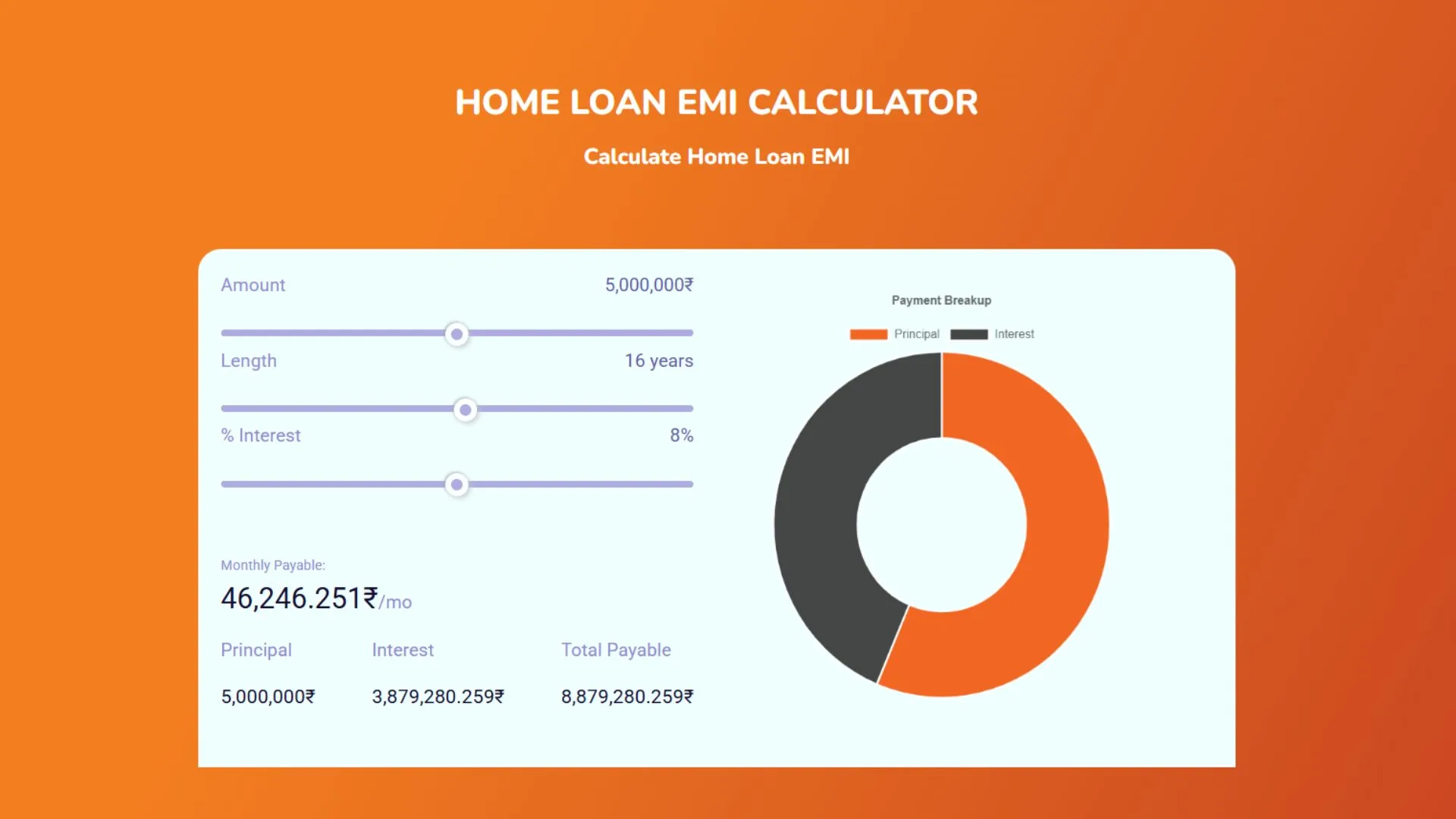
AquireAcres EMI Calculator is the fastest way to validate whether a home loan balance transfer actually works in your favour before you apply to a single lender. Enter your outstanding loan amount, current interest rate, new offered rate, and remaining tenure to instantly calculate your revised EMI, monthly savings, total interest reduction, and break-even period. Use it before initiating any balance transfer conversation, with your existing lender or a new one.
Who is Eligible for a Home Construction Loan
Eligibility criteria are quite similar to standard home loans, but there is one extra condition: you must possess the land where the construction will take place. Lenders assess not only your ability to repay financially but also the legal status of the property and the feasibility of the construction project.
Basic Eligibility Criteria
- Age: 18 to 70 years
- Employment: Salaried or self employed
- Credit score: Ideally 700 or above
- Stable income and repayment capacity
- Ownership of residential plot
Lenders also consider factors like job stability, business continuity, and existing EMIs before approving the loan.
Documents Required for Home Construction Loan
The documentation required for a construction loan is more comprehensive than that for a traditional home loan, as lenders require not just your financial details but also technical documents concerning the land and the proposed building. Having everything arranged before you contact a lender greatly accelerates the approval process.
Essential Documents
- Identity proof and address proof
- Income proof and bank statements
- Employment or business proof
- Property ownership documents
- Approved building plan
- Estimated construction cost
Lenders may ask for additional documents depending on your profile.
Also Read: Documents Required for Loan Against Property (LAP) on Old Residential Properties
Step by Step Process to Get a Home Construction Loan
Getting a home construction loan is straightforward if you follow the right steps.
Step 1: Check Eligibility
Prior to contacting any lender, dedicate time to a realistic self-evaluation. Determine your overall household earnings, enumerate all current EMIs and financial commitments, and assess how much extra EMI your budget can easily sustain. Utilize a home loan EMI calculator to determine the loan amount based on your preferred monthly payment. Request your CIBIL credit report to check your score; don’t wait for a lender’s denial to be your initial sign of a credit problem that could have been tackled ahead of time.
Step 2: Compare Lenders
The interest rate is a clear point of comparison, but it isn't the sole one. Processing charges range from 0.5 to 2 percent of the loan sum on a ₹50 lakh loan, resulting in an initial cost of ₹25,000 to ₹1 lakh.
The payment schedule, which shows how lenders release money during construction phases, determines your required working capital. Certain lenders possess greater experience with construction loan paperwork and have quicker internal workflows; seeking insights from those who have obtained construction loans from particular banks can be enlightening.
Step 3: Prepare Documents
You must prepare all required documents before you can submit any application. The construction loan process requires two specific documents which include an approved building plan and a professionally prepared construction cost estimate.
These documents are essential for starting the project but they become the main reason for delaying application processing when applicants fail to prepare properly. Should there be any missing information or a need for further clarity in your plot's title documentation, resolve these issues with a lawyer prior to contacting the bank.
Step 4: Submit Application
Currently, most significant lenders accept construction loan applications online, but the submission of physical documents and property verification will still need some coordination. Submit fully; incomplete applications frequently cause delays.
Clearly indicate that you are seeking a construction loan instead of a purchase loan, as the documentation and verification procedures vary.
Step 5: Loan Approval and Verification
The lender will check your documents, evaluate your income and credit status, perform a legal examination of the plot’s title documents, and review the construction plan and cost projection. A bank's technical officer usually goes to the site to confirm ownership and evaluate the location in person.
This procedure usually requires more time than a conventional home loan approval, generally ranging from two to four weeks, depending on the bank and the intricacy of the title verification.
Step 6: Loan Disbursement
After approval, the loan is distributed in stages, typically four to six tranches that align with construction milestones. A standard structure could disburse payments upon completion of the foundation, plinth, lintel, roof slab, and finishing phases.
Every release is followed by an inspection of the site conducted by the bank's technical officer. In this phase, you are responsible for paying "pre-EMI" interest solely on the amount released until the complete loan is utilized and regular EMIs commence.
Key Features of Home Construction Loans
Understanding the structural aspects of the loan prior to making a commitment aids in planning both the construction and financing more efficiently.
- Loan to Value Ratio (LTV):
- Up to 90 percent for loans up to 30 lakh
- Up to 75 to 80 percent for higher amounts
- Loan Tenure:
- Up to 30 years
- EMI Structure:
- Pre EMI option during construction
- Full EMI starts after completion
- Processing Fees:
- Usually up to 2 percent of loan amount
- Prepayment Charges:
- Not applicable on floating rate loans
Factors That Affect Your Interest Rate
The interest rate you ultimately receive depends on the lender's evaluation of your individual profile rather than solely the advertised initial rate. The elements that influence your rate to increase or decrease comprise:
- Credit score is the most significant factor. A CIBIL score of 650 compared to 780 can result in an interest rate difference of 50 to 100 basis points, which on a ₹50 lakh loan for 20 years amounts to lakhs of rupees in total interest. If your score requires enhancement, three to six months of consistent credit habits can substantially impact it before you apply.
- Stability of income influences a lender's perception of your ability to repay.
- The loan amount and duration affect your rate differently depending on the lender. Higher loan amounts may sometimes lead to slightly better rates, while extended terms might occasionally result in slightly higher rates.
- Current debt obligations that take up 40 percent or more of your monthly income lead lenders to evaluate any new loan more carefully and might influence the interest rate they provide.
- Including a financially capable co-borrower, often a working spouse or parent, enhances the application and may lead to a better rate.
Even small improvements in your financial profile can help you get better rates.
Benefits of Taking a Home Construction Loan
For those who own land and have a genuine desire to construct, a construction loan is typically the most suitable financing option when compared to other choices.
- Rates for personal loans usually begin between 10 to 14 percent, while construction loan rates beginning at 7.10 percent offer a significantly lower cost of capital for the same objectives.
- A repayment period of up to 30 years distributes the load in a manner that no other construction loan type provides.
- Interest on a home construction loan is eligible for a deduction as per Section 24(b) of the Income Tax Act, while principal repayments qualify under Section 80C, enhancing the appeal of the after-tax cost.
- You have a balance transfer option; if a more favorable rate is found elsewhere after your loan is issued, you can shift the remaining balance to another lender without incurring prepayment fees on variable-rate loans
Tips to Get the Best Interest Rate
Securing a favorable rate on a construction loan relies more on preparation than on luck.
- Improve your credit score to 750 or higher before applying
- Maintain your debt-to-income ratio under 50 percent
- Review at least three to five lenders before making a choice
- Obtain approval for your building plan before applying
- Think about opting for a shorter loan term if your earnings can support the interest savings from a 15-year loan compared to a 25-year loan at the same interest rate
Final Thoughts
A home construction loan stands as the most affordable construction method for your personal residence because it provides lower interest rates than its various alternatives which also offer lengthier repayment terms and tax benefits and allow for construction progress to determine funding disbursements.
Your financial discipline requirements together with your documentation requirements and your planning requirements will determine your approval results. You must compare multiple lenders while you need to understand their terms and your construction plan must be organized before you submit your application. The smart loan you create today will bring you future savings of lakhs through reduced interest expenses.







Ans 1. A home construction loan is a housing finance product designed for people who own a plot and want to build a residential property on it. The key difference from a regular home loan is that funds are disbursed in stages corresponding to construction milestones rather than as a lump sum. Regular home loans are used to purchase ready or under-construction properties from builders and are typically disbursed in a single amount or linked to builder payment schedules. Construction loans also require an approved building plan and construction cost estimate as part of the documentation.
Ans 2. Home construction loan interest rates in India in 2026 start from approximately 7.10 percent per annum at the most competitive end. Bank of India offers rates from 7.10 percent, State Bank of India from 7.25 percent, ICICI Bank from 7.65 percent, HDFC Bank from 7.90 percent, and Axis Bank from 8.25 percent. These are starting rates, your actual offered rate depends on your CIBIL score, income, loan amount, and repayment tenure. Most construction loans are offered on a floating rate basis linked to the lender's benchmark rate.
Ans 3. Eligibility for a home construction loan requires the applicant to be between 18 and 70 years of age, be either salaried or self-employed with stable verifiable income, have a CIBIL credit score of at least 700 (750 or above for the best rates), demonstrate sufficient repayment capacity after accounting for existing financial obligations, and own the residential plot on which construction is planned. Lenders also assess job stability, business continuity for self-employed borrowers, debt-to-income ratio, and the legal clarity of the plot's ownership documentation.
Ans 4. Documents required for a home construction loan include identity and address proof such as Aadhaar and PAN cards, income proof including salary slips and Form 16 for salaried applicants or ITR and business financials for self-employed, bank statements for the last six to twelve months, the plot's title deed and ownership documents, an approved building plan from the relevant municipal or local authority, and a professionally prepared construction cost estimate. Additional documents may be required depending on the lender's specific policies and the complexity of the property's title history.
Ans 5. A home construction loan is disbursed in stages rather than as a single lump sum. Funds are released in tranches, typically four to six that correspond to verified construction milestones such as foundation completion, plinth level, lintel level, roof slab completion, and finishing work. Before each tranche release, the lender's technical officer visits the site to verify that the claimed construction stage has been completed. During the disbursement period, borrowers pay pre-EMI interest only on the amount released until the full loan amount is drawn and regular EMIs begin.
Ans 6. Pre-EMI is the interest-only payment made on the disbursed portion of a home construction loan during the construction phase before the full loan amount is released. Since the loan is disbursed in stages, interest accrues only on the amount released at each stage. Pre-EMI payments are typically smaller than full EMIs because you're paying only interest without principal repayment. Full EMIs which include both principal and interest on the entire loan amount, typically commence after the final loan tranche is disbursed, once construction is complete.
Ans 7. The Loan to Value (LTV) ratio for home construction loans in India is up to 90 percent for loan amounts up to ₹30 lakh, meaning you need to contribute only 10 percent from personal funds. For loan amounts between ₹30 lakh and ₹75 lakh, the LTV reduces to 80 percent, requiring a 20 percent personal contribution. For loan amounts above ₹75 lakh, the LTV is 75 percent, requiring 25 percent personal funding. The actual loan amount is determined by the lower of the construction cost estimate, the lender's property valuation, and the amount your income supports in repayment capacity.
Ans 8. Yes, home construction loans qualify for tax benefits under the Income Tax Act. Interest paid on the construction loan qualifies for deduction under Section 24(b) up to ₹2 lakh per year for self-occupied properties, with this deduction available from the financial year in which construction is completed (not during the construction phase). Principal repayment qualifies for deduction under Section 80C up to ₹1.5 lakh per year. Any interest paid during the pre-construction period can be claimed in five equal installments starting from the year of completion. Consult a tax advisor to optimize these benefits for your specific situation.
Ans 9. Your CIBIL credit score is the single most impactful factor in determining the interest rate you're offered on a home construction loan. Lenders use credit scores as a primary indicator of repayment reliability, borrowers with scores of 750 or above typically receive rates at or near the advertised starting rate, while borrowers with scores below 700 may be offered rates 50 to 100 basis points higher or may face difficulty getting approved at all. On a ₹40 lakh loan over 20 years, a 50 basis point rate difference translates to approximately ₹2 to ₹3 lakh in additional total interest. Improving your credit score before applying is one of the highest-return financial preparation steps available.
Ans 10. If construction is delayed and you can't meet the milestones tied to loan disbursements, communicate proactively with your lender rather than going silent. Most lenders have provisions for timeline extensions in genuine cases and can adjust the disbursement schedule with appropriate documentation. Extended pre-EMI periods increase the total interest cost of the loan. Persistent delays that prevent the loan from being fully disbursed can create complications, including the possibility of the bank withdrawing the undisbursed portion of the approved loan in extreme cases. Building a construction timeline buffer of at least 15 to 20 percent into your planning is strongly advisable.