
✦ AI Summary
Table of Content
▲- What Is SBI Home Loan and What Is LIC Housing Finance?
- SBI vs. LIC Housing Finance: Head-to-Head Comparison 2026
- SBI Home Loan Interest Rates by CIBIL Score (2026)
- LIC HFL Home Loan Interest Rates by CIBIL Score (2026)
- 20-Year EMI Cost Breakdown on ₹50 Lakh Home Loan
- When Should You Choose SBI?
- When Should You Choose LIC Housing Finance?
- 5 Practical Tips Before You Decide
- AquireAcres EMI Calculator for Smart Home Loan Planning
- Conclusion
Indian homebuyers are currently evaluating the housing financing options between SBI and LIC Housing Finance throughout 2026 because of their important reasons. Home loan rates have decreased significantly because the RBI repo rate reached its lowest point at 5.50%, which is one of the two lenders that are now fighting for your business.
Your selection of the wrong option through its advertised rate will result in a financial loss of lakhs during a 20-year period. The guide provides detailed information about the strengths and weaknesses of each lender which helps you decide which one requires your signature on the contract.
What Is SBI Home Loan and What Is LIC Housing Finance?
You need to identify the type of lender you work with because that choice determines which interest rates will be shown to you and which financial products you can access.
State Bank of India (SBI)
- Type: India's largest public sector bank and the country's single biggest mortgage lender
- Rate benchmark: Floating rates linked to the RBI's External Benchmark Lending Rate (EBLR), currently at 8.15%
- Key advantage: Highest LTV ratio in its class (up to 90%), zero prepayment charges, and government-backed stability
- Best for: Salaried professionals, government employees, and defence personnel seeking the lowest possible rate
LIC Housing Finance (LIC HFL)
- Type: Subsidiary of Life Insurance Corporation of India; one of India's largest dedicated Housing Finance Companies (HFCs)
- Rate benchmark: Floating rates linked to its internal Prime Lending Rate (PLR), reviewed quarterly
- Key advantage: Specialized schemes for pensioners, cash-salary earners, and NRIs that commercial banks do not offer
- Best for: Pensioners, self-employed borrowers, and salaried applicants needing flexible income documentation
Also Read: Fixed vs. Floating Interest Rate: A 20-Year Cost Breakdown for 2026
SBI vs. LIC Housing Finance: Head-to-Head Comparison 2026
|
Feature |
SBI |
LIC Housing Finance |
|
Starting Rate (2026) |
7.25% p.a. |
7.50% p.a. |
|
Rate Range |
7.25% – 8.70% |
8.00% – 10.25% |
|
Rate Type |
Floating (EBLR-linked) |
Floating (PLR-linked) |
|
Max Loan Amount |
Subject to eligibility |
Up to ₹5 crore (purchase) |
|
Max Tenure |
30 years |
30 yr salaried / 20 yr self-emp. |
|
Processing Fee |
0.35% (min ₹2,000; max ₹10,000) |
0.25%–0.50% (min ₹5,000) |
|
LTV Ratio |
Up to 90% |
Up to 85% |
|
Prepayment Penalty |
None |
None (floating rate) |
|
Women's Concession |
0.05% discount |
Available |
|
Special Schemes |
Privilege, Shaurya, Flexipay |
Griha Varishtha, Griha Suvidha |
SBI Home Loan Interest Rates by CIBIL Score (2026)
The CIBIL score functions as the primary factor that determines your SBI interest rate. The following presents the specific benefits which you receive at each credit tier.
|
CIBIL Score |
Interest Rate (p.a.) |
|
800 and above |
7.25% – 7.50% |
|
750 – 799 |
7.50% – 7.75% |
|
700 – 749 |
7.75% – 8.25% |
|
650 – 699 |
8.25% – 8.70% |
Key things to know about SBI rates:
- Minimum CIBIL score: SBI requires a minimum score of 650–700 to qualify for a home loan
- Rate type: SBI offers floating rates only, so your EMI adjusts when the RBI changes the repo rate
- Women borrowers: An additional 0.05% concession applies, making SBI one of the few lenders with a gender-based rate benefit
- Processing fee relief: SBI regularly offers 50% concession on card rate, with 100% waiver in select campaigns
Also Read: How to Check Home Loan Eligibility Before Applying in India?
LIC HFL Home Loan Interest Rates by CIBIL Score (2026)
The differentiation LIC HFL exercises with regard to rates is based upon credit scores as well as applicant type, which ultimately influences how much an applicant will have to pay.
|
CIBIL Score |
Salaried (p.a.) |
Self-Employed (p.a.) |
|
800 and above |
8.00% – 8.25% |
8.25% – 8.50% |
|
750 – 799 |
8.25% – 8.50% |
8.50% – 8.75% |
|
700 – 749 |
8.50% – 8.75% |
8.75% – 9.25% |
|
Below 700 |
9.25% – 10.25% |
9.50% – 10.25% |
Key things to know about LIC HFL rates:
- Rate linkage: LIC HFL uses its own PLR as the benchmark, not the RBI's EBLR. This means rate transmission can be slightly slower
- Rate review cycle: Rates for existing customers are reviewed every 6 months, not every quarter like most EBLR-linked loans
- Self-employed penalty: Self-employed borrowers typically pay 25–50 basis points more than their salaried counterparts at the same CIBIL score
- Maximum tenure: 30 years for salaried borrowers, but only 20 years for self-employed, a critical difference if you are looking to keep EMIs manageable
20-Year EMI Cost Breakdown on ₹50 Lakh Home Loan
This is where the SBI vs. LIC Housing Finance debate becomes a real rupee-and-paise decision:
|
Interest Rate |
Monthly EMI |
Total Interest (20 yr) |
|
7.25% — SBI best case |
₹39,272 |
₹44.25 lakh |
|
7.50% — SBI / LIC standard |
₹40,280 |
₹46.67 lakh |
|
8.00% — LIC HFL entry |
₹41,822 |
₹50.37 lakh |
|
8.50% — LIC HFL mid-tier |
₹43,391 |
₹54.14 lakh |
|
Difference (7.25% vs 8.50%) |
~₹4,119/month |
~₹9.89 lakh extra |
What the numbers actually mean: A borrower who qualifies for SBI's best rate of 7.25% pays nearly ₹4,119 less per month than someone on LIC HFL's mid-tier rate of 8.50%. Over 20 years, that gap compounds to approximately ₹9.89 lakh in extra interest, enough to fully furnish your new home.
When Should You Choose SBI?
- Your CIBIL score is 750 or above: SBI's rate slabs are sharply tiered, a 750+ score unlocks rates below 7.75%, which very few lenders can match
- You are a government, PSU, or defence employee: SBI Privilege and SBI Shaurya schemes are designed exclusively for these profiles and come with preferential pricing
- You want maximum LTV: At up to 90%, SBI allows you to borrow more against the property value, reducing the down payment you need upfront
- You plan to prepay: Zero foreclosure charges mean any annual bonus, inheritance, or surplus income can go straight off your principal without cost
- Transparency is important to you: EBLR linkage means every rate change is publicly announced by the RBI and immediately traceable, no opaque internal decisions
When Should You Choose LIC Housing Finance?
- You are a pensioner: LIC HFL's Griha Varishtha scheme allows loan tenure up to 80 years of age, no other major lender comes close for this demographic
- You receive part of your salary in cash: The Griha Suvidha scheme is mortgage-guarantee backed and specifically designed for cash-salary and informally paid borrowers
- You need a construction loan above ₹5 crore: LIC HFL finances home construction up to ₹15 crore, well above what many banks sanction
- You value the 2 EMI waiver benefit: Maintain a default-free record for 5 years and LIC HFL waives 2 EMIs, a unique loyalty benefit that effectively reduces your total outgo
- You are an NRI: LIC HFL's NRI home loan programme has flexible documentation norms and tenures up to 20 years for the diaspora buyer
5 Practical Tips Before You Decide
- Get your CIBIL score to 750 or above first: The difference between a 730 and a 760 score can mean 50–80 basis points off your rate. On ₹50 lakh over 20 years, that is ₹5–8 lakh in savings. Spend 3–6 months fixing your credit before applying.
- Compare total interest outgo, not just the EMI: A small EMI reduction which comes from extending the loan period will result in hidden interest costs that exceed one lakh. The total interest figure needs to be requested before making any loan comparisons.
- Negotiate the spread, not the headline rate: Both SBI and LIC HFL add a spread over their benchmark. Even a 0.10% reduction on ₹50 lakh saves over ₹1 lakh across 20 years. Ask for it, especially if your credit profile is strong.
- Check the balance transfer option before you commit: Both lenders accept home loan takeovers from other banks. If you are currently paying above 8.75% elsewhere, a balance transfer to SBI or LIC HFL at today's rates could save you significantly.
- Use an EMI calculator with both rate scenarios: Run the numbers at today's rate and at a hypothetical 1% higher rate to see how your budget holds up in a rate-hike cycle. A loan that strains you today will break you if rates rise.
AquireAcres EMI Calculator for Smart Home Loan Planning
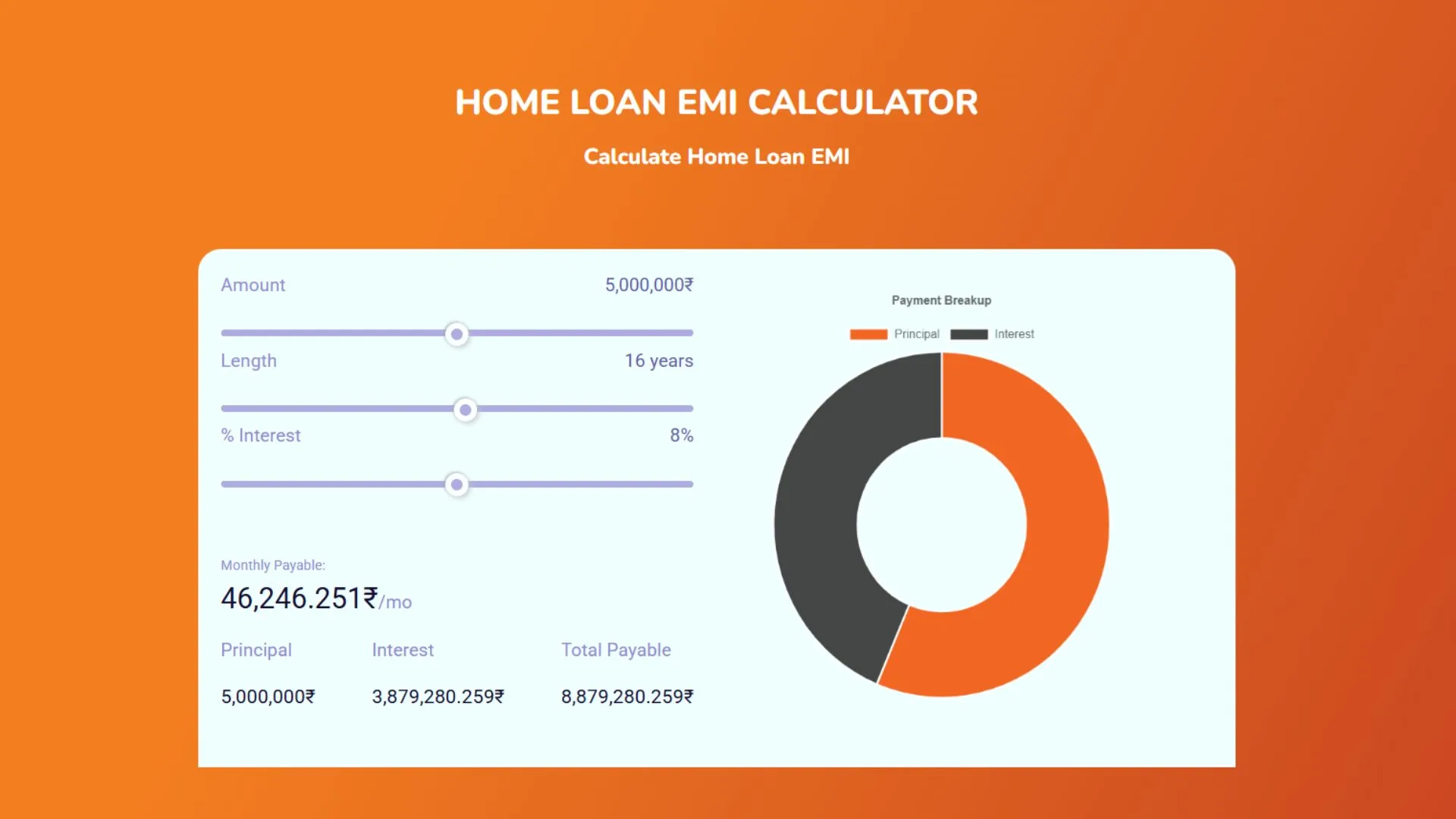
The AquireAcres EMI Calculator is a simple and reliable tool that helps you estimate your monthly home loan payments instantly. By entering your loan amount, interest rate, and tenure, you can understand your EMI, total interest payable, and overall cost of the loan, making it easier to plan your finances and make informed property decisions.
Conclusion
The selection between SBI and LIC Housing Finance depends on your identity as a borrower. SBI offers the best 2026 loan option for you because you have a strong CIBIL score and receive a formal salary and need the lowest cost loan which offers complete transparency. LIC HFL provides special products which SBI does not provide to customers who are pensioners or cash-salary workers or NRIs or need construction loans exceeding ₹5 crore. You should test both lenders with an EMI calculator about their total interest costs throughout the entire loan period while checking whether your credit status meets the requirements for the advertised interest rate. The best home loan is not the one with the lowest number on the website, it is the one that fits your financial life perfectly.




Ans 1. SBI home loan interest rates in 2026 start from 7.25% p.a. for borrowers with a CIBIL score of 800 and above, and go up to 8.70% p.a. for those in the 650–699 range. All rates are floating and EBLR-linked.
Ans 2. LIC HFL home loan interest rates in 2026 start from 7.50% p.a. and range up to 10.25% p.a. depending on the borrower's CIBIL score, employment type (salaried or self-employed), and the specific scheme chosen.
Ans 3. For most salaried borrowers with a CIBIL score above 750, SBI is cheaper, with rates starting at 7.25% vs. LIC HFL's 8.00%. The difference on a ₹50 lakh, 20-year loan amounts to approximately ₹5–9 lakh in total interest savings.
Ans 4. No. SBI does not charge any prepayment or foreclosure penalty on floating-rate home loans for individual borrowers. You can make part-payments or close the loan early at no additional cost.
Ans 5. Both SBI and LIC HFL offer a maximum tenure of 30 years for salaried borrowers. However, LIC HFL restricts self-employed borrowers to 20 years, while SBI applies the 30-year limit to both profiles.
Ans 6. Yes. LIC HFL's Griha Varishtha scheme is exclusively for government and PSU pensioners and allows loan tenure up to the age of 80 years, making it unique among Indian home loan lenders and far more flexible than what SBI offers for retirees.
Ans 7. A CIBIL score of 800 or above qualifies you for SBI's best rate of 7.25% p.a. A score in the 750–799 range attracts 7.50%–7.75%. Scores below 700 can still get approval but at rates of 8.25% or higher.
Ans 8. SBI charges 0.35% of the loan amount (minimum ₹2,000, maximum ₹10,000) plus GST, and frequently offers a 50% concession or a full waiver on this fee. LIC HFL charges 0.25%–0.50% with a minimum of ₹5,000 depending on the scheme.
Ans 9. Yes. Both SBI and LIC HFL offer balance transfer (home loan takeover) facilities for borrowers currently servicing a loan at a higher rate with another lender. The process requires standard documentation and is subject to eligibility criteria at the time of application.
Ans 10. SBI offers home loans exclusively at floating rates, linked to the RBI's EBLR. LIC HFL also primarily offers floating-rate products, linked to its internal PLR. Both rates move when the RBI revises the repo rate, currently at 5.50%, though LIC HFL's transmission may be slightly less frequent than SBI's quarterly reset cycle.