
✦ AI Summary
Table of Content
▲- The Core Difference: Consideration, Voluntariness, and Who's Eligible
- Sale Deed: When Money Changes Hands
- Gift Deed: Voluntary Transfer, No Consideration
- Relinquishment Deed: Only Between Co-Owners
- Gift Deed or Relinquishment Deed? The Case That Gets Misreported
- Stamp Duty Comparison: A Worked Example
- Tax Treatment: What Happens When You Eventually Sell
- Can Any of These Be Cancelled or Challenged Later?
- A Decision Framework by Scenario
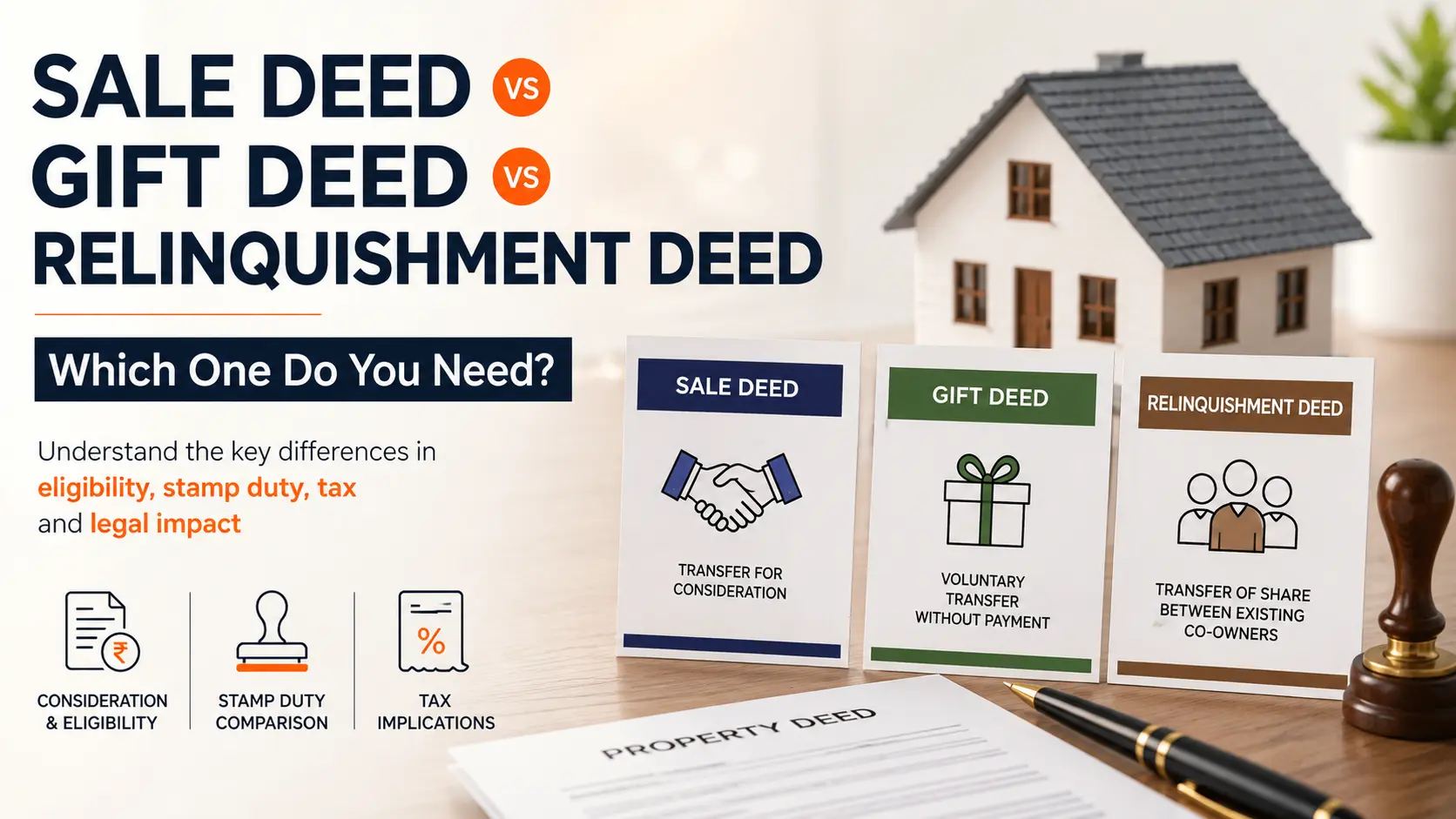
These three instruments aren't interchangeable alternatives you pick based on preference. Each one is legally suited to a different kind of transfer, and in the case of a relinquishment deed, eligibility itself is restrictive: you can only use one if you're already a co-owner transferring your share to another co-owner. A sale deed involves payment and works for any transfer between any parties. A gift deed is voluntary, involves no payment, and can go to anyone, related or not. A relinquishment deed is narrower still: it only works between existing co-owners of the same property.
Getting this choice right matters because it determines your stamp duty, your future tax liability, and whether the document can later be challenged for being something other than what it claims to be. Here's how to tell them apart and choose correctly.
The Core Difference: Consideration, Voluntariness, and Who's Eligible
Before comparing costs or tax treatment, settle this first: are you even eligible to use each instrument for your specific transfer?
- Sale deed: requires consideration, money or something of value, changing hands. Works between any parties, related or not, co-owners or not.
- Gift deed: requires no consideration; it must be a voluntary transfer, accepted by the recipient. Works between any parties, related or not, but gifting to a non-relative can trigger tax consequences for the recipient, covered below.
- Relinquishment deed: requires no new party to gain rights they didn't already have; it can only be executed by a co-owner surrendering their existing share in favour of another existing co-owner of the same property. You cannot use a relinquishment deed to bring in someone who wasn't already a co-owner.
That eligibility gate, particularly for the relinquishment deed, is where a lot of confusion starts, and it's worth confirming before deciding anything else.
Sale Deed: When Money Changes Hands
A sale deed is the standard instrument for any property transfer involving payment, whether between strangers, family members, or business parties. It attracts the full, standard conveyance stamp duty in your state, generally calculated on the higher of the actual sale price or the government's circle rate or guideline value for the property. This is typically the most expensive of the three instruments in stamp duty terms, but it's also the most straightforward and least likely to be challenged later, since it's unambiguous about what happened: property changed hands for value.
Even between relatives, a sale deed remains fully valid and is sometimes chosen deliberately, for instance, to establish a clean, well-documented transaction history, or because the parties genuinely want money to change hands rather than treat the transfer as a gift.
Gift Deed: Voluntary Transfer, No Consideration
A gift deed transfers property voluntarily, without any payment, from a donor to a donee, and it must be accepted by the donee to be valid; if the donee dies before accepting, the gift is void. It can be used between relatives or non-relatives, and can involve property the donor bought, inherited, or received as a gift themselves.
For immovable property, a gift deed must be registered to be legally effective, and it generally attracts stamp duty calculated on the property's market value, similar in structure to a sale deed's ad valorem calculation, though many states offer meaningfully reduced rates when the gift is made to a close relative. Once validly executed and accepted, a gift deed is generally irrevocable, except where the donor's consent can be shown to have been obtained through fraud, coercion, or undue influence.
Relinquishment Deed: Only Between Co-Owners
A relinquishment deed, also called a release deed, is used when a co-owner of a property, most commonly co-owned or inherited property, voluntarily surrenders their share in favour of another existing co-owner. No new party gains rights they didn't already have some claim to; the transaction simply consolidates existing shares among people who already own part of the property together.
This makes a relinquishment deed narrower in purpose than a gift deed, but often meaningfully cheaper, since many states apply a lower, sometimes nominal, stamp duty to a release executed without consideration between co-owners, compared to the ad valorem rate a gift deed typically attracts. A relinquishment deed must also be registered under the Registration Act, 1908, to be legally enforceable, and, like a gift deed, is generally treated as irrevocable once executed and registered, again subject to limited grounds like fraud or coercion.
Gift Deed or Relinquishment Deed? The Case That Gets Misreported
This is the single most confusing point across existing online content on this topic, so it's worth getting right, using the actual judgment text rather than secondhand summaries.
The Delhi High Court, in Tripta Kaushik v. Sub-Registrar VI-A, Delhi & Anr. (decided 20 May 2020), addressed exactly this question: if a co-owner relinquishes their share in favour of just one other co-owner, rather than all remaining co-owners collectively, does that turn the document into a gift deed instead of a valid relinquishment deed? Several sources summarising this case state that the court said yes, it becomes a gift deed. That is not what the court held.
The Delhi High Court's actual position, as recorded in the judgment, is the opposite: there is no basis in law for the proposition that a relinquishment deed executed in favour of one co-owner, rather than all of them, must be treated as a gift deed. The court held that what's decisive is the actual character of the transaction the parties intended, not the document's title, its wording, or how many co-owners happen to benefit from it. Where a co-owner genuinely renounces their right in favour of another co-owner, the use of words like "consideration" or "transfer" in the document doesn't, by itself, convert it into something else, and neither does directing the release toward one co-owner rather than all of them.
The practical takeaway: if you're a co-owner relinquishing your share to one specific other co-owner rather than the whole group, that alone doesn't force you into gift deed territory, or its typically higher stamp duty, provided the transaction genuinely reflects a release of your existing share rather than a disguised transfer to someone gaining fresh rights. What matters is the substance of what's actually happening, and it's worth having the document drafted carefully with that substance clearly reflected, since a Sub-Registrar can still examine and, if unconvinced, impound and reclassify a document that doesn't genuinely match its stated character.
Stamp Duty Comparison: A Worked Example
Stamp duty and registration charges are state subjects in India, so exact figures vary considerably; what follows is a real worked example from Delhi, useful for understanding the pattern rather than as a figure to apply elsewhere.
For a transfer between spouses in Delhi:
- Relinquishment deed: a nominal stamp duty (around ₹100 for family members, including a spouse), plus roughly 1% registration charges on the declared value.
- Gift deed between close relatives: also concessional, but somewhat higher than a relinquishment deed (around ₹200 stamp duty plus roughly 1% registration fee in the same example).
- Sale deed: full ad valorem stamp duty, commonly in the range of 4 to 6% of the circle rate value depending on the state and the seller's gender, plus registration charges, making it by far the costliest of the three for the same transfer.
The consistent pattern across states: where a relinquishment deed is available (co-owners only) and the family exemption applies, it's typically the cheapest route; a gift deed between close relatives is usually the next cheapest; a sale deed is generally the most expensive, though sometimes chosen anyway for reasons other than cost.
Tax Treatment: What Happens When You Eventually Sell
This is where the choice of instrument has consequences well beyond the immediate stamp duty bill.
Receiving a gift or relinquished share: if you receive property through a gift deed from a relative (as defined under Section 56(2)(x) of the Income Tax Act, a fairly wide category covering spouse, siblings, lineal ascendants and descendants, and their spouses, among others), there's no income tax on receipt. If the gift comes from a non-relative and the property's value exceeds ₹50,000, the full value is generally taxable in the recipient's hands as "Income from Other Sources." A relinquishment between co-owners without consideration is generally treated similarly to a gift for this purpose.
Selling it later: when you eventually sell property you received through a gift or relinquishment, your cost of acquisition for capital gains purposes is not what you paid, since you paid nothing, but what the original owner paid when they acquired it. Their holding period also carries over to you, meaning if they held it long enough to qualify as a long-term asset, you inherit that long-term status even if you personally held it for a shorter period before selling. This combination, inherited cost basis plus inherited holding period, is a genuinely significant detail: it means a property that has appreciated substantially since the original owner bought it will generate a correspondingly large capital gain when you sell, calculated from that original, often much lower, purchase price.
Selling property acquired through a sale deed, by contrast, has a straightforward cost basis: what you actually paid, with your own holding period starting from your own purchase date.
Can Any of These Be Cancelled or Challenged Later?
A registered sale deed generally cannot be unilaterally cancelled by either party once executed; undoing it requires a fresh transaction (a sale back) or a court order in cases of fraud or similar defects.
A gift deed, once validly executed and accepted, is generally irrevocable, except where the donor can show their consent was obtained through fraud, coercion, or undue influence, in which case it can be challenged in court.
A relinquishment deed, once registered, is similarly treated as generally irrevocable, subject to the same kind of limited grounds, and can also be challenged, or reclassified by a Sub-Registrar, if its actual character doesn't genuinely match a release between existing co-owners, regardless of what the document is titled.
A Decision Framework by Scenario
You're one of several siblings who inherited a property, and you want to give up your share in favour of just one sibling, not all of them. A relinquishment deed remains available to you for this, based on the correct reading of the Tripta Kaushik precedent; you are not automatically forced into gift deed territory just because the release favours one co-owner rather than the whole group.
A parent wants to transfer property to one child while the parent is still alive, and the child wasn't previously a co-owner. A relinquishment deed isn't available here, since the child has no existing share to begin with; a gift deed is the appropriate instrument.
Family members want a clean, unambiguous paper trail, or genuinely want money to change hands. A sale deed remains valid and appropriate even within a family, at the cost of full ad valorem stamp duty.
You're transferring your share in co-owned property and want the lowest-cost route. Where you're an existing co-owner and the recipient is also an existing co-owner of the same property, a relinquishment deed is typically the cheapest option, provided the transaction genuinely reflects a release rather than a disguised gift or sale.






Ans 1. A sale deed involves payment and works between any parties. A gift deed is voluntary, involves no payment, and can go to anyone. A relinquishment deed only works between existing co-owners of the same property, where one surrenders their share in favour of another.
Ans 2. A relinquishment deed is typically cheaper where it's available, since it's often taxed at a nominal or lower stamp duty rate than a gift deed's ad valorem calculation, but exact figures vary significantly by state.
Ans 3. No. A relinquishment deed can only be used by an existing co-owner surrendering their share to another existing co-owner. If the recipient wasn't already a co-owner, a gift deed or sale deed is the appropriate instrument instead.
Ans 4. No. The Delhi High Court in Tripta Kaushik v. Sub-Registrar VI-A, Delhi (2020) held there is no legal basis for that proposition. What matters is the actual character of the transaction, not how many co-owners the release favours. Note that several sources online summarise this case incorrectly.
Ans 5. Receipt of a gift from a relative, as defined under Section 56(2)(x) of the Income Tax Act, is not taxable. A gift from a non-relative exceeding ₹50,000 in value is generally taxable as "Income from Other Sources" in the recipient's hands.
Ans 6. Your cost of acquisition is what the original owner paid, not zero, and their holding period carries over to you. This means a long-held, significantly appreciated property can generate a large capital gain calculated from the original, often much lower, purchase price.
Ans 7. Generally no, once validly executed and registered, except on limited grounds like fraud, coercion, or undue influence, which would need to be proven in court.
Ans 8. It depends on eligibility. If you're an existing co-owner transferring to another existing co-owner, a relinquishment deed is usually cheapest. If the recipient wasn't already a co-owner, a gift deed to a close relative is typically the next most cost-effective option.