

✦ AI Summary
Table of Content
▲
Online and offline home loan applications aren't two different processes, they're two different front doors to the same process. Once your application is submitted, whether you filled it out on a bank's app or handed over a paper form at a branch, the verification, credit check, property assessment, sanction, and disbursement steps that follow are identical. The real question worth answering isn't "which method is better," but getting the sequence and documentation right regardless of which door you use.
Online vs Offline What Actually Differs
Applying online means filling out the application on the lender's website or app, checking eligibility instantly through a built-in calculator, and uploading documents digitally. Applying offline means visiting a branch, filling a paper form, and submitting physical documents to a representative. The genuine advantage of online is convenience and speed at the front end instant eligibility checks, round-the-clock availability, and real-time status tracking but the underwriting itself, credit verification, property assessment, and sanction, proceeds through the same internal process at the lender regardless of which route you started from.
The Step-by-Step Process
- Check eligibility first before you shortlist a property. This is worth emphasising, since one common and avoidable mistake is choosing a specific house before knowing how much you can actually borrow. Most lenders let you check eligibility and even get an in-principle (pre-approval) sanction without a finalised property, which tells you your realistic budget before you start seriously shortlisting. Before applying, it is also useful to understand the factors lenders consider when calculating home loan eligibility, including income, existing obligations, credit score and tenure.
- Fill out the application form, either online or at a branch, providing personal details, employment and income information, and existing loan obligations.
- Submit your documents (covered below), digitally if applying online, or as physical copies if applying offline.
- Pay the processing fee. This is non-refundable across virtually every lender worth knowing upfront, since it's charged regardless of whether your loan is ultimately sanctioned.
- Verification. The lender checks your credit score (CIBIL), verifies your employment and income, and may conduct a phone or in-person discussion to confirm your repayment capacity. Your credit history is an important part of this assessment, so understanding how CIBIL score is calculated for a home loan can help you prepare before applying.
- Property legal and technical check. The lender's team separately verifies the property's title, ownership chain, and construction approvals covered in more depth below, since this step protects the lender's collateral interest specifically.
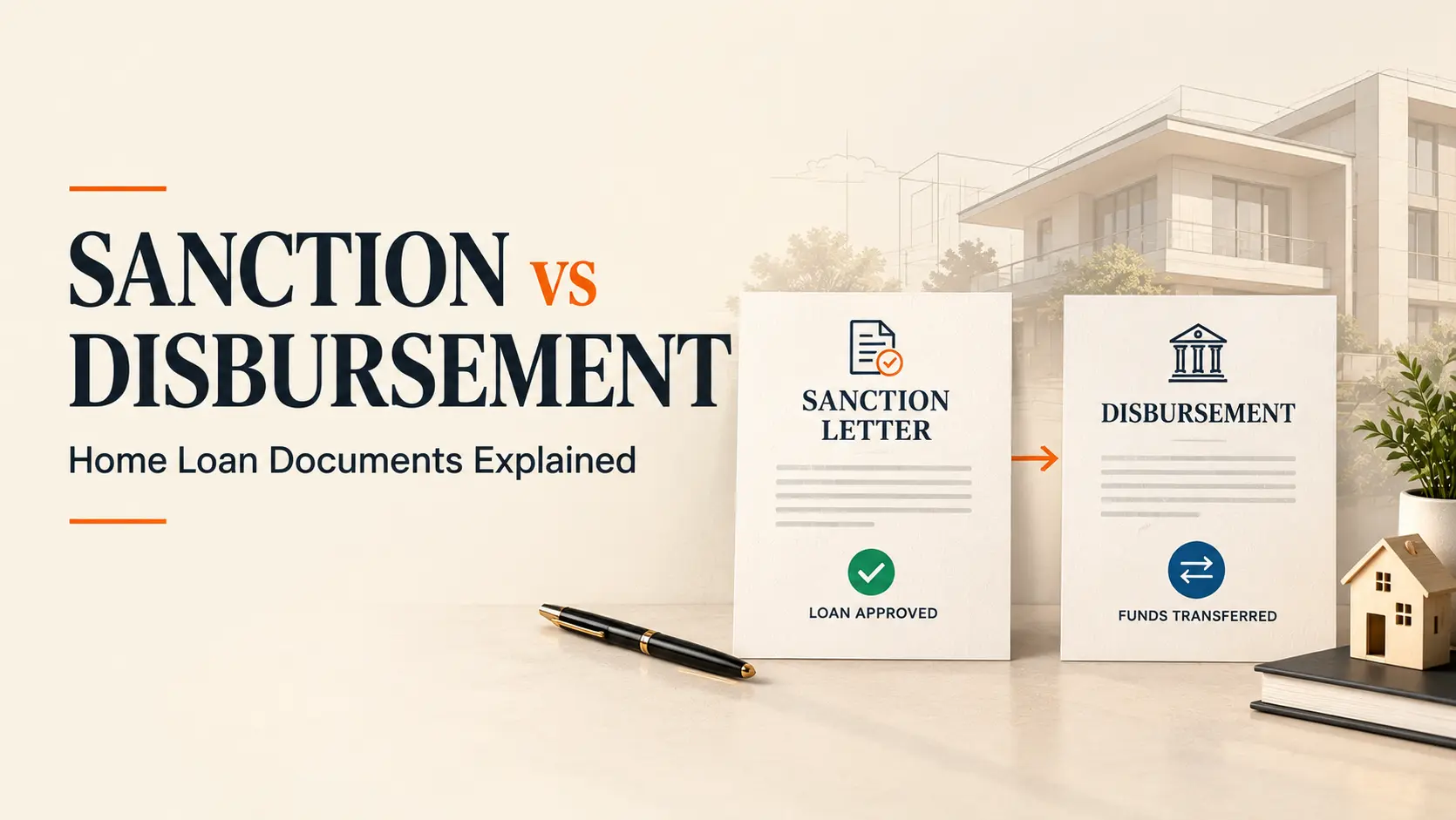
- Sanction. Once approved, you receive a sanction letter stating the approved amount, interest rate, and terms.
- Loan agreement and disbursement. After signing the agreement, the loan amount is disbursed, either in full or in stages depending on the property type, covered further below.
One current, genuinely useful 2026 development: many lenders now use e-KYC and AI-assisted document verification, which several sources describe as reducing the verification timeline from weeks to a few days for straightforward applications though this varies meaningfully by lender and the complexity of your specific case, so treat it as a possibility rather than a guarantee.
Documents You'll Need
The exact checklist varies by borrower and property type, so it is useful to review the documents required to buy a property in India before submitting your application.
- Identity proof: Aadhaar, PAN, passport, or driving licence
- Address proof: Aadhaar, utility bills, or property tax receipts
- Income proof: salary slips and Form 16 for salaried applicants; balance sheets, profit and loss statements, and business proof for self-employed applicants
- Property documents: the approved building plan, a consent letter from the society or builder, and, for under-construction property, the construction cost estimate
The Property Check Protects the Bank Not Just You
This is worth stating clearly, since it's easy to assume a bank's approval means the property has been fully vetted on your behalf. The lender's legal and technical verification exists to confirm the property is sound collateral clean title, valid construction approvals, no legal disputes protecting the bank's interest in case of default. It's genuinely thorough on these specific points, but it isn't the same as your own due diligence, and it doesn't cover everything a buyer might reasonably want checked. Running your own independent verification alongside the lender's, following the same due-diligence sequence covered in our property title verification checklist, is still worth doing rather than assuming the bank's clearance is a complete substitute.
Disbursement: Ready Property vs Under-Construction
For a ready-to-move property, disbursement typically happens in full, once the agreement is signed and the sale deed is ready for registration. For an under-construction property, disbursement happens in stages, tied to the builder's construction progress, and EMIs on the disbursed portion typically begin from that stage, not from the full sanctioned amount upfront. This staged structure means a construction delay directly affects your disbursement schedule and out-of-pocket cost during the gap, a risk covered in more detail in our guide on delayed possession and homebuyer rights, worth reading before committing to an under-construction purchase specifically.





Ans 1. The front-end steps are faster online instant eligibility checks and digital document upload but the underwriting process itself (credit check, property verification, sanction) is the same either way and takes similar time regardless of application method.
Ans 2. Not checking eligibility and getting an in-principle sanction before shortlisting a specific property is the smarter sequence, and choosing a house before confirming eligibility is a commonly cited mistake among first-time buyers.
Ans 3. No, the processing fee is non-refundable at virtually every lender, charged regardless of the final outcome.
Ans 4. No. The lender's legal and technical check protects its own interest as collateral security and is genuinely thorough, but it isn't a substitute for your own independent due diligence.
Ans 5. Identity and address proof, income proof (salary slips and Form 16 for salaried applicants, or business financials for self-employed applicants), and property documents including the approved building plan.
Ans 6. Disbursement happens in stages tied to construction progress, rather than in full upfront, with EMIs typically starting on the disbursed portion as each stage is released.
Ans 7. Many lenders now use e-KYC and AI-assisted verification, which can reduce processing time for straightforward applications, but this varies by lender and case complexity, so it's not a guaranteed timeline.