
✦ AI Summary
Table of Content
▲
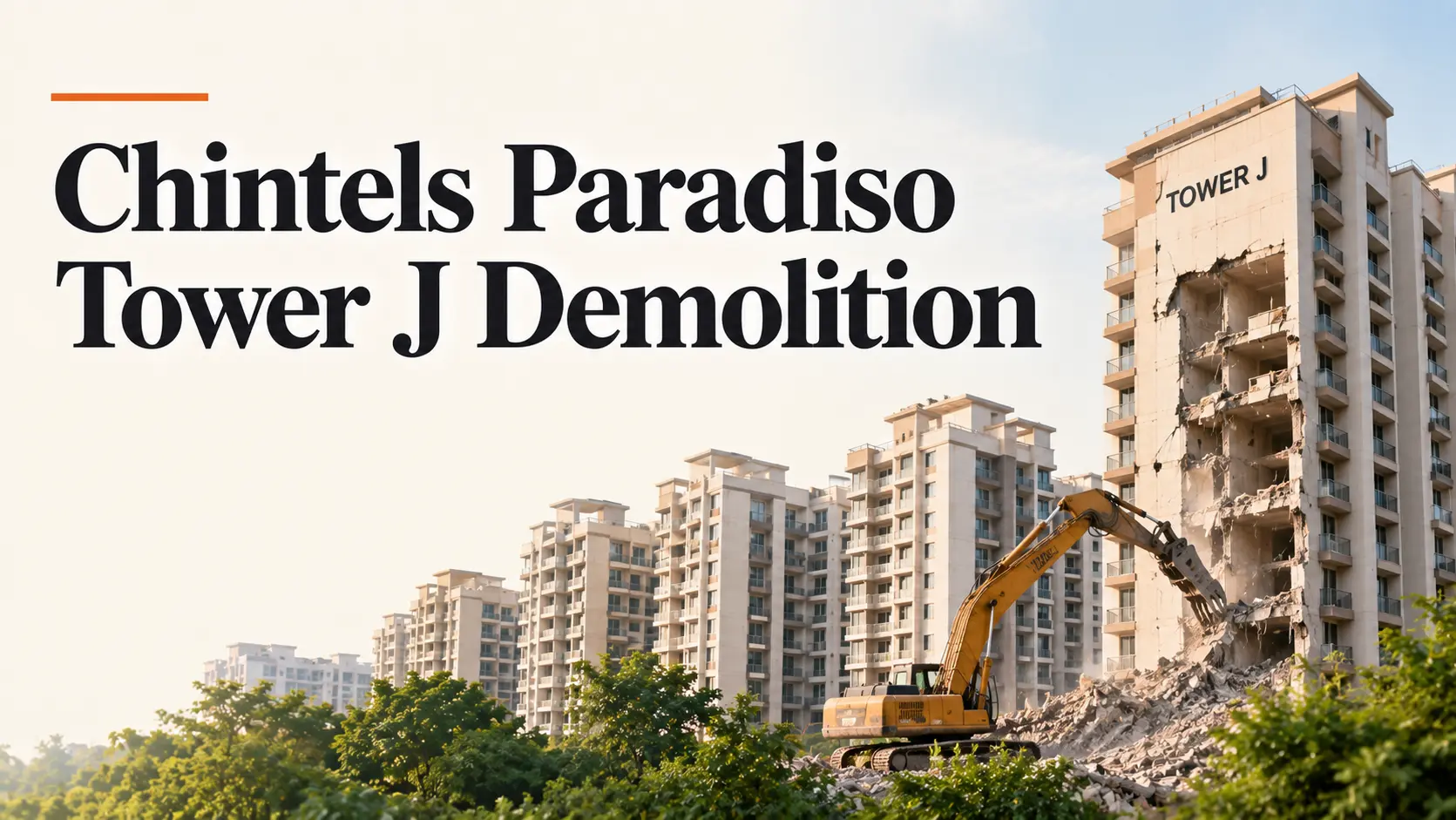
The developer of Chintels Paradiso in Gurugram’s Sector 109 has sought permission from the Department of Town and Country Planning (DTCP) and the district administration to demolish Tower J, the sixth tower in the residential complex to be cleared after structural safety concerns.
Tower J was declared unsafe in 2024 and has already been vacated. Chintels India has said the demolition contractor has been appointed and work can begin once the required permission is granted. The developer expects the demolition itself to take around two months.
The latest move comes shortly after the Supreme Court approved a time-bound redevelopment framework for Chintels Paradiso. The court has directed residents in the remaining unsafe towers to vacate by January 1, 2027, with redevelopment required to begin by March 31, 2027.
Chintels seeks permission to demolish Tower J
Chintels India has submitted an application to DTCP and the Gurugram district administration seeking approval to bring down Tower J.
According to the developer, the tower has already been vacated and a contractor has deployed manpower and machinery at the site. The company wants to start demolition at the earliest so that the wider reconstruction schedule can move forward.
A senior DTCP official told Hindustan Times that the proposal would be placed before the district committee constituted for the matter. The committee, headed by the deputy commissioner, will take the decision on the request.
The developer has also requested government supervision of the demolition, according to the Times of India. Chintels has contracted Edifice Engineering for the work.
Why was Tower J declared unsafe?
The safety concerns at Chintels Paradiso date back to February 2022, when a portion of a flat in Tower D collapsed during repair work, killing two residents.
The incident triggered structural investigations across the condominium. IIT Delhi experts subsequently assessed several towers, with five towers in Phase I - D, E, F and G and H declared unsafe. Those five towers have since been demolished.
Tower J was declared unsafe later, in 2024.
A joint assessment cited by the Times of India found a high risk of reinforcement corrosion linked to chlorides in the concrete. The assessment also pointed to reduced alkalinity and deterioration of the concrete. The administration concluded that repair and rehabilitation were not feasible and directed residents to vacate the tower.
The case illustrates why independent structural audits can become important when safety concerns emerge in older or distressed high-rise buildings.
For homebuyers looking at high-rise properties in Delhi-NCR, AquireAcres has also covered the key structural safety checks for high-rise buyers, including structural design documents, soil reports and independent audits.
Five towers have already been demolished
Chintels Paradiso originally comprised nine residential towers across two phases.
The demolition process has already covered five towers:
|
Tower |
Current status |
|
Tower D |
Demolished |
|
Tower E |
Demolished |
|
Tower F |
Demolished |
|
Tower G |
Demolished |
|
Tower H |
Demolished |
|
Tower J |
Awaiting demolition permission |
|
Tower A |
Residents to vacate |
|
Tower B |
Residents to vacate |
|
Tower C |
Residents to vacate |
The remaining four towers - A, B, C and J form the second phase of the redevelopment process. Towers A, B and C are to be vacated by the existing residents before demolition, while Tower J has already been vacated.
Supreme Court sets redevelopment timeline
The latest demolition request has to be viewed against the Supreme Court's September 2026 order on the redevelopment of Chintels Paradiso.
The court-approved framework requires residents occupying the unsafe towers to hand over possession by January 1, 2027. The redevelopment work is required to start by March 31, 2027, with the rebuilt homes to be handed over within 48 months.
The court also directed the Haryana government to process the statutory permissions required for redevelopment within three weeks of an application being made. This is intended to prevent administrative approvals from becoming another source of delay.
For eligible homeowners, the arrangement includes rental support during the redevelopment period. Chintels is required to pay fixed rent for alternative accommodation from January 31, 2027, until physical possession of the redeveloped homes. Homeowners are also entitled to a one-time relocation payment of up to ₹40,000.
What happens to the residents?
The redevelopment framework provides for existing homeowners to receive redeveloped apartments corresponding to their original carpet area, with a maximum variation of 3%, according to reporting on the Supreme Court settlement.
Homeowners opting for reconstruction are required to contribute ₹1,000 per sq ft towards construction, with the court framework barring additional or hidden financial burdens.
The redevelopment process had remained stalled partly because some residents had continued to occupy flats in the unsafe towers. Recent reports put the number of remaining occupants at around 80–90.
The Supreme Court has now set a firm deadline for vacation, removing the possibility of further extensions under the settlement.
Why Tower J's demolition matters
The permission for Tower J is more than an isolated demolition approval. It is one of the steps needed to clear the existing Phase II structures before reconstruction can proceed.
Chintels has said it wants to complete the demolition quickly because the Supreme Court has imposed a fixed redevelopment schedule. Once the necessary approvals are secured, the contractor is expected to take about two months to demolish Tower J.
For the wider Gurugram housing market, the case also highlights a less visible part of apartment ownership: what happens when a residential building is found structurally unsafe years after possession.
Buyers generally focus on location, price, amenities and possession dates. Structural history, approved plans, maintenance records and past regulatory action can be equally important, particularly when purchasing resale apartments in large housing societies.
AquireAcres' guide on HRERA complaint filing is also relevant for homeowners dealing with unresolved developer or project-related disputes in Gurugram.
What homebuyers can learn from the Chintels Paradiso case
The Chintels Paradiso redevelopment is specific to the project and should not be treated as evidence that similar problems exist across Gurugram's apartment market.
For buyers considering a resale or under-construction property, however, the case reinforces the importance of checking:
- The project's Haryana RERA registration and current status
- Approved building plans and amendments
- Occupation and completion certificates
- Structural audit reports, where available
- Major repair or safety-related notices
- Pending litigation involving the project
- Maintenance and structural repair records
- Developer-buyer agreements and possession documents
These checks become particularly relevant when buying into a project with a complicated regulatory or construction history.
Buyers evaluating properties in the city can also refer to our guide on Gurgaon circle rates and property registration values when assessing the broader transaction costs.
What happens next?
The immediate step is the district administration's decision on Chintels India's request to demolish Tower J. If permission is granted, the developer has indicated that demolition could take about two months.
The larger redevelopment schedule is already fixed: residents of the remaining unsafe towers are expected to vacate by January 1, 2027, redevelopment is to begin by March 31, 2027, and the rebuilt homes are to be delivered within the court-prescribed 48-month period.

_1792140859.webp)




Ans 1. Tower J at Chintels Paradiso was declared unsafe in 2024 and has already been vacated. Chintels India has sought permission from DTCP and the Gurugram district administration to demolish the tower.
Ans 2. Five towers - D, E, F, G and H have already been demolished. Tower J is awaiting demolition permission, while Towers A, B and C are to be vacated and subsequently demolished.
Ans 3. Tower J was declared unsafe in 2024 following structural assessment and administrative action concerning the safety of the building.
Ans 4. Under the Supreme Court-approved redevelopment framework, residents occupying the remaining unsafe towers have to vacate and hand over possession by January 1, 2027.
Ans 5. The Supreme Court has directed that redevelopment should begin by March 31, 2027.
Ans 6. The redeveloped homes are to be handed over within 48 months from January 1, 2027, under the court-approved framework.
Ans 7. A portion of a flat in Tower D collapsed on February 10, 2022, during repair work, resulting in the deaths of two residents. Subsequent structural assessments led to multiple towers being declared unsafe.
Ans 8. Eligible homeowners are to receive fixed rent for alternative accommodation from January 31, 2027, until physical possession of their redeveloped flats, according to the Supreme Court-approved arrangement.