
✦ AI Summary
Table of Content
▲
Before you can check land conversion status correctly, it helps to be sure you're checking the right thing. Conversion and mutation are two entirely different processes, get them mixed up, and you can end up staring at the wrong government record entirely, concluding a plot is "clear" when what you've actually confirmed is just that ownership records are up to date, not that the land is legally approved for non-agricultural use.
This guide starts with that distinction, then walks through exactly where to check status for the major state systems, what a genuinely converted record looks like, and, since this is the part almost no other guide covers honestly, what to actually do when an application seems stuck with no response.
Conversion vs Mutation: Know the Difference First
Land conversion (also called NA permission, non-agricultural conversion, or Change of Land Use) changes the permitted use of a parcel from agricultural to residential, commercial, or industrial. Without this change, agricultural land generally cannot legally be used for construction or non-farming purposes, regardless of who owns it or how long they've owned it.
Mutation updates the ownership record after a sale, inheritance, or gift, reflecting who currently holds the land. It says nothing about what the land is legally permitted to be used for.
These are separate government processes, handled through separate applications, sometimes even through separate portals within the same state. A parcel can have perfectly up-to-date mutation records (correctly showing you, or a seller, as the current owner) while still being agricultural land with no conversion order at all. Checking mutation records alone tells you nothing about conversion status, and this exact confusion is one of the most common, avoidable mistakes in Indian land due diligence.
What a Converted (NA) Record Actually Shows
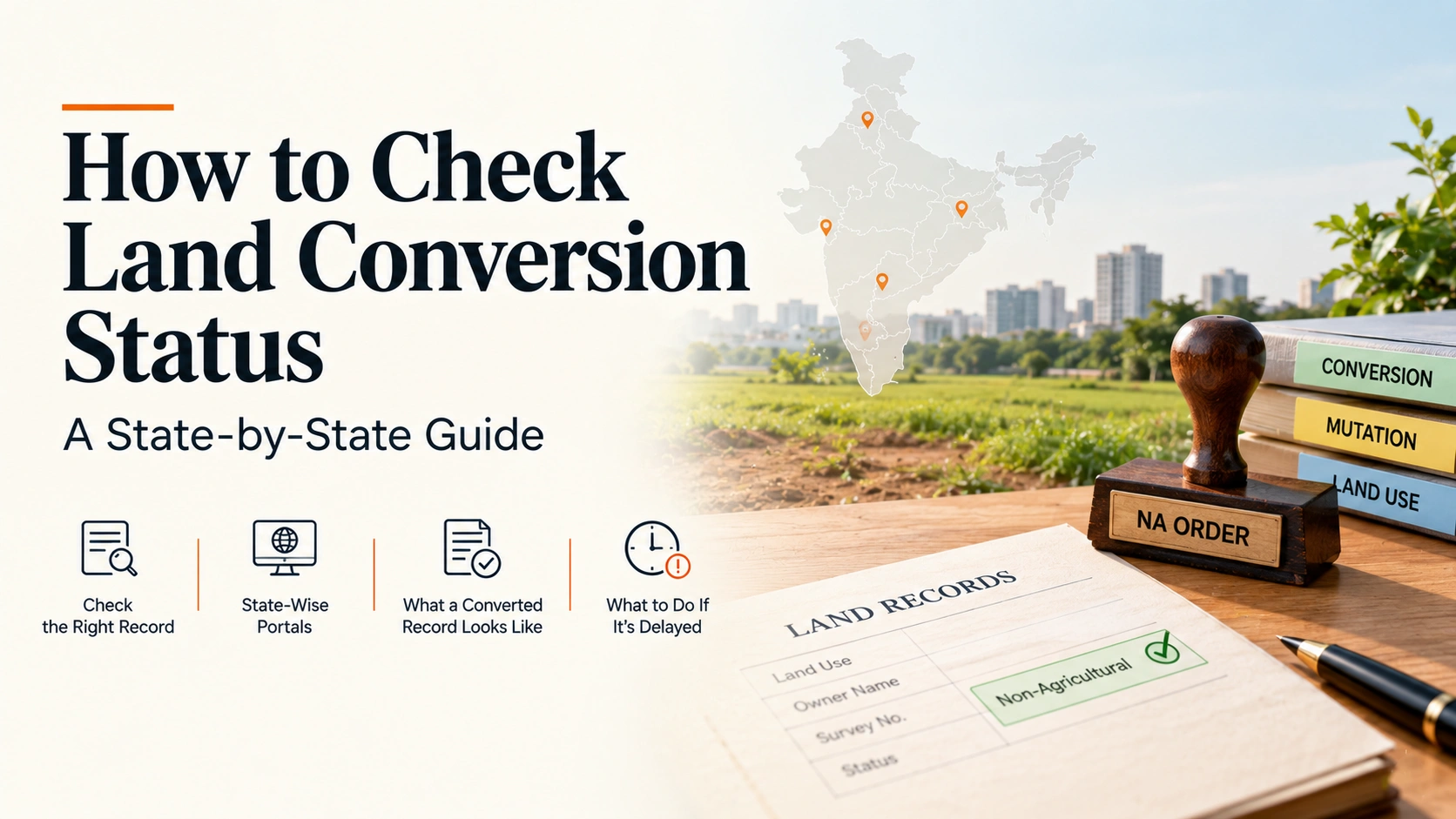
Once you're checking the correct record, here's what to actually look for. Most state land records show a classification field, sometimes labelled "Klass," "Nature of Possession," "Land Use," or similar, on the Record of Rights (known as RTC in Karnataka, and by other names elsewhere, such as Pahani, 7/12 extract, or Khatauni depending on the state).
If that field shows "Agricultural," the land has not been converted. If it shows "Non-Agricultural" or explicitly references an "NA Order" as issued, conversion has been approved and recorded. Where the online record is unclear or hasn't been updated, the safest confirmation is a direct copy of the Conversion Order (sometimes called the NA Order), issued and typically digitally signed by the relevant authority, which is the definitive document regardless of what the online summary record shows.
State-by-State: Where to Check Online
Land is a state subject in India, and there is no single national portal for checking conversion status. Each state runs its own system, with different names, different required inputs, and different authorities. Here are the major ones:
Karnataka (Bhoomi)
Karnataka has one of the more developed systems, built around the Bhoomi portal. For a general status check, visit the Bhoomi RTC portal, navigate to "View RTC and MR," and enter District, Taluk, Village, and Survey Number; the "Klass" or "Nature of Possession" column on the resulting RTC confirms current status. For tracking a specific pending application under Karnataka's affidavit-based conversion system, use the dedicated pendency-report tool at the state's land conversion portal, entering your Affidavit ID or User ID to see exactly where your application currently sits in the approval chain.
Telangana (Dharani)
Telangana's land records, including conversion-related status, run through the Dharani portal, the state's integrated land records and registration system.
Madhya Pradesh (MPIGR)
Madhya Pradesh consolidates property registration and land conversion tracking through the MPIGR (Madhya Pradesh Inspector General of Registration) portal, where you can check agricultural land conversion status using your application number, document number, or Khasra number, alongside the separate MP Bhulekh portal for detailed land records.
Delhi (e-District)
Delhi's e-District portal includes a "Track Your Application" feature specifically for tracking the progress of a submitted application, using your application number and name.
Andhra Pradesh
Andhra Pradesh's land conversion service, converting agricultural land to commercial or other non-agricultural use, is accessible through the state's listing on the National Government Services Portal, which directs to the relevant state e-service for filing and tracking.
Other States
Most other states run an equivalent portal under names like Bhulekh, Anyror, or Jamabandi for general land records, though conversion-specific tracking tools vary in how developed and centralised they are. If your state isn't listed above, search for "[your state] revenue department land records portal" and look specifically for a "Land Conversion Status," "NA Order," or "Change of Land Use" section, distinct from the general ownership or mutation lookup section on the same portal.
Documents You'll Need
Whether applying for conversion or verifying it's genuinely complete, these are the documents typically involved:
- The Record of Rights (RTC, Pahani, or equivalent for your state)
- Mutation records showing current ownership
- A property sketch or site plan (in some states, specifically an "11-E sketch" for partial conversions or multi-owner parcels)
- Land tax payment receipts
- NOCs from relevant departments, where required
- Proof of the intended use (residential, commercial, or industrial)
Along with conversion-specific records, buyers should review the wider set of property documents required to buy land before proceeding with registration.
What the Approval Process Actually Involves
While the exact chain of authority varies by state, a typical process, using Karnataka's as an illustrative example, moves through several stages: the application (often via an affidavit-based system in states that have adopted this reform) is reviewed by a Revenue Inspector, then the Tahsildar, then an Assistant Commissioner, before final approval and digital signature by the Deputy Commissioner. In other states, a Sub-Divisional Officer or District Collector may hold the equivalent final authority. Once approved, the conversion fee, commonly calculated per square metre or unit, sometimes tied to the area's guidance value and generally higher for urban-proximate land than rural land, must be paid before the formal order is issued and the land record updated to reflect the new NA status.
My Application Is Delayed. What Do I Do?
This is genuinely common, and it's worth having an actual plan rather than just waiting indefinitely. Land is a state subject, so the exact law, authority, fee, and notified timeline vary by state, but the general pattern for following up is consistent:
- Check the online portal first, if your state has one, using your application number to confirm the current stage and whether any additional fee or document is pending on your end.
- If the status is vague ("in process," with no further detail), submit a polite, written representation addressed to the officer who signs the order (the Collector, SDO, or Tahsildar, depending on your state), stating your application number, land details, and the date you applied.
- Reference your state's public service guarantee law, if one exists, and note that the notified timeline has passed, asking for the current status and expected date of the order.
- Keep a written record of every interaction, the date, the name of the person you spoke to, and what they said, since this record becomes useful if you need to escalate further.
- Consider an RTI (Right to Information) request if the file genuinely appears stuck with no clear explanation, which can compel a written response on where exactly the file stands and why.
What Happens If You Skip Conversion?
Building on agricultural land without proper conversion carries real risk: in various states, this can result in penalties, and, in more serious cases, a demolition order for unauthorised construction on unconverted land. Beyond direct penalties, unconverted land is also generally not marketable in the way converted land is: banks are typically unwilling to finance a purchase or construction on land still classified as agricultural, and a buyer's own due diligence, if done properly, will flag this as a serious defect rather than a minor paperwork gap. This connects directly to the plot-specific risks already flagged in AquireAcres' guide comparing plots and flats as investments, where NA conversion status was identified as one of the genuine, under-verified risks specific to buying land rather than a completed flat.
Land-use status should also be checked as part of a broader property title verification checklist before completing a land purchase.
A Quick Checklist
- Confirm you're checking conversion status, not just mutation/ownership records; these are separate.
- Identify the correct state portal for the land's location, not a generic national tool.
- Look for the specific classification field (Klass, Nature of Possession, or equivalent) showing "Non-Agricultural" or a referenced NA Order.
- If the online record is unclear, request a direct copy of the Conversion Order from the issuing authority.
- If you're the applicant and the process is delayed, follow up in writing, keep records, and consider an RTI request if needed.
- Before finalising any plot purchase, treat unconfirmed conversion status as a genuine red flag, not a minor formality, consistent with the broader due-diligence approach in our property title verification checklist.






Ans 1. Conversion changes the permitted use of land (agricultural to residential, commercial, or industrial). Mutation updates the ownership record after a sale, inheritance, or gift. They're separate processes, and confirming one tells you nothing about the other.
Ans 2. Visit your state's land records portal (Bhoomi for Karnataka, Dharani for Telangana, MPIGR for Madhya Pradesh, e-District for Delhi, and equivalents elsewhere), enter your survey number and location details, and look for a classification field showing "Non-Agricultural" or a referenced NA Order.
Ans 3. It shows a classification field, often called "Klass," "Nature of Possession," or "Land Use," reading "Non-Agricultural," or explicitly referencing an issued NA Order. If it still reads "Agricultural," conversion hasn't happened.
Ans 4. Check the online portal for your specific status first. If it's vague, submit a written representation to the issuing officer citing your application number and the date applied. Keep records of every interaction, and consider an RTI request if the file seems genuinely stuck.
Ans 5. Typically the Record of Rights (RTC or equivalent), mutation records, a property sketch, land tax receipts, relevant NOCs, and proof of the intended use.
Ans 6. Fees vary by state and are commonly calculated per square metre or unit, sometimes tied to the area's guidance value, generally higher for urban-proximate land than rural land. Confirm the exact current fee with your state's revenue department.
Ans 7. You risk penalties and, in serious cases, a demolition order for unauthorised construction. Unconverted land is also generally difficult to finance through a bank and represents a genuine red flag in due diligence for any prospective buyer.
Ans 8. It varies by state; commonly the District Collector or Deputy Commissioner for land with occupancy rights, or the Tahsildar for other categories, following review by a Revenue Inspector and other officials earlier in the process.