
✦ AI Summary
Table of Content
▲- What Are Solar Loans?
- PSU Solar Loans Explained
- NBFC Solar Loans Explained
- PSU vs NBFC Solar Loans: Key Comparison
- Interest Rate Comparison
- Government Subsidy and Solar Loans
- Which Loan Offers Better EMI Affordability?
- Factors to Consider Before Choosing a Solar Loan
- Who Should Choose a PSU Solar Loan?
- Who Should Choose an NBFC Solar Loan?
- Common Mistakes to Avoid When Applying for a Solar Loan
- Tips to Get the Best Solar Loan
- Conclusion
Installing rooftop solar panels has become more affordable than ever, thanks to government incentives and easy financing options. However, one question often confuses homeowners; should you choose a PSU bank solar loan with a lower interest rate or an NBFC loan that allows you to retain government subsidies?
Government-owned banks, like SBI and other state-owned banks, usually give lower interest rates than private banks. Non-banking finance companies, on the other hand, will often provide prospective borrowers easier access to solar energy financing because they offer quicker decision-making times, more flexible qualification options, and tailor-made loan products.
This guide will compare Public Sector Unit (PSU) vs Non-Banking Financial Company (NBFC) solar loans based on interest rates, eligibility for subsidy, repayment terms, benefits of each type and items to evaluate when determining the best method of financing a solar system.
What Are Solar Loans?
A solar loan provides a way for homeowners to install solar systems on their roofs without having to pay for everything upfront. The borrower then makes monthly repayments towards the loan, while also enjoying lower energy bills right away, as well as other savings that accrue over time.
Solar loans are commonly used for:
- Residential rooftop solar systems
- Solar panel installation
- Solar inverters and batteries
- Complete rooftop solar packages
- Government-approved solar projects
Today, both PSU banks and NBFCs offer dedicated financing solutions for residential solar adoption.
Also Read: How Much Home Loan Can I Get on a ₹1 Lakh Monthly Salary?
PSU Solar Loans Explained
Public Sector Unit banks provide solar loans under government-backed schemes or their own green financing programs. Since these institutions generally have access to lower-cost funding, they can offer competitive interest rates. Many PSU banks are also aligned with the PM Surya Ghar Muft Bijli Yojana, which provides subsidies for eligible residential rooftop solar installations. Borrowing from a bank that actively supports these schemes can simplify the subsidy claim process compared to navigating it independently with an NBFC.
Major PSU lenders include:
- State Bank of India (SBI)
- Punjab National Bank (PNB)
- Bank of Baroda
- Union Bank of India
- Canara Bank
- Indian Bank
Benefits of PSU Solar Loans
Homeowners often prefer PSU financing because of:
- Lower interest rates
- Longer repayment periods
- Government-backed lending
- Transparent loan terms
- Better affordability over time
- Suitable for larger solar installations
However, documentation and approval timelines may take longer compared to private lenders.
NBFC Solar Loans Explained
NBFCs have become an important financing partner for India's growing rooftop solar market. They cater to customers who may not meet traditional banking requirements or who need faster loan processing.
NBFC interest rates are generally higher than PSU banks, and their processing fees can also be more variable. But for a homeowner who would otherwise wait months navigating a PSU loan process or who doesn't meet the stricter eligibility criteria of public sector lenders, the higher rate may be entirely acceptable given what they're getting in return.
Advantages of NBFC Solar Loans
NBFC financing generally offers:
- Faster loan approval
- Minimal paperwork
- Flexible eligibility
- Digital application process
- Quick loan disbursement
- Financing for a wider range of customers
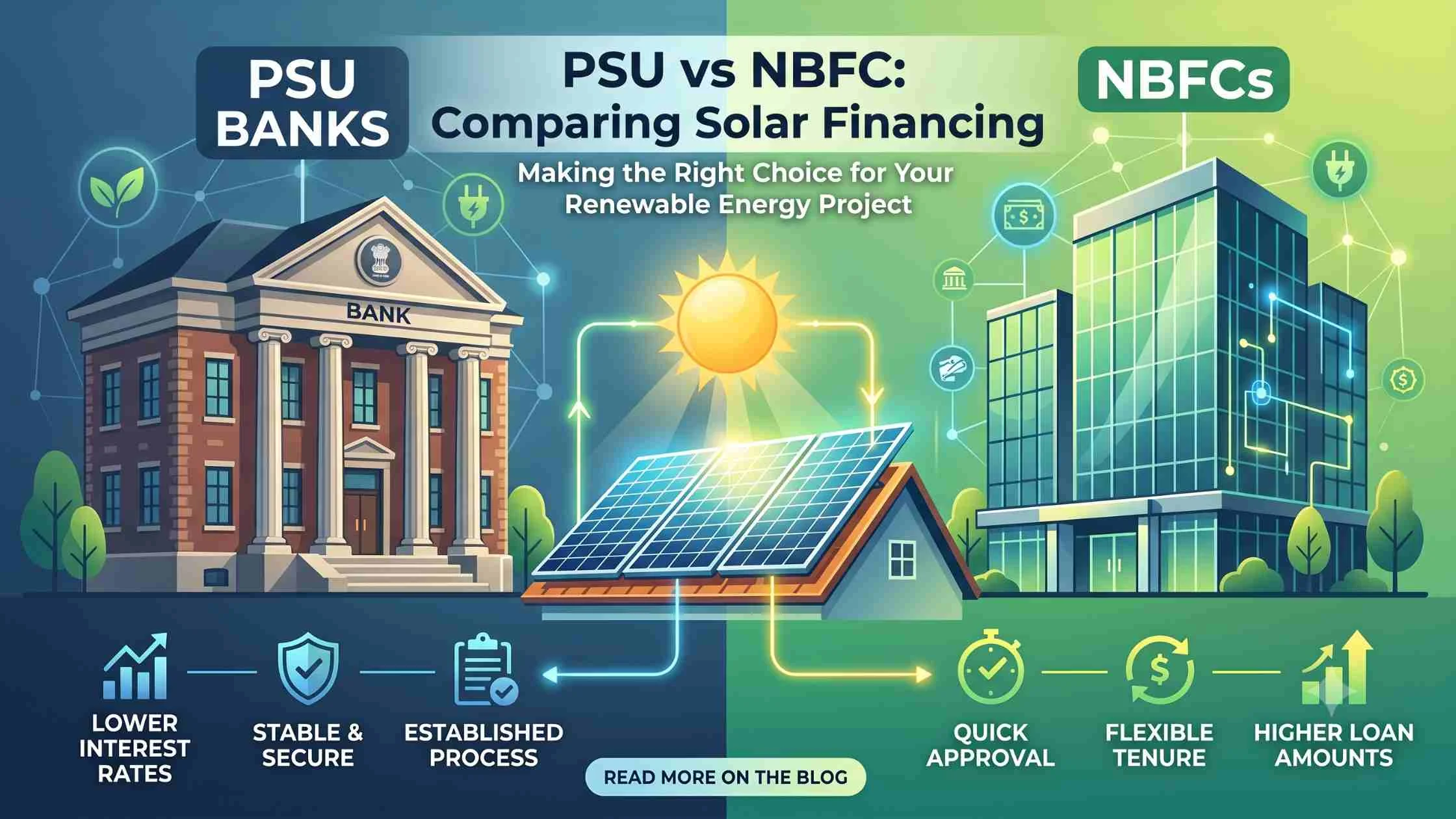
PSU vs NBFC Solar Loans: Key Comparison
|
Feature |
PSU Banks |
NBFCs |
|
Interest Rate |
Generally lower |
Usually higher |
|
Loan Processing |
Moderate to slow |
Faster |
|
Documentation |
More detailed |
Simpler |
|
Eligibility |
Stricter |
More flexible |
|
Loan Approval |
May take longer |
Often quicker |
|
Digital Services |
Improving |
Highly digital |
|
Customer Flexibility |
Limited |
Higher |
|
Best For |
Cost-conscious borrowers |
Faster installations |
The right option depends on whether your priority is saving on interest costs or getting quick access to financing.
Interest Rate Comparison
Interest rate is one of the biggest deciding factors when choosing a solar loan.
PSU Bank Interest Rates
Most PSU banks generally offer lower rates because of government support and lower borrowing costs.
Typical benefits include:
- Lower EMI burden
- Reduced total repayment
- Better affordability over long tenures
For eligible borrowers, some government-supported schemes may offer particularly attractive financing rates.
NBFC Interest Rates
NBFC interest rates usually vary depending on:
- Credit score
- Income profile
- Loan amount
- Repayment tenure
- Solar system size
Although rates may be slightly higher, many borrowers value the faster approval process enough to justify the difference.
Here's the practical implication: on a ₹3 lakh solar loan repaid over seven years, a 2% difference in interest rate represents a total additional interest payment of roughly ₹22,000 to ₹25,000 over the loan life. That's a real number enough to matter. But faster NBFC approval means your solar system starts generating electricity three months earlier than it would have with a delayed PSU process; the earlier electricity savings can substantially or fully offset that interest cost differential. The right comparison is total financial outcome, not just interest rate.
Government Subsidy and Solar Loans
One of the most important considerations is how government subsidies work alongside solar financing. India's rooftop solar program provides financial assistance for eligible residential consumers installing approved rooftop systems.
Before applying, borrowers should verify:
- Whether the lender supports government-approved installations
- Eligibility under the subsidy scheme
- Approved vendors
- Required documentation
- Current subsidy guidelines
Understanding these requirements helps homeowners maximize financial benefits while avoiding unnecessary delays.
Which Loan Offers Better EMI Affordability?
Interest rate is the most discussed factor in EMI calculations, but several other variables have material impact on what you actually pay each month.
Loan tenure is often as important as rate. A PSU bank offering a seven-year tenure at a lower rate might produce a higher monthly EMI than an NBFC offering a ten-year tenure at a slightly higher rate, counterintuitively. Always calculate the monthly EMI rather than just comparing rates.
Down payment reduces the financed principal, which directly reduces the EMI regardless of which lender you choose. If you can make even a 15-20% down payment, the EMI from either type of lender becomes more manageable.
Processing fees are added to the effective cost of borrowing. A lender with a lower interest rate but higher processing fees may cost more in total than a lender with a slightly higher rate but negligible upfront charges.
Prepayment flexibility matters if you expect to have surplus funds at any point. Some lenders allow part-prepayment without penalty, which can significantly reduce total interest cost over the loan life. Others charge foreclosure fees that make prepayment financially unattractive.
The monthly EMI calculation should always factor in: interest rate, tenure, principal after down payment, and any capitalised processing charges. Running this calculation for two or three specific lender offers gives you a much more accurate comparison than rate alone.
Also Read: How to Get a Home Loan on Ancestral or Inherited Property in India
Factors to Consider Before Choosing a Solar Loan
Instead of focusing only on interest rates, compare the complete financing package.
Evaluate These Factors
- Total loan cost
- Interest rate
- Processing fees
- Subsidy compatibility
- Loan tenure
- EMI affordability
- Prepayment charges
- Approval timeline
- Customer service
- Digital loan management
A slightly higher interest rate may still be worthwhile if faster installation allows earlier electricity savings.
Who Should Choose a PSU Solar Loan?
PSU financing works well for borrowers who:
- Have a strong credit profile
- Can provide complete documentation
- Prefer lower borrowing costs
- Plan long-term ownership
- Want affordable EMIs
- Do not require immediate loan approval
For financially disciplined borrowers, PSU banks often provide the most economical financing option.
Who Should Choose an NBFC Solar Loan?
NBFCs are ideal for homeowners who value speed and flexibility over the lowest possible interest rate. If you need quick financing or do not meet the stricter eligibility requirements of PSU banks, an NBFC may be the better choice.
- Homeowners needing quick loan approval
- Self-employed professionals
- First-time solar buyers
- Borrowers with limited banking history
- Customers looking for digital loan processing
- Homeowners planning immediate solar installation
Many NBFCs also offer doorstep documentation and online loan tracking, making the borrowing process more convenient.
Common Mistakes to Avoid When Applying for a Solar Loan
Picking the wrong loan can quietly cut into the financial upside you get from rooftop solar. Before you sign any agreement , look over all the actual costs, and not just the headline interest rate they mention in ads.
Avoid These Mistakes
- Comparing only advertised interest rates without accounting for processing fees, insurance charges, or other embedded costs gives you a misleading picture of total loan cost. Always ask for the full cost schedule and calculate the effective cost including all charges.
- Not verifying subsidy eligibility before choosing a lender is one of the costliest mistakes possible. If a subsidy is available for your installation, choosing a lender whose product isn't compatible with the subsidy scheme or who works with unapproved vendors can cause you to forfeit the subsidy entirely.
- Selecting an unapproved solar vendor to save installation cost, without realising that approval status determines subsidy eligibility, is surprisingly common. Always verify vendor approval status under the applicable scheme before signing any installation contract.
- Ignoring prepayment charges when the loan product has significant foreclosure fees and you plan to prepay once your electricity savings accumulate.
- Choosing the lowest EMI through the longest tenure without calculating total interest paid over the full term. A ten-year loan at a higher rate can cost significantly more than a seven-year loan at a lower rate even if the monthly payment feels more comfortable.
- Not comparing at least three lenders before committing. The solar loan market has become competitive enough that meaningful rate and terms differences exist between lenders targeting the same borrower profile.
Taking time to evaluate these factors can save thousands of rupees over the life of the loan.
Tips to Get the Best Solar Loan
Whether you choose a PSU bank or an NBFC, following a few best practices can help you secure better financing.
Smart Borrowing Tips
- Maintain a good credit score before applying.
- Compare offers from at least three lenders.
- Verify that the solar vendor is government-approved.
- Understand all loan charges before signing.
- Select an EMI that comfortably fits your monthly budget.
- Check whether part-prepayment is allowed without penalties.
- Read the loan agreement carefully before acceptance.
Proper planning ensures that your rooftop solar investment delivers maximum financial returns.
Conclusion
In India's rapidly expanding solar rooftop industry, PSU banks and NBFCs are significantly involved in solar project financing. Due to their relatively lower interest rates than other lenders, as well as lower overall costs due to lower borrowing costs, PSU banks would seem to be the best option for borrowers who qualify under more stringent eligibility requirements. However, NBFCs provide borrowers with faster access to financing, quicker turnaround time for approvals, greater flexibility in terms of required documentation, and shorter timelines to install the solar rooftop systems, making solar installation easier for many more homeowners than otherwise would be possible.
When considering loan options, potential borrowers should consider multiple factors, including interest rates, loan-processing fees, repayment terms, eligibility for government subsidies, and quality of customer service, rather than simply focusing on one aspect of the loan option or financing.
By choosing the right type of loan, borrowers can decrease their initial costs of installation as well as provide long-term savings through reduced utility bills while creating a healthier and more sustainable environment in the future.





Ans 1. The core difference is in cost versus speed and flexibility. PSU banks, government-owned lenders like SBI and PNB generally offer lower interest rates and longer tenures, making them cheaper over the full loan life. NBFCs offer faster approval, simpler documentation, and more flexible eligibility criteria, making them more accessible for self-employed borrowers or those needing quick financing. The right choice depends on your income profile, urgency, and how much the interest rate difference matters given your loan size and tenure.
Ans 2. Several major PSU banks have dedicated solar loan products or green financing programs that include rooftop solar. State Bank of India, Punjab National Bank, Bank of Baroda, Union Bank of India, Canara Bank, and Indian Bank are among the prominent public sector lenders active in this space. Many are also aligned with central government schemes like PM Surya Ghar Muft Bijli Yojana for eligible residential borrowers. Private sector banks and various NBFCs also offer solar financing products, some of which are specifically designed for the rooftop solar segment.
Ans 3. It depends on the specific NBFC and how their product is structured. Government subsidies under schemes like PM Surya Ghar Muft Bijli Yojana are tied to the installation meeting specific eligibility criteria including using an approved vendor and following the scheme's application process, rather than being automatic entitlements based on which lender you use. Before choosing any lender, verify that their product is compatible with subsidy scheme requirements and that the vendor you're using is approved under the scheme. Some NBFCs have structured their products specifically to work alongside government subsidies while others have not.
Ans 4. PSU bank interest rates for solar loans vary by lender, loan amount, tenure, and borrower profile. Rates are generally competitive compared to NBFCs because PSU banks have lower funding costs and in some cases access to priority sector or green lending programs that allow subsidised rates. The specific rate offered to you will depend on your credit score, income documentation, and the bank's current product terms. It's advisable to get written rate quotes from at least two or three PSU banks before deciding, as rates can differ meaningfully even within the public sector.
Ans 5. PSU bank solar loan approvals typically take anywhere from two to six weeks depending on documentation completeness, branch workload, and credit evaluation complexity. Some banks have been improving their digital processes, but physical verification and committee-based approval can still add time. NBFC approvals are significantly faster, many can complete credit assessment and approval within two to five business days for straightforward applications, with fully digital NBFCs sometimes moving even faster. If your installation timeline is firm or urgent, the NBFC processing speed advantage is a meaningful practical consideration.
Ans 6. Yes, and this is actually one of the primary use cases where NBFCs have a clear advantage over PSU banks. Self-employed individuals, business owners, freelancers, and professionals with income that isn't documented through standard salary certificates often find PSU credit evaluation difficult to navigate. NBFCs are generally more experienced at assessing non-standard income profiles through bank statements, ITR filings, and business financials, and their eligibility criteria are designed to accommodate a broader range of income documentation. For self-employed borrowers who qualify in terms of actual income but don't fit the PSU template, NBFCs are often the practical primary option.
Ans 7. PSU bank solar loan applications generally require a complete identity and address proof, recent salary slips and Form 16 for salaried applicants or ITR filings and financial statements for self-employed borrowers, six months of bank statements, a credit score report, property ownership documents, and documentation related to the solar installation including the vendor quote and system specifications. For installations linked to government subsidy schemes, additional documentation confirming vendor approval and scheme eligibility may be required. Requirements vary by bank and can sometimes be more extensive than initial checklists suggest.
Ans 8. The EMI on a ₹3 lakh solar loan depends on the interest rate and repayment tenure. As a rough guide, at a 9% interest rate over seven years, the monthly EMI would be approximately ₹4,800. At 11% over seven years, it rises to around ₹5,100. At the same 11% rate but over ten years, it falls to approximately ₹4,100. Processing fees, if capitalised into the loan amount, would increase the principal and therefore the EMI slightly. The key point is that tenure selection can have as much impact on monthly payment as interest rate, so both need to be considered together rather than separately.
Ans 9. Prepayment and foreclosure options vary significantly between lenders. RBI guidelines allow floating-rate loan borrowers to prepay without penalty, but fixed-rate products may have prepayment charges that vary by lender. Some NBFCs charge a percentage of the outstanding principal as a foreclosure fee, which can make early repayment less attractive financially. Before choosing any solar loan, specifically ask about part-prepayment flexibility and foreclosure charges, as the ability to reduce your principal through surplus income significantly affects total interest cost over the loan life.
Ans 10. The Ministry of New and Renewable Energy maintains a list of registered and approved vendors under the PM Surya Ghar Muft Bijli Yojana. This information is accessible through the official PM Surya Ghar portal. Before signing any installation contract, verify the specific vendor's registration status directly on the official portal rather than relying on the vendor's self-declaration. Using an unapproved vendor is one of the most common reasons subsidy claims get rejected, and this verification takes only a few minutes but can save the entire subsidy amount.