
✦ AI Summary
Table of Content
▲- What Counts as Retail Property?
- End Use or Investment? Decide This First
- How to Evaluate Location: Footfall, Catchment, and Competition
- The Legal and Title Due Diligence Checklist
- RERA and Retail Property: What Actually Applies
- The Real Cost of Buying Retail Property
- Financing a Retail Property Purchase
- Rental Yield: What to Actually Expect
- Buying a Pre-Leased Retail Shop: What's Different
- Common Mistakes First-Time Retail Property Buyers Make
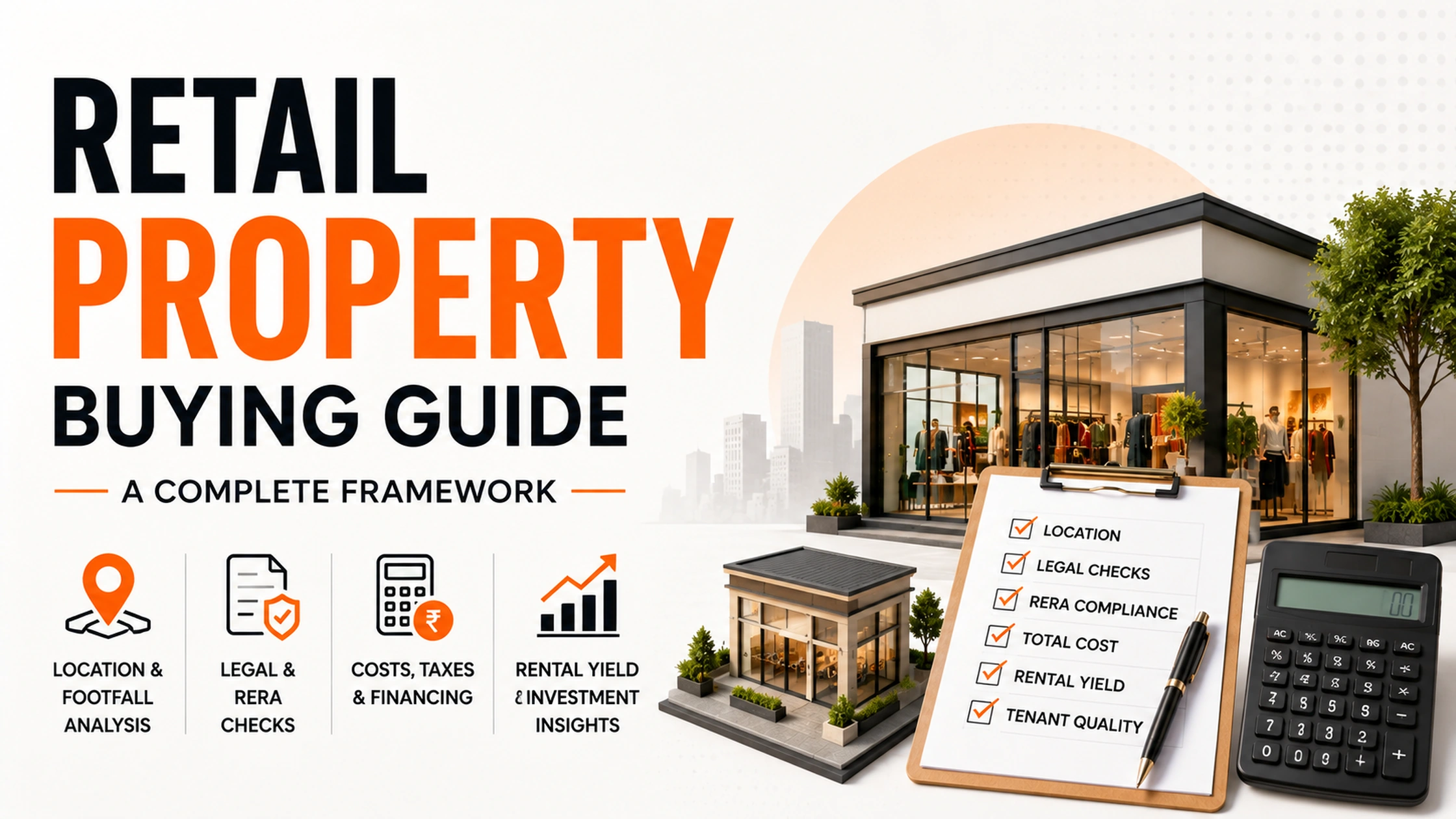
Buying retail property is not the same exercise as buying an office unit or a warehouse, even though most commercial real estate guides treat them as interchangeable. A retail shop's value depends on footfall, catchment, and tenant mix in a way office space simply doesn't, and the due diligence, financing, and yield expectations that follow from that difference deserve their own framework, especially for those considering commercial property investment.
This guide walks through that framework: how to decide between end use and investment, how to actually evaluate a location, what legal and RERA checks apply, what the purchase really costs once GST and stamp duty are added, and what rental yield you can realistically expect in 2026.
What Counts as Retail Property?
Retail property refers to any commercial unit intended for selling goods or services directly to consumers. In practice, that spans three broad formats:
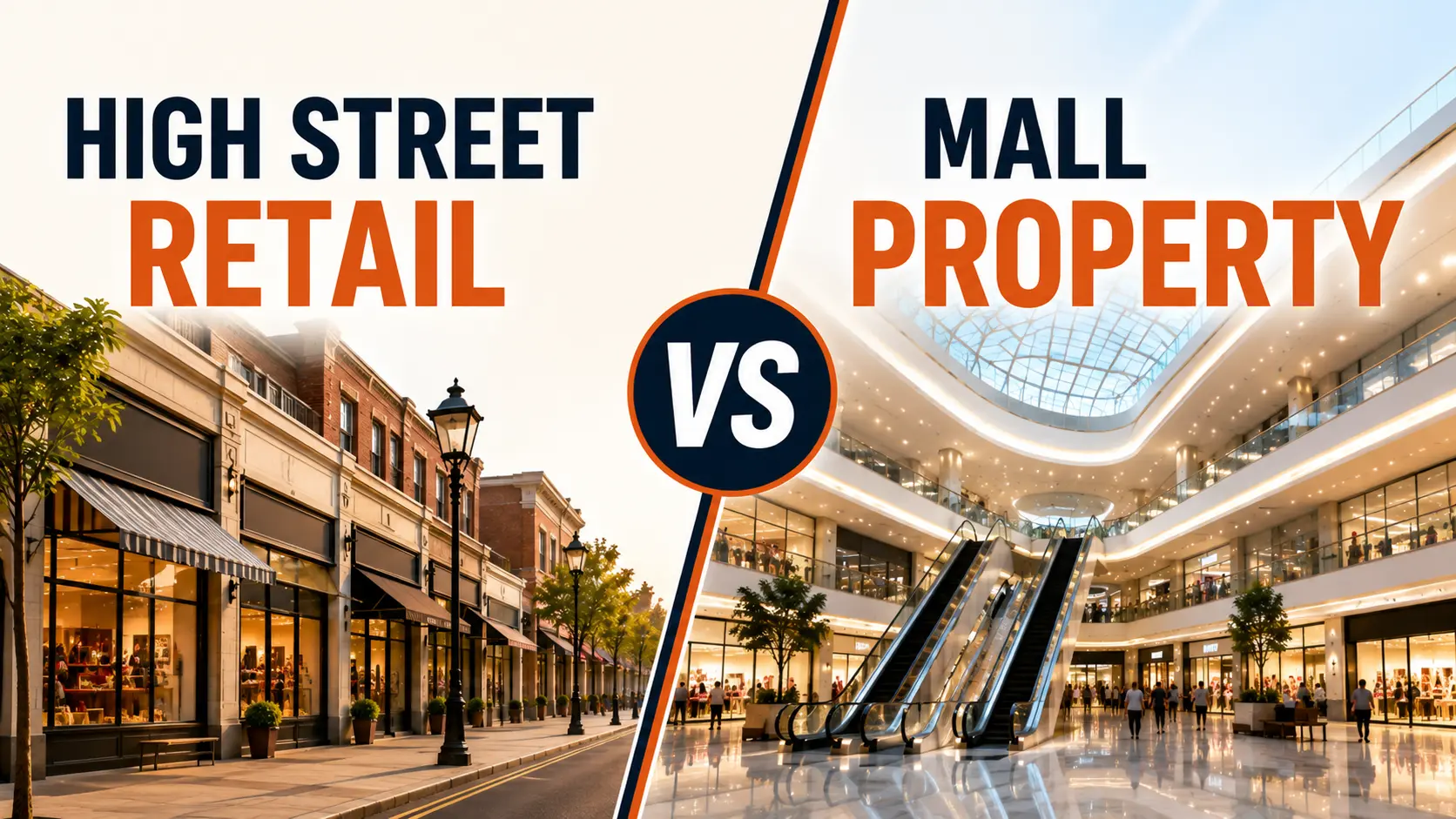
- High street shops: individual, often ground-floor units along a public road or market, with direct street access and organic footfall from passing traffic and nearby residential or office density.
- Mall units: shops inside an enclosed or open shopping centre, where footfall is driven collectively by the mall's overall draw, anchor tenants, and entertainment or food options, rather than by the individual shop's street visibility.
- Showrooms: larger-format retail spaces, often for furniture, automobiles, electronics, or similar categories, where the buying decision takes longer and footfall matters less than visibility and accessibility for a planned visit.
Each format carries different risk. A high street shop lives or dies on its own visibility and the immediate neighbourhood. A mall unit's fortunes are tied to the mall's overall management and anchor tenant strength, something an individual buyer has little control over. A showroom depends more on category demand and accessibility than daily walk-in footfall.
End Use or Investment? Decide This First
This single decision changes almost everything else in the process, so it's worth settling before you shortlist properties.
If you're buying for your own business (end use): footfall and connectivity should dominate your evaluation, even if it means paying more or compromising on unit size. A well-located but smaller shop will usually outperform a large, cheap unit in a low-footfall pocket.
If you're buying purely as an investment: tenant quality, lease stability, and the property's ability to attract and retain a paying tenant matter more than whether you personally find the location appealing. A pre-leased unit with a reputable tenant already in place is often a lower-risk investment than a vacant shop you plan to lease out yourself.
How to Evaluate Location: Footfall, Catchment, and Competition
Three checks matter more than any brochure or broker pitch.
Catchment analysis. Draw a roughly 1-kilometre radius around the shop and map what's actually there: residential societies, offices, schools, hospitals. The denser the mix of daily-need destinations, the more reliable the footfall, regardless of how the road itself looks on a weekday drive-by.
Competition mapping. Walk the immediate stretch and count how many similar businesses already operate there. Five existing mobile repair shops on one street is a warning sign, not proof of demand; a category gap- no pharmacy, no bakery- in an otherwise busy stretch is a stronger signal.
Actual footfall, not assumed footfall. Where possible, observe the location at different times and days rather than relying on a single visit or a broker's claim. Footfall in organised retail environments varies enormously by day; a large Delhi mall, for instance, can see roughly 35,000 to 40,000 visitors on a weekday and 50,000 to 60,000 on a weekend, and the same swing logic applies at a smaller scale to individual high street clusters.
What Is an Anchor Tenant, and Why It Matters Even Outside a Mall
An anchor tenant is a large, well-known retailer that draws visitors to a shopping centre and is positioned, often contractually, to pull footfall toward the smaller units around it. Anchor leases typically run long, 10 to 25 years, often at below-market rent, because the anchor's traffic is what makes the rest of the tenant mix viable.
If you're buying a mall unit, the anchor's presence and stability directly affect your footfall and your resale value; a mall that loses its anchor tenant can see a sharp drop in walk-in traffic for every smaller shop around it. If you're buying a high street shop instead, there's no formal anchor, but the same logic applies informally: a strong, established business nearby, a popular supermarket, a well-known restaurant, functions as an unofficial anchor for the whole stretch, and its presence or absence should factor into your evaluation.
The Legal and Title Due Diligence Checklist
Before committing to any retail unit, verify:
- Title chain: confirm current ownership through the sale deed, and trace the mother deed if the property has changed hands multiple times.
- Encumbrance status: an Encumbrance Certificate confirms the property isn't mortgaged, pledged, or under a legal charge that could surface after purchase.
- Approved commercial use: confirm the unit is legally approved for commercial use under the local development plan, particularly important in mixed-use buildings where residential and commercial floors can have different approval status.
- Occupancy Certificate (OC): occupying or operating from a unit without an OC is a real and often overlooked risk, both for fire and safety compliance and for the property's legal standing.
- RERA status, for under-construction units: verify registration is active on the relevant state RERA portal, not merely applied for.
- Power of Attorney authenticity, if applicable: if the seller is transacting through a GPA rather than directly, verify the document's validity and, where relevant, confirm it doesn't attempt to substitute for a registered sale deed.
RERA and Retail Property: What Actually Applies
RERA is not a residential-only law. Any commercial real estate project with a plot area exceeding 500 square metres, or more than 8 units, must be registered with the state RERA authority before it can be advertised or sold, which covers the large majority of organised retail and mall developments.
For a buyer, this means the same practical checks apply as they would for a residential purchase: confirm active registration on the relevant state RERA website, check the promised possession date against the registered timeline, and treat "application in process" as no protection at all, since only an active, verified registration carries legal weight.
The Real Cost of Buying Retail Property
The quoted price is rarely the full cost. Three components typically add to it.
GST
Under GST 2.0, effective 22 September 2025, under-construction commercial property, including retail shops, showrooms, and mall units, attracts 18% GST with Input Tax Credit available, revised upward from the earlier 12% rate. A GST-registered buyer using the property for taxable business activity, running a shop, leasing it out, can generally claim Input Tax Credit on this amount, subject to standard conditions. Ready-to-move retail property with an Occupancy or Completion Certificate is exempt from GST; only stamp duty and registration charges apply. Commercial rent, separately, attracts 18% GST where the landlord is GST-registered.
Stamp Duty and Registration
Stamp duty on commercial property is a state-level levy, typically in the 5 to 8% range depending on the state, with registration charges generally adding around 1% on top. These are charged regardless of whether GST applies, since they're outside the GST framework entirely.
CAM and Ongoing Charges
For mall units and organised retail developments, Common Area Maintenance (CAM) charges apply on top of the purchase price and any rent you might later collect, typically in the range of a few rupees per square foot per month. These recur for as long as you own or lease the unit and should be factored into any yield calculation, not treated as a footnote.
Financing a Retail Property Purchase
Loans against commercial property are available from most major lenders, but terms differ meaningfully from home loans: interest rates typically run higher, loan-to-value ratios are usually more conservative, and lenders weigh the property's rental income potential and your business's financial profile more heavily than they would for a residential purchase. Because commercial property financing carries less standardisation across lenders than home loans, comparing at least two or three offers before committing is worth the time.
Rental Yield: What to Actually Expect
Commercial property rental yield in India in 2026 typically runs between 6% and 9% annually, with retail specifically in the 5% to 8% range depending on city, location quality, and tenant strength, generally well above the 2% to 4% yields typical of residential property.
The headline number, though, is a gross figure. To get a realistic net yield, subtract property tax, maintenance charges, and a reasonable vacancy allowance, typically a month or two a year, from annual rent before dividing by the purchase price. A property advertised at an attractive 8% gross yield can easily fall closer to 6% once those costs are accounted for; treat any yield figure quoted by a seller or broker as a starting point for your own calculation, not the final answer.
Buying a Pre-Leased Retail Shop: What's Different
A pre-leased shop, one that already has a paying tenant in place, shifts the evaluation from "will this attract footfall" to "will this tenant renew, and at what rate." Key questions differ accordingly: how long is the remaining lease term, does it include a rent escalation clause, what's the tenant's track record and business stability, and what happens to the yield if the current tenant eventually vacates.
Pre-leased units in strong corridors often trade at somewhat compressed yields, commonly in the 5% to 7% range, in exchange for immediate income and lower vacancy risk, a reasonable trade-off for investors who prioritise stability over maximum return.
Common Mistakes First-Time Retail Property Buyers Make
- Evaluating location from a single drive-by visit instead of observing footfall at different times and days.
- Treating retail property valuation the same way as office space, ignoring that footfall and catchment matter far more for retail.
- Quoting or accepting gross rental yield as if it were net return, without subtracting maintenance, tax, and vacancy.
- Assuming RERA doesn't apply to commercial projects and skipping registration verification as a result.
- Underestimating CAM and ongoing charges, especially in mall and organised retail developments.
- Buying into a mall unit without researching the anchor tenant's lease stability and the mall's overall occupancy health.

_1792140859.webp)



_1792151285.webp)

Ans 1. For end use, footfall and connectivity should be your top priority, even at higher cost. For investment, tenant quality and lease stability matter more, since your return depends on someone else's business succeeding in that space, not your own.
Ans 2. Yes. Any commercial project with a plot area exceeding 500 square metres or more than 8 units must be registered with the state RERA authority before it can be sold or advertised, which covers most organised retail and mall developments.
Ans 3. Under-construction retail property attracts 18% GST with Input Tax Credit available, as of the GST 2.0 rate change effective 22 September 2025. Ready-to-move retail property with an Occupancy Certificate is exempt from GST; only stamp duty and registration apply.
Ans 4. Retail rental yield in India in 2026 typically runs between 5% and 8% gross, depending on city and location quality. Subtract property tax, maintenance, and a vacancy allowance to get a realistic net figure.
Ans 5. An anchor tenant is a major retailer that drives footfall to a shopping centre. It matters directly for mall units and, informally, for high street shops too, since a strong established business nearby functions as an unofficial anchor for the whole stretch.
Ans 6. At minimum: the sale deed and mother deed for title history, an Encumbrance Certificate, confirmation of approved commercial use, the Occupancy Certificate, and, for under-construction units, active RERA registration on the relevant state portal.
Ans 7. It depends on your risk appetite. A pre-leased shop offers immediate income and lower vacancy risk, often at a slightly compressed yield of 5% to 7%. A vacant shop carries more upside if you can secure a strong tenant, but also more vacancy and leasing risk in the meantime.
Ans 8. Property tax, maintenance or CAM charges, typically a few rupees per square foot per month for organised developments, and a realistic vacancy allowance if you plan to rent it out, all reduce your effective yield below the advertised gross figure.