
✦ AI Summary
Table of Content
▲- What Is an On-Grid Solar System?
- What Is an Off-Grid Solar System?
- On-Grid vs Off-Grid Solar Systems Comparison
- Which Solar System Is Better for Homes with Frequent Power Cuts?
- Hybrid Solar Systems Are Becoming Popular
- Important Factors to Consider Before Installing Solar
- Cost Difference Between On-Grid and Off-Grid Solar
- Common Mistakes Homeowners Should Avoid
- Why Solar Adoption Is Growing Rapidly in India
- Final Thoughts
The increasing costs of electricity together with the constant interruptions in power supply drive Indian homeowners to adopt solar energy systems. The process of selecting an on-grid solar system or an off-grid solar system becomes challenging for users who need reliable power backup.
Both systems help reduce dependence on traditional electricity, but their operational methods show complete differences. The On-Grid solar systems operate to reduce electricity expenses through net metering while the Off-Grid systems provide continuous backup power together with energy independence. The appropriate choice requires your location information together with your power interruption history and electricity consumption patterns and your financial resources.
What Is an On-Grid Solar System?
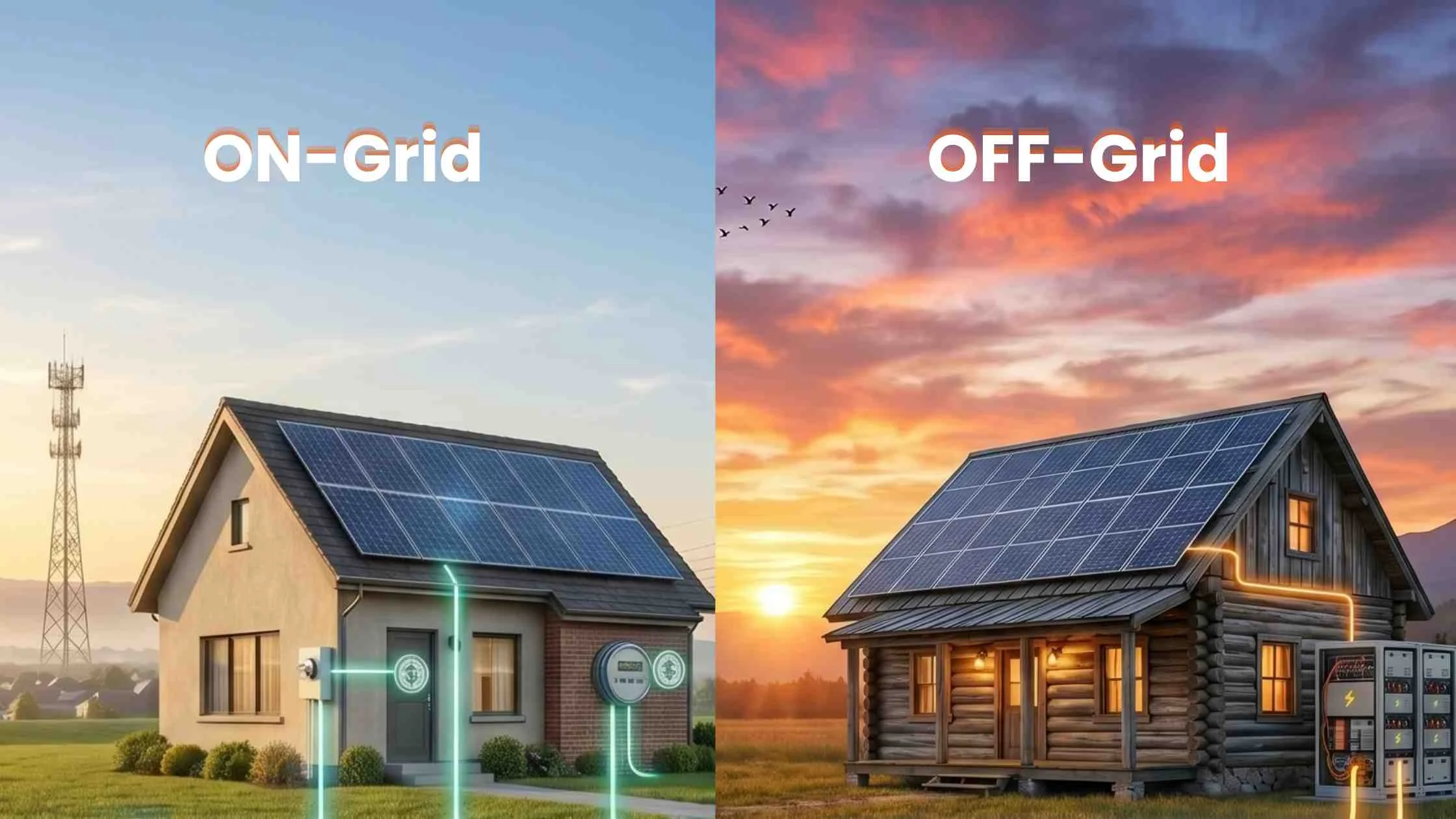
An On-Grid solar system, also known as a grid tied system, maintains its connection to the local electricity grid. The solar panels produce power throughout the day and any surplus energy is transmitted back to the grid through net metering.
The fundamental components of the system execute their tasks through a straightforward operating procedure. The solar panels produce direct current electricity from sunlight which the inverter transforms into alternating current that powers your appliances. The solar power system generates electricity which your home consumes first, and any remaining power goes to the electricity grid.
How On-Grid Solar Works
The system works through the following components:
- Solar panels capture sunlight
- Inverter converts DC power into AC electricity
- Electricity powers home appliances
- Extra electricity flows to the grid
- The home uses grid power during low solar generation
One important thing homeowners must understand is that standard On-Grid systems usually shut down during power cuts for safety reasons. This means they do not provide backup during outages unless paired with batteries or hybrid technology.
Main Benefits of On-Grid Solar Systems
- Lower installation cost
- No expensive battery storage required
- Reduced electricity bills
- Net metering benefits
- Lower maintenance requirements
- Ideal for urban homes with stable electricity supply
On-Grid systems are considered the most cost effective solar option for Indian cities with reliable power infrastructure.
Also Read: 3kW Solar Panel Price in India (2026): Actual Cost After Government Subsidy
What Is an Off-Grid Solar System?
Off-grid solar systems operate as self-sufficient power systems which require no connection to electrical grids for their operation. The solar panels charge a battery bank throughout the day which stores energy to provide power to the home during times when sunlight is not available including blackouts, night hours and extended periods of cloud cover.
How Off-Grid Solar Works
The system typically includes:
- Solar panels
- Charge controller
- Battery bank
- Off-Grid inverter
- Distribution panel
During the day, solar panels generate electricity while simultaneously charging the batteries. The stored energy powers the house during nighttime or electricity failures.
Main Benefits of Off-Grid Solar Systems
- Complete power backup during outages
- Energy independence
- Works in remote locations
- No dependence on DISCOM supply
- Reliable during long power cuts
Off-Grid systems are becoming increasingly popular in semi urban and rural areas where electricity supply remains unstable.
On-Grid vs Off-Grid Solar Systems Comparison
Choosing between these systems becomes easier when homeowners understand the practical differences.
|
Feature |
On-Grid Solar System |
Off-Grid Solar System |
|
Grid Connection |
Connected to utility grid |
Independent from grid |
|
Battery Requirement |
Usually not required |
Mandatory |
|
Backup During Power Cuts |
No backup |
Full backup available |
|
Initial Cost |
Lower |
Higher |
|
Maintenance |
Minimal |
Battery maintenance needed |
|
Net Metering |
Available |
Not available |
|
Best For |
Cities with stable power |
Areas with frequent outages |
|
Electricity Bills |
Significantly reduced |
Mostly eliminated |
|
Energy Independence |
Partial |
Complete |
Which Solar System Is Better for Homes with Frequent Power Cuts?
For homes that experience both daily power outages and extended electricity interruptions, Off-Grid solar systems serve as the most suitable solution. The system maintains power delivery during grid outages because it uses batteries to store electricity.
If your area experiences short power outages that last for one or two hours during multiple days each week, a standard on-grid system with a small inverter-battery UPS system for essential devices will provide you with the most affordable solution. You receive maximum advantages through on-grid solar net metering and government incentives while your expenses decrease and you maintain operational capacity during small power interruptions with a basic backup system.
If your area experiences daily power outages lasting 4 to 8 hours or longer, the calculation adjusts considerably. A battery backup for an off-grid or hybrid system is truly critical instead of a mere luxury feature. Operating your home On-Grid electricity for 4 to 8 hours each day while investing in a solar system that ceases functioning during those hours undermines the practical goal of pursuing solar energy for numerous households.
Choose Off-Grid Solar If
- Your area faces frequent power cuts
- Electricity supply is unreliable
- You live in a rural or remote location
- You need uninterrupted power for appliances
- You want complete energy independence
However, Off-Grid systems come with higher upfront costs because batteries significantly increase installation expenses.
Choose On-Grid Solar If
- Your city has stable electricity supply
- Your primary goal is reducing electricity bills
- You want lower installation cost
- You can tolerate occasional outages
- You want government subsidy and net metering benefits
For most urban homeowners, On-Grid systems remain the more affordable and practical choice.
Also Read: PM Surya Ghar Muft Bijli Yojana 2026: Step-by-Step Guide to Claim Your Solar Subsidy
Hybrid Solar Systems Are Becoming Popular
Many homeowners now prefer hybrid solar systems because they combine the advantages of both On-Grid and Off-Grid systems. Hybrid systems remain connected to the grid while also including battery backup.
A hybrid system remains linked to the grid like an on-grid system, allowing for net metering and bill savings, while also featuring a battery bank. In normal operation, surplus solar energy charges the batteries. In the event of power outages, the system automatically transitions to battery power instead of turning off. Once the grid is restored, the system reconnects and continues standard net metering functions.
Why Hybrid Systems Are Gaining Attention
- Backup during power cuts
- Lower electricity bills
- Battery support during outages
- Net metering benefits
- Better energy management
Although hybrid systems cost more initially, they are increasingly seen as the ideal long term solution for Indian homes facing moderate power outages.
Important Factors to Consider Before Installing Solar
Electricity Consumption
Calculate your monthly electricity usage before selecting system capacity.
Power Cut Frequency
Frequent outages usually justify battery investment.
Budget Planning
On-Grid systems are cheaper, while Off-Grid and hybrid systems require higher investment due to batteries.
Roof Space Availability
Larger systems require more rooftop area for solar panel installation.
Government Subsidies
Many state and central government subsidy schemes mainly support grid residential systems.
Cost Difference Between On-Grid and Off-Grid Solar
The biggest cost difference comes from battery storage.
|
System Type |
Approximate Cost Range for 5kW System |
|
On-Grid Solar |
₹2 lakh to ₹3 lakh |
|
Off-Grid Solar |
₹3.5 lakh to ₹5 lakh |
|
Hybrid Solar |
₹4 lakh to ₹6 lakh |
Battery replacement costs should also be considered in long term planning.
Common Mistakes Homeowners Should Avoid
Many buyers focus only on upfront pricing and ignore future energy needs. Before choosing a solar setup, homeowners should avoid:
- Ignoring backup requirements
- Choosing undersized battery capacity
- Selecting low quality inverters
- Not checking net metering policies
- Ignoring maintenance costs
- Installing systems without load analysis
Proper planning helps avoid expensive upgrades later.
Why Solar Adoption Is Growing Rapidly in India
India’s growing solar adoption is driven by:
- Rising electricity tariffs
- Frequent power disruptions
- Government subsidy programs
- Improved solar technology
- Increasing environmental awareness
Solar systems are no longer viewed only as eco-friendly upgrades. They are now becoming essential long term energy solutions for households seeking savings and reliable electricity.
Final Thoughts
The decision between On-Grid and Off-Grid solar systems depends on your energy requirements and your need for dependable power sources. Homeowners who want to reduce their electricity expenses should choose On-Grid systems because these systems operate efficiently in areas that have reliable power supply. Homeowners who experience regular power outages and unstable electricity service should select Off-Grid systems as their optimal power solution.
For many Indian households, hybrid solar systems are emerging as the most balanced solution because they combine battery backup with grid connectivity. The increasing adoption of advanced solar energy systems by homeowners will continue until solar technology reaches better performance and battery prices reach more affordable levels.

_1792151285.webp)

Ans 1. On-grid solar systems stay connected to the electricity grid, generate power during the day, reduce electricity bills through net metering, and shut down during power cuts for safety. Off-grid solar systems operate completely independently from the grid using batteries to store energy, provide full backup during outages, but don't offer net metering benefits and cost more due to battery requirements. The fundamental difference is that on-grid systems prioritise bill reduction while off-grid systems prioritise energy independence and backup power.
Ans 2. For homes with frequent power cuts, off-grid or hybrid solar systems are significantly better than standard on-grid systems. Standard on-grid systems automatically shut down during outages because they're connected to the grid, meaning they provide no backup power when the grid fails. Off-grid systems use battery storage to continue supplying power regardless of grid status. Hybrid systems combine grid connectivity preserving bill reduction and net metering benefits with battery backup for outages, making them increasingly the preferred choice for households with moderate to frequent power cuts.
Ans 3. A standard on-grid solar system cannot work during a power cut, it shuts down automatically as a safety measure to protect electricity workers repairing the lines. This means that despite having solar panels on your roof, you'll have no electricity during an outage if you have a standard on-grid system. The solution is either upgrading to a hybrid inverter with battery storage, which allows the solar system to continue operating in island mode during outages, or accepting the standard on-grid limitation if your area has infrequent and short outages.
Ans 4. A hybrid solar system combines the features of on-grid and off-grid systems. It stays connected to the electricity grid allowing net metering and bill reduction benefits while also including a battery bank for backup power during outages. During normal operation, solar generation powers the home and excess charges the batteries. During a power cut, the system automatically switches to battery power, continuing to power the home without interruption. When the grid is restored, it reconnects and resumes normal operation. Hybrid systems are increasingly popular in India for households that want both bill reduction and outage protection.
Ans 5. For a standard 5kW residential system in India in 2026, on-grid solar typically costs ₹2 lakh to ₹3 lakh, off-grid solar costs ₹3.5 lakh to ₹5 lakh, and hybrid solar costs ₹4 lakh to ₹6 lakh. The cost difference between on-grid and the other two types is driven almost entirely by battery storage, which is the most expensive component in off-grid and hybrid systems. Battery type lead-acid versus lithium iron phosphate also significantly affects both the upfront cost and the long-term replacement schedule.
Ans 6. Solar system sizing depends on your monthly electricity consumption. As a general rule, divide your monthly electricity units consumed by 30 (days in a month) to get your average daily consumption, then size the solar system to cover that generation requirement with a reasonable buffer. A home consuming 300 units per month uses approximately 10 units per day and typically needs a 3kW to 4kW system with good sun exposure. For off-grid and hybrid systems, the battery bank must also be sized to cover consumption during non-solar hours. A professional load analysis from a qualified solar installer is the most reliable way to size your system correctly.
Ans 7. For rural areas in India where grid electricity is unreliable, frequently interrupted, or not available at all, off-grid solar systems are typically the most appropriate choice. They provide complete energy independence from a grid that may not be reliable enough to serve as a useful backup or net metering partner. For rural homes where the grid is present but unreliable, off-grid solar eliminates dependence on the distribution company entirely. For rural homes where the grid is absent or extremely expensive to connect, off-grid solar is often the most cost-effective electricity solution available.
Ans 8. The backup duration from a solar battery system depends on the battery bank's total capacity in kilowatt-hours and the home's power consumption rate during the outage period. A 10 kWh battery bank powering a home drawing 1 kW continuously provides approximately 8 to 10 hours of backup (accounting for efficiency losses and the recommended depth of discharge limit). To calculate your approximate backup requirement, estimate the wattage of appliances you need to run during an outage, multiply by the hours you need them to run, and size the battery bank to provide that capacity with a 20 to 30% buffer. A solar installer can perform this calculation properly as part of the system design process.
Ans 9. The most common mistakes when choosing between on-grid and off-grid solar in India include selecting on-grid purely for lower cost without realising it provides no backup during the frequent outages that justified going solar in the first place. Undersizing battery capacity in off-grid or hybrid systems, resulting in power failure before sunrise or through extended cloudy periods. Choosing the cheapest inverter without considering quality and efficiency. Not accounting for battery replacement costs in the 10-year financial comparison. Failing to check net metering policies before designing an on-grid system. And not conducting a proper load analysis before sizing the system, leading to either insufficient capacity or unnecessary capital expenditure.
Ans 10. Yes solar energy is particularly worth the investment for Indian homes with frequent power cuts when the correct system type is chosen. Standard electricity tariffs continue rising, making the financial case for solar stronger over time. For homes with frequent outages, the combination of bill reduction and backup power means the solar system provides value on two dimensions simultaneously. Government subsidies reduce upfront cost for on-grid systems. And the technology particularly batteries and hybrid inverters continues improving while prices decline, meaning the total cost of a system that provides both bill reduction and backup power is significantly more accessible in 2026 than it was even three years ago.