
✦ AI Summary
Table of Content
▲- What Is an Overdraft Home Loan?
- BOB Max: How It Works
- SBI Maxgain vs BOB: Head-to-Head Comparison 2026
- Interest Saving Illustration: ₹50 Lakh Loan, ₹5 Lakh Parked
- When Should You Choose SBI Maxgain?
- When Should You Choose BOB Max?
- 4 Practical Tips Before You Decide
- AquireAcres EMI Calculator for Smart Home Loan Planning
- Conclusion
SBI Maxgain and BOB Max are two of the smartest overdraft home loan products in India right now, and if you have surplus funds sitting idle in a savings account every month, you are almost certainly losing money by not switching to one of them.
Put your extra amount in the account linked to your home loan, pay interest only on what remains, and withdraw it anytime you need it. But which bank does it better in 2026? That depends entirely on who you are as a borrower, your property type, income profile, and how much surplus you actually hold. This guide breaks it down, number by number.
What Is an Overdraft Home Loan?
An overdraft (OD) home loan is a hybrid financial product that combines your home loan with an overdraft or savings account. Any surplus funds you deposit into the linked account reduce the net outstanding principal on which interest is calculated. You still pay the same EMI every month but a greater portion of it goes towards principal repayment because the interest component shrinks. The result: you clear your loan faster without permanently committing your money. The two biggest players in this space are SBI Maxgain and BOB's Baroda Max Home Loan (also known as Baroda Home Loan Advantage).
Also Read: Fixed vs. Floating Interest Rate: A 20-Year Cost Breakdown for 2026
SBI Maxgain: How It Works
SBI Maxgain is India's most popular home saver loan. It operates through two accounts, your regular home loan account and a dedicated OD (Excess) account. Every rupee you deposit in the OD account reduces the effective outstanding principal for interest calculation. Your EMI stays the same, but the interest component shrinks as your parked balance grows.
Key Features of SBI Maxgain
- Interest Rate (2026): 8.50%–9.15% p.a., with a 0.05–0.10% premium over the standard SBI rate
- Minimum Loan Amount: ₹20 Lakhs; no upper cap
- Account Access: ATM/debit card, internet banking, and IMPS transfers on the OD account, functions like a current account
- Drawing Power: Reduces monthly by the principal component of EMI until the overdraft is liquidated at tenure end
- Withdrawal Rule: Funds can be withdrawn anytime, but not until you receive possession of the property
- Property Eligibility: Ready-to-move-in properties only, under-construction not eligible
- Tax Note: Parked surplus is not treated as prepayment under Section 80C, no additional deduction applies
- Prepayment Charges: Nil on floating rate loans
BOB Max: How It Works
Bank of Baroda's equivalent product is the Baroda Max Savings Home Loan (also known as Baroda Home Loan Advantage). Instead of a separate OD account, BOB links your home loan directly to a savings bank account. The daily end-of-day credit balance in that linked account is offset against the outstanding loan principal every single day.
Key Features of BOB Max
- Interest Rate (2026): 8.00%–9.25% p.a., with an additional 0.50% for the OD facility
- Rate Benchmark: Baroda Repo Linked Lending Rate (BRLLR), currently 8.15% p.a. as of June 2026
- Account Structure: Home loan linked to savings account; EMIs are auto-recovered from the same account
- Interest on Savings Account: Zero, but interest saved on the loan acts as the effective return
- Processing Fee: No processing fee on the OD facility, a clear cost advantage over SBI
- Property Eligibility: Purchase, construction, balance transfer, and home extension, broader than Maxgain
- Eligible Borrowers: Salaried, self-employed, NRIs, PIOs, and OCIs
- Prepayment Charges: Nil
- Loan Limit: No maximum cap, rate is CIBIL-score and loan-amount dependent
SBI Maxgain vs BOB: Head-to-Head Comparison 2026
|
Feature |
SBI Maxgain |
BOB Max Savings |
|---|---|---|
|
Account Type |
Dedicated OD / Excess Account |
Linked Savings Bank Account |
|
Interest Rate (2026) |
8.50%–9.15% p.a. + 0.05–0.10% OD premium |
8.00%–9.25% p.a. + 0.50% OD premium |
|
Rate Benchmark |
SBI EBLR-linked |
BRLLR (8.15% as of June 2026) |
|
Property Eligibility |
Ready-to-move-in only |
Purchase, construction, BT, extension |
|
Minimum Loan Amount |
₹20 Lakhs |
No stated minimum |
|
Withdrawal Flexibility |
Anytime (post-possession) |
Anytime from linked savings account |
|
Processing Fee (OD) |
Standard SBI charges applicable |
Nil on OD facility |
|
Prepayment Charges |
Nil (floating rate) |
Nil |
|
Interest on Parked Funds |
No, interest saved is the return |
No, daily balance reduces loan interest |
|
Eligible Borrowers |
Resident Indians (salaried / self-employed) |
Salaried, self-employed, NRI, PIO, OCI |
|
Max Loan Limit |
No upper cap |
No upper cap |
Interest Saving Illustration: ₹50 Lakh Loan, ₹5 Lakh Parked
|
Scenario |
Effective Rate Applied On |
Annual Interest Saved |
|---|---|---|
|
SBI Maxgain @ 8.50%, ₹5L parked |
Effectively on ₹45L |
₹42,500 approx. |
|
BOB Max Savings @ 8.50% (incl. premium), ₹5L parked |
Effectively on ₹45L |
₹42,500 approx. |
|
Regular home loan @ 8.50% — no surplus parked |
Full ₹50L |
₹0 saved |
|
OD premium cost (BOB: 0.50% on ₹50L) |
Extra annual cost |
₹25,000 p.a. |
What the numbers actually mean: If you park ₹5 lakh consistently, both products save significantly more than the premium they charge. The OD feature pays for itself the moment your parked balance crosses ₹2–3 lakh.
Also Read: SBI Realty vs. HDFC Plot Loan: Comparing Land Purchase Loans for Independent Homes
When Should You Choose SBI Maxgain?
- You are buying a ready-to-move-in flat or house as Maxgain is available exclusively for this category
- You consistently maintain ₹2 lakh or more in idle surplus, the OD account premium is worth it above this threshold
- You want a dedicated OD account with ATM and internet banking access as Maxgain's excess account functions like a current account
- You are a resident Indian (salaried or self-employed), then, straightforward eligibility, no special documentation
- You trust SBI's brand and wider branch network for pan-India reach and government-backed stability
When Should You Choose BOB Max?
- You are buying an under-construction property and BOB's scheme supports construction loans, Maxgain does not
- You are an NRI, PIO, or OCI borrower and BOB Max Savings explicitly covers the diaspora buyer, SBI Maxgain does not
- You want zero processing fee on the overdraft facility as BOB charges nil vs SBI's standard processing charges
- You prefer your salary account linked directly to your home loan for simpler account management, automatic daily offset
- You need home renovation or balance transfer under the OD structure, BOB covers extension and BT cases too
4 Practical Tips Before You Decide
- Keep your surplus above ₹2 lakh consistently. The OD feature is a mathematical advantage only when your parked balance is large enough to offset the rate premium. Below ₹1 lakh, a regular home loan with a lower base rate may actually cost less.
- Check whether your property qualifies for SBI Maxgain. If it is under construction, you cannot avail Maxgain at all, BOB Max Savings or another product is your only OD option.
- Compare the total rate, not just the headline rate. SBI Maxgain adds 0.05–0.10% over the standard rate. BOB adds 0.50%. On a ₹50 lakh loan, that 0.40% gap costs approximately ₹20,000 extra per year with BOB, make sure your OD savings justify it.
- Negotiate conversion terms upfront. Both banks allow conversion from overdraft to regular home loan. Understand the switching process and any applicable charges before you sign.
AquireAcres EMI Calculator for Smart Home Loan Planning
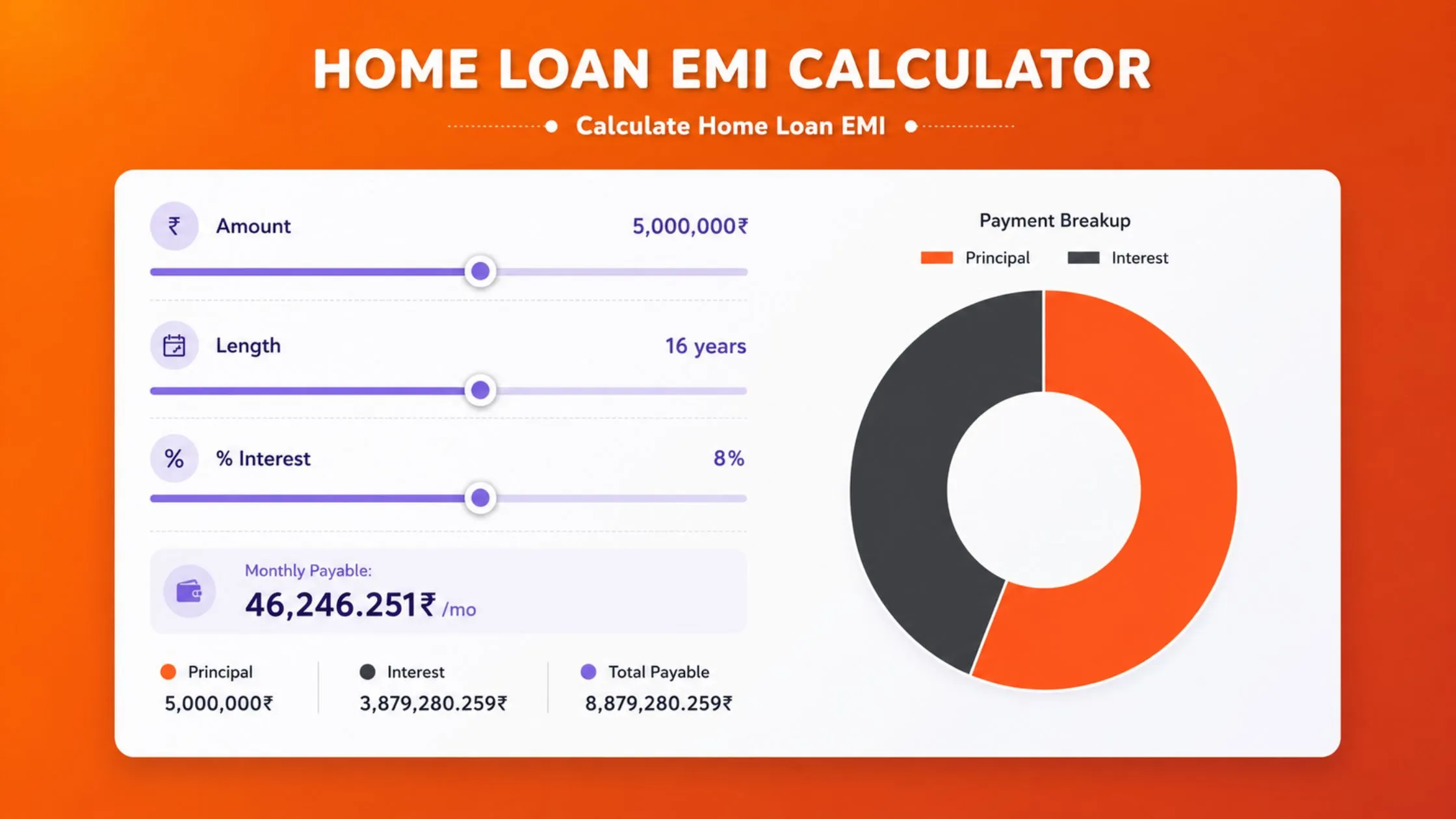
Choosing between SBI Maxgain and BOB Max Savings is only half the decision, the other half is knowing your numbers before you walk into a branch. The AquireAcres EMI Calculator is a simple and reliable tool that helps you estimate your monthly home loan payments instantly. By entering your loan amount, interest rate, and tenure, you can understand your EMI, total interest payable, and overall cost of the loan, making it easier to plan your finances and make informed property decisions.
Conclusion
SBI Maxgain and BOB Max Savings are not just home loan products, they are active financial management tools for the disciplined Indian borrower. If you are a salaried resident Indian buying a ready-to-move property and hold ₹2 lakh or more in surplus at any given time, SBI Maxgain is the sharper, simpler and more liquid choice.
If you are an NRI, PIO, buying under-construction property, or want zero OD processing fees, BOB Max Savings gives you flexibility that Maxgain simply cannot match. Run your numbers, check your property eligibility, and choose the one that fits your financial life, not just the one with the better-looking interest rate on paper.
|
Read This Also |
|
|---|---|
|
What Are Green Home Loan? Benefits for Eco-Friendly Homes |
Sanctioned vs Disbursed Amount in Home Loan: Explained for Homebuyers |
|
Mortgage Loan Types A Comprehensive Guide to Home Loan Options in India |
|
|
Loan to Value Ratio Meaning Calculation and Importance for Homebuyers |
Universal Account Number UAN Login 2025: How to Use EPF Savings to Buy Dream Home |


Ans 1. SBI Maxgain is an overdraft-linked home loan from State Bank of India. It comes with a dedicated OD (Excess) account that works like a current account. Any surplus funds parked in this account reduce the effective outstanding principal, lowering your interest outgo while keeping the funds fully accessible post-possession.
Ans 2. The core difference is structural. SBI Maxgain uses a dedicated OD/excess account, while BOB Max Savings links your home loan to a savings bank account. BOB also supports under-construction properties and NRI/PIO/OCI borrowers, eligibility categories that SBI Maxgain does not cover.
Ans 3. SBI Maxgain carries a rate of 8.50%–9.15% p.a. depending on your CIBIL score and loan amount, with an additional 0.05%–0.10% premium over the standard SBI home loan rate for the overdraft feature.
Ans 4. Yes, with one condition. You cannot withdraw funds from the Maxgain excess account until you receive possession of the property. Once possession is granted, the full balance is available for withdrawal at any time without restriction.
Ans 5. No. The linked savings account earns zero interest under the BOB Max Savings scheme. However, the daily end-of-day balance in that account reduces the outstanding home loan principal, and the interest saved on the loan itself acts as the effective return on your parked funds.
Ans 6. No. SBI Maxgain is exclusively available for ready-to-move-in properties. If you are purchasing an under-construction flat or building a home, BOB Max Savings is the more suitable overdraft home loan option.
Ans 7. As a general benchmark, the OD feature becomes financially worthwhile when you consistently maintain ₹2 lakh or more in the linked account. Below this level, the interest saved may not adequately offset the rate premium charged by the bank.
Ans 8. No. BOB charges no processing fee on the OD facility under its Max Savings / Home Loan Advantage scheme, a clear advantage over SBI Maxgain, which applies standard processing charges to the base loan.
Ans 9. Yes. SBI allows borrowers to convert their Maxgain overdraft home loan to a regular term loan at any point during the tenure. You need to approach your base branch with a written request, and the interest rate will be adjusted to the applicable standard home loan slab.
Ans 10. Neither is universally superior, it depends on your profile. SBI Maxgain suits salaried resident Indians buying ready-to-move property with stable surplus funds of ₹2 lakh or more. BOB Max Savings is the better choice for under-construction buyers, NRI/PIO borrowers, or those who prefer linking the home loan to their salary account with zero OD processing fees.