
✦ AI Summary
Table of Content
▲
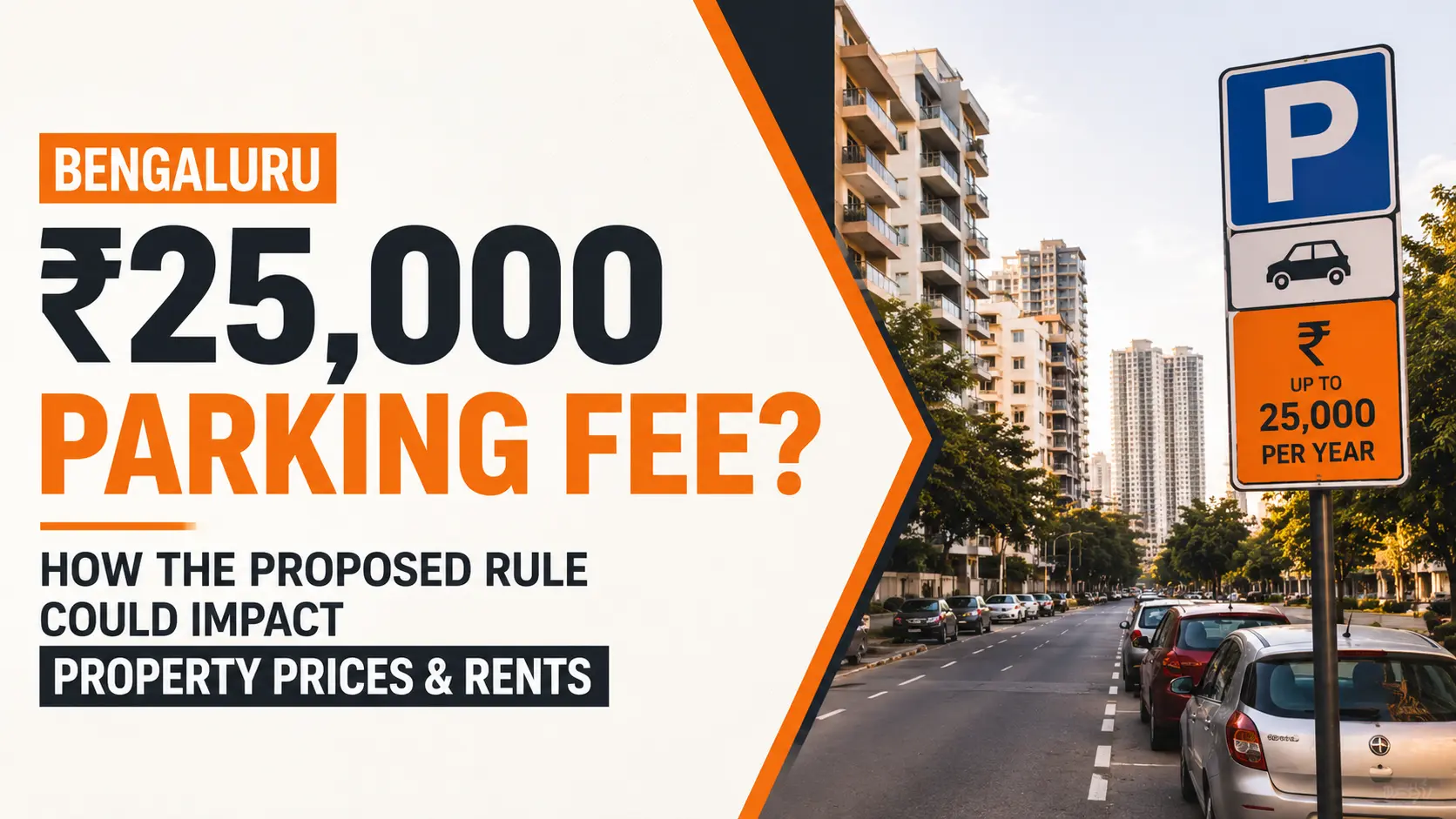
A parking space outside your home may soon become a more expensive part of living in Bengaluru.
The Karnataka government's draft Greater Bengaluru Area (Parking) Rules, 2026 propose annual residential parking permit fees for vehicles parked on designated public roads. The proposed charge ranges from ₹15,000 for hatchbacks to ₹25,000 for SUVs.
The proposal has triggered a wider property question: could parking charges eventually affect home prices and rents?
The answer is unlikely to be a simple city-wide price increase. The bigger impact could be on the value buyers and tenants place on homes with assured parking.
What are Bengaluru's proposed parking charges?
Under the draft rules, residents who use designated public roads for residential parking could face an annual permit fee based on vehicle type.
|
Vehicle |
Proposed annual fee |
|
Hatchback |
₹15,000 |
|
Sedan |
₹20,000 |
|
SUV |
₹25,000 |
These are proposed charges, not a final city-wide fee. The government has invited public feedback before the rules are finalised.
The draft also proposes charges for other forms of on-street parking, with rates reported at ₹40 to ₹80 per hour, depending on the road category.
That makes the proposal broader than simply introducing an annual residential parking fee. It is an attempt to regulate how public road space is used for parking.
Why could parking affect property values?
Parking has always mattered to Bengaluru homebuyers, particularly in established neighbourhoods where road space is limited.
The proposed rules could make that consideration more visible.
Imagine two similar apartments in the same locality. One comes with an assured parking space inside the building. The other depends on parking along the public road.
If roadside parking becomes regulated and carries an annual cost, the first property could become more attractive to buyers.
That does not mean its price will automatically rise by ₹25,000. Property prices are influenced by much larger factors such as location, connectivity, supply, demand and the quality of the project.Connectivity remains one of the strongest factors shaping Bengaluru property values.
The likely effect is more specific: parking could command a higher premium where it is scarce.
Could rents also rise?
The rental market may feel the change differently.
A tenant who owns a car has to consider not only the monthly rent but also the cost and availability of parking.
If a landlord provides assured parking, the property could become more attractive than a similar home where the tenant has to rely on public road parking.
Some landlords may absorb additional parking expenses to remain competitive. Others could pass part of the cost to tenants through rent or a separate parking charge.
The impact is likely to be strongest in neighbourhoods where parking supply is already tight. Parking is only one part of Bengaluru's changing rental market.
Recent public reaction to the proposal has also included concerns that additional parking costs could eventually put pressure on rents.
Will every Bengaluru property become more expensive?
That is unlikely.
A parking charge by itself is not enough to drive up residential prices across a city as large as Bengaluru.
The property market has several other forces at work. Location, employment hubs, metro connectivity, apartment supply, construction costs and buyer demand remain much bigger determinants of value.
The parking proposal could instead create a clearer difference between properties with and without dedicated parking.
|
Property type |
Possible market impact |
|
Home with dedicated parking |
Could become more attractive |
|
Home dependent on street parking |
Buyers may scrutinise parking costs |
|
Property in a congested locality |
Parking could carry greater value |
|
New project with adequate parking |
May gain an advantage |
|
Rental home with assured parking |
Could attract car-owning tenants |
|
Property without parking |
May face greater negotiation pressure |
The effect will therefore vary from one neighbourhood to another.
What should homebuyers check?
The proposed rules are a useful reminder that buyers should consider the total cost of owning a home, not just its sale price. For buyers, the decision also comes down to choosing the right location and understanding the area's long-term potential.
Read More: Top Bangalore Areas to Buy a Home in 2025: Guide for First-Time Buyers
Before buying a property in Bengaluru, a car-owning buyer should ask whether parking is included and where the vehicle can legally be parked.
It is also worth checking whether the parking space is part of the project's approved arrangement and how it is recorded in the property's documentation.
For tenants, the question is even more direct:
Is parking included in the rent?
If not, what will it cost each month or year?
These questions could become increasingly relevant if the proposed parking framework comes into force.
Why the issue matters beyond parking
Bengaluru's parking problem is closely tied to the way the city has grown.
Older neighbourhoods were not designed around today's level of car ownership. Apartment construction has increased, but road space in many established areas has remained largely unchanged.
That has turned roadside parking into a regular source of conflict.
The proposed rules attempt to put a price and regulatory framework around that public space.
From a real estate perspective, that could gradually change how buyers compare properties.
A home with a parking garage or designated space may no longer be viewed simply as having an additional amenity. In some locations, it could be seen as avoiding a recurring cost and uncertainty associated with street parking.
What does this mean for Bengaluru's property market?
The proposed ₹25,000 charge should not be interpreted as a signal that Bengaluru property prices are about to rise across the board.
The more realistic possibility is a parking premium.
Properties with assured parking could become more attractive, particularly in areas where road parking is difficult. Homes without dedicated parking may face more questions from buyers and tenants.
The outcome will also depend on the final rules and how they are implemented.
For now, the charges remain part of a draft policy. Bengaluru residents still have the opportunity to respond before the framework is finalised.
For homebuyers, the takeaway is fairly simple: when comparing two otherwise similar properties, parking may increasingly deserve the same attention as maintenance charges, connectivity and amenities.



Ans 1. Not yet. The ₹25,000 figure is part of the draft Greater Bengaluru Area (Parking) Rules, 2026, not a final charge that residents are currently required to pay. The proposed annual residential parking permit is ₹15,000 for hatchbacks, ₹20,000 for sedans and ₹25,000 for SUVs. The Karnataka government has invited objections and suggestions before finalising the rules.
Ans 2. The proposed fee would apply to residents seeking permits to park vehicles on designated public roads outside their homes. The draft also says residential parking permits would be available to residents of buildings that meet the minimum parking requirements under applicable building bye-laws. So, the proposal is not simply a blanket ₹25,000 charge on every car owner in Bengaluru.
Ans 3. It could influence property values, but a city-wide increase in property prices is unlikely to come from the parking fee alone. The more noticeable effect could be on the price difference between homes with dedicated parking and those that depend on public roads. Experts cited by Hindustan Times expect the impact to remain largely location-specific.
Ans 4. Possibly, particularly for tenants who need parking. Landlords may choose to absorb the additional expense, charge separately for parking or factor the cost into rent. The effect is likely to be stronger in established neighbourhoods where parking is already difficult to find.
Ans 5. They could. If parking on public roads becomes regulated and carries an annual cost, a home with assured parking within the premises may become more attractive to buyers and tenants. This does not mean every such flat will automatically become more expensive, but dedicated parking could command a stronger premium in parking-constrained neighbourhoods.
Ans 6. Parking should be checked alongside the property's price, maintenance charges and other costs. Buyers should ask whether dedicated parking is available, where the space is located, whether it is part of the approved project arrangement and how the parking allocation is documented. If a property relies on roadside parking, buyers should also consider the possible cost and availability of public parking under the proposed rules.