
✦ AI Summary
Table of Content
▲- Why Sequence Matters More Than a Flat Checklist
- Phase 1: Ownership and Title History
- Phase 2: Encumbrance and Financial Checks
- Phase 3: Land Records and Digital Identity
- Phase 4: Construction and Regulatory Compliance
- Phase 5: The Physical Site Visit
- Phase 6: Registration-Day Requirements
- What to Do When a Check Turns Up a Problem
- The Complete Checklist, In Order
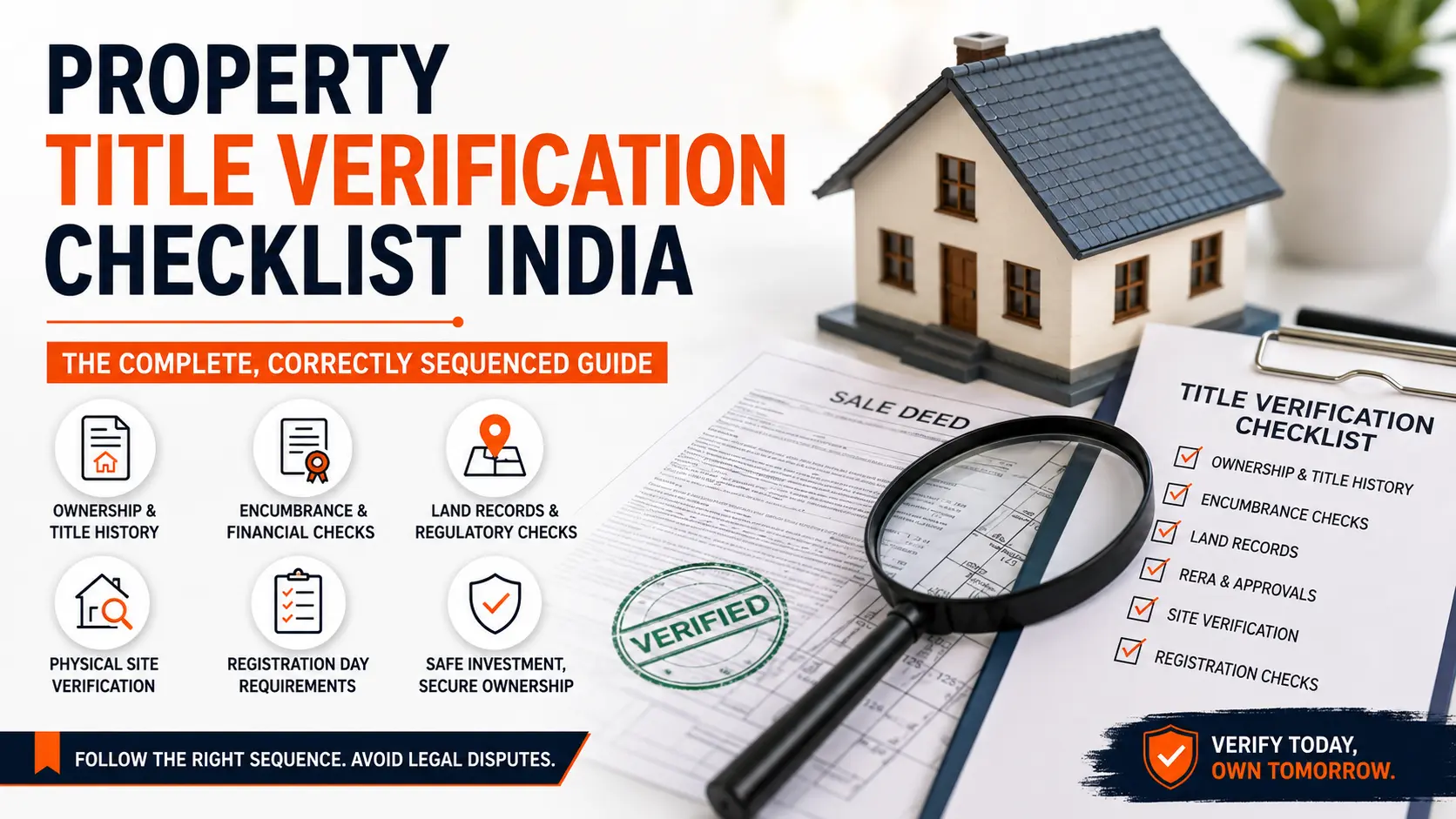
Property title verification in India isn't a flat list of documents to collect; it's a sequence of checks where each stage depends on the one before it. You can't meaningfully evaluate a builder's RERA compliance before confirming the underlying land title is clean, and a spotless Encumbrance Certificate means very little if the property is separately mortgaged through a route the EC was never designed to capture. Property disputes account for a large share of India's civil litigation, and cases can take well over a decade to resolve, which is exactly why this sequence, done properly, is worth the time it takes.
This guide walks through that sequence: ownership and title history first, then encumbrance and financial checks, then land records and regulatory compliance, then a physical site visit, and finally registration-day requirements, ending with a consolidated checklist you can actually use.
Why Sequence Matters More Than a Flat Checklist
Most checklists online list documents alphabetically or by category, which is intuitive for organising information but obscures what actually depends on what. Confirming the chain of ownership has to come before anything else, since every later check- encumbrance, construction compliance, financial clearance- only means something once you know you're verifying the right property with a genuinely traceable ownership history. This guide follows that dependency order deliberately, rather than presenting everything as equally weighted.
Phase 1: Ownership and Title History
The Mother Deed and the 30-Year Chain of Title
The current Sale Deed tells you who owns the property today. The Mother Deed, the earliest traceable deed establishing how the property came into private ownership, tells you the history behind that. Between the two should sit an unbroken chain: every subsequent sale, gift, partition, or inheritance document showing how the property moved from one owner to the next, with no unexplained gaps.
The working convention in Indian property due diligence is to trace this chain back at least 30 years, not because of any single specific rule, but because it's the practical window within which most disputed claims, including those of minors or legal heirs subject to long limitation periods, are likely to surface. A 30-year Encumbrance Certificate, run against this same chain, is the standard companion document used to confirm the same period.
Why 30 Years, Specifically
Legal claims to property in India, particularly those involving minors, missing heirs, or contested inheritances, can remain valid for extended limitation periods. A 30-year lookback isn't a guarantee that no claim exists, but it covers the period within which the overwhelming majority of realistically enforceable claims would need to have arisen. Shorter searches genuinely increase the risk of missing something that later surfaces as a live dispute.
Phase 2: Encumbrance and Financial Checks
Encumbrance Certificate: What It Shows, and What It Doesn't
An Encumbrance Certificate (EC), obtained from the Sub-Registrar's office, lists registered transactions affecting a property, sales, mortgages, gifts, leases, over a specified period. A "Form 16" or NIL EC means no registered encumbrance was found for the exact survey number, office, and period searched.
Here's the critical limitation: a NIL EC is not, by itself, proof of a clean title. It only confirms that nothing was registered against the specific parameters you searched. A blank certificate on a property that's changed hands multiple times or previously carried a loan is actually a red flag worth investigating, not reassurance, since it usually means the search ran against the wrong survey number, the wrong Sub-Registrar's office, or an incomplete period, rather than genuinely reflecting a clean history.
CERSAI: The Check Most Buyers Skip
This is the gap almost no generic checklist covers adequately, and it matters. Under the Transfer of Property Act, 1882, an equitable mortgage, more precisely, a mortgage by deposit of title deeds, can be created simply by the borrower handing their original title documents to a lender, with intent to secure a loan. No mortgage deed is executed, nothing is presented to the Sub-Registrar, and as a result, it never appears on an Encumbrance Certificate at all. This is also the most common form of home and project financing in India, precisely because it avoids registration cost, which makes the gap a live, practical risk rather than a theoretical one.
CERSAI, the Central Registry of Securitisation Asset Reconstruction and Security Interest of India, exists specifically to close this gap. Lenders are required to record equitable mortgages here within a defined window of creating the charge. To check: go to cersai.org.in, use Public Search, and run either an Asset-Based Search (by property or survey details) or a Borrower-Based Search (by the seller's PAN or name), for a nominal fee of roughly ₹10. Two caveats worth knowing: CERSAI has been mandatory only since 2011, so older mortgages predating that may not appear, and compliance isn't universal, some lenders are slow to update discharge status once a loan is repaid. Running both an EC and a CERSAI search, and treating neither as sufficient alone, is the accurate current standard.
Phase 3: Land Records and Digital Identity
ULPIN/Bhu-Aadhaar: Current Rollout Status
The Unique Land Parcel Identification Number (ULPIN), popularly called Bhu-Aadhaar, is a 14-digit code assigned to individual land parcels based on geo-referenced coordinates, part of the central government's Digital India Land Records Modernisation Programme. Where available, it lets you confirm a plot's exact boundaries against the state's Bhu-Naksha portal and cross-check ownership and land-use details tied to that specific parcel.
As of 2026, ULPIN has been rolled out to some degree in around 29 states and Union Territories, with a handful of states, Uttar Pradesh, Bihar, and Assam among them, lagging in implementation, and national coverage sits at roughly half of all land parcels rather than being complete. Its mandatory status also varies by state; some states have made it a required part of registration, others haven't yet. Where your property's state has an active ULPIN rollout, checking it is a valuable, genuinely new verification layer; where it doesn't, the absence of a ULPIN number isn't itself a red flag, just a reflection of where that state's rollout currently stands.
Phase 4: Construction and Regulatory Compliance
Occupancy Certificate vs Completion Certificate
A Completion Certificate confirms a building was constructed according to the sanctioned plan. An Occupancy Certificate (OC) goes a step further, confirming the building is actually fit for occupation, connected to civic services, and compliant with fire and safety norms. Occupying or operating from a property without a valid OC carries real legal and safety-compliance risk, and lenders often require one before releasing the final tranche of a home loan.
A physical site visit, cross-checking the approved building plan against the actual constructed structure, matters here too: unauthorised floors or extensions are more common than most buyers expect, particularly in older or informally developed buildings, and this specific check can only be done in person, not through any document review.
RERA Verification for Under-Construction Property
For any under-construction property, confirm active registration on the relevant state RERA portal, not merely an application that's been filed. Active registration status, the promised possession date against the registered timeline, and any recorded complaint history are all visible on the state RERA website and are not reliably disclosed through builder marketing material alone.
Phase 5: The Physical Site Visit
Beyond confirming the constructed structure against the approved plan, a physical visit should also confirm: that the property's actual boundaries match what's described in the title documents and, where available, the ULPIN/Bhu-Naksha map; that there's no visible sign of a dispute (a locked gate, a rival occupant, a notice posted on the property); and, for land specifically, that access and surrounding land use match what you were told, since documents can be accurate on paper while the ground reality has shifted.
Phase 6: Registration-Day Requirements
As of 2026, most Sub-Registrar offices require both buyer and seller to complete real-time Aadhaar-based biometric authentication, fingerprint or iris verification, at the time of registration, specifically to prevent impersonation fraud where someone poses as the property owner using forged identity documents. Confirm in advance that all parties, including any Power of Attorney holder acting on someone's behalf, have the required identity documents and are prepared for this step, since it can't be substituted with a signature alone as older registration processes allowed.
Under Section 194-IA of the Income Tax Act, a 1% TDS applies on property transactions above ₹50 lakh, which the buyer is responsible for deducting and depositing, a step that's easy to overlook amid the other registration-day paperwork.
What to Do When a Check Turns Up a Problem
Not every issue found during verification is fatal to the deal, but knowing which category a problem falls into changes what you should do next.
Commonly resolvable, worth negotiating a fix rather than walking away: a pending mutation entry (the record hasn't yet been updated to reflect a previous, otherwise valid transfer), outstanding property tax, a minor documentation gap that the seller can genuinely produce on request.
Should prompt renegotiation or seriously reconsidering the deal: a break in the chain of title that can't be explained, active litigation involving the property, unauthorised construction beyond the sanctioned plan, a Section 22A-style prohibited-property flag (covered in more depth in our IGRS AP guide for that state specifically), or a registered charge on CERSAI that the seller hasn't disclosed.
The general principle: title defects and active disputes are not something a buyer should simply accept at a discounted price, since the legal exposure generally transfers with the property regardless of what was paid for it.
The Complete Checklist, In Order
- Obtain and review the Mother Deed and trace an unbroken chain of title back at least 30 years.
- Pull a 30-year Encumbrance Certificate from the Sub-Registrar's office covering the same period and survey number.
- Run a separate CERSAI search (Asset-Based and, where possible, Borrower-Based) to check for equitable mortgages the EC won't show.
- Check ULPIN/Bhu-Aadhaar availability for the property's state, and cross-verify boundaries on the Bhu-Naksha portal where available.
- Confirm current revenue records (mutation entry, khata, pattadar passbook, or the equivalent for your state) match the seller's name.
- Verify the Occupancy Certificate and Completion Certificate for constructed property.
- For under-construction property, confirm active RERA registration and the registered possession timeline on the state RERA portal.
- Conduct a physical site visit: compare the built structure against the approved plan, and confirm boundaries and access match the documents.
- Verify identity documents for all parties, including any Power of Attorney holder, and confirm readiness for Aadhaar-based biometric registration.
- Confirm 1% TDS deduction and deposit under Section 194-IA for transactions above ₹50 lakh, where applicable.





Ans 1. The Mother Deed, since it establishes the origin of ownership. The current Sale Deed alone only tells you who owns the property today; the Mother Deed and the chain of documents after it tells you whether that ownership can actually be traced back cleanly.
Ans 2. Not necessarily. An EC only shows registered transactions at the Sub-Registrar's office. It does not capture equitable mortgages created by deposit of title deeds, which is the most common form of home loan security in India and never gets registered. A separate CERSAI search is needed to check for these.
Ans 3. CERSAI is the Central Registry of Securitisation Asset Reconstruction and Security Interest of India, a registry specifically created to capture equitable mortgages the EC misses. Checking both the EC and CERSAI is necessary, since neither one alone gives a complete picture of a property's encumbrance status.
Ans 4. No, not yet. As of 2026, ULPIN has some rollout in around 29 states and Union Territories, with national coverage at roughly half of all land parcels and a few states still lagging. Its mandatory status also varies by state, so its absence isn't necessarily a red flag.
Ans 5. It's the practical window within which most realistically enforceable legal claims, including those involving minors or contested inheritance, are likely to have arisen, given the limitation periods that apply to such claims under Indian law.
Ans 6. A Completion Certificate confirms the building was constructed according to the sanctioned plan. An Occupancy Certificate goes further, confirming the building is actually fit for occupation, connected to civic services, and compliant with fire and safety norms.
Ans 7. It depends on the type of issue. Minor, resolvable issues, like a pending mutation or outstanding property tax, are usually worth negotiating a fix for. Serious issues, like an unexplained gap in the title chain, active litigation, or unauthorised construction, should prompt renegotiation or seriously reconsidering the purchase, since this kind of legal exposure generally follows the property regardless of price.