
✦ AI Summary
Table of Content
▲
The entrance of your residence sets the tone for everything about your property. Long before landscaping or front facade; the entrance provides the initial impression of the property. Iron entrances continue to be seen as a predominately strong choice for entrances in residential Indian architecture style in 2026.
Whether you are building a new independent house or thinking of upgrading an existing one, you should consider an iron gate for your entrance. An iron gate will offer you a combination of durability, design options, and long-lastingness than most any other material. In this article, we will review the most frequently used modern decorative wrought iron gates and how to determine which style is right for you.
Why Iron Is Still the Go-To Material for Main Gates
Homeowners have been choosing iron for main gates for decades and the reasons have not changed, they have only grown stronger.
- Durability: Properly build iron gate lasts for 20 to 30 years with easy maintenance
- Design range: Iron can be fabricated into almost any style
- Security: Heavier gauge iron provides a physical deterrent that aluminium or wood cannot match
- Customisation: Every gate can be made to exact measurements and specifications
- Cost efficiency: MS (mild steel) iron gates are significantly cheaper than stainless steel or aluminium at comparable sizes
- Powder coating options: Modern powder coat finishes resist rust and come in hundreds of colour options
The only real maintenance requirement is a fresh coat of paint or powder coat every three to five years to prevent corrosion, a small trade-off for the structural strength iron delivers.
Also Read: 9 Main Gate Colours That Transform Your Home’s Entrance
Most Popular Modern Iron Gate Designs for Independent Houses
1. Minimalist Flat Panel Iron Gate
.webp)
Clean horizontal or vertical bars with no decorative elements. This design works particularly well with contemporary and modern architecture, flat facades, large windows, cube-form homes. The simplicity makes it look intentional rather than plain.
Best for: Modern and contemporary homes, urban plots, compact frontages
2. Geometric Pattern Gate
.webp)
Triangles, diamonds, hexagons, or interlocking squares cut or welded into the gate panel. These designs photograph beautifully and add visual interest without looking fussy.
Best for: Mid-century modern homes, architect-designed houses, larger frontages
3. Laser Cut Designer Gate
.webp)
CNC laser cutting allows intricate patterns, florals, abstract motifs, nature-inspired designs to be cut directly into flat MS sheets. The result is a gate that functions as a piece of art. Light passing through the cut-outs creates dramatic shadow patterns during the day.
Best for: Premium homes, wide gate openings, homes where the gate is a design statement
4. Vertical Bar Gate with Decorative Top
.webp)
Classic vertical bars with spear tips, scroll tops, or fleur-de-lis finials at the upper edge. This is arguably the most widely used iron gate design in Indian independent houses, traditional enough to suit most architectural styles, strong enough to be taken seriously as a security measure.
Best for: Traditional and transitional homes, bungalows, independent houses in gated layouts
5. Combination Gate (Iron Frame with Infill Panels)
.webp)
An iron frame with wooden, glass, or metal sheet infill panels that offers privacy while maintaining a premium look. The iron provides the structural skeleton and the infill material delivers the aesthetic finish.
Best for: Homes requiring privacy screening, upscale independent houses, premium villa projects
6. Sliding Iron Gate
.webp)
Ideal for plots with limited driveway depth or narrow road margins. A single or bi-parting sliding iron gate runs on a track and does not swing outward into the road. Works with automation easily.
Best for: Corner plots, narrow road-facing properties, homes with automated entry systems
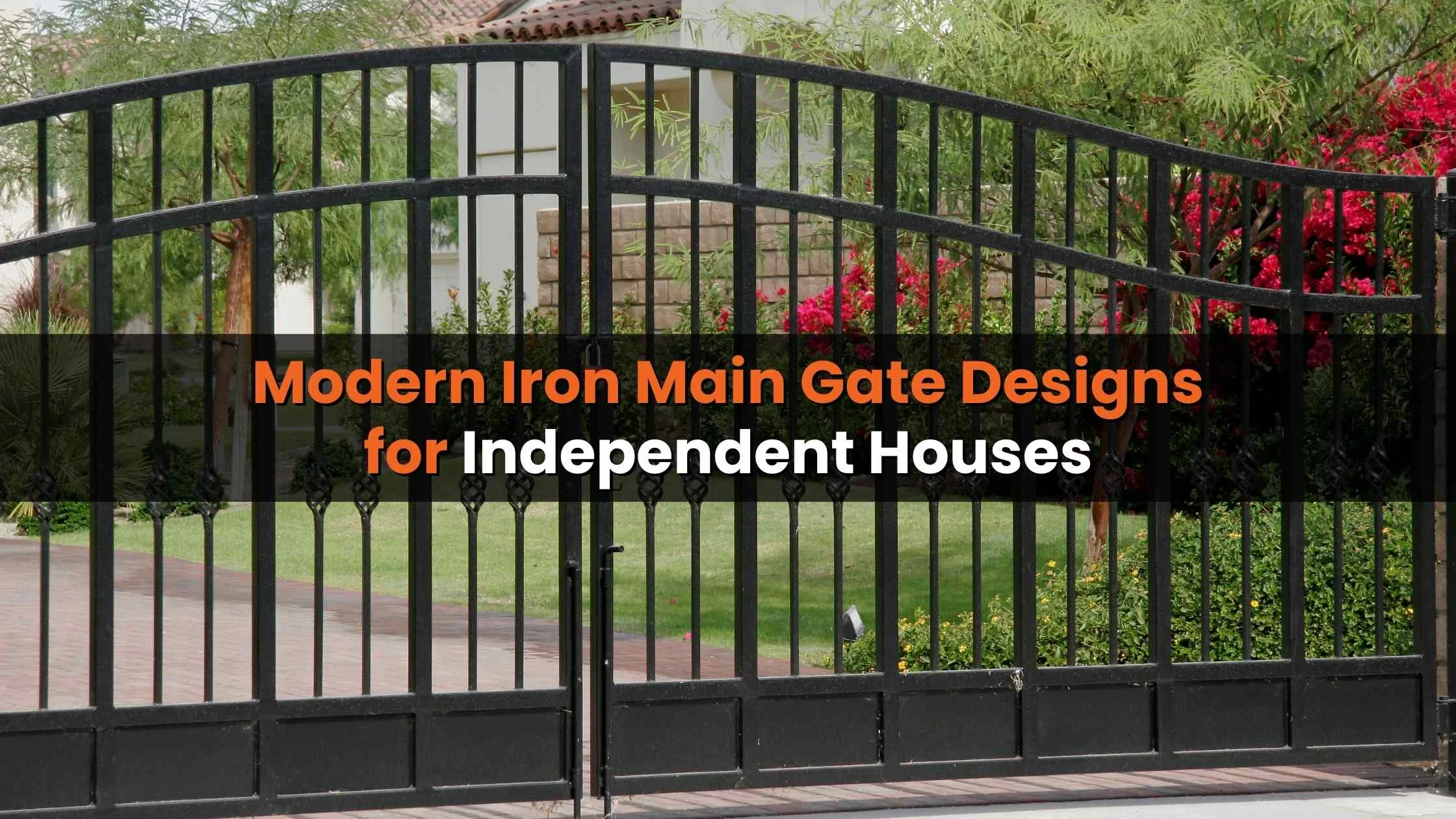
7. Double Swing Arched Gate
.webp)
Two panels that swing inward or outward, meeting at a central arch at the top. The arched silhouette adds a grand, classic quality to the entrance without requiring ornate detailing throughout.
Best for: Wide frontage independent houses, bungalows, farmhouses
Iron Gate Design Comparison Style vs Function
|
Gate Design |
Best Architectural Style |
Approx. Cost (10×4 ft) |
Maintenance |
|
Minimalist Flat Panel |
Modern / Contemporary |
₹18,000–₹28,000 |
Low |
|
Geometric Pattern |
Modern / Designer |
₹22,000–₹35,000 |
Low |
|
Laser Cut Designer |
Premium / Any |
₹35,000–₹65,000 |
Low–Medium |
|
Vertical Bar with Top |
Traditional / Transitional |
₹15,000–₹25,000 |
Low |
|
Combination Frame + Infill |
Upscale / Villa |
₹40,000–₹80,000 |
Medium |
|
Sliding Iron Gate |
Any |
₹25,000–₹50,000 |
Medium |
|
Double Swing Arched |
Classic / Bungalow |
₹30,000–₹55,000 |
Low–Medium |
Costs are indicative for standard sizes in Tier 1 Indian cities. Final pricing depends on gauge thickness, finish type, and fabrication complexity.
Also Read: Sliding Gate Design: Enhancing Security and Style
What to Look for When Choosing an Iron Gate
Match the Gate to Your Architecture
A laser-cut floral gate looks out of place on a stark modern house. A flat panel minimalist gate looks underdressed in front of a traditional bungalow. The gate should feel like it belongs to the house, not like it was chosen from a catalogue without context.
Gauge Thickness Matters More Than You Think
- 16-gauge MS: Light, suitable for pedestrian gates and smaller openings
- 14-gauge MS: Standard residential gate, good balance of weight and cost
- 12-gauge MS: Heavy-duty, recommended for wide driveway gates and high-security requirements
Thicker gauge means higher material cost but also significantly longer life and better resistance to bending or forced entry.
Finish Options and Their Trade-offs
- Enamel paint: Most common, lowest cost, requires repainting every two to three years
- Powder coating: More durable than paint, resists chips and rust, increases gate costs by ₹3,000 to ₹8,000
- Epoxy primer plus topcoat: Provides optimal rust protection for coastal regions with high humidity
- Galvanised finish: Provides maximum rust protection together with an industrial appearance which matches modern design requirements
Automation Compatibility
Let your fabricator know at the point of design whether you want to have your gate motorised either now or at a future date. Swing gates should have hinges that are compatible with a motor and will need a power point located close to the gate. Sliding gates should have a track, a rake gear, and have enough wall space for the panel to slide to the rear when opened.
How Much Does a Modern Iron Main Gate Cost in India?
Costs vary based on size, gauge, design complexity, and city. Here is a general range for 2026:
- Simple MS vertical bar gate (10×4 ft): ₹15,000–₹25,000
- Geometric or designer gate (10×4 ft): ₹25,000–₹45,000
- Laser cut premium gate (10×4 ft): ₹40,000–₹70,000
- Sliding gate with motor (12 ft opening): ₹55,000–₹1,00,000
- Combination frame + wood/glass infill: ₹50,000–₹90,000
Labour for installation typically adds ₹3,000 to ₹8,000 depending on the gate weight and type of fitting required.
Final Word
A modern iron gate functions as both a protective as well as aesthetic component that influences public perception of your entire property. The proper selection of design elements and gauge measurements and finishing techniques results in improved exterior attractiveness and permanent value enhancement for your independent house.
The best approach is to shortlist two or three designs that suit your architecture, compare fabricators on gauge thickness and finish quality rather than just price and invest in powder coating from the start. A properly constructed and expertly finished gate will provide you with reliable service for 20 years or more.


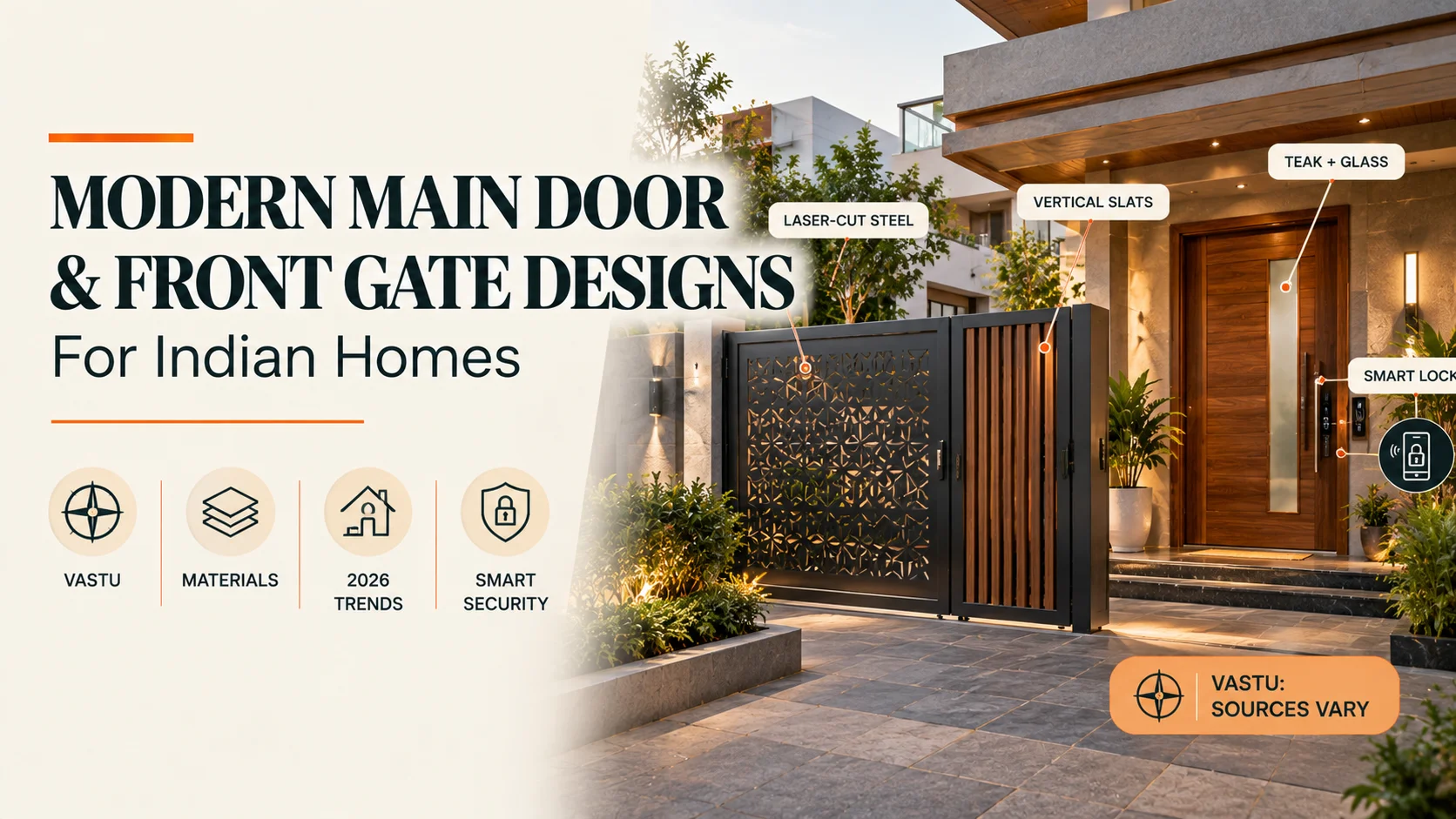


Ans 1. The best iron gate design depends entirely on your home's architectural style. For modern and contemporary homes, minimalist flat panel or geometric pattern gates work best. For traditional bungalows and independent houses, vertical bar gates with decorative tops or double swing arched gates are the most popular choice. If privacy is a priority, a combination frame gate with wood or glass infill panels is worth considering. There is no single best design, the right one is the one that looks like it was built for your specific home.
Ans 2. MS stands for mild steel, which is the most commonly used material for residential gates in India today. It is machine-fabricated, relatively affordable, and easy to customise. Wrought iron is a traditional material that is hand-forged, heavier, more intricate in detailing, and significantly more expensive.
Ans 3. A standard MS vertical bar main gate measuring 10×4 ft costs between ₹15,000 and ₹25,000 including basic enamel finish. Geometric or designer pattern gates of the same size run ₹25,000 to ₹45,000.
Ans 4. For standard residential main gates, 14-gauge MS is the recommended choice, it provides a good balance between weight, cost, and structural strength. If the gate opening is wider than 12 feet or if security is a primary concern, 12-gauge MS is more appropriate
Ans 5. Powder coating is significantly more durable than standard enamel paint for iron gates. It bonds to the metal surface chemically, resists chipping, and holds up much better against rain, humidity, and UV exposure.
Ans 6. A properly fabricated iron gate using 14-gauge or 12-gauge MS, finished with powder coating or epoxy primer, typically lasts 20 to 30 years with basic maintenance.
Ans 7. Both have specific use cases. Swing gates suit wider frontages where there is sufficient driveway depth for the panels to open inward or outward without blocking traffic. Sliding gates are better for plots with limited depth, narrow road margins, or corner plots where a swing gate would open into the street.
Ans 8. Matte black is the single most popular colour for modern iron gates in India and works across almost every architectural style. Charcoal grey is a close second and tends to look slightly softer against light-coloured facades.
Ans 9. Iron gate maintenance is straightforward if done regularly. Inspect the gate twice a year for rust spots, paint chips, or exposed metal. Sand down any rust patches immediately and apply a rust converter before repainting. Keep hinges and bolts lubricated with a light machine oil every six months.
Ans 10. Standard sizing for a residential main gate in India depends on whether it is a driveway gate or a pedestrian gate. For a single car driveway, a 10 to 12 foot wide gate is the minimum comfortable width. For a two-car driveway or if you own an SUV, 14 to 16 feet is recommended. Pedestrian side gates are typically 3 to 4 feet wide.