
✦ AI Summary
Table of Content
▲- What is changing in West Bengal’s land-record system?
- What are the 16 broad land categories?
- Why is the new classification important for land buyers?
- What will remain unchanged?
- How can buyers check West Bengal land records online?
- Can the new category establish ownership or allow land conversion?
- What happens next?
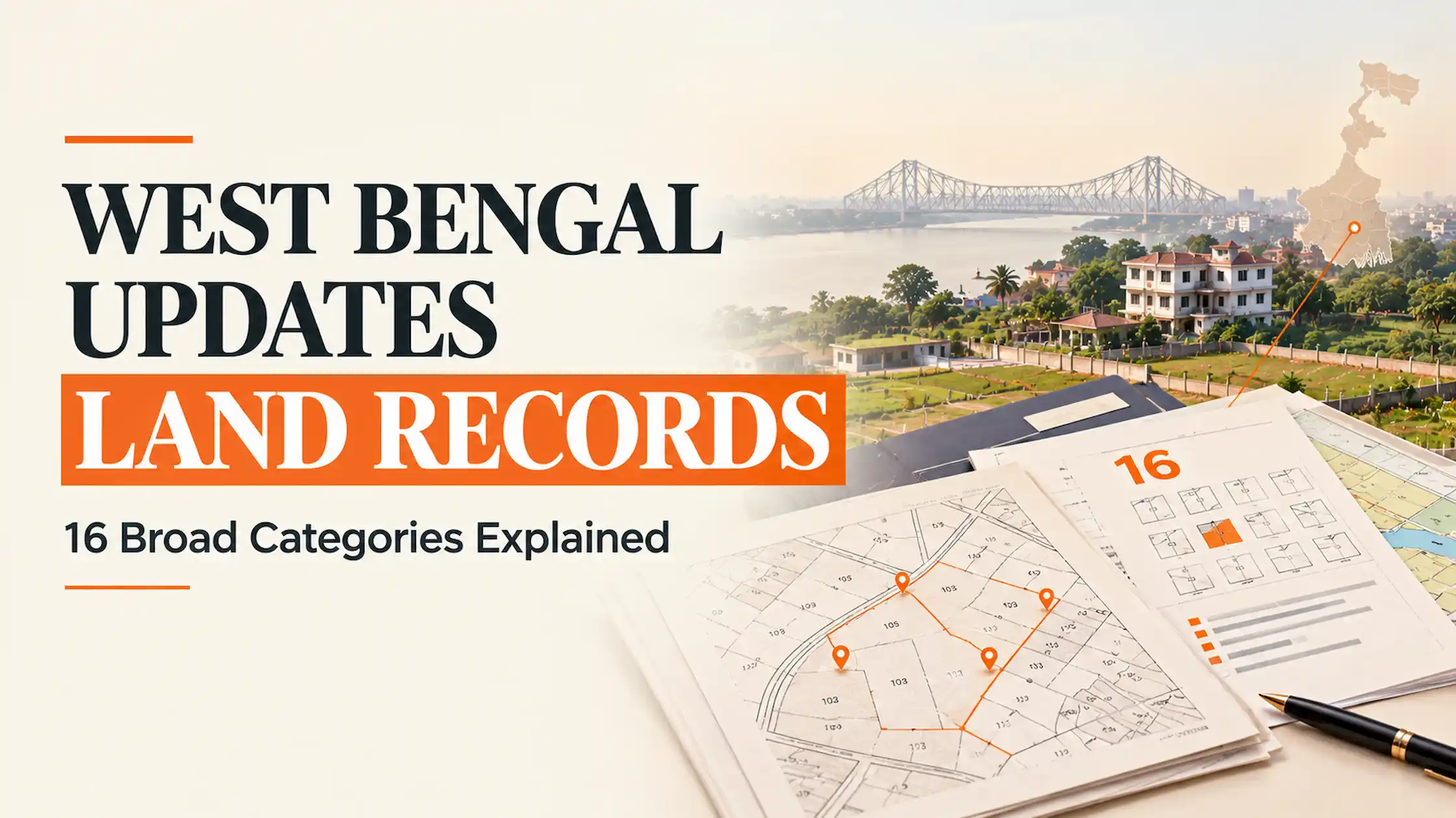
West Bengal is planning changes to how land classifications appear in its digitised land records, with 16 broad categories and a new “Supra Category” column in the Record of Rights (RoR). The proposed system is intended to make plot information easier to interpret for buyers, landowners, officials and businesses. The existing classification will remain unchanged, and the new category will not, by itself, alter ownership or permit a change in land use.
What is changing in West Bengal’s land-record system?
The Directorate of Land Records & Surveys and the Joint Land Reforms Commissioner have outlined a framework to group existing plot classifications under 16 broader categories. The changes are set out in a recent circular reported by The Times of India on October 26, 2026.
West Bengal’s land records contain traditional classifications used to describe the nature of a plot. These entries can be difficult for people unfamiliar with local land terminology to interpret, particularly when they are checking a property before purchase or reviewing records for a proposed development.
Under the proposed arrangement, the existing classification in the RoR will continue to appear. A separate column, called “Supra Category”, will identify the broader category to which the plot belongs. The state’s computerised land database and e-Bhuchitra software are expected to be modified to accommodate the framework.
The distinction matters because the change concerns how land information is organised and displayed. It is not, on its own, a new ownership document or permission to use a plot for a different purpose.
What are the 16 broad land categories?
The reported framework groups existing land classifications into the following categories:
|
No. |
Broad category |
Examples or general meaning |
|
1 |
Industrial |
Factories, rice mills, cold storage facilities and industrial parks |
|
2 |
Commercial |
Land classified for commercial activity |
|
3 |
Agricultural |
Agricultural plots, including traditional classifications such as Shali, Shuna, Danga, Aus and Aman |
|
4 |
Agri-allied |
Land associated with allied agricultural activities |
|
5 |
Water body |
Ponds, lakes, canals and wetlands |
|
6 |
Public utility |
Roads, bridges, parks, bus stands and public facilities |
|
7 |
Institutional |
Schools, colleges, hospitals, libraries, railway stations and similar facilities |
|
8 |
Orchard |
Land classified as orchard |
|
9 |
Religious |
Land associated with religious use |
|
10 |
Residential |
Bastu land, houses, buildings, townships and housing complexes |
|
11 |
Forest |
Land classified as forest |
|
12 |
River |
Land recorded under the river category |
|
13 |
Fallow land |
Land classified as fallow |
|
14 |
Ground/field |
Land recorded as ground or field |
|
15 |
Tea plantation |
Land classified as tea plantation |
|
16 |
Others |
Classifications not covered by the other broad categories |
The examples above reflect the descriptions in the published reporting. The exact treatment of an individual plot will depend on its existing land-record entry and the applicable classification rules.
Why is the new classification important for land buyers?
For someone considering a plot in West Bengal, understanding the recorded classification is an important part of property due diligence. The broad category may help buyers identify whether a parcel is recorded as agricultural, residential, industrial, commercial or another type of land.
The new column is intended to make this information easier to read. It could also help officials and businesses interpret land records more consistently, particularly when reviewing parcels for proposed industrial or real-estate development. The reform has been linked in reporting to the state’s wider efforts to support industrial growth and improve land administration.
However, buyers should not treat the broad category as a final decision on whether a plot can be developed. A parcel classified under a particular heading may still be subject to planning restrictions, conversion requirements, environmental rules or other legal conditions.
For example, a plot appearing under the agricultural category does not automatically become suitable for a housing project simply because its broad classification is now easier to identify. The buyer must check the applicable land-use rules and obtain any required permissions.
What will remain unchanged?
The reported framework is designed to add a broader category to the existing Record of Rights rather than replace the underlying classification. The plot’s recorded ownership, area and land-use rights will not change merely because the new column is introduced.
This distinction is important because land classification and ownership are separate questions. The RoR provides information recorded by the revenue authorities, but a buyer still needs to examine the documents establishing how the property was transferred and whether the seller has a valid title.
Before completing a transaction, buyers should review the sale deed and title history, compare the plot details with the land records, check for relevant restrictions and verify whether the proposed use is permitted.
A useful starting point is the AquireAcres guide to property title verification in India, which covers ownership history, land records, encumbrances and other checks.
How can buyers check West Bengal land records online?
West Bengal’s official Banglarbhumi portal provides access to land-record services, including plot information and Record of Rights details. The state also uses the e-Bhuchitra system for land-record administration.
Buyers can use the existing online services as part of their preliminary checks:
- Visit the official Banglarbhumi website.
- Identify the relevant district, block and mouza.
- Search using the available plot or khatian details.
- Review the recorded land classification, area and holder information.
- Compare the record with the seller’s documents and seek clarification from the relevant land-record office if details do not match.
The steps above describe existing record-checking practices. It has not been independently confirmed that the new Supra Category column is already visible to the public on the portal. Buyers should check the latest portal information or contact the relevant office before relying on the new feature.
For a more detailed walkthrough, see AquireAcres’ guide to checking land records and khatian status on Banglarbhumi.
Can the new category establish ownership or allow land conversion?
No. The additional category is intended to make the recorded classification easier to understand. It does not replace the legal documents needed to establish ownership, and it does not independently authorise a change in land use.
Buyers should keep three checks separate:
- Land classification: What type of land is recorded in the revenue records?
- Ownership and title: Does the seller have a valid, traceable legal title to the property?
- Permitted use: Can the plot legally be used for the intended purpose under the applicable rules and permissions?
These checks answer different questions. A clearer classification may help with the first, but it does not remove the need to complete the other two.
Where a buyer intends to use agricultural land for residential or commercial development, the applicable conversion process and planning permissions must be verified separately. AquireAcres’ article on conversion of agricultural land to residential use provides broader background on the subject.
What happens next?
The reported framework requires changes to West Bengal’s computerised land database and e-Bhuchitra software. The circular also allows district-level land-record authorities, including district land and land reforms officers, to propose corrections, additions or deletions to the classification framework.
The next practical step is to establish when the changes become operational and how the new column will appear in individual land records. The original circular’s reference number, implementation schedule and public rollout status could not be independently confirmed from the available sources.
Until those details are clear, buyers should continue to rely on the existing official land records and supporting legal documents, rather than assuming the new classification feature is already available for every plot.
The proposed change aims to make land records easier to interpret. Its usefulness for buyers will ultimately depend on how consistently the new categories are applied and how clearly the updated information is made available.





Ans 1. The state plans to group existing plot classifications into 16 broad categories and add a separate Supra Category column to the Record of Rights.
Ans 2. They are industrial, commercial, agricultural, agri-allied, water body, public utility, institutional, orchard, religious, residential, forest, river, fallow land, ground/field, tea plantation and others.
Ans 3. No. The reported framework is intended to make classifications easier to interpret. Adding a broad category will not, by itself, change ownership or the recorded plot area.
Ans 4. Not automatically. Buyers and developers must check the applicable land-use rules and obtain any required conversion approvals and permissions.
Ans 5. The existing Banglarbhumi portal provides land-record services, but the public rollout of the new Supra Category column has not been independently confirmed. Buyers should check the portal or contact the relevant land-record office for the latest status.