
✦ AI Summary
Table of Content
▲
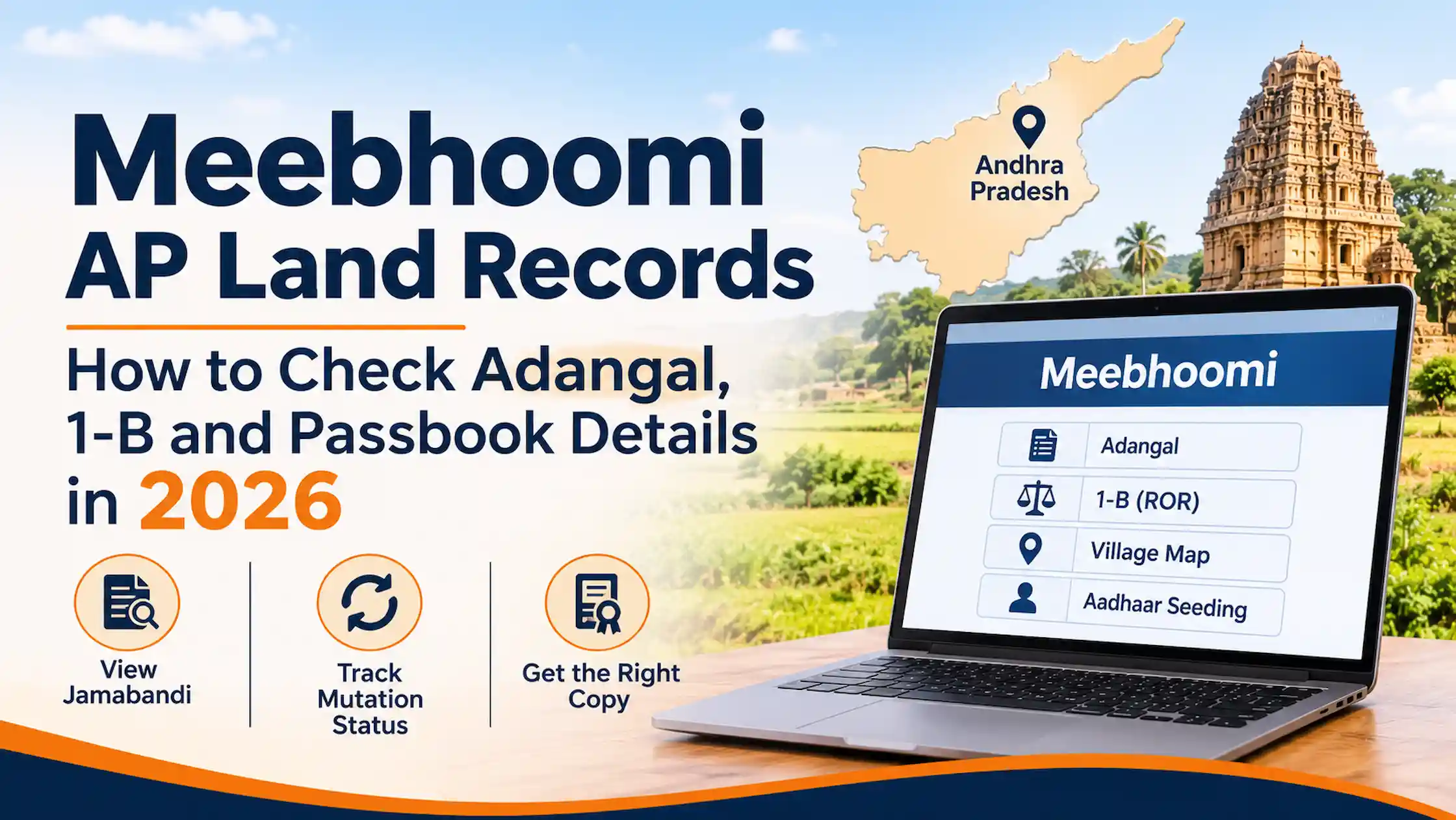
Meebhoomi is the Andhra Pradesh Revenue Department’s free portal for viewing land records online. Anyone can look up land details in the state through it, including ownership. You can check the Adangal, ROR-1B, village maps and Aadhaar-seeding status at meebhoomi.ap.gov.in without visiting a tahsildar’s office. But checking a record is only the first step. Since the state began its resurvey, the survey number on a seller’s papers may no longer match what the portal shows, so buyers need to read these records more carefully than before.
What Meebhoomi AP land records actually are
Launched in June 2015, Meebhoomi (“your land” in Telugu) is the public face of Webland, the land records system run with the National Informatics Centre (NIC). Webland runs the records and e-passbooks, and Meebhoomi shows them to the public. Webland is where officials update records, sign them digitally and process mutations. Meebhoomi is where citizens read the result. NIC’s own material reports more than 15 crore ownership verifications through the portal. Anyone can search; you don’t need to be the owner.
Adangal vs 1-B: which record answers which question?
The Adangal describes the land and who is cultivating it. The ROR-1B describes the owner’s account. Both matter, and they answer different questions.
|
Record |
Organised by |
What it shows |
Use it to |
|
Adangal (Pahani) |
Survey number |
Extent, land class, crop, cultivator |
Check the land and who is in possession |
|
ROR-1B |
Khata (account) number |
Pattadar and every survey number on the account |
See what the seller holds in total |
|
FMB / village map |
Survey number or village |
Boundaries and dimensions |
Match the plot on the ground to the paper |
|
e-Passbook |
Pattadar |
Digital version of the passbook |
Compare with the passbook the seller shows |
One practical habit: if the Adangal names a cultivator who isn’t the pattadar on the 1-B, ask why before any money changes hands. There may be an innocent tenancy. There may not.
How to check Meebhoomi AP land records online
- Open meebhoomi.ap.gov.in and choose Adangal or 1-B from the menu.
- Pick your search route: survey number, account (khata) number or Aadhaar number.
- Select the district, mandal and village.
- Enter the number and the captcha, then submit.
- View the record on screen or download it.
Start with the survey number. Your sale deed describes the land that way, so it’s the easiest cross-check. If you search by name, confirm the result against the survey number, because name spellings vary between records. Menu labels change from time to time, so treat these steps as the general path rather than a screen-by-screen script.
Aadhaar linking deserves attention. The portal has a self-seeding option, and new passbooks are issued only after e-KYC, so an unlinked account can hold you up. Never share an Aadhaar OTP with anyone who offers to “fix” your record for a fee.
Is a free download enough for a bank loan?
Usually not. Treat the free download as a working reference. Lenders may accept an online extract for preliminary checks but ask for a certified copy before disbursal. Certified ROR-1B and Adangal are issued through MeeSeva centres. The fee is nominal, but guides quote different amounts, so check MeeSeva’s current tariff instead of relying on a blog. Order the certified pair close to your application date so the extract is recent.
What changed in 2026: resurvey and new passbooks
Under the Mee Bhoomi–Mee Hakku programme, the state is resurveying villages and issuing new pattadar passbooks with the state emblem and a QR code. They are handed out after a gram sabha, at no cost to the farmer.
On 9 September 2026, Chief Minister N. Chandrababu Naidu said the survey was complete in 8,234 villages, with 36 lakh passbooks issued and a target of 56 lakh across 8,582 villages by March. In August he had cited a larger target of 68.64 lakh passbooks across 9,365 villages. Official targets have shifted, so check your own village’s status rather than quoting a statewide figure. The government also says the passbooks use blockchain; we couldn’t find independent technical confirmation of that.
What this means for you: in a resurveyed village, extents and parcel numbers can change. A hypothetical example: a seller offers 10 cents, but the resurveyed record shows 8 cents. At 435.6 sq ft per cent, that’s a gap of 871.2 sq ft. Either the seller gets the record corrected before the sale, or the price should reflect 8 cents. Make sure your deed, the 1-B, the Adangal and the map all describe the same parcel.
What happens to the record after you buy?
For registered sales, mutation is now largely automatic. NIC says it is triggered instantly once registration is complete. The Chief Minister says 100 per cent auto-mutation is in place for sales, gifts and partitions, and villages move to Webland 2.0 only after 80 per cent e-KYC. Succession and backlog cases go through a MeeSeva mutation application. After registration, look up the 1-B and Adangal to confirm your name appears. If it doesn’t, go to the tahsildar with your registered deed. For more details on the process, see property mutation (Dakhil Kharij), including documents, fees and online steps.
What Meebhoomi can’t tell you
A revenue entry is not a title. It shows who the government’s records say holds or cultivates the land, so it should never be your only verification. Three more checks belong alongside it:
- Encumbrances. Search the Registration Department’s portal, registration.ap.gov.in, which has digitised records available since 1983.
- Section 22A. This bars registration of certain categories, such as assigned and endowment lands. Five categories were delisted in January 2026, and further orders in July moved more lands off the list; the Inspector General of Registration and Stamps must maintain a single centralised database. Check it on the day you register.
- Old legal advice. The AP Land Titling Act, 2022 was repealed; the Governor assented on 31 July 2024. Ignore guidance built on it.
Before completing a purchase, buyers can also use this property title verification checklist to review ownership documents and other checks that go beyond the revenue entry.
If your record has an error
Corrections are requested from the concerned authorities with supporting proof. Keep your registered deed, older Adangals and the earlier passbook. Take them to the village revenue officer or tahsildar, and ask for the grievance to be logged in writing.
The bottom line
Use Meebhoomi to read the land, not to certify it. Pull the Adangal and 1-B by survey number, compare them with the deed and the map, get certified copies for lenders, and check encumbrances and the 22A list separately. In a resurveyed village, verify the extent on the ground before you pay.




Ans 1. It is the Andhra Pradesh Revenue Department’s online land records portal. It lets you view the Adangal, ROR-1B, maps and passbook details.
Ans 2. Viewing records is free. The state has said land records on the portal are available without a fee. Certified copies through MeeSeva carry a small charge.
Ans 3. The Adangal records land use and crop details. The RoR-1B records title and the rights held in the land.
Ans 4. Yes. Survey number, account number and Aadhaar number are the common search options, as listed in the guides above.
Ans 5. It’s a reference. Lenders often want a certified copy from MeeSeva before final disbursal.
Ans 6. For registered sales, mutation is meant to be automatic. For inheritance or backlog cases, you apply through MeeSeva. Always check your 1-B afterwards.
Ans 7. Raise a grievance with the tahsildar’s office, backed by your registered deed, older Adangals and passbook.