
✦ AI Summary
Table of Content
▲
Most guides to decorating around a mounted TV are written for American homes, and it shows the moment they get to mounting technique "find a stud" is standard US advice for a wall made of wood framing and drywall. Indian homes are built differently, almost entirely solid brick or concrete, which means the actual mounting requirement is different too, and it's worth getting right before any styling decision matters.
Get the Mounting Right First
Mount the TV so its centre sits roughly at eye level when seated commonly cited as 40-42 inches from the floor for a standard sofa height. Mounted higher than this, the TV forces a slight upward tilt of the neck during long viewing sessions, a genuinely common and avoidable discomfort.
On the technical side, Indian walls need a different approach than the US "hit the studs" advice repeated across most English-language guides. A solid brick or concrete wall needs a mount and anchors rated for at least 1.5 times the combined weight of the TV and bracket, installed with a masonry drill bit and proper wall plugs, not a stud finder, which is largely irrelevant here. If you're unsure about your wall's construction or the mount's weight rating, this is genuinely worth having a professional handle, since a failed mount is a real safety risk, not just an inconvenience.
Hiding Cables in an Indian Home What Actually Works
Every serious guide to TV wall decor agrees on one point: visible cables undo an otherwise well-styled wall more than almost any other mistake. The practical options differ by how much you're willing to commit to.
Surface-mounted cord covers or raceways are the realistic default for most Indian homes' paintable channels that run down the wall from the TV to a socket or console below, concealing the cable bundle without any construction work. These can be matched to your wall colour for a nearly invisible finish.
In-wall conduit gives a completely hidden result, but only works if it's planned before the wall is plastered, since retrofitting a channel into an already-finished solid wall means real construction work, not a weekend project. If you're building or renovating and know a TV wall is coming, this is worth planning with your contractor at that stage rather than trying to add later.
Whichever option you choose, route the TV's power cable separately from any other low-voltage cabling where possible, and keep the console or media unit positioned to catch the cable run rather than leaving it exposed for the final stretch to the floor.
Styling the Shelves Without Overcrowding
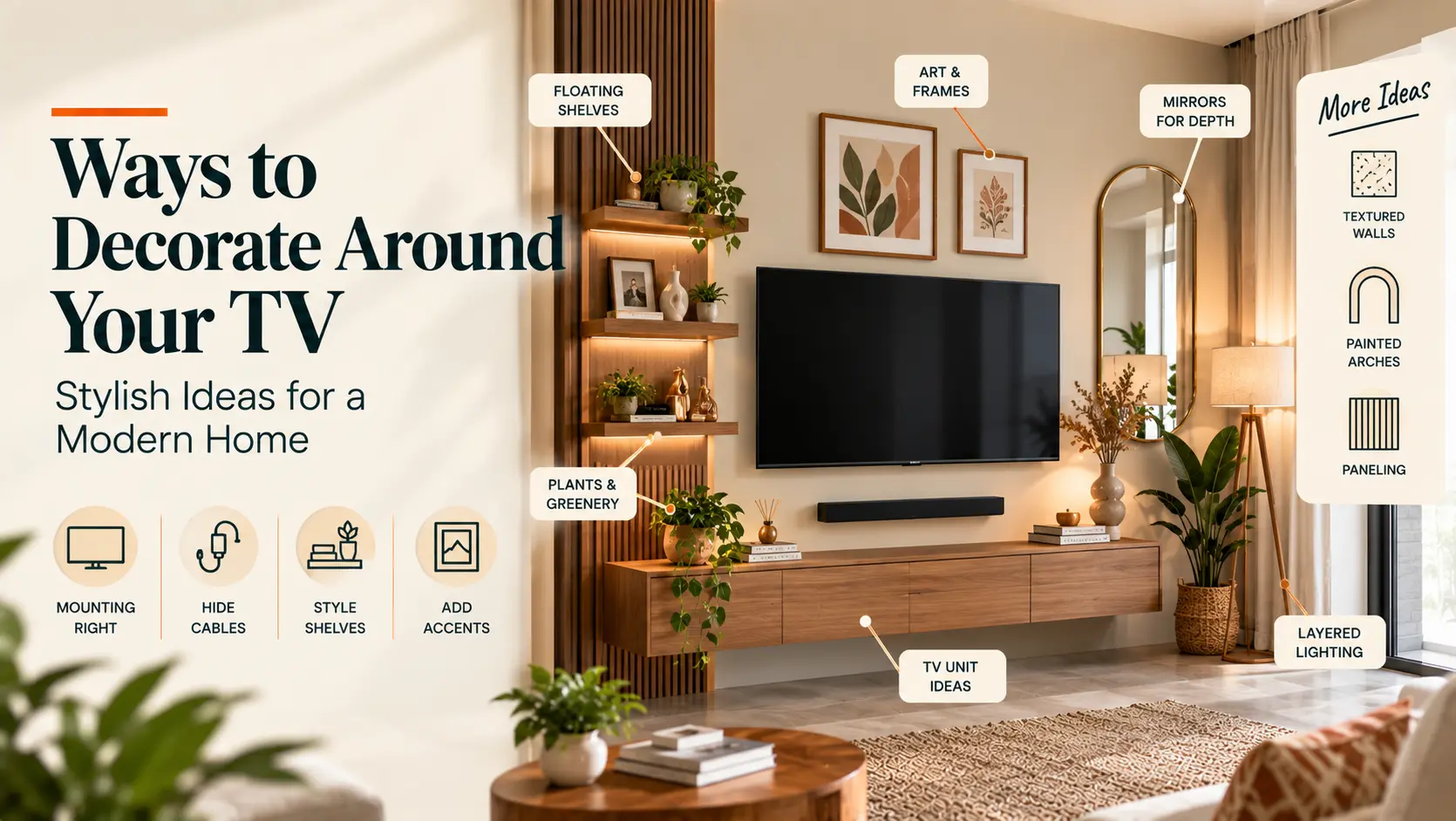
If you're adding floating shelves on either side of the TV, the reliable rule across multiple design sources is consistent: three to five objects per shelf, at most, mixing a plant, a couple of books, and one taller decorative object for height variation. Leaving genuine empty space on the shelf is part of the design, not a gap to fill overcrowded shelves read as clutter rather than curated decor, which is the single most common mistake once cable management is handled correctly.
Mounting the shelves a consistent distance from either edge of the TV, roughly equal on both sides, gives the wall a deliberate, balanced look rather than an asymmetric, accidental one.
Beyond Shelves: Other Ways to Frame the TV
Floating shelves aren't the only option. A mixed arrangement of mirrors of different shapes and frame finishes grouped around, not directly behind, the TV adds light and a collected-over-time feel, and connects naturally with the placement guidance in our dedicated mirror wall decor guide. A textured wall treatment, a painted arch, panelling, or a subtly different finish confined to the TV's immediate area, visually integrates the screen into the wall rather than leaving it looking bolted onto a plain surface, an approach worth pairing with the accent-wall guidance in our current accent wall ideas guide.
Whatever direction you choose, test the layout with painter's tape or paper templates before drilling anything permanently, the same low-risk approach worth using for a gallery wall, and just as valuable here, since a mounting mistake on a solid Indian wall is considerably harder to patch invisibly than one on drywall.
If you prefer a more functional approach, explore these modern TV unit designs for living rooms that combine storage, cable management and visual appeal.








Ans 1. Aim for the TV's centre at roughly eye level when seated commonly 40-42 inches from the floor for a standard sofa. Mounting it higher forces an uncomfortable upward neck tilt during longer viewing.
Ans 2. No Indian walls are typically solid brick or concrete, not the wood-stud construction most US guides describe. You need a mount and anchors rated for at least 1.5 times the combined weight, installed with a masonry drill bit and proper wall plugs.
Ans 3. Surface-mounted cord covers or raceways, paintable channels that run down the wall, are the practical default for most Indian homes and conceal cables without any construction work.
Ans 4. Yes, but only if planned before the wall is plastered. Retrofitting in-wall conduit into an already-finished solid wall means real construction work, so this is best planned with a contractor during a build or renovation.
Ans 5. Three to five per shelf is the reliable guideline, mixing a plant, books, and one taller object for height variation. Leave genuine empty space rather than filling every inch.
Ans 6. Yes mock up shelf and decor placement with painter's tape or paper templates first. A mounting mistake on a solid Indian wall is considerably harder to patch invisibly than on a US-style drywall panel.
Ans 7. A mixed arrangement of mirrors in different shapes and finishes grouped around the TV, or a textured wall treatment confined to the TV's immediate area, both work well as alternatives to shelving.