
✦ AI Summary
Table of Content
▲
Most Indian living rooms still treat the wall behind the sofa as an afterthought: a neutral finish, two framed prints, a sconce on either side. That formula has genuinely aged. The living room now carries more weight than it did a decade ago; it's where work calls happen on weekends, where children study, where the family eats, and where guests are received, and the accent wall has evolved accordingly, from a simple contrasting paint colour into a genuine design element built with texture, depth, and personality.
This guide covers what's actually current for 2026, honestly names what's already dated so you don't repeat a decorating mistake that will look tired within a year or two, gives a real, India-specific material cost comparison, and covers Vastu-conscious colour options for readers who want that consideration factored in.
Which Wall Should Actually Be Your Accent Wall?
Before any material or colour decision, get this right: the wall behind your main sofa is the default, correct anchor choice, since it carries the room's "first read," the first thing a guest's eye lands on when they walk in.
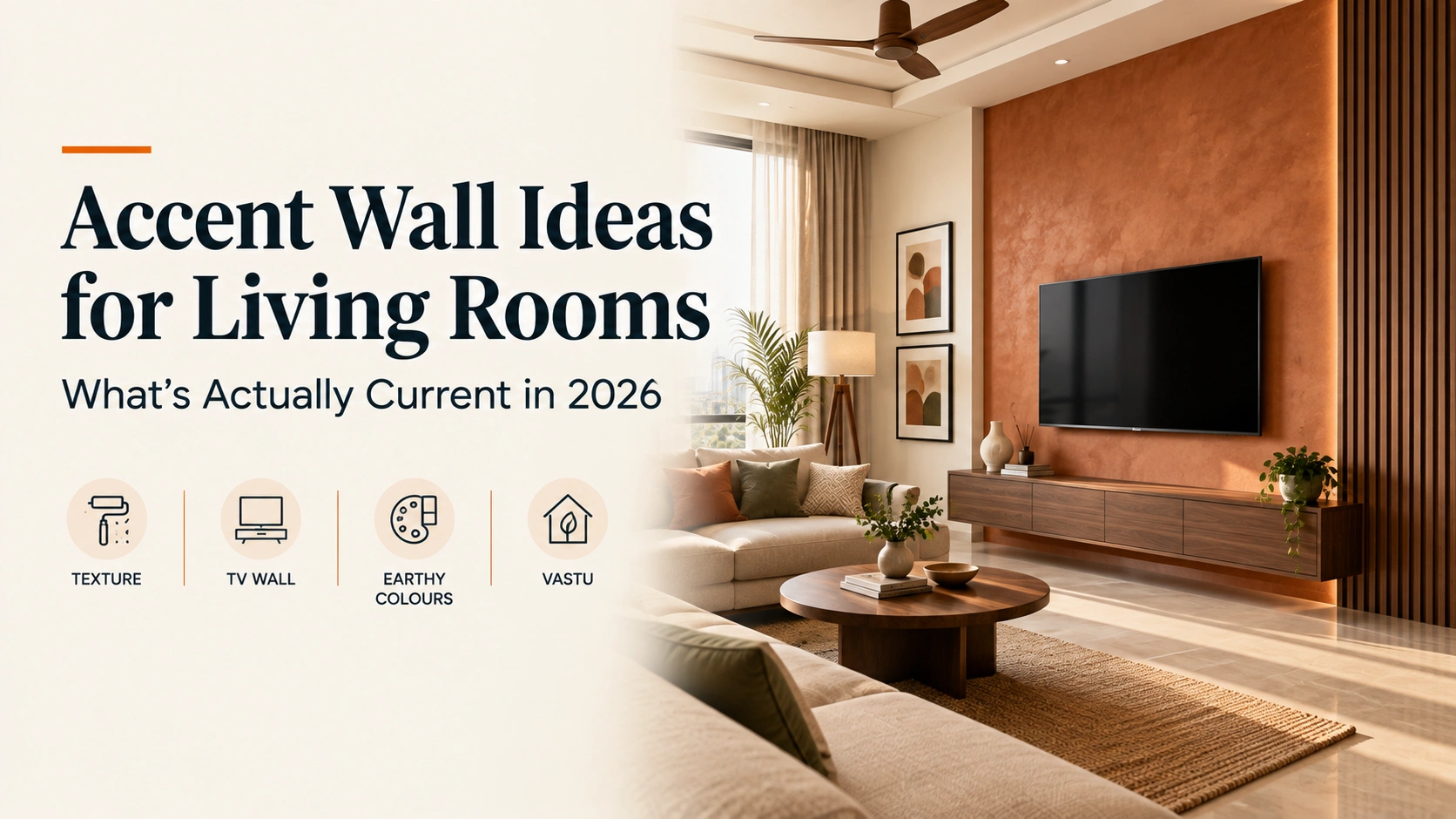
One genuinely practical rule that most idea lists skip: avoid putting a busy pattern, mural, or heavily textured design on a wall interrupted by a TV unit. The screen will visually compete with the composition, and neither wins. If your TV wall is also your most prominent wall, choose a calmer treatment there (a solid colour, a subtle texture, or wood slat panelling, covered below) and reserve a bolder pattern or mural for the sofa-facing wall instead, if your layout allows for a distinct treatment on each.
What's Genuinely Current in 2026
Textured Finishes: Limewash, Micro Cement, Fluted Panelling
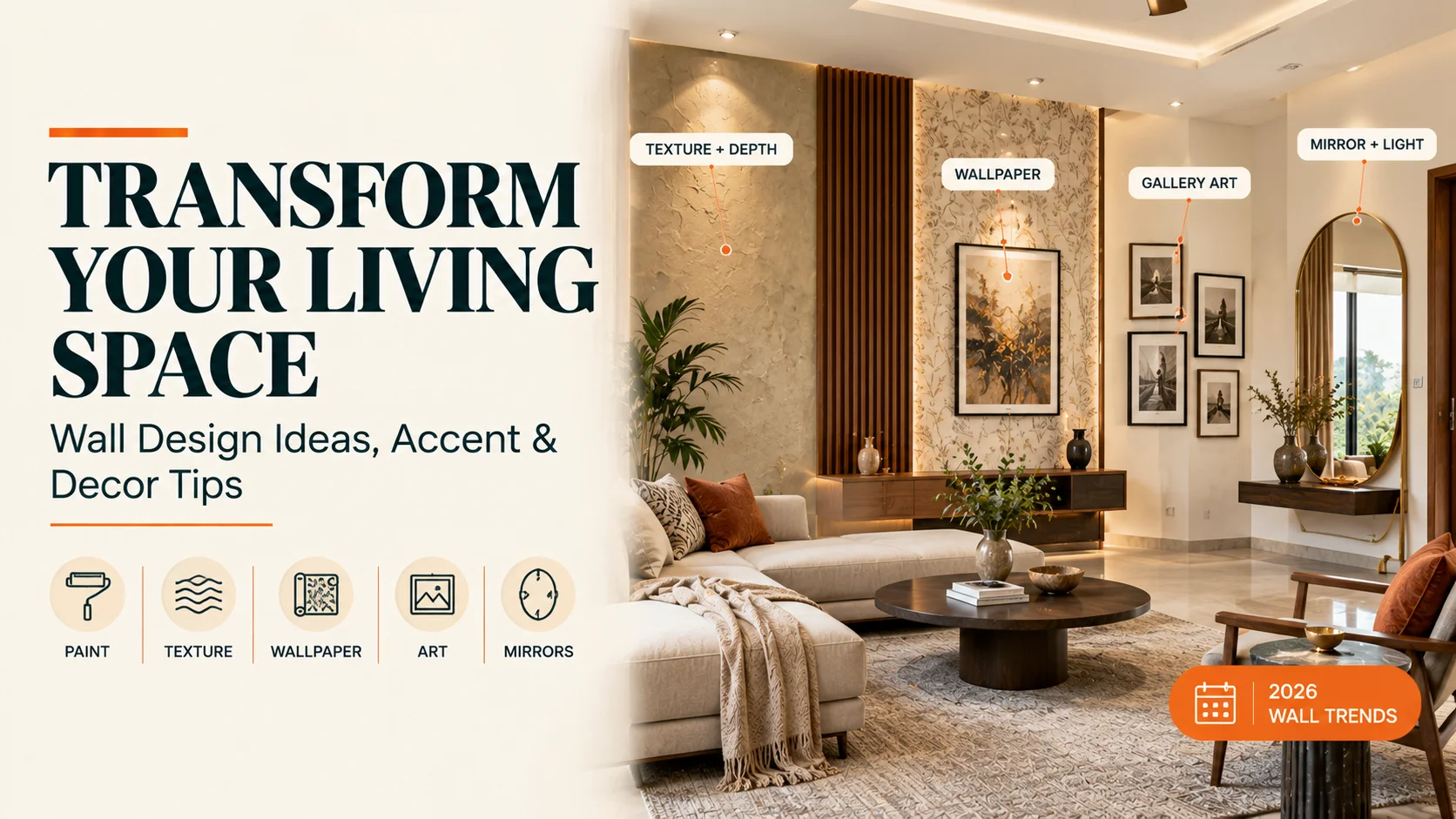
The flat, single-colour accent wall of the 2010s has genuinely evolved. Textured finishes, limewash plaster, micro cement, and fluted panelling are considerably more prominent in 2026 than a flat painted wall alone. Limewash specifically offers a strong visual impact relative to its cost, a soft, cloud-like variation in tone that a flat paint colour simply can't replicate, and pairs naturally with the warm, earthy colour palette covered below. For more ideas using wall treatments in Indian homes, explore these PVC wall panel designs for living rooms.
Wood Slat Panelling Behind the TV
This has become the default modern accent wall treatment specifically for the wall behind a TV or media console, and for good practical reasons: it adds genuine texture and depth, visually frames the screen rather than competing with it, and conveniently hides wiring that would otherwise run visibly across a flat painted wall. Walnut and other warm, deeper wood tones are currently favoured over the lighter natural oak that was more dominant a couple of years ago. This treatment also improves room acoustics slightly by reducing echo, a genuine, functional side benefit beyond the visual appeal. If the TV wall is also your main storage and entertainment zone, these modern TV unit designs for living rooms offer practical ways to combine the wall treatment with storage.
Earthy, Nature-Inspired Colours
Indian interior colour trends for 2026 have moved decisively toward warmth and nature-inspired depth, away from the cool greys that dominated Indian homes for years. Deep emerald green has shifted from an occasional accent to something closer to a base living-room colour, forest, jungle, and palm-toned greens now anchor entire rooms the way a quiet beige once did. Warm terracotta and dusty sienna, evoking sun-baked earth tones, bring a grounded, cosy warmth well-suited to smaller urban living rooms without overwhelming the space. More broadly, warm off-whites are now generally preferred over stark pure white, and medium-light tones are favoured over very dark ones, a preference shaped partly by how these colours read under India's typically brighter natural light compared to cooler Western climates.
Heritage-Inspired Wallpaper Murals
A genuinely distinctive, India-specific trend worth highlighting: wallpaper murals reinterpreting traditional Indian motifs, heritage carpet and dhurrie compositions translated to a vertical, wall-scale format, and tropical, botanical scenes drawing on Kerala and South Indian landscapes are replacing the safer, more generic damask-in-grey or small-floral-in-beige patterns that dominated the previous decade. These treatments work best on the sofa-facing wall specifically, where the composition has room to be appreciated as a genuine visual statement rather than being interrupted by furniture or, as noted above, a television screen.
What's Already Dated (Be Honest With Yourself Here)
This is worth stating plainly, since avoiding a soon-to-be-dated choice saves real money and disruption down the line:
- Metallic gold trowel and comb textures, once ubiquitous in Indian living rooms through the 2010s, now read clearly as belonging to that period.
- High-contrast sponging (a cream base with terracotta or teal blobs), a technique that isn't inherently flawed but whose specific colour contrast reads distinctly as a 1990s choice.
- Chalkboard paint walls, charming in concept but which typically show smudging and wear within months, ageing poorly and quickly.
- The full-wall single-motif decal (an oversized tree, a city skyline in vinyl), which tends to date faster and more visibly than a painted or textured wall would.
- Very narrow, high-contrast stripes (black and white in a tight repeat across a full wall), which read as a strong period signal and can be genuinely uncomfortable to look at across a room over time.
What holds up instead: flat colour blocking, panelling and battens picked out in paint, half-wall dado treatments, limewash, and tonal stripes (a subtler, same-hue-family variation rather than stark contrast), treatments that don't announce a specific decade the way the choices above now do.
Material and Cost Comparison for Indian Homes
|
Material |
Typical cost |
Best for |
|
Paint (flat colour, colour blocking, tonal stripes) |
The most budget-friendly option by a wide margin; a single wall typically costs a small fraction of any other treatment in materials alone |
Any budget, any commitment level, easiest to repaint if trends shift |
|
Peel-and-stick wallpaper |
Considerably cheaper than traditional wallpaper, and removes cleanly |
Renters, or anyone not ready to commit to a permanent choice |
|
Traditional wallpaper (standard to premium designer) |
A meaningfully wider range depending on pattern and brand, premium designer prints command a real premium over standard patterns |
A genuine statement wall, heritage or mural-style patterns specifically |
|
Wall panelling (MDF) |
Roughly ₹150-400 per sq ft |
Budget-friendly feature walls, bedrooms, and general decor makeovers |
|
Wall panelling (PVC, veneer, leatherette) |
Priced above MDF, varying by finish quality |
A step up in finish quality for a living room specifically, without reaching real-wood cost |
|
Wood slat panelling (real wood) |
The most expensive common accent wall material, particularly in solid wood |
A premium, TV-wall-compatible treatment where budget allows |
|
Stone cladding |
A premium-tier cost, typically reserved for a fireplace wall or a genuine statement installation |
Feature walls where a natural, textured, high-end look is the priority |
For homeowners considering textured treatments specifically, our guide to texture paint designs for halls offers additional design references.
As a general rule, paint remains the most flexible, lowest-risk choice for a first accent wall; wallpaper (particularly the heritage-mural style) delivers the strongest single statement for a moderate cost, and panelling or wood slats suit the TV-wall specifically, where a busy pattern isn't appropriate but a flat colour feels underwhelming.
Vastu-Conscious Colour Guidance
For readers who want this factored into their decision: Vastu Shastra colour guidance for living rooms generally favours shades that keep the space feeling bright, calm, and welcoming; white, cream, light yellow, pastel blue, beige, and light green are considered to work well across most room directions. Darker or more intense tones aren't necessarily prohibited outright, but the general guidance is to use them as smaller accents rather than covering a full wall, a genuinely compatible approach with the accent-wall concept itself, since an accent wall is, by definition, one wall rather than the whole room. If Vastu alignment matters to your decision, this gives you real room to incorporate current, richer colour trends (a deep green or terracotta accent wall, for instance) while keeping the room's overall palette on the lighter, calmer side the broader guidance favours.
Homeowners who want to explore Vastu-based colour choices in greater detail can also refer to our guide to Vastu-compliant colours for home walls.
Can You Do More Than One Accent Wall?
Yes, but only in specific configurations, and only when the two walls share a clear, intentional relationship rather than competing. Two situations where this genuinely works: adjacent walls in a corner arrangement (common around a corner fireplace, for instance), and opposite walls that visually frame the room rather than each trying to be the room's singular focal point. In either case, the two walls should use the same treatment or a clearly related one, two different bold, contrasting paint colours on opposite walls rarely reads well and tends to fragment the room's visual coherence rather than enhancing it.
DIY vs Professional Installation
Paint is the most genuinely DIY-friendly option for a confident amateur, provided you test a small patch before committing to the full wall, a step worth taking seriously given how differently a colour can read once it covers an entire surface versus a small swatch.
Peel-and-stick wallpaper is specifically designed for DIY application and removal, making it a low-risk way to test a bolder colour or pattern before committing to something more permanent; it's worth noting it may not adhere as well to a heavily textured wall and can be more prone to lifting in humid conditions, a genuine consideration in much of India's climate.
Traditional wallpaper, wall panelling, and stone cladding generally benefit from professional installation, both for a clean, properly aligned finish and, for panelling and cladding specifically, for correct wall preparation and mounting that a DIY attempt can more easily get wrong in ways that are expensive to correct afterward.






Ans 1. The wall behind your main sofa is the default, correct choice, since it carries the room's "first read" for anyone walking in. Avoid a busy pattern or mural on a wall interrupted by a TV unit, since the screen will visually compete with the design.
Ans 2. Textured finishes (limewash, micro cement, fluted panelling), wood slat panelling behind TV units, earthy nature-inspired colours (deep emerald green, terracotta), and heritage-inspired wallpaper murals reinterpreting traditional Indian motifs are the strongest current trends.
Ans 3. Metallic gold trowel and comb textures, high-contrast sponging (cream with terracotta or teal blobs), chalkboard paint, full-wall single-motif vinyl decals, and very narrow high-contrast stripes all read as dated. Flat colour blocking, panelling picked out in paint, dado treatments, limewash, and tonal stripes hold up better.
Ans 4. Paint is the most budget-friendly option by a wide margin. MDF wall panelling runs roughly ₹150-400 per sq ft, with PVC, veneer, and leatherette panelling priced higher depending on finish. Peel-and-stick wallpaper is a lower-cost, renter-friendly alternative to traditional wallpaper.
Ans 5. White, cream, light yellow, pastel blue, beige, and light green are generally considered to work well across most directions under Vastu guidance. Darker or more intense tones are best used as smaller accents rather than a full wall, which naturally suits the accent-wall concept itself.
Ans 6. Yes, in specific configurations: adjacent walls in a corner arrangement, or opposite walls that visually frame the room. The two walls should share the same or a clearly related treatment; two different bold, competing colours on opposite walls rarely works well.
Ans 7. Paint and peel-and-stick wallpaper are genuinely DIY-friendly. Traditional wallpaper, wall panelling, and stone cladding generally benefit from professional installation for a clean finish and correct wall preparation.
Ans 8. Wood slat panelling has become the default modern choice for a TV wall, since it adds texture, hides wiring, and visually frames the screen without competing with it the way a busy pattern or mural would.