
✦ AI Summary
Table of Content
▲- What Is a SWAGAM Portal?
- What Is PM-UDAY, and How Does It Connect to SWAGAM?
- Is Your Colony Eligible? (1,511 of 1,731 Explained)
- Conveyance Deed vs Authorisation Slip: What's the Difference?
- How to Apply on SWAGAM Portal: Step by Step
- Documents You Need
- Charges and Timelines
- Rules for Reconstruction, Redevelopment, and FAR
- Current Status: How Is the Rollout Going?
- What Regularisation Means for Buyers, Owners, and Investors
- Common Problems and What to Do
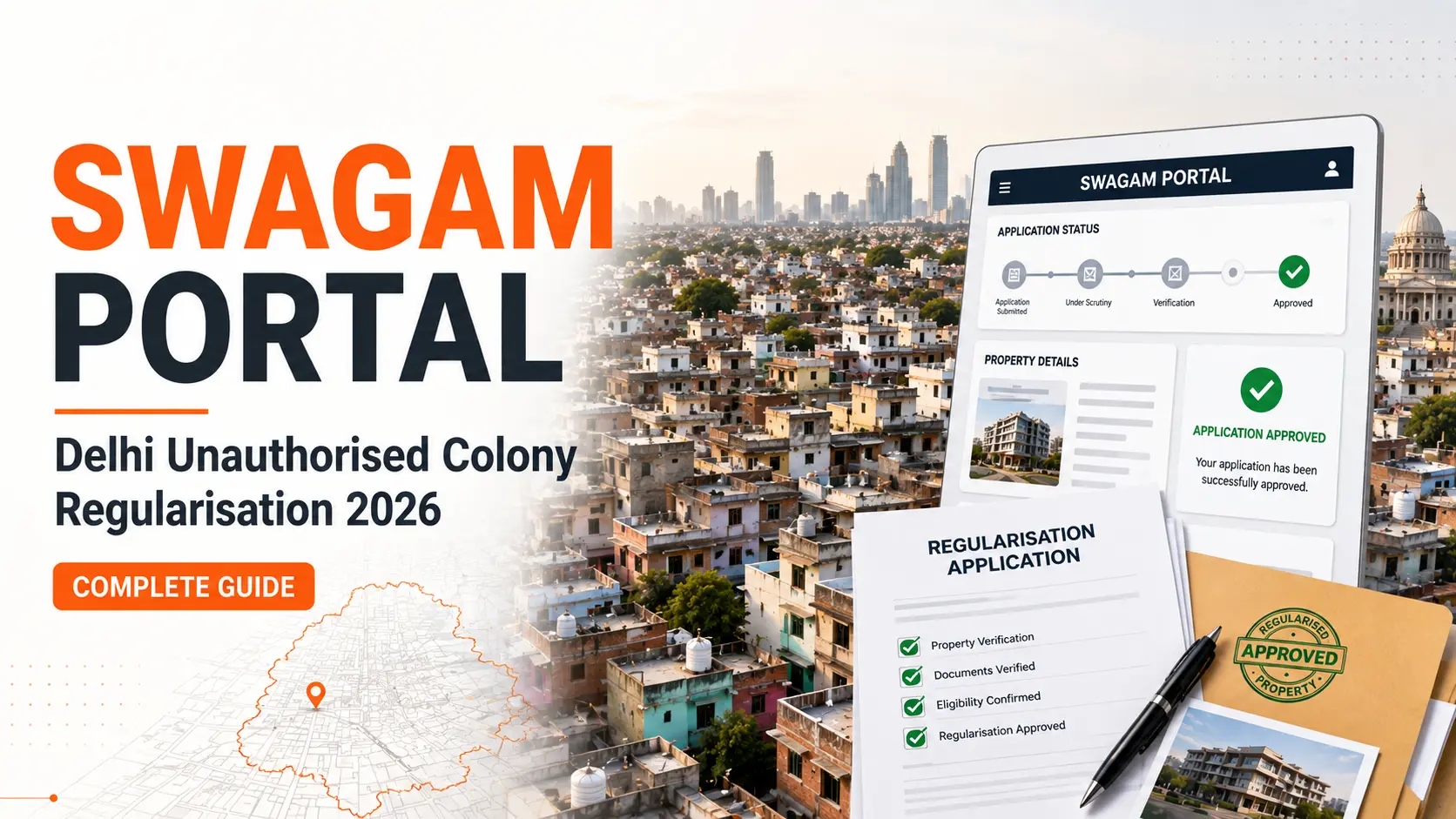
SWAGAM Portal is the Municipal Corporation of Delhi's (MCD) online platform for regularising properties in Delhi's unauthorised colonies. Launched on 24 April 2026, it lets residents who already hold a Conveyance Deed or Authorisation Slip under the PM-UDAY scheme apply to have their existing built up property formally regularised, without needing an approved layout plan, which had been the biggest hurdle for years.
If you own, or are planning to buy, property in one of Delhi's unauthorised colonies, this guide walks through what SWAGAM Portal actually does, who qualifies, the exact application steps, the costs and timelines involved, and what regularisation changes for you as an owner or buyer.
What Is a SWAGAM Portal?
SWAGAM is an MCD run digital platform, accessible at mcdonline.nic.in/swagam, built specifically to process regularisation applications for the 1,511 unauthorised colonies identified for the current phase of reform. It is not a new ownership scheme. It works on top of the existing PM-UDAY framework, taking residents who already have ownership documentation and moving them toward a formal Certificate of Regularisation.
A source of common confusion is treating SWAGAM and the PM-UDAY portal as the same thing. They aren't:
- The PM-UDAY portal, run by DDA and linked via pmuday.ncog.gov.in, is where you establish ownership rights and receive a Conveyance Deed (CD) or Authorisation Slip (AS).
- SWAGAM Portal, run by MCD, is where, once you have that CD or AS, you apply to regularise the actual built structure so it can get building plan approvals, be legally reconstructed, or connect to civic infrastructure.
In practice, the two portals are linked. If you log into SWAGAM and don't yet have a Case ID or an issued CD/AS, the system redirects you back to the PM-UDAY portal to complete that step first.
What Is PM-UDAY, and How Does It Connect to SWAGAM?
PM-UDAY, the Pradhan Mantri Unauthorised Colonies in Delhi Awas Adhikar Yojana, was launched on 29 October 2019, following the National Capital Territory of Delhi (Recognition of Property Rights of Residents in Unauthorised Colonies) Regulations, 2019. Its purpose was to convert informal property arrangements, such as a General Power of Attorney (GPA), Will, Agreement to Sell, or payment and possession documents, into legally recognised ownership.
By 31 March 2026, only around 40,000 Conveyance Deeds or Authorisation Slips had been issued despite roughly 45 lakh people living in these colonies. The government's own review found the bottleneck wasn't ownership recognition itself. It was that residents still couldn't get building plans approved or regularise their homes because approved layout plans for these colonies didn't exist, and preparing them (originally the job of Resident Welfare Associations, subject to MCD approval) had stalled for years.
On 7 April 2026, the Ministry of Housing and Urban Affairs announced a fix. 1,511 of the 1,731 notified unauthorised colonies would be regularised on an "as-is-where-is" basis, removing the layout plan requirement entirely. SWAGAM Portal is the operational tool built to carry that decision out.
Is Your Colony Eligible? (1,511 of 1,731 Explained)
To qualify under the original PM-UDAY Regulations, a colony had to exist as a colony on or before 1 June 2014, and have a minimum 50% built up area as on 1 January 2015.
Of the 1,731 colonies that met this bar, 1,511 are covered under the current as-is-where-is regularisation. The remaining 220 are excluded because they fall on:
- Reserved or notified forest land
- Land protected under the Ancient Monuments and Archaeological Sites and Remains Act, 1958
- Zone-O, the Yamuna flood plain
- Right of way for roads or high tension power lines
- Ridge areas of Delhi
- Land otherwise protected by law
A further 69 colonies identified as more affluent are excluded from this phase and are expected to be considered separately.
To check your own colony, go to the SWAGAM Portal and, in the colony selection field, start typing your colony's name. If it appears in the dropdown, it's one of the 1,511 eligible colonies, and your ward and zone will auto-populate once selected. The PM-UDAY mobile app also has a "UC Locator" tool for the same purpose. This is useful if you're unsure whether your specific plot falls inside or outside a colony's mapped boundary, since properties completely outside the delineated boundary aren't eligible even if the surrounding area is.
Conveyance Deed vs Authorisation Slip: What's the Difference?
This trips up a lot of applicants, so here's the direct answer. A Conveyance Deed (CD) is issued when the built up property sits on government land. An Authorisation Slip (AS) is issued when the property sits on private land.
Which one you get depends entirely on the land status underneath your property, not on anything you choose. Both function as your proof of ownership recognition under PM-UDAY and are the prerequisite for applying on SWAGAM.
How to Apply on SWAGAM Portal: Step by Step
Based on the official process flow published by the government:
- Log in to the MCD SWAGAM portal at mcdonline.nic.in/swagam.
- Select your unauthorised colony name from the list of 1,511 eligible colonies. Your ward and zone are filled in automatically.
- Confirm whether you already have a PM-UDAY Case ID.
- If you don't have one, you're redirected to the PM-UDAY portal to apply for ownership recognition first. You can't skip ahead on SWAGAM without this.
- If you do have a Case ID, enter it. If your CD/AS has already been issued, the SWAGAM application form opens directly. If it hasn't been issued yet, you're redirected to the PM-UDAY portal to check status.
- Submit your application. It's processed jointly by the Revenue Department (GNCTD) with DDA support, and the outcome is sent back to MCD through SWAGAM.
Applications for cases with an already issued CD/AS have been accepted since 24 April 2026.
Documents You Need
Since SWAGAM builds on your PM-UDAY case, most of the document work happens at that earlier stage. Typically required:
- Your Conveyance Deed or Authorisation Slip, or PM-UDAY Case ID if still in process
- Underlying ownership chain documents: GPA, Will, or Agreement to Sell
- Proof of payment and possession
- Proof the structure existed before the applicable cutoff, such as utility bills, tax receipts, or similar dated records
Because SWAGAM is meant to work more like a simplified digital form than a document upload marathon, MCD has said the portal was redesigned in plain language rather than administrative jargon. Even so, keeping scanned copies of the above ready before you start will save you a rejected or stalled application.
Charges and Timelines
Charges under PM-UDAY and SWAGAM are described officially as nominal, calculated based on property size, category, and applicable circle rates, and kept deliberately below market rates. Exact amounts vary by colony and plot size, so check the fee calculation shown at your application stage rather than relying on a flat figure quoted elsewhere.
Timelines promised by the Delhi government at launch:
- GIS survey: within 7 days of application
- Rectification of any deficiencies: within 15 days
- Issuance of the Certificate of Regularisation: within 45 days
Several news reports since launch cite a realistic 45 to 60 day window end to end, which is a more honest expectation to set than the 45 day figure alone.
Rules for Reconstruction, Redevelopment, and FAR
If you plan to rebuild rather than simply regularise what already exists, additional rules apply.
Where the existing right of way is short of the minimum access width (6 metres for internal roads, 9 metres for approach roads), you must surrender land equal to 50% of the shortfall. Floor Area Ratio (FAR) is calculated on your original plot area, but you can only build within the reduced plot area after any surrender. If your existing construction already exceeds the permissible FAR under the Master Plan for Delhi, penal charges of three times the normal additional FAR charge apply. Convenience shops up to 20 sq. metres are allowed if they have at least 6 metres of road access; shops up to 10 sq. metres are allowed with a somewhat lower access requirement.
Layout plans for these colonies are being separately prepared by an inter agency cell (DDA, MCD, GNCTD) using satellite imagery, but their absence is no longer a blocker for your regularisation application.
Current Status: How Is the Rollout Going?
In the first days after SWAGAM went live, MCD reported roughly 80 applications approved, 153 rejected, and 185 pending, a small early sample that officials attributed to documentation complexity and the portal's continued dependence on data from the PM-UDAY system. MCD has appointed 711 architects to help applicants prepare documentation and navigate the process, and directed all 12 zonal deputy commissioners to support the rollout.
The practical takeaway: expect early friction. If your application is delayed or bounced back for corrections, that's currently a common experience, not necessarily a sign something is wrong with your case.
What Regularisation Means for Buyers, Owners, and Investors
For existing owners, a completed CD/AS plus SWAGAM regularisation converts a legally uncertain GPA based holding into something you can sell, mortgage, or rebuild with a formal Certificate of Regularisation, which is what banks and buyers actually check for. For prospective buyers, it's worth confirming at the time of purchase whether a property's CD/AS has been issued and, ideally, whether SWAGAM regularisation is already in progress or complete. This materially affects loan eligibility and resale ease, and is now a reasonable question to ask any seller in one of these 1,511 colonies.
Common Problems and What to Do
Your colony doesn't show up in the SWAGAM dropdown. It likely isn't among the 1,511 eligible colonies, or your specific plot falls outside the delineated boundary. Check with the PM-UDAY app's UC Locator before assuming an error.
You don't have a Case ID yet. You'll need to complete the PM-UDAY ownership recognition process first; SWAGAM won't let you proceed without it.
Your application is rejected. Given the early rejection rate, first re-check your documents against the checklist above before escalating. Most early rejections have been attributed to documentation gaps rather than eligibility issues.
Your Case ID shows a CD/AS not yet issued. You're redirected back to the PM-UDAY portal to track status; SWAGAM can't move forward until that step is complete.

_1792140859.webp)



_1792151285.webp)

Ans 1. SWAGAM Portal is the Municipal Corporation of Delhi's online platform, launched 24 April 2026, for regularising built up properties in Delhi's unauthorised colonies under the PM-UDAY scheme.
Ans 2. No. The PM-UDAY portal, run by DDA, is where you get your Conveyance Deed or Authorisation Slip. SWAGAM, run by MCD, is where you use that document to apply for regularisation of the structure itself.
Ans 3. Search your colony name in the SWAGAM Portal's colony selection dropdown, or use the "UC Locator" feature in the PM-UDAY mobile app to check your specific plot.
Ans 4. A Conveyance Deed is issued for properties on government land; an Authorisation Slip is issued for properties on private land. Which one you receive depends on the land status, not on your choice.
Ans 5. Your PM-UDAY Case ID or issued CD/AS, along with the underlying ownership documents (GPA, Will, or Agreement to Sell) and proof of payment, possession, and construction before the applicable cutoff dates.
Ans 6. Charges are described as nominal and are calculated based on property size, category, and applicable circle rates, kept deliberately below market rates. The exact figure is calculated during your application, so treat any flat number quoted elsewhere as indicative only.
Ans 7. The government's target is a GIS survey within 7 days, deficiency correction within 15 days, and certificate issuance within 45 days, though several early reports suggest a realistic 45 to 60 day window in practice.
Ans 8. Yes, but if your existing right of way is short of the minimum access width, you may need to surrender land, and if your construction exceeds permissible FAR, penal charges (three times the additional FAR charge) apply.