
✦ AI Summary
Table of Content
▲
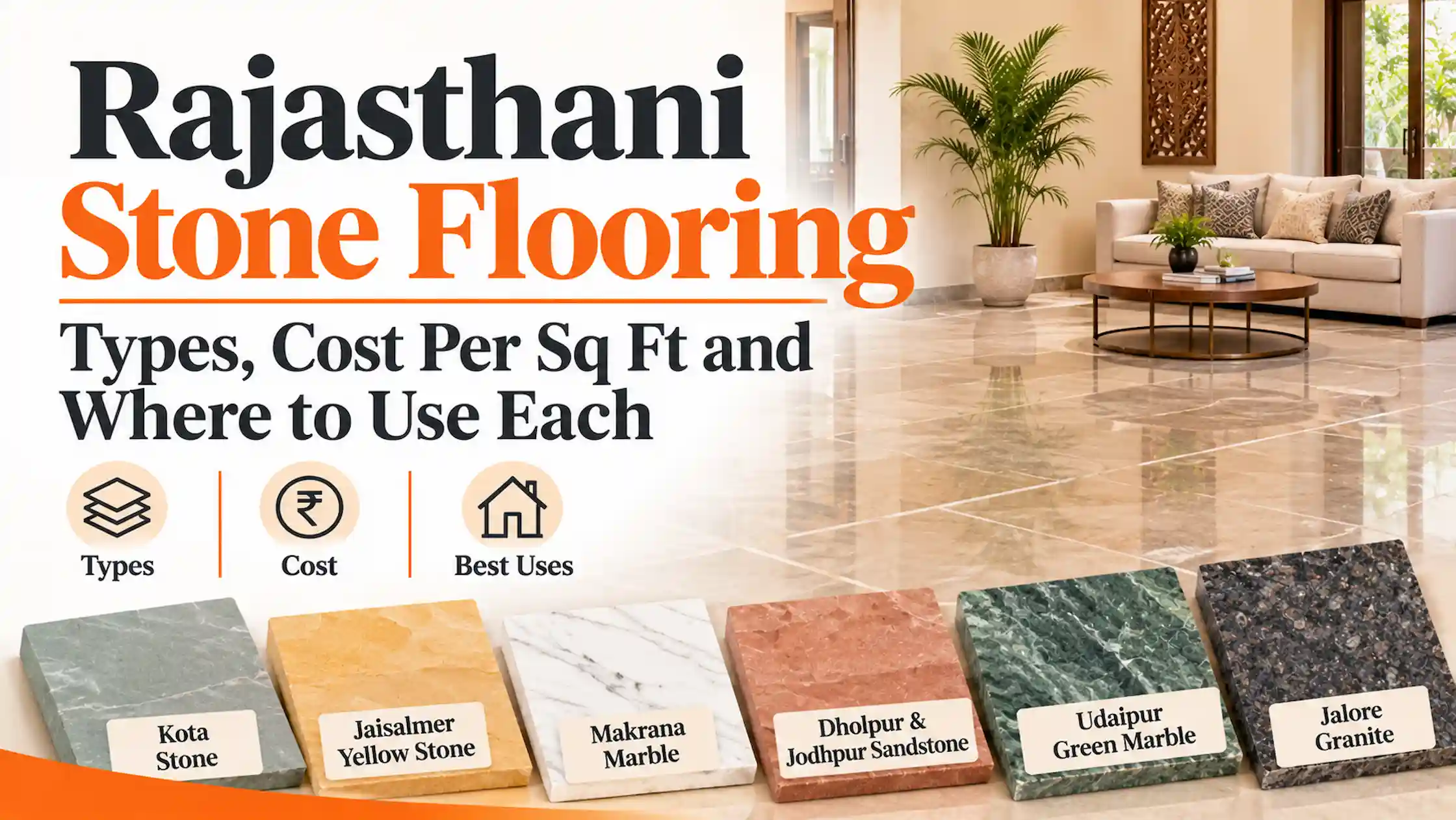
Kota stone is the practical choice for most Indian homes, and it is also the cheapest of the Rajasthani floor stones. Jaisalmer yellow stone and Makrana marble suit living rooms and pooja rooms where looks matter more than budget. Sandstone works best on verandahs and terraces, and Jalore granite suits kitchens and entrances.
Price depends more on grade, finish and distance from Rajasthan than on the stone’s name. Supplier listings in 2026 put common Kota stone at roughly ₹18 to ₹50 per sq ft before laying. Makrana marble can cost anything from under ₹100 to ₹1,000 per sq ft depending on the grade. The sections below compare six stones on origin, cost, suitable rooms and upkeep.
Rajasthani stone flooring at a glance
|
Stone |
What it is |
Source area |
Indicative supply price (₹/sq ft) |
Best for |
|
Kota stone |
Limestone |
Ramganj Mandi, Kota |
18 to 50 for common grades, up to about 100 or more for premium finishes |
Living areas, kitchens, balconies, staircases |
|
Jaisalmer yellow |
Limestone |
Jaisalmer |
From about 40 (installed rates higher, see cost section) |
Living and dining rooms, pooja rooms, sheltered verandahs |
|
Makrana marble |
Calcitic marble |
Makrana, Nagaur |
80 to 1,000, depending on grade |
Living rooms, mandir, medallions |
|
Dholpur and Jodhpur sandstone |
Sandstone |
Dholpur, Jodhpur |
Dholpur 20 to 45, Jodhpur (30 mm) 45 to 80 |
Verandahs, terraces, courtyards |
|
Udaipur green marble |
Marble |
Udaipur region |
60 to 250 (AquireAcres marble guide) |
Feature areas, accents |
|
Jalore granite |
Granite |
Jalore, Barmer |
Varies by variety, get a dealer quote |
Kitchens, entrances, parking |
Rates are indicative supply prices from supplier listings and trade guides in 2026, before laying, polishing, transport and GST. Delivered rates outside Rajasthan are higher.
Which Rajasthani stone is best for flooring?
No single stone wins on every count. Kota stone gives the lowest cost per sq ft and a naturally grippy surface, so it suits large areas and daily use. Makrana and Jaisalmer look more refined but need sealing and careful cleaning. Granite is the hardest of the group, and sandstone is mostly an outdoor choice. Pick the stone by room first, then by budget.
Kota stone: the budget workhorse
Kota stone is a fine-grained limestone quarried around Ramganj Mandi in Kota district. It comes in blue-grey, green, brown and black shades, as slabs or tiles, usually 18 mm to 25 mm thick. Listings from Ramganj Mandi suppliers show common slabs and tiles at roughly ₹21 to ₹38 per sq ft, with polished and brown grades costing more.
Its first advantage is price. The second is grip. A natural or leather-finish surface is slip-resistant, but a high polish changes that, so ask to see the exact finish when wet. The limits are shade variation from slab to slab, staining if left unsealed, and a softer surface than granite. A mirror polish costs extra, typically ₹10 to ₹25 per sq ft according to supplier guides.
.jpg)
Jaisalmer yellow stone: warm colour, but handle with care
Jaisalmer stone is often sold as yellow sandstone, but it is a limestone. That matters at home. Like marble, it reacts to acids, so lemon juice, acidic cleaners and harsh floor chemicals can dull or mark it. It is also porous. Seal the underside and edges before laying, and reseal as the floor ages.
It suits living and dining rooms, pooja rooms and sheltered verandahs. Kitchens are a poor fit because of oil and acid spills. Make sure the concrete beneath is fully dry before laying, because trapped moisture shows up as damp patches on a light stone.
.jpg)
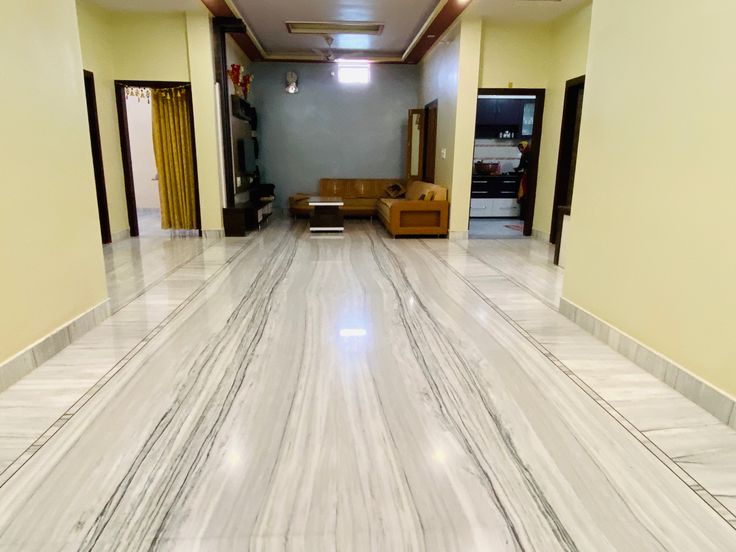
Makrana marble: the premium white
Makrana marble comes from Makrana in Nagaur district. It is a calcitic marble with a very high calcium carbonate content, commonly put at 90 to 98 per cent. The name is protected by a Geographical Indication tag granted in 2015, and the stone received Global Heritage Stone Resource status from the International Union of Geological Sciences in 2019. In practice, ask the dealer for the grade, thickness and quarry source in writing.
Prices vary widely by grade. Types of marble used in Indian homes lists Makrana at ₹250 to ₹1,000 per sq ft, while one Jaipur trade guide lists premium flooring grades at ₹80 to ₹200. Confirm the grade rather than comparing names.
Marble etches on contact with acids. Use pH-neutral cleaners only, and keep it out of kitchens. If you use an inlay medallion, check that the medallion and the surrounding slabs have the same thickness, so the surface sits level.
Sandstone, Udaipur green marble and Jalore granite
Sandstone. Dholpur stone (beige to pink) and Jodhpur stone (pink to red) are the main flooring sandstones. The surface is naturally non-slip, which is why it is mostly used outdoors. Slabs vary in thickness, so insist on calibrated pieces and plan border strips so edge pieces do not end up as slivers. Mint sandstone, with cream to pale green tones, is used the same way, though reliable price data for it is thin, so rely on dealer quotes.
Udaipur green marble. Deep green with white veining, it works best as a feature, for example as alternate squares with white marble. Marble care rules apply. When laying it beside white marble, use a white-cement-based adhesive so grey cement does not show through.
Jalore granite. Jalore and Barmer are leading granite districts, and Jalore alone offers over 20 varieties. Granite sits at about 6 to 7 on the Mohs hardness scale, which makes it the sturdiest choice for kitchens, entrances and parking areas.
Which stone suits which room?
|
Room |
Good choices |
Avoid |
Reason |
|
Living and dining |
Kota (polished or honed), Makrana, sealed Jaisalmer |
Rough sandstone |
Looks matter, traffic is moderate |
|
Kitchen |
Kota (honed or leather), granite |
Jaisalmer, Makrana, green marble |
Acid and oil spills mark limestone and marble |
|
Bathroom |
Leather-finish Kota or granite with an anti-skid finish |
Any high polish |
Wet floors need grip |
|
Pooja room |
Makrana, Jaisalmer |
None specific |
Low traffic, appearance counts |
|
Verandah, terrace, balcony |
Sandstone, natural-finish Kota |
High-polish stone |
Weather exposure and grip |
|
Parking and driveway |
Natural-finish Kota, granite |
Soft or polished stone |
Load and wear |
This matrix is editorial guidance based on each stone’s properties, not a standards-based rating. Confirm with your contractor.
What does Rajasthani stone flooring cost per sq ft?
The stone price is only part of the bill. Add wastage of about 10 per cent, transport, laying, polishing or sealing, skirting, adhesive and GST. One trade guide puts laying at ₹22 to ₹40 per sq ft in Jaipur and ₹35 to ₹60 in big metros. Confirm the current GST rate on your invoice.
Illustrative example: 1,000 sq ft, in rupees. Assumptions: 10 per cent wastage, laying at ₹35 per sq ft for all three, and the finishing rates shown. This excludes GST, transport, skirting and adhesive. It is an example, not a quotation.
|
Item |
Kota stone |
Jaisalmer (honed) |
Makrana (entry grade) |
|
Material rate assumed (₹/sq ft) |
40 |
70 |
250 |
|
Material for 1,100 sq ft |
44,000 |
77,000 |
2,75,000 |
|
Laying (1,000 sq ft at ₹35) |
35,000 |
35,000 |
35,000 |
|
Polish or sealing (₹/sq ft) |
15 |
30 |
30 |
|
Finishing cost |
15,000 |
30,000 |
30,000 |
|
Total |
94,000 |
1,42,000 |
3,40,000 |
|
Per sq ft |
about 94 |
about 142 |
about 340 |
On these assumptions, all-in Kota stone costs about the same as the material-only price of standard vitrified tiles (₹70 to ₹150 per sq ft). The comparison comes from how marble compares with vitrified tiles on cost.
Installation and upkeep that decide how the floor ages
- Choose the finish by room. Natural, leather and honed finishes grip better than polished ones.
- Order 8 to 10 per cent extra from the same lot, and dry-lay the stone before fixing so shade variation is spread evenly.
- Check thickness. Uneven pieces create lippage, especially where two stones meet.
- Seal and clean correctly. Seal limestone and marble, use pH-neutral cleaners, and blot acidic spills quickly. Test the seal by dropping water on the floor. If it soaks in within minutes, reseal. For polished marble, the steps in restoring and sealing marble floors apply.
Pairing stones in one floor
Kota and Jaisalmer are a traditional pair: grey-green Kota as a checkerboard or border around yellow stone. Makrana medallions also sit well within a Kota field. Keep thicknesses equal at every junction and lay the border first, so the centre tiles do not drift out of alignment.
Before you pay the dealer
Ask for three things in writing: a sample of the exact finish, the stone’s grade and thickness, and a rate that includes laying, polishing and sealing. A floor that costs less per sq ft at the stone yard often costs more once these are added.








Ans 1. Kota stone suits most homes because it is the cheapest and has a natural grip. Makrana and Jaisalmer suit living areas and pooja rooms, sandstone suits outdoor areas, and granite suits kitchens and entrances.
Ans 2. Supplier listings in 2026 show common Kota stone at roughly ₹18 to ₹50 per sq ft for the stone alone. Laying typically adds ₹20 to ₹40, and polishing ₹10 to ₹25. Rates vary by city and grade.
Ans 3. It is a limestone, although it is often sold as yellow sandstone. It reacts to acids and is porous, so it needs sealing.
Ans 4. It is not recommended. Acidic and oily spills can mark it, and it is porous. Honed Kota or granite is a safer choice.
Ans 5. The name has a Geographical Indication tag, so ask the dealer for the grade, quarry source and invoice. Appearance alone is not proof.
Ans 6. Kota is cheaper and grips better in its natural finish. Granite is harder and more scratch-resistant. Choose Kota for large, budget-led areas and granite for kitchens and heavy-use spots.