
✦ AI Summary
Table of Content
▲
Your main gate and door do double duty in most Indian homes; they're the first thing a visitor sees, and for a large share of households, they also carry real Vastu significance. The trouble is that not every source agrees on the details, and knowing where the guidance is genuinely settled versus where it conflicts matters before you commit to a design.
Vastu Guidance What's Settled, and Where Sources Disagree
The direction guidance is reasonably consistent across sources: north, east, and northeast are the favoured directions for both the main gate and main door, believed to support positive energy flow. Most sources also agree the door should open inward, in a clockwise direction an anticlockwise-opening door is considered a Vastu flaw worth correcting.
Here's where it gets genuinely inconsistent, and worth knowing before you shop: one detailed guide states plainly that Some Vastu sources recommend wood and discourage metal, while other sources assign metal a favourable association with west-facing entrances. Another source, discussing gate colours by direction, treats metal as specifically favourable for a west-facing entrance, associating the west with the metal element in Vastu. These two claims genuinely contradict each other, and rather than pick one to repeat as settled fact, it's worth knowing both exist and deciding which source you trust, or consulting a Vastu practitioner directly if this matters to your decision.
One more point worth flagging with appropriate caution rather than confidence: a single source states the main door should always be exactly twice as long as it is wide. This specific ratio doesn't appear consistently across other sources, so treat it as one commonly cited guideline rather than a universal rule.
What is consistently agreed: keep the entrance well-lit and free of obstacles, avoid placing a mirror directly opposite the main entrance, as discussed in our guide to mirror wall decor ideas for 2026. and don't keep shoes or a dustbin right at the entrance, both practical and Vastu-aligned advice at once. For a more detailed look at entrance placement and design, see our guide to Vastu tips for home entrance.
Choosing the Right Material for Indian Weather
Beyond Vastu, practical durability in Indian conditions matters just as much, especially for a gate that sits outdoors year-round:
Mild steel (MS) is the affordable, sturdy default, suited to most designs but genuinely requires rust protection, specifically because sustained monsoon humidity accelerates corrosion on untreated or poorly coated steel.
Stainless steel is sleek and low-maintenance, resisting rust considerably better than mild steel without ongoing treatment, at a higher upfront cost.
Aluminium is lightweight and naturally weather-resistant, a strong contemporary choice that needs less upkeep than steel over time.
Wrought iron remains the classic, ornamental choice, well suited to a more traditional gate design, though it shares mild steel's need for rust management in humid climates.
Wood and wood-finish panels, commonly paired with a metal frame for structural strength, add warmth and privacy, with teak specifically favoured for how well it handles moisture compared to other woods.
If you're comparing entrance materials more broadly, our guide to main gate design ideas covers steel, aluminium, wrought iron, wood-and-metal combinations and practical security considerations.
What's Trending for 2026
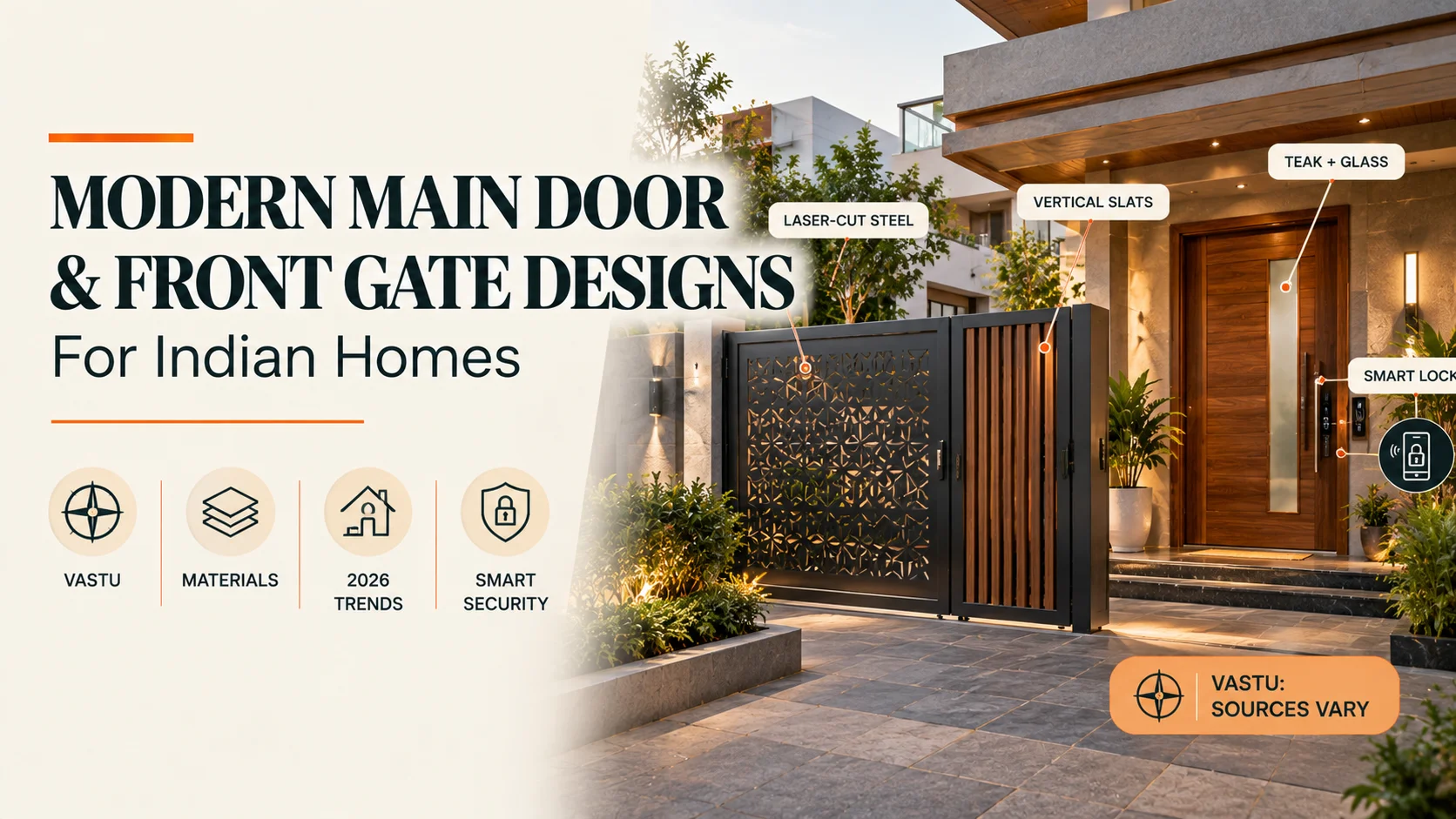
Laser-cut steel panel gates are the clearest current signature look: a solid metal sheet cut with a geometric jaali, mandala, or abstract pattern that reads as both privacy screen and design statement from the street, increasingly paired with brass or wood accents for warmth against the metal.
Vertical panels and slatted gates are a major direction this year specifically, giving the entrance a taller, wider visual feel compared to the more horizontal designs common previously.
Teak wood main doors with glass panel inserts frosted or textured glass set into a solid teak frame are a widely cited trending combination, since the glass lets natural light into the entrance area, which most Vastu guidance treats as genuinely auspicious, while the teak frame carries the traditional warmth many homeowners still want.
High-tech and app-controlled gates, operated by remote or smartphone, are increasingly common, adding a real security layer on top of the design itself.
Smart Locks and Tradition Can Coexist
This is worth stating directly, since it's a genuinely current point: adding a smart or digital lock, sensor entry, or a camera system doesn't conflict with a traditionally styled, Vastu-conscious door. A solid teak door with a smart lock and a carved Om or Swastik motif above the frame is a genuinely common current combination of modern security technology layered onto a traditional design, rather than one replacing the other. If both matter to you, there's no need to choose between a contemporary security upgrade and a more traditional design language.

_1792140859.webp)


_1792151285.webp)
Ans 1. North, east, and northeast are the consistently favoured directions across Vastu sources, associated with positive energy flow.
Ans 2. Sources genuinely disagree here. One source recommends wood and advises against metal doors entirely; another treats metal as specifically favourable for a west-facing entrance. These claims conflict, so it's worth choosing which source you trust or consulting a Vastu practitioner directly.
Ans 3. Stainless steel and aluminium require the least ongoing maintenance and resist rust well. Mild steel is affordable and sturdy but needs proper rust protection, particularly important given Indian monsoon humidity.
Ans 4. Laser-cut steel panel gates with geometric or jaali patterns, vertical slatted gate designs, and teak wood doors with frosted glass panel inserts are the most consistently cited current trends.
Ans 5. Yes, a smart or digital lock doesn't conflict with traditional design elements. A teak door with a smart lock and a carved Om or Swastik motif is a commonly cited current combination.
Ans 6. This specific ratio appears in one source but isn't consistently corroborated elsewhere, so treat it as one guideline among several rather than a strict universal rule.
Ans 7. Most guidance advises against this a mirror directly opposite the main door is believed to reflect positive energy back outside rather than letting it circulate through the home.