
✦ AI Summary
Table of Content
▲
A mirror is one of the few pieces of wall decor that does actual work; it bounces light, changes how large a room feels, and finishes a wall the way art alone sometimes can't. But for a lot of Indian homes, choosing where to hang one isn't purely a style decision. It's also a Vastu one, and getting that part wrong is the kind of mistake you can't quietly patch over later. This guide covers what's genuinely current in mirror styling right now, and the direction guidance most decor content leaves out entirely.
What's Current in Mirror Wall Decor Right Now
Mirror decor has moved past the plain rectangular piece hung to "fill a wall." Designers are increasingly using mirrors the way they'd use a piece of furniture to change how a room reads the moment you walk in.
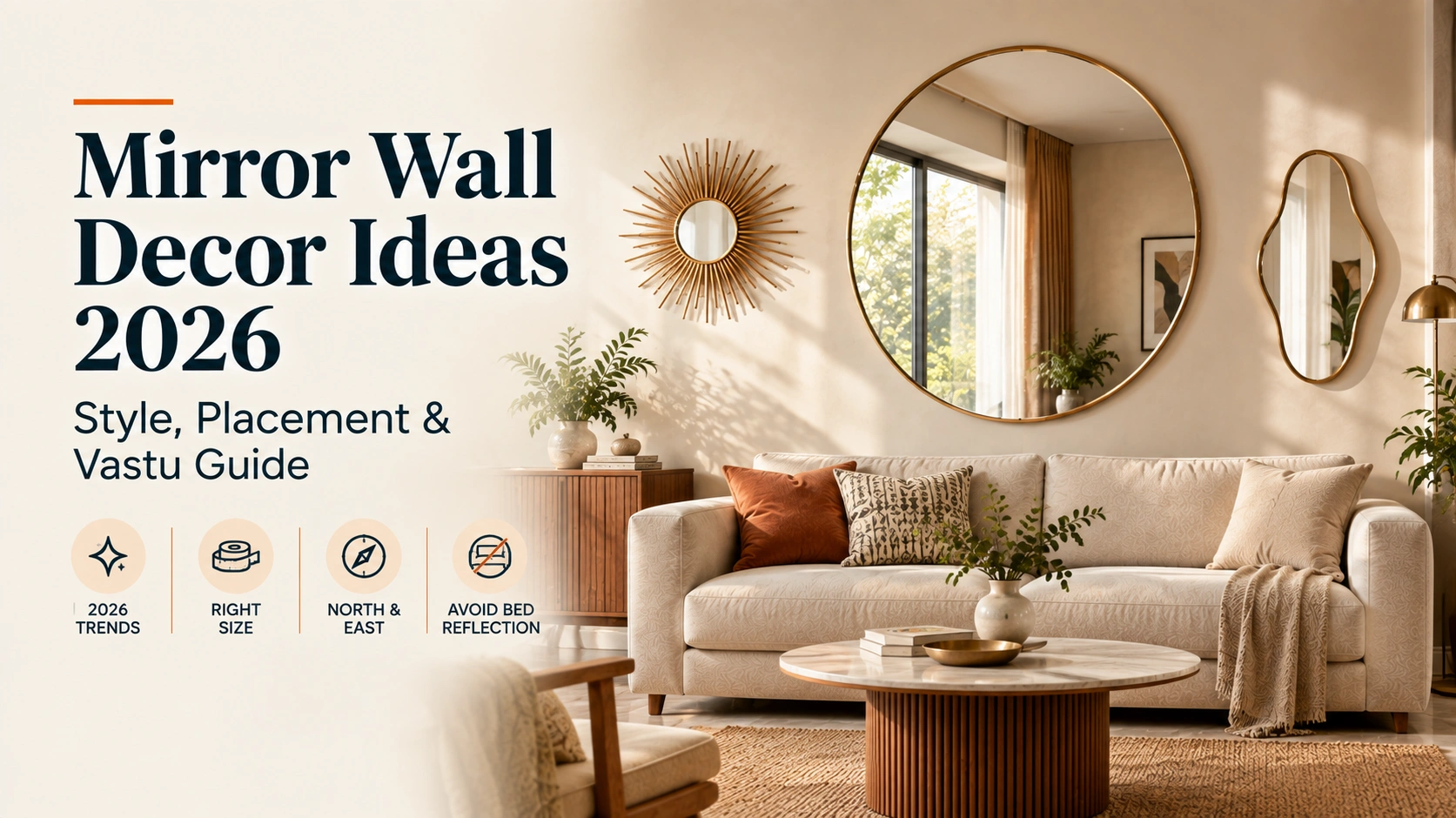
Oversized round or arched mirrors above the sofa are the single most common current living room choice. A large round mirror softens a room with a lot of straight lines and hard edges, while an arched mirror adds a slightly more traditional, elegant note without feeling heavy.
Sunburst mirrors work well as a standalone focal point on an otherwise plain wall, particularly in a room that doesn't already have much pattern or texture elsewhere.
Mirror-only gallery walls, a cluster of differently shaped and sized mirrors grouped the way you'd arrange framed art are a genuinely newer trend. They solve a real problem: a traditional gallery wall of framed art can make a small room feel more closed in, while a cluster of mirrors keeps the same layered, curated look without that effect, since each piece still reflects light rather than absorbing it.
Organic and irregular shapes asymmetric, sculptural mirror frames rather than a clean circle or rectangle are increasingly used as wall art in their own right, chosen as much for the frame's form as for the reflection.
Where Should the Mirror Actually Go? (Placement and Sizing)
Shape and size should follow the furniture beneath the mirror, not the empty wall space around it. Above a sofa, a mirror sized to roughly two-thirds of the sofa's width reads as intentional; one that's noticeably narrower looks undersized, and one that spans the full width can overwhelm the piece below it.
Placement relative to light matters as much as placement relative to furniture. A mirror positioned to reflect a window or a well-lit part of the room genuinely amplifies natural light and makes the space feel larger. This is the actual mechanism behind "mirrors make a room feel bigger," not just a decorating cliché. A mirror facing a blank wall or a dark corner does far less work.
For more ideas on creating a balanced living space, explore these trending living room themes for 2026.
Vastu Direction for Mirrors What to Know Before You Hang One
This is where global decor advice stops and where a large share of Indian readers actually need guidance, so it's worth stating plainly rather than treating it as a footnote.
Across multiple independent Vastu sources, the guidance is consistent: the north and east walls are considered the most favourable directions for a mirror, believed to support positive energy flow and, practically, to catch morning and midday light well. South and southwest walls are consistently advised against several sources tie this specifically to the fire and earth elements associated with those directions in Vastu Shastra.
If Vastu isn't a consideration for your household, none of this needs to override the style and light-based placement guidance above. But if it is, it's worth deciding the wall before you decide the shape, since a beautiful arched mirror on the wrong wall is still, by this logic, the wrong choice.
For a more detailed room-by-room breakdown, see our guide to mirror placement as per Vastu for home and office.
Two Placement Mistakes Almost Everyone Agrees On
Regardless of which specific Vastu source you read, two placement rules come up almost unanimously, which makes them worth treating as close to settled guidance rather than one interpretation among many:
Don't place a mirror facing the bed. Multiple sources independently describe this as disruptive to sleep and, in Vastu terms, to relationship harmony. If a mirror is attached to a dressing table in the bedroom, the consistent advice is to angle it so it doesn't reflect the bed directly, or to keep it covered when not in use.
Don't place a mirror directly opposite the main entrance. The reasoning given across sources is that a mirror facing the front door is believed to reflect incoming positive energy straight back outside before it can circulate through the home. Practically, it's also simply an odd style choice; the first thing a guest sees is their own reflection rather than the room.
If you are also planning the wall colour around the mirror, see our guide to Vastu-compliant colours for home walls.
Beyond these two, sources vary somewhat in their specifics, but the north/east-favourable, south/southwest-avoided pattern and these two placement rules are the most consistently repeated guidance and are worth treating as the baseline for anyone who wants their mirror decor to be both current and, where it matters to them, Vastu-conscious.






Ans 1. North and east walls are generally considered the most favourable; south and southwest walls are consistently advised against across Vastu sources.
Ans 2. No, the consistent Vastu guidance is to avoid this, since it's believed to reflect positive energy back outside before it circulates through the home.
Ans 3. Yes, but avoid positioning it to face the bed directly. If a dressing table mirror is present, angle it away from the bed or keep it covered when not in use.
Ans 4. Roughly two-thirds of the sofa's width reads as proportionate noticeably narrower and looks undersized, and full-width can overwhelm the furniture below.
Ans 5. Oversized round and arched mirrors above the sofa, sunburst mirrors as standalone focal points, and mirror-only gallery walls are the most current trends.
Ans 6. It's genuine, provided the mirror reflects a well-lit area or a window that's what amplifies light and creates the sense of added space, not the mirror alone.
Ans 7. The style, sizing, and light-placement guidance stands on its own. The Vastu section is relevant only if that consideration matters to your household.