
✦ AI Summary
Table of Content
▲
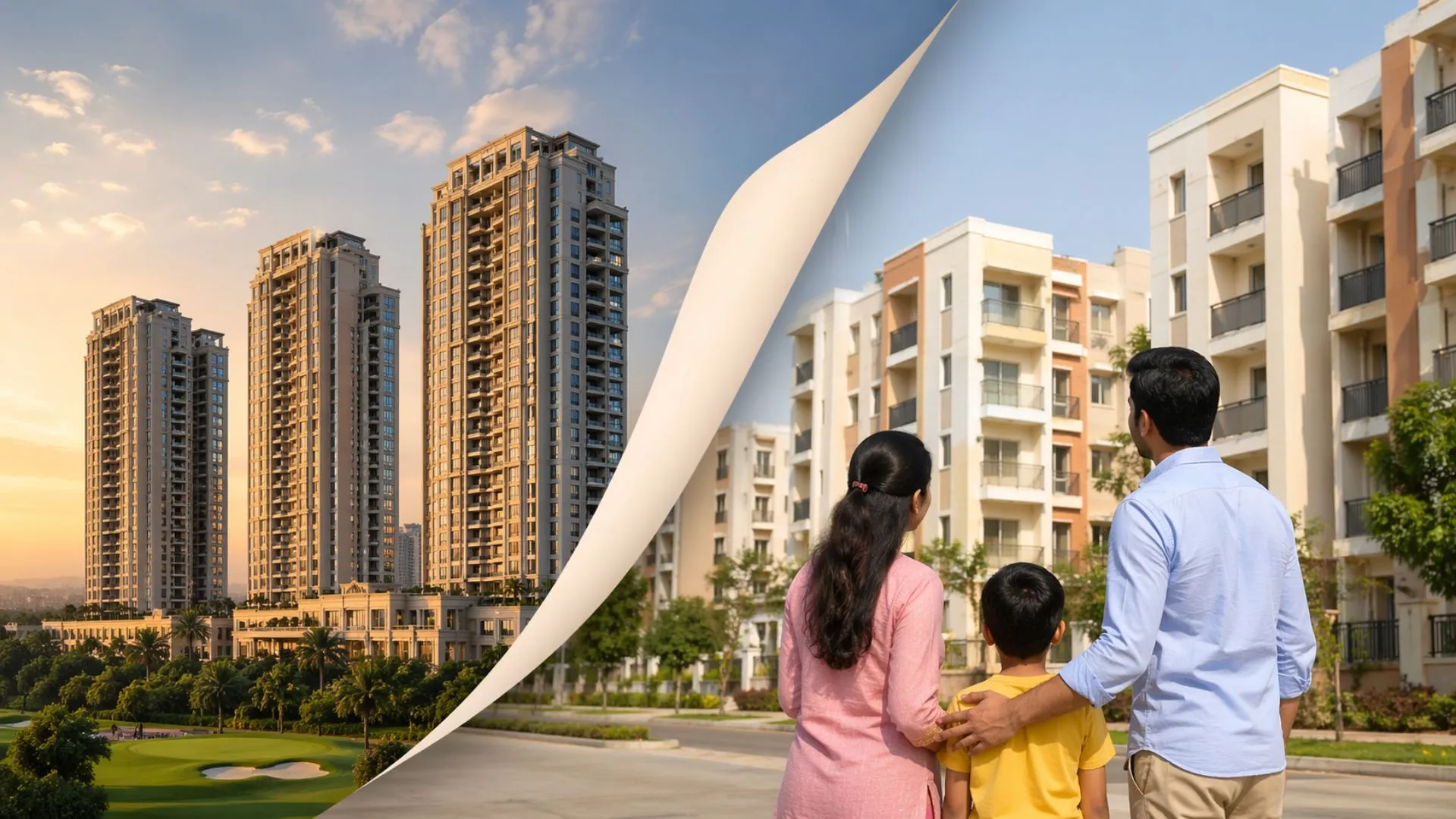
The Indian real estate market reaches its vital turning point which has not occurred in the past ten years. The country's leading metropolitan areas saw developers invest their resources into high-end 3 BHK and 4 BHK apartments for almost five years because they wanted to attract wealthy buyers and NRI investors while they ignored the salaried middle class, which represents India's biggest homebuying market. The current economic situation has started to disrupt our existing business plan.
The amount of unsold luxury products has reached excessive levels. The price of housing has exceeded what most working families can afford. The residential property market in India is entering a new phase because experts monitoring the market indicate that the 3 and 4 BHK supercycle has ended and middle-class housing development has resumed its previous level of importance.
The detailed breakdown of changes now described. What do these modifications signify for the homebuyer, the investor, and the home seller/ builder.
The Luxury Supercycle: How It Started and Why It Is Ending
The period from 2019 through 2024 saw India experience a complete transformation of its residential real estate market. Developers shifted their focus to premium and luxury housing because of two driving forces: the post-pandemic 'upgrade' wave, which made professionals need bigger work-from-home spaces, and the strong presence of NRI investors and HNI buyers. The business case proved attractive because companies could earn more profit from each unit which made larger apartments more valuable, while buyers with higher spending power made quick purchasing decisions.
The outcome created a neighborhood where 3 BHK and 4 BHK apartments, which cost ₹1.5 crore and higher, became the only available options for families whose income ranged from ₹8 lakh to ₹25 lakh per year. The supply of affordable 2 BHK apartments in Tier 1 cities completely stopped. The market for properties priced under ₹50 lakh disappeared almost completely in the cities of Mumbai, Delhi-NCR, and Bengaluru.
What Drove the Luxury Boom
- Post-pandemic demand from high-income professionals seeking larger spaces
- NRI investment surge in premium and luxury residential projects
- Higher per-unit profit margins, making luxury development more bankable
- Rising land acquisition costs in metros favouring large-format configurations
- Weak RERA enforcement in early years allowing speculative luxury launches
Key Insight: Between 2021 and 2024 more than 60% of new residential developments in Tier 1 cities launched at prices exceeding ₹1 crore which was three times the rate established before 2019.
Also Read: Capital Inflows Real Estate India Cross $5.1 Billion Mark in Q1 2026
The Numbers Tell the Story: A Head-to-Head Comparison
The luxury market and the affordable market present a complete contrast. The data below shows the present status of each segment and their future development until 2025 and beyond.
Luxury vs. Affordable Housing Segment Comparison 2025
|
Parameter |
3 & 4 BHK / Luxury Segment |
1 & 2 BHK / Affordable Segment |
|
Demand Trend (2024–25) |
Declining sharply |
Rising steadily |
|
Unsold Inventory Level |
18–36 months (high) |
Under-supplied |
|
Primary Buyer |
HNI / NRI / Ultra-Premium |
Salaried Middle Class |
|
Typical Price Range |
₹1.5 Cr and above |
₹30L – ₹80L |
|
Builder Focus (2020–24) |
Dominant |
Neglected |
|
Market Phase (2025+) |
Correction / Slowdown |
Revival / Opportunity |
|
EMI Affordability |
Unserviceable for most |
Within salaried reach |
The data shows clear results. The luxury segment holds inventory which the market cannot sell at present pricing and current EMI rates. The affordable segment has a supply shortage which persists despite continuous and increasing customer demand.
Why the 3 & 4 BHK Era Is Definitively Fading
The cycle reversal process is being accelerated by multiple forces that are currently combining together. The processes that drive the cycle reversal process will continue to operate without interruption.
1. EMI Wall
The current home loan interest rates remain high because the Reserve Bank of India completed its tightening cycle. The cost of a ₹1.5 crore apartment requires monthly payments above ₹1.2 lakh, which makes it impossible for most urban workers in India to qualify for the loan. The buyer has lost his dream of owning a 3 BHK home because of current market prices.
2. Inventory Overhang
Premium projects in Delhi-NCR, MMR, and Hyderabad currently possess unsold inventory that has remained unsold between 18 to 36 months. The healthy market benchmark requires 8 to 10 months as essential for normal market operations. The threshold for distress begins at 18 months and multiple luxury corridors now operate above this limit.
3. Demand-Supply Mismatch
First-time homebuyers and nuclear families and young professionals consistently search for 1 BHK and 2 BHK apartments, which fall within the price range of ₹35 lakh to ₹75 lakh. This is the segment where real organic demand sits. Developers have continuously underfunded this particular market segment during the last five years.
4. RERA Accountability
The luxury market now follows stricter regulations because of RERA enforcement, which affects all aspects of risk assessment for developers. Developers now need real proof that buyers have bought their properties, which prevents them from using investor parking as valid evidence. The current market environment requires developers to build luxury products through land requirements, which increases development costs and development risks.
5. Tier 2 City Signal
The emerging cities of Lucknow, Jaipur, Ahmedabad, Coimbatore, and Indore have achieved the highest affordable housing absorption rates in Canada. The middle-class purchasing power remains stable in these markets while competition decreases and PMAY eligibility creates new opportunities for buyers. The smart developers have started to establish their presence in this location.
India's Most Underserved Buyer: The Salaried Middle Class
The urban middle class of India, which exceeds 300 million people, forms the largest group of homeownership seekers in the nation. This is not a niche. This is the market. For most of the past five years, the Indian real estate market abandoned its dedication to them while it underwent territorial reconstruction.
What the Middle-Class Buyer Actually Needs in 2025
- The market offers 2 BHK apartments, which are situated in prime locations between the ₹45 lakh and ₹75 lakh price range.
- The construction projects which have RERA registration must adhere to their established possession dates according to legal requirements.
- Home loan EMIs should not exceed 35 percent to 40 percent of the monthly income which people receive after taxes.
- PMAY eligibility for first-time buyers in the EWS and LIG categories
- The construction of high-quality buildings with access to metro and highway systems
- The pricing system, which discloses all expenses to customers, restores their trust in the business.
City-wise Middle-Class Housing Opportunity Map 2025
|
City |
Middle-Class Demand Level |
Affordable Supply Gap |
2025 Opportunity Rating |
|
Delhi-NCR |
Very High |
Critical |
★★★★★ |
|
Mumbai (MMR) |
High |
Severe |
★★★★☆ |
|
Bengaluru |
High |
Moderate-High |
★★★★☆ |
|
Pune |
Very High |
Moderate |
★★★★☆ |
|
Tier 2 Cities |
Rising Fast |
Low (Opportunity) |
★★★★★ |
Data Point: Properties priced between ₹30 lakh and ₹80 lakh account for over 65% of active homebuyer searches on major portals yet represent less than 20% of new launches in Tier 1 cities. The existing gap in the market offers a business opportunity.
Also Read: BDA Housing Dispute Reaches Odisha REAT After Kantabada Panchayat Objection
What Builders Must Do or Get Left Behind
The developers who will lead India's next real estate growth cycle are the ones recalibrating now. The builders who refuse to abandon the luxury playbook will end up with unsold inventory problems while their cash flow situation becomes more severe and their institutional investors grow more frustrated.
The Winning Playbook for 2025 and Beyond
- The demand for 2 BHK apartments with 650 to 850 square-foot space requirements exists throughout high-demand urban areas.
- The integrated township developments in Tier 2 cities combine multiple essential services into one complete package.
- The strategic land acquisition process identifies suburban areas which offer affordable land access for development purposes.
- The product design process generates working prototypes based on the salary-based repayment capacity of salaried buyers.
- The middle-class community regains its trust through RERA-compliant pricing, which RERA allows construction companies to disclose.
The top developers DLF and Sobha and Prestige, together with certain Tier 2 developers, have started to shift their project focus toward mid-segment and affordable housing. The institutional capital that enters India's real estate market reached a record amount of $5.1 billion during the first quarter of 2026, according to CBRE data, but now operates primarily through residential platforms instead of commercial properties. The developers need to follow the capital because it represents their only path to future success.
Conclusion
The Indian real estate market has now begun its process of market correction. The construction industry has accumulated excessive unsold three- and four-bedroom apartment inventory because developers spent years targeting high-end customers, who now base their purchasing decisions on actual market value. The existing situation needs to end because it creates problems. The new market conditions allow homebuyers to access properties which now offer better investment opportunities. The next growth cycle will benefit developers who establish their services for middle-class customers before their competitors do.

_1792140859.webp)


_1792151285.webp)
Ans 1. A full market crash is unlikely. Analysts expect a price correction and inventory stress in the premium segment, while the affordable and mid-segment housing market sees a demand revival.
Ans 2. A combination of oversupply, sky-high ticket prices, elevated home loan EMIs, and eroded middle-class affordability has pushed the primary buyer base out of the 3–4 BHK segment entirely.
Ans 3. Luxury and premium segment prices may stagnate or soften due to unsold inventory pressure. Affordable housing prices are likely to stabilise as new supply enters the market.
Ans 4. After years of being sidelined by developer focus on premium projects, affordable housing is staging a comeback. Chronic undersupply and unmet middle-class demand are forcing a course correction.
Ans 5. Yes. Market data, analyst forecasts, and shifting developer strategies all point to a clear re-pivot toward 1 BHK and 2 BHK formats targeting India's salaried buyer segment.
Ans 6. India's residential real estate market is transitioning from a premium-led expansion phase into a correction phase for luxury and an early revival phase for affordable and mid-segment housing.
Ans 7. 1 BHK and 2 BHK apartments are witnessing the strongest demand momentum, especially in Tier 1 metros and fast-growing Tier 2 cities where affordability is intact.
Ans 8. Post-pandemic HNI demand, significantly higher profit margins, and rising land acquisition costs made large-format luxury development far more financially attractive for developers between 2020 and 2024.
Ans 9. For salaried middle-class buyers, improving supply in the 1–2 BHK segment, potential EMI relief from RBI rate adjustments, and a more balanced market make 2025 a genuine window of opportunity.
Ans 10. Long-term fundamentals remain among the strongest globally. The next growth cycle is expected to be driven by affordable and mid-segment residential housing, backed by urbanisation, demographics, and PMAY support.