
✦ AI Summary
Table of Content
▲- What is AnyROR Gujarat?
- What is 7/12 Utara?
- How to Check 7/12 Utara Online Through AnyROR Gujarat
- Types of Records Available on AnyROR Gujarat
- Information Required to Search Land Records
- Benefits of Using AnyROR Gujarat
- AnyROR Gujarat vs Traditional Land Record Verification
- Common Mistakes to Avoid While Checking Land Records
- Future of Digital Land Records in Gujarat
- Conclusion
Land ownership verification is one of vital steps before buying, selling, inheriting, or even applying for a loan against property. In Gujarat getting access to land records is now way easier because of the AnyROR Gujarat portal. Citizens can look for property documents online like ownership details, previous title deeds and more about a particular property, they don’t need to go to government offices in person for these things.
Whether you are a landowner, property buyer, farmer, or investor, understanding how to access 7/12 Utara records online can help you verify ownership details, avoid disputes, and make informed property decisions.
What is AnyROR Gujarat?
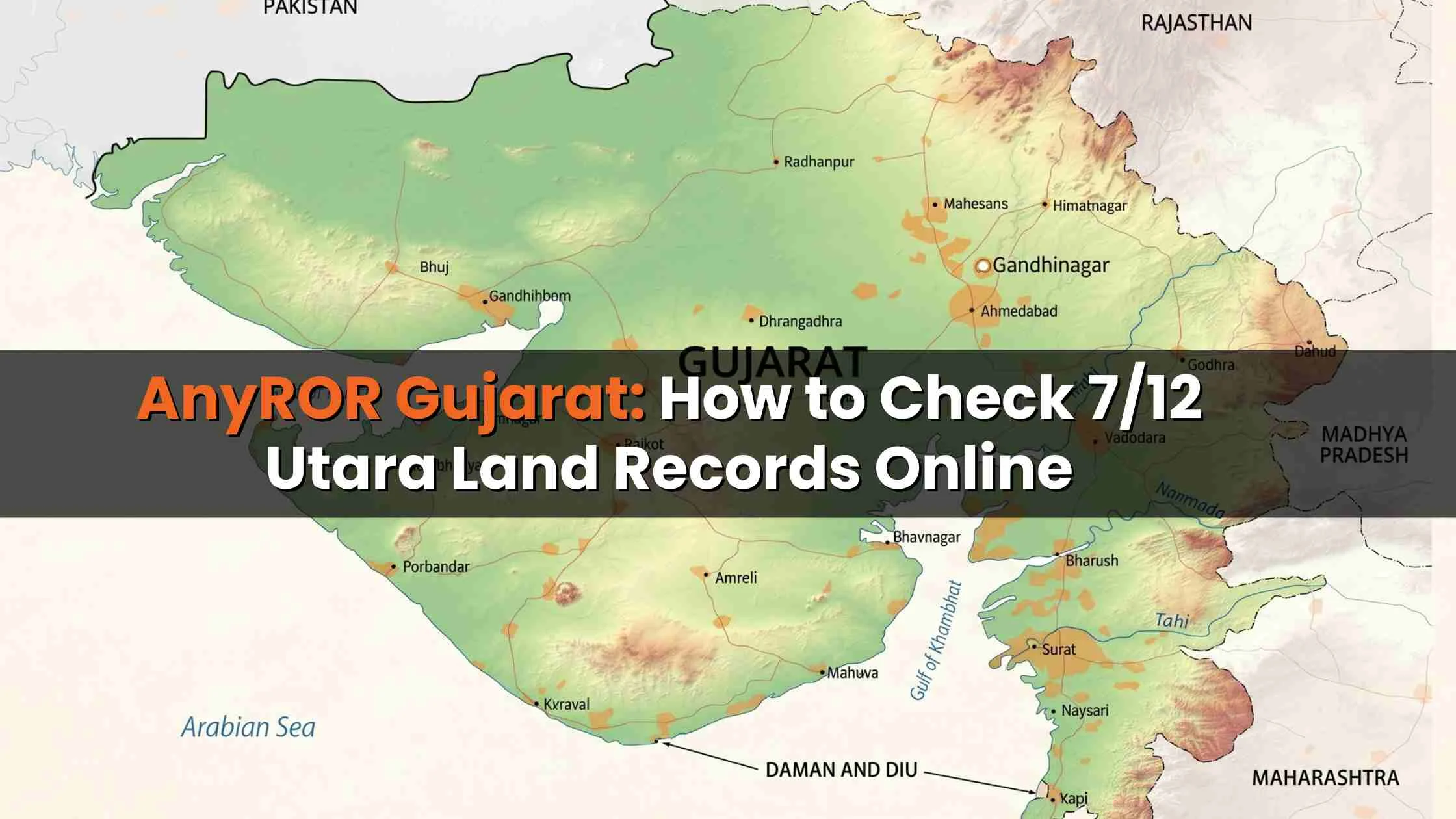
AnyROR stands for Any Record of Rights Anywhere in Gujarat. It is the official online land records portal launched by the Gujarat Revenue Department to provide easy access to property and agricultural land records. The platform enables users to check ownership details, survey numbers, mutation records, and other important land-related information from anywhere.
Launched as part of the state’s digital governance initiative, the platform gives citizens direct access to land and property records that, until now, were basically stuck behind physical revenue offices. No middlemen, no travel, no waiting.
The portal serves a wide range of users farmers checking their own land details, property buyers doing due diligence before a purchase, banks verifying land ownership before processing loans, lawyers checking encumbrances during transactions, and heirs sorting out inheritance matters. All of them can now do their initial verification independently without depending on anyone at government counters.
Key Objectives of AnyROR Gujarat
The portal was introduced to:
- Improve transparency in land ownership records
- Reduce dependency on physical government offices
- Simplify property verification
- Minimize land disputes
- Provide instant access to revenue records
- Support digital governance initiatives
Today, AnyROR has become one of the most widely used land record services in Gujarat.
Also Read: How to View and Download Bhu Naksha from Jamabandi Haryana Portal
What is 7/12 Utara?
If you are dealing with any type of agricultural property, whether it be buying, selling, inheriting, or borrowing, the 7/12 Utara is the most important document for agricultural properties in the state of Gujarat. The 7/12 Utara is the primary document showing the actual legal and official status of farmland throughout the state.
The term 7/12 Utara comes from the origin of this document which appears in the village land record registers. The overall 7/12 is actually two forms (7 and 12) that contain important ownership information (Form 7) and cultivation data (Form 12). When you have both forms, they will give you a complete overview of any parcel of agricultural land; including information identifying the owner of record, the size of the land, its use, and any legal or financial encumbrances against it.
Information Available in 7/12 Utara
The document generally includes:
- The registered owner's name
- Survey number of the land parcel
- Total area of the land
- Classification of land (irrigated, unirrigated, etc.)
- Details of cultivation and crop sown
- Encumbrance details, if any
- Revenue and tax records
- Mutation entries reflecting ownership changes
For farmers and land buyers, the 7/12 extract serves as a primary ownership verification document.
Why is 7/12 Utara Important?
The 7/12 record reveals information that can completely change your decision about a property, and finding out too late after a deal is done can lead to years of legal trouble.
Major Benefits
- Confirms legal ownership
- Helps verify land boundaries
- Supports property transactions
- Required for agricultural loans
- Useful during inheritance claims
- Assists in resolving disputes
- Acts as proof of cultivation
Banks and financial institutions frequently request 7/12 records while processing land-related loans.
How to Check 7/12 Utara Online Through AnyROR Gujarat
The Gujarat government has simplified the process considerably. Here's exactly how to do it:
Step 1: Visit the Official Portal
Open the AnyROR Gujarat website (anyror.gujarat.gov.in)
Step 2: Select Land Record Type
Choose the appropriate option:
- Rural Land Records
- Urban Land Records
For agricultural land, select Rural Land Records.
Step 3: Choose Search Criteria
Users can search records through:
- District
- Taluka
- Village
- Survey Number
- Khata Number
- Owner Name
Step 4: Enter Required Details
Fill in the requested information accurately.
Step 5: Verify Captcha
Complete the security verification.
Step 6: View Land Record
The system displays the available record instantly.
Step 7: Download or Print
Users may save or print the record for future reference.
The entire process usually takes only a few minutes.
Types of Records Available on AnyROR Gujarat
The 7/12 Utara is the most searched document on the platform, but AnyROR Gujarat offers access to a broader set of revenue records that are equally useful depending on your situation.
|
Record Type |
Purpose |
|
7/12 Utara |
Agricultural ownership and cultivation details |
|
VF6 Entry Details |
Mutation records |
|
VF7 Survey Details |
Land ownership information |
|
VF8A Khata Details |
Account and holding information |
|
Village Form 12 |
Crop and cultivation records |
|
Land Ownership Records |
Property verification |
This makes AnyROR a comprehensive land information platform.
Information Required to Search Land Records
To retrieve land records successfully, users should keep the following information ready:
- District name
- Taluka name
- Village name
- Survey number
- Khata number
- Registered owner name
Having accurate information helps avoid search errors and incorrect results. For inherited land where names may have changed across generations, the survey number is usually the safest way to find the right record.
Benefits of Using AnyROR Gujarat
The digital portal has transformed how citizens access land records.
Time Saving
No need to visit revenue offices repeatedly.
Improved Transparency
Property details can be verified instantly online.
Easy Access
Records are available 24x7.
Reduced Documentation Delays
Property verification becomes faster.
Better Property Due Diligence
Buyers can verify ownership before investing.
Support for Loan Applications
Banks often require land ownership records during loan processing.
These benefits have significantly improved land administration across Gujarat.
Also Read: How to Evict a Commercial Tenant: Rules for Making a Safe Rent Agreement
AnyROR Gujarat vs Traditional Land Record Verification
The difference between digital and traditional verification is substantial.
|
Feature |
AnyROR Gujarat |
Traditional Method |
|
Accessibility |
Online Anytime |
Office Visit Required |
|
Time Required |
Few Minutes |
Several Days |
|
Cost |
Mostly Free |
Travel and Documentation Costs |
|
Transparency |
High |
Moderate |
|
Convenience |
Excellent |
Limited |
|
Record Availability |
Instant |
Subject to Office Processing |
Common Mistakes to Avoid While Checking Land Records
Users should remain cautious while verifying land information.
Entering Incorrect Survey Numbers
Always double-check the survey number before searching.
Ignoring Mutation Entries
Ownership changes may not be reflected if mutation records are pending.
Assuming Online Records Are Final Proof
For legal transactions, certified copies may still be required.
Not Verifying Encumbrances
Buyers should also check whether any legal claims exist on the property.
Skipping Professional Verification
For high-value transactions, legal due diligence remains essential.
Avoiding these mistakes can prevent future property disputes.
Future of Digital Land Records in Gujarat
The Gujarat government continues to strengthen digital governance through land record modernization.
Future improvements may include:
- Faster mutation tracking
- GIS-based land mapping
- Mobile application access
- Real-time ownership updates
- Integrated property databases
These developments are made to push more transparency and lower land-related disputes across the state. Land records in Gujarat are now moving toward a system where it becomes harder to manufacture disputes, fraud is more difficult, and real owners get better tools to prove, and guard their rights.
Conclusion
By using AnyROR, accessing land records is now simple, quick, and transparent for property owners, buyers, farmers, and investors in Gujarat. Users only need to check the 7/12 records online to be able to verify ownership information, access cultivation information and access important documentation among other things without having to go to the government office.
If you are dealing with agricultural land in Gujarat, it is important to know how to use AnyROR and use it for your 7/12 record. Even though you can get very helpful information from online records, it is important to have legal proof, such as certified documents, before entering into any real estate transaction.




Ans 1. The 7/12 Utara is a consolidated land record document used for agricultural properties in Gujarat. It combines Form 7, which contains ownership details, and Form 12, which contains cultivation information. The extract includes the registered owner's name, survey number, total land area, land classification, crop and cultivation details, encumbrance information, revenue records, and mutation entries. It is the primary ownership document for agricultural land in the state.
Ans 2. For initial verification purposes, the online extract is generally accepted during early stages of loan processing. However, most banks and cooperative credit societies require a certified copy of the 7/12 Utara issued by the taluka office or Sub-Registrar for formal loan documentation. It's advisable to confirm the specific requirements with your bank before assuming the online download will be sufficient for loan sanction.
Ans 3. If you don't have the survey number, you can search by khata number or by the registered owner's name. The name-based search works best when you know the exact name as recorded in the official revenue records, since even small spelling differences can affect results. If none of these identifiers are available, visiting the local taluka office with other property documents may be necessary to retrieve the survey number first.
Ans 4. The portal reflects the data in the Gujarat Revenue Department's land records database. Mutation entries and ownership changes go through an administrative approval process before being reflected online, so there can be a delay between a transaction occurring and the updated ownership appearing in the portal. If you've recently purchased land and the 7/12 still shows the previous owner, it likely means the mutation process is still pending.
Ans 5. A mutation entry records a change in ownership whether due to sale, inheritance, gift, or court order. The 7/12 shows the current recorded owner, while the VF6 mutation records show how and when the ownership history changed. Checking mutation records alongside the 7/12 is important because it helps you verify whether a recent change is properly documented and approved, and whether there are any incomplete or disputed transfers in the property's history.
Ans 6. The 7/12 Utara is specifically a rural and agricultural land record. For urban properties in Gujarat, different documents apply such as the Property Card (Aakarbandh) for municipal areas. AnyROR Gujarat does offer an Urban Land Records section, but the 7/12 format is used specifically for agricultural and village land parcels, not for urban residential or commercial properties.
Ans 7. Yes, the AnyROR portal covers land records across all districts and talukas in Gujarat. You select the relevant district, taluka, and village when initiating a search. The platform is designed to be a statewide resource, and records from all parts of Gujarat including rural and tribal areas are progressively being integrated into the system.
Ans 8. If you find an error in the 7/12 record such as a wrong name spelling, incorrect area measurement, or outdated ownership details, you need to apply for a correction through the local taluka Mamlatdar's office. Online verification shows you what the record currently states, but corrections to the revenue record require a formal application with supporting documents. A legal advisor familiar with Gujarat revenue law can guide you through the correction process.
Ans 9. No, AnyROR shows what the revenue records currently reflect, it does not certify that the property is free of legal disputes, encumbrances, or third-party claims. The 7/12 may show a clear owner name while a court case or bank lien exists elsewhere in the system. For complete due diligence, especially before purchasing land, you should also obtain an encumbrance certificate, check court records for any pending litigation, and have a property lawyer verify the title chain.
Ans 10. When agricultural land is inherited after the death of the original owner, the legal heirs need to apply for a mutation to get their names recorded on 7/12. Until the mutation is completed and approved, the deceased owner's name continues to appear on the record. The 7/12 at any given point shows the currently recorded owner, making it useful to verify whether previous inheritances in the property's history have been properly documented and mutated.
Ans 11. VF8A, also known as the Khata or land account record, provides information about a landowner's total agricultural land holdings within a village essentially a consolidated account of all survey numbers held under one khata. While the 7/12 is parcel-specific, the VF8A gives you a broader view of all the land registered under a particular khata number. It's useful when a landowner holds multiple plots and you want to see the full picture of their holdings.