
✦ AI Summary
Table of Content
▲- Factors That Affect Jantri Rate in Gujarat
- How Jantri Rate Differs from Market Rate
- Jantri Rates Across Key Cities in Gujarat
- How to Check Jantri Rate Online in Gujarat
- Offline Method to Find Jantri Rate
- Stamp Duty and Registration Charges in Gujarat
- Latest Updates: Jantri Rate Revision 2023–2026
- Key Takeaways
- Conclusion
The Jantri Rate is the minimum government-notified property value in Gujarat, which establishes the threshold that prevents all land and building locations from receiving lawful registration. The Annual Statement of Rates, which people call ASR, functions as a ready reckoner rate that the Gujarat Revenue Department publishes to assist people.
- The system prevents property in real estate transactions from being undervalued
- The system guarantees precise stamp duty and registration fee collection
- The system establishes a legal standard that buyers, sellers, and financial institutions can use to view property value.
The Gujarat government is gearing up to introduce major revisions to Jantri rates across all districts in 2025–26. In some areas, these changes could be quite significant, with property rates expected to rise sharply, by as much as 2000% compared to the 2023 base levels.
Factors That Affect Jantri Rate in Gujarat
Jantri rates across Gujarat depend on multiple factors which include:
- Property Type which establishes higher rates for commercial and industrial properties compared to residential properties.
- Prime areas which include city centers and highways and metro corridors exist at higher rates.
- Land value increases due to proximity to schools and hospitals and transport hubs and commercial markets.
- The Jantri values of newly constructed properties exceed those of older properties.
- High-demand zones get adjusted to match their actual transaction prices.
Also Read: Circle Rate in Assam: Government Land Rates in Guwahati, Goalpara & Sonitpur
How Jantri Rate Differs from Market Rate
While Jantri rates act as government benchmarks, market rates are actual transaction values determined by demand, supply, and location.
|
Aspect |
Jantri Rate |
Market Rate |
|
Purpose |
Legal registration & stamp duty calculation |
Real-time property sale/purchase |
|
Determined By |
Gujarat Revenue Department |
Buyers and sellers |
|
Typically |
Lower than market rate |
Often higher than Jantri Rate |
|
Revision |
Every 2–3 years by the government |
Fluctuates continuously |
|
Binding? |
Yes, registration cannot go below this |
No |
|
Usage |
Stamp duty, registration fees, home loans |
Investment analysis, negotiations |
Jantri Rates Across Key Cities in Gujarat
Ahmedabad (2023 Onwards)
|
Area / Locality |
Residential (₹/sq.m.) |
Commercial (₹/sq.m.) |
|
Thaltej / SG Highway |
₹25,000 – ₹1,20,000 |
₹45,000 – ₹2,00,000 |
|
Prahlad Nagar / Satellite |
₹20,000 – ₹90,000 |
₹35,000 – ₹1,60,000 |
|
Bopal / South Ahmedabad |
₹12,000 – ₹55,000 |
₹20,000 – ₹90,000 |
|
Naroda / East Ahmedabad |
₹5,000 – ₹18,000 |
₹8,000 – ₹30,000 |
|
Chandkheda / North Zone |
₹8,000 – ₹30,000 |
₹14,000 – ₹55,000 |
Surat (2023 Onwards)
|
Area / Locality |
Residential (₹/sq.m.) |
Commercial (₹/sq.m.) |
|
Vesu / Adajan |
₹18,000 – ₹80,000 |
₹32,000 – ₹1,50,000 |
|
Pal / Althan |
₹12,000 – ₹55,000 |
₹22,000 – ₹95,000 |
|
Udhna / Ring Road |
₹7,000 – ₹28,000 |
₹12,000 – ₹48,000 |
|
Katargam / Industrial Belt |
₹5,500 – ₹22,000 |
₹10,000 – ₹38,000 |
Vadodara (2023 Onwards)
|
Area / Locality |
Residential (₹/sq.m.) |
Commercial (₹/sq.m.) |
|
Alkapuri / Fatehgunj |
₹20,000 – ₹70,000 |
₹35,000 – ₹1,20,000 |
|
Gotri / Makarpura Road |
₹10,000 – ₹45,000 |
₹18,000 – ₹80,000 |
|
Waghodia / Padra Road |
₹5,000 – ₹20,000 |
₹9,000 – ₹35,000 |
Rajkot, Gandhinagar & Other Cities
|
City |
Residential (₹/sq.m.) |
Commercial (₹/sq.m.) |
|
Rajkot |
₹2,100 – ₹45,000 |
₹4,000 – ₹65,000 |
|
Gandhinagar |
₹2,500 – ₹50,000 |
₹5,000 – ₹75,000 |
|
Bhavnagar |
₹2,100 – ₹45,000 |
₹3,500 – ₹65,000 |
|
Jamnagar |
₹1,800 – ₹35,000 |
₹3,500 – ₹55,000 |
Also Read: Faridabad Circle Rate 2025: Complete Guide to Area-Wise Collector Rates
How to Check Jantri Rate Online in Gujarat
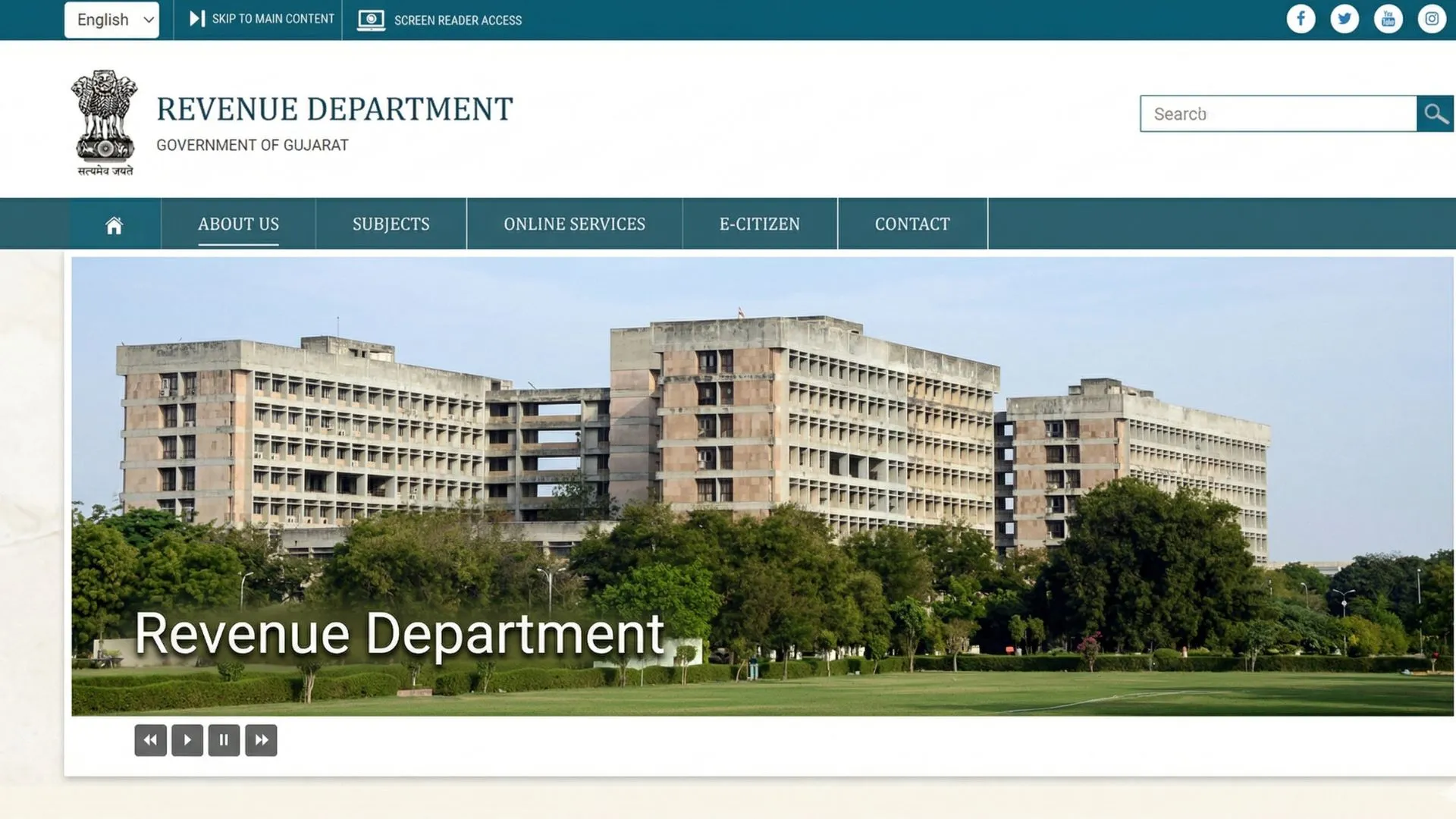
Method 1: Gujarat Revenue Department Website
- Visit revenuedepartment.gujarat.gov.in
- Click on the Jantri option on the homepage
- Select your district from the Gujarat map displayed
- Enter Taluka, Village, Land Type, and Survey Number
- Click Show Jantri to view the applicable rate instantly
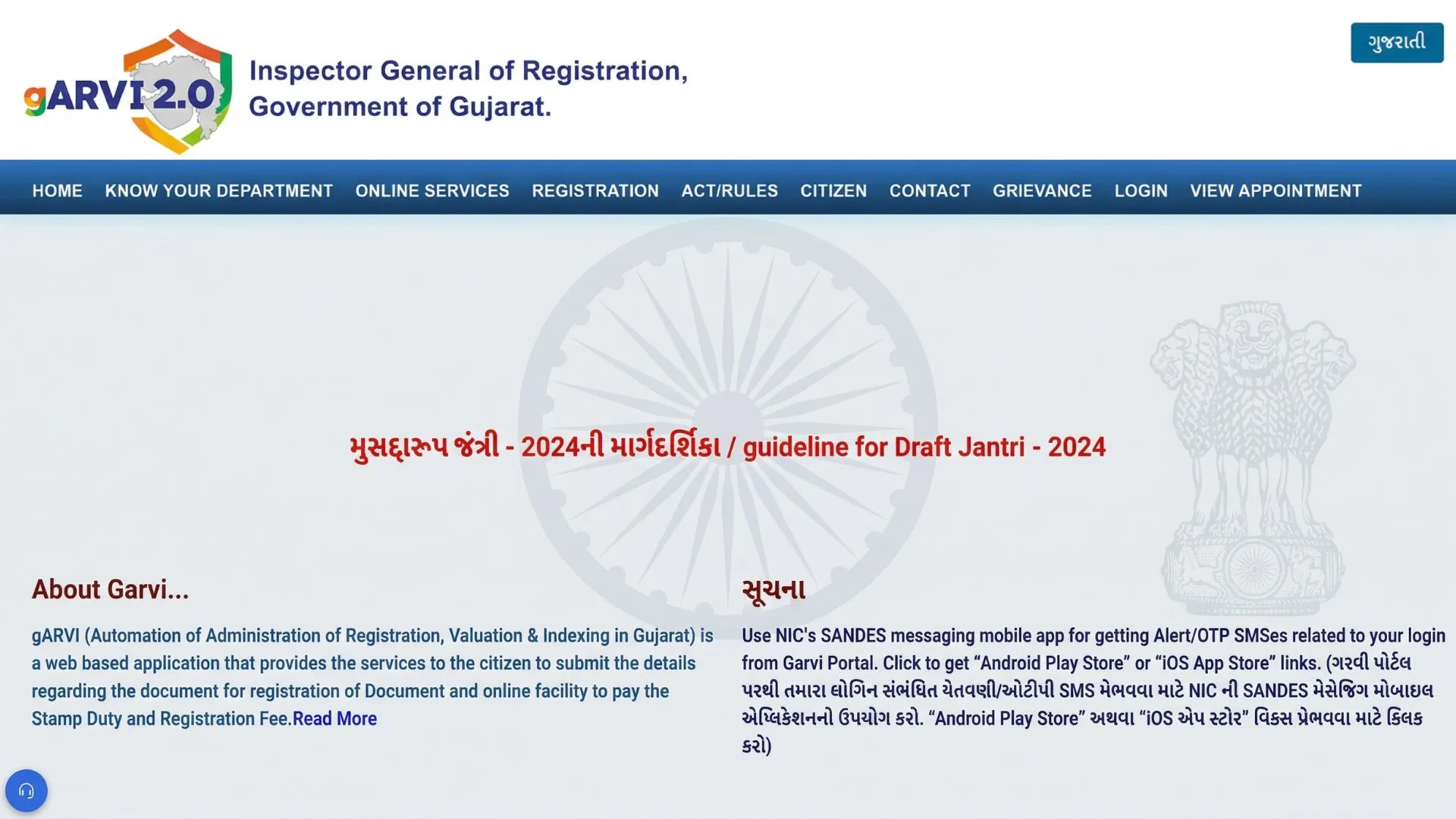
Method 2: Garvi Gujarat Portal
- Visit garvi.gujarat.gov.in
- Select Jantri Rate from the top navigation menu
- Choose District → Taluka → Village
- Select land category; Corporation / Nagarpalika / Rural–Agriculture / Rural–Non-Agriculture
- Click Show Jantri to view and download the rate certificate
Method 3: Mobile App
- Download Gujarati Jantri Ready Reckoner Rates from Google Play Store
- Select your District and Taluka from the drop-down menu
- Enter Survey Number and Land Type
- Tap Show Jantri for on-the-go results
Offline Method to Find Jantri Rate
- Visit the nearest E-Dhara Kendra in your district
- Fill the Jantri application form with Aadhaar number, survey number, land address, and relationship with owner
- Submit to the E-Dhara Kendra operator, who will issue an application reference
- The Tehsildar conducts a field survey and issues the Jantri certificate within 30 days
This method is recommended for rural or agricultural land where online records may need verification.
Stamp Duty and Registration Charges in Gujarat
Fee Structure (2025–26):
|
Buyer Type |
Stamp Duty |
Registration Fee |
Total |
|
Male |
4.9% |
1% |
5.9% |
|
Female |
4.9% |
Nil |
4.9% |
|
Joint (Male + Female) |
4.9% |
0.5% |
5.4% |
Example
Buying a residential flat in Vesu, Surat, with a Jantri Rate of ₹18,000/sq.m., total area 1,000 sq.m.:
Jantri Value: ₹18,000 × 1,000 sq. m. = ₹18,000,000
Stamp Duty (M): 4.9% of ₹1.80 Cr = ₹882,000
Registration Fee: 1% of ₹1.80 Cr = ₹180,000
Total Payable: ₹1,062,000
Tip: Registering under a female family member eliminates the 1% registration fee, a direct saving of ₹180,000 on this transaction.
Latest Updates: Jantri Rate Revision 2023–2026
- The system creates a clear and reliable benchmark that helps buyers, sellers, and financial institutions determine the fair value of a property with confidence.
- Looking ahead, the Gujarat government is set to roll out significant revisions to Jantri rates across all districts in 2025–26.
- In some locations, these revised rates could see a dramatic surge, rising by as much as 2000% compared to the 2023 base rates.
Key Takeaways
- The Jantri Rate established by the Gujarat government functions as the lowest property value, which must be used during registration.
- The calculation of stamp duty uses the greater value between the Jantri rate and the actual sale price.
- The official portal to check rates is garvi.gujarat.gov.in or revenuedepartment.gujarat.gov.in.
- In Gujarat all buyers must pay a stamp duty rate of 4.9 percent, while female owners receive a one percent discount on their registration fees.
- The highest Jantri values exist in prime areas, which include Thaltej (Ahmedabad), Vesu (Surat), and Alkapuri (Vadodara).
- The current lower rates benefit buyers who transact before the major rate revision, which is still pending.
Conclusion
Every buyer and seller and investor and farmer in Gujarat needs to understand the Jantri rate. The official rates have become mandatory information because the upcoming major revision will impact multiple cities, which already experience rising rates in Ahmedabad and Surat. You need to check the exact Jantri rate for your area through the Garvi Gujarat portal or the Revenue Department website before you sign any agreement or start registration.

_1792140859.webp)




_1792151285.webp)

Ans 1. Jantri Rate is the minimum government-notified value of land or property in Gujarat, set by the Revenue Department. No property can be legally registered below this rate. It serves as the official base for calculating stamp duty, registration charges, home loan valuations, and land acquisition compensation.
Ans 2. Jantri Rate is a legally fixed minimum set by the government, while market rate is the actual price agreed between buyer and seller. In most areas, market rates are significantly higher than Jantri rates. Stamp duty, however, is calculated on whichever value is higher.
Ans 3. Jantri rates in Gujarat depend on property type (residential, commercial, or agricultural), location and connectivity, surrounding infrastructure, age of the property, and prevailing market demand in that specific area or taluka.
Ans 4. You can check Jantri rates by visiting revenuedepartment.gujarat.gov.in or garvi.gujarat.gov.in. Select your district, taluka, village, land type, and survey number, then click “Show Jantri.” A mobile app is also available on Google Play Store.
Ans 5. Stamp duty in Gujarat is 4.9% of the higher of Jantri Rate or sale price for all buyers. Male buyers pay an additional 1% registration fee, while female buyers are exempt from registration charges.
Ans 6. The revised Jantri rates proposed in November 2024, suggesting hikes of 5x to 2,000x in select areas, were delayed from the originally planned April 2025 rollout. A phased implementation is expected in 2026. Always verify current rates on the official Garvi Gujarat portal before any transaction.
Ans 7. Prime localities like Thaltej, SG Highway, and Prahlad Nagar in Ahmedabad; Vesu and Adajan in Surat; and Alkapuri in Vadodara have the highest Jantri rates in Gujarat due to strong infrastructure, connectivity, and demand.
Ans 8. Checking the Jantri Rate ensures accurate stamp duty and registration fee calculation, helps buyers plan their total transaction cost, avoids legal disputes, and provides a benchmark for negotiations. With a revision pending, it also helps buyers time their transactions advantageously.
Ans 9. Yes, the agreement sale price can be higher than the Jantri Rate. However, for stamp duty calculation, authorities consider whichever value is higher, either the Jantri Rate or the actual transaction value.
Ans 10. Yes, Jantri Rates are applicable to agricultural land as well. Separate classifications exist for rural agricultural and non-agricultural land, and rates vary based on location and land usage.