
✦ AI Summary
Table of Content
▲- The ₹50 Lakh Crore Capital Picture: What the Numbers Actually Say
- The Affordable Housing Crisis: Hard Numbers Behind the Soft Headlines
- Affordable Housing vs. Premium Housing: Where Capital Is Flowing
- SWAMIH Fund 2.0 and PMAY-Urban 2.0: Government Steps In Where Capital Won't
- Where India's Real Estate Capital Is Actually Going Instead
- What Needs to Change for India's Real Estate to Deliver on Its Promise
- Conclusion
India's Real Estate is heading toward a $1 trillion market by 2030, but somehow, there is a deep contradiction sitting right at the centre of this growth story. As per ANAROCK Capital’s latest report, “Powering the Next Decade: India’s Real Estate Finance Transformation Story” the sector will require nearly ₹50 lakh crore of capital over the next decade.
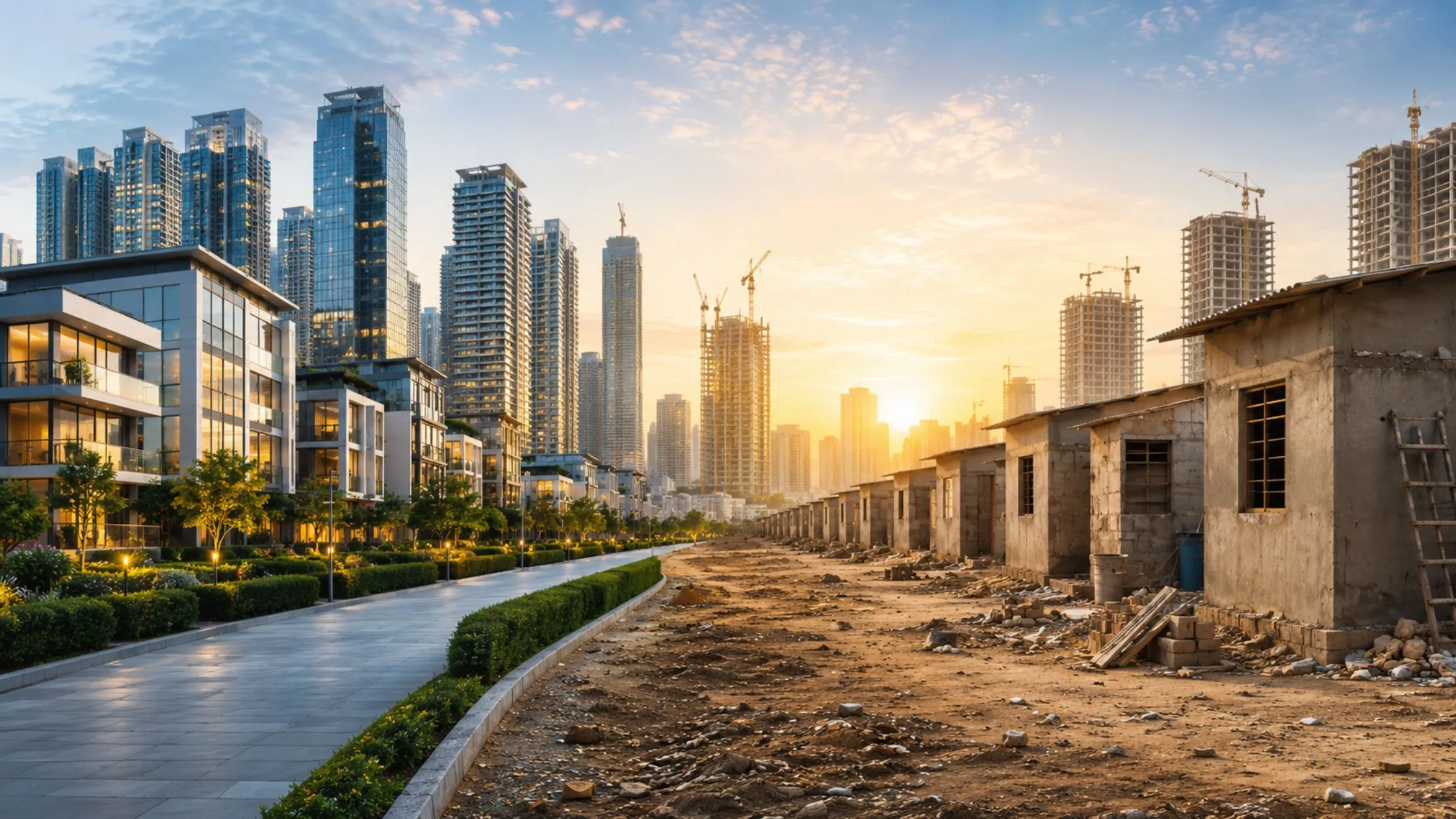
The money is there. The issue is, where it is actually going. It is flowing into premium towers and Grade-A offices in the top metros, while the bit that needs it most, affordable housing, is being quietly, and systematically starved of capital. Here is a detailed breakdown of the funding crisis, who it is hurting, and what structural changes are needed to fix it.
The ₹50 Lakh Crore Capital Picture: What the Numbers Actually Say
India’s real estate capital market is sitting at around ₹50 lakh crore right now. Over time the sector has gone through a real kind of change, from a patchy NBFC-led setup , to something more regulated and multi-vehicle, with the flow shaped by banks, AIFs, REITs, private credit, and those government-backed schemes too.
Here is how the current capital structure breaks down:
India's Real Estate Capital Market: Current Structure (2026)
|
Capital Segment |
Current Value |
Key Source |
|---|---|---|
|
Individual Housing Loans |
₹38 lakh crore |
Banks & HFCs |
|
Commercial Real Estate Loans |
₹12 lakh crore |
Banks & NBFCs |
|
Total Capital Market Size |
₹50 lakh crore |
ANAROCK Capital, 2026 |
|
Listed REITs Combined Market Cap |
₹2.07 lakh crore |
Six Listed REITs |
|
Stalled Affordable Housing Funding Gap |
₹55,000 crore |
1,500+ Stalled Projects |
Key Insight: India’s real estate capital market is not exactly short on money but it is maybe short on direction, like in a weird way. As Shobhit Agarwal, CEO of ANAROCK Capital, said “The real challenge is whether this capital can reach beyond the top developers and major metros so it can fund affordable housing, smaller developers, and emerging Tier II and Tier III cities”.
Also Read: Delhi Development Authority Identifies TOD Plots for Affordable Housing Expansion
The Affordable Housing Crisis: Hard Numbers Behind the Soft Headlines
Despite record institutional participation, affordable housing has seen its share of new launches collapse over the past five years. This is not a demand problem, families across India need affordable homes urgently. It is a capital allocation problem, plain and simple.
Here is what the data reveals:
- In Q1 2026, homes that were priced under ₹40 lakh made up only 10% of the new launches, and this was a big drop from 26% back in 2021 .
- Meanwhile , the properties priced over ₹1.5 crore made 53% of the new launches for that same time period
- India currently faces an urban housing shortage of 10 million units
- By 2030 at least 25 million affordable homes are needed to actually bridge the demand gap , and somehow it’s getting harder.
- More than 4.5 lakh affordable mid income homes , in over 1,500+ projects are still stalled, as in they’re not moving ahead.
- Estimated funding required to restart stalled projects: ~₹55,000 crore
Vishal Srivastava, Managing Director of ANAROCK Capital, stated it plainly: "India's affordable housing problem is no longer a demand issue, but a structural capital allocation and financing architecture challenge."
Affordable Housing vs. Premium Housing: Where Capital Is Flowing
New Launch Share and Capital Access: Affordable vs. Premium Segment (2021–2026)
|
Parameter |
Affordable (Below ₹40L) |
Premium (Above ₹1.5 Cr) |
|---|---|---|
|
Share of New Launches, Q1 2026 |
10% |
53% |
|
Share of New Launches, 2021 |
26% |
~25% |
|
Institutional Capital Access |
Very Low |
High |
|
Developer Profit Margin |
Low |
High |
|
Primary Markets |
Tier II / III Cities |
Top 5 Metros |
|
Social Return on Investment |
Highest |
Low |
|
Formal Lending Preference |
Ignored |
Preferred |
Key Insight: The financing system has kind of drifted into some strange pattern where it keeps rewarding high margin projects,while the part that actually brings the highest social return works mostly outside the formal capital reach. It feels like a structural failure, not really a market correction.
SWAMIH Fund 2.0 and PMAY-Urban 2.0: Government Steps In Where Capital Won't
Recognising the gap that private capital refuses to fill, the government has stepped in with direct policy intervention. Here is where things currently stand:
- SWAMIH Fund was launched in 2019, with an expanded corpus of ₹15,530 crore , it helped in completing 58,596 homes and they’re saying over 1 lakh units are expected in total.
- SWAMIH Fund 2.0 was announced in Budget 2025–26 as a ₹15,000 crore blended finance vehicle , aiming at another 1 lakh stalled units.
- PMAY-Urban 2.0 targets 1 crore extra urban homes across India , so it’s kind a big jump compared to earlier targets.
- Affordable Housing Finance Companies: Projected to grow AUM by 20–21% in FY27, outpacing the broader mortgage sector
These schemes are meaningful steps. But government intervention cannot substitute for the structural redirection of ₹50 lakh crore in private capital toward the people who actually need it.
Where India's Real Estate Capital Is Actually Going Instead
Three emerging asset classes are absorbing the bulk of long-term institutional attention right now:
Emerging Sectors Attracting Long-Term Institutional Capital
|
Sector |
Key Projection by 2030 |
Capital Type |
|---|---|---|
|
Data Centres |
Capacity exceeding 8 GW |
Long-term, yield-focused |
|
Warehousing & Logistics |
605+ million sq. ft. stock |
Globally benchmarked |
|
GCC-Led Office Spaces |
1.2 billion sq. ft. demand |
Institutional, offshore |
These sectors are commercially attractive, high-margin, and globally benchmarked. Affordable housing, with its lower margins and structural complexity, remains off this list entirely.
Also Read: Telangana Real Estate Tribunal Strengthens Homebuyer Rights Under RERA
What Needs to Change for India's Real Estate to Deliver on Its Promise
Three structural shifts are non-negotiable if the ₹50 lakh crore capital story is to actually reach the people who need it:
- Capital has to move past the top five metros: Tier II and Tier III cities do show documented real demand, but somehow they keep getting only minimal formal funding, like it is being ignored or delayed too much.
- Affordable housing also needs dedicated capital frameworks, not just “here’s some announcements” energy, think blended finance, credit guarantees and tax incentives that are actually aimed at sub- ₹40 lakh homes. Not only that, but it should be designed for those homes, specifically not for everything else.
- Smaller developers also need access: the current financing stack tends to reward only established metro developers, which ends up leaving out the builders who are operating closest to where affordable housing demand really sits.
The regulatory environment is improving. RERA , IBC reforms, GST rationalisation, and the RBI ‘s evolving project finance framework are kind of building a clearer, more transparent lending ecosystem . Right now , the developers with better balance sheets are already reaping benefits in a noticeable way, like, step by step. The urgent task is to extend that access downward, to smaller builders, smaller cities, and smaller budgets.
Conclusion
India's Real Estate is at a defining crossroads. The ₹50 lakh crore of capital flowing into the sector over the next decade is enough to address the affordable housing crisis multiple times over, but only if it reaches the right places. Right now, it is not. Premium housing absorbs the attention, metro developers capture the capital, and 25 million families who need a home by 2030 are left waiting.
The growth story is real. The funding is real. The gap is equally real. Whether India's real estate closes that gap or widens it will define the sector's legacy for the next generation of homebuyers.


Ans 1. India's real estate sector needs nearly ₹50 lakh crore of capital over the next 10 years to support its growth into a $1 trillion market by 2030, as projected in ANAROCK Capital's 2026 report.
Ans 2. Institutional capital and formal lending are concentrated around high-margin projects in top metros. Affordable housing, despite offering the highest social return, is seen as commercially unattractive and remains outside formal capital channels.
Ans 3. India currently faces an urban housing shortage of 10 million units, with an additional 25 million affordable homes needed by 2030 to bridge the demand gap.
Ans 4. Only 10% of new housing launches in Q1 2026 were priced below ₹40 lakh, down from 26% in 2021. In the same period, homes priced above ₹1.5 crore made up 53% of all new launches.
Ans 5. SWAMIH Fund 2.0 is a ₹15,000 crore blended-finance vehicle announced in Budget 2025–26, targeting the completion of an additional 1 lakh stalled affordable and mid-income housing units across India.
Ans 6. PMAY-Urban 2.0 is a government housing scheme targeting 1 crore additional urban homes, with a focus on low and middle-income households who cannot access housing through private market channels.
Ans 7. Over 4.5 lakh affordable and mid-income homes across 1,500+ projects are currently stalled in India, requiring approximately ₹55,000 crore in funding support for completion.
Ans 8. Data centres, warehousing, logistics, industrial real estate, and GCC-led office developments are the top recipients of long-term institutional capital in India's real estate market as of 2026.
Ans 9. India has six listed REITs with a combined market capitalisation exceeding ₹2.07 lakh crore as of May 2026, covering 198 million sq. ft. of India's 520 million sq. ft. REIT-worthy office stock.
Ans 10. Currently valued at $550 billion, India's real estate market is projected to reach $5–7 trillion by 2047, backed by strong domestic demand, infrastructure investment, and ongoing regulatory reforms.