
Table of Content
▲- Factors That Affect Jammu & Kashmir Circle Rates
- How Jammu & Kashmir Circle Rates Differ from Market Rates
- Jammu & Kashmir Circle Rates Across Key Localities
- How to Check Jammu & Kashmir Circle Rates Online
- Offline Method to Find Jammu & Kashmir Circle Rates
- Stamp Duty and Registration Charges in Jammu & Kashmir
- Key Takeaways
- Conclusion
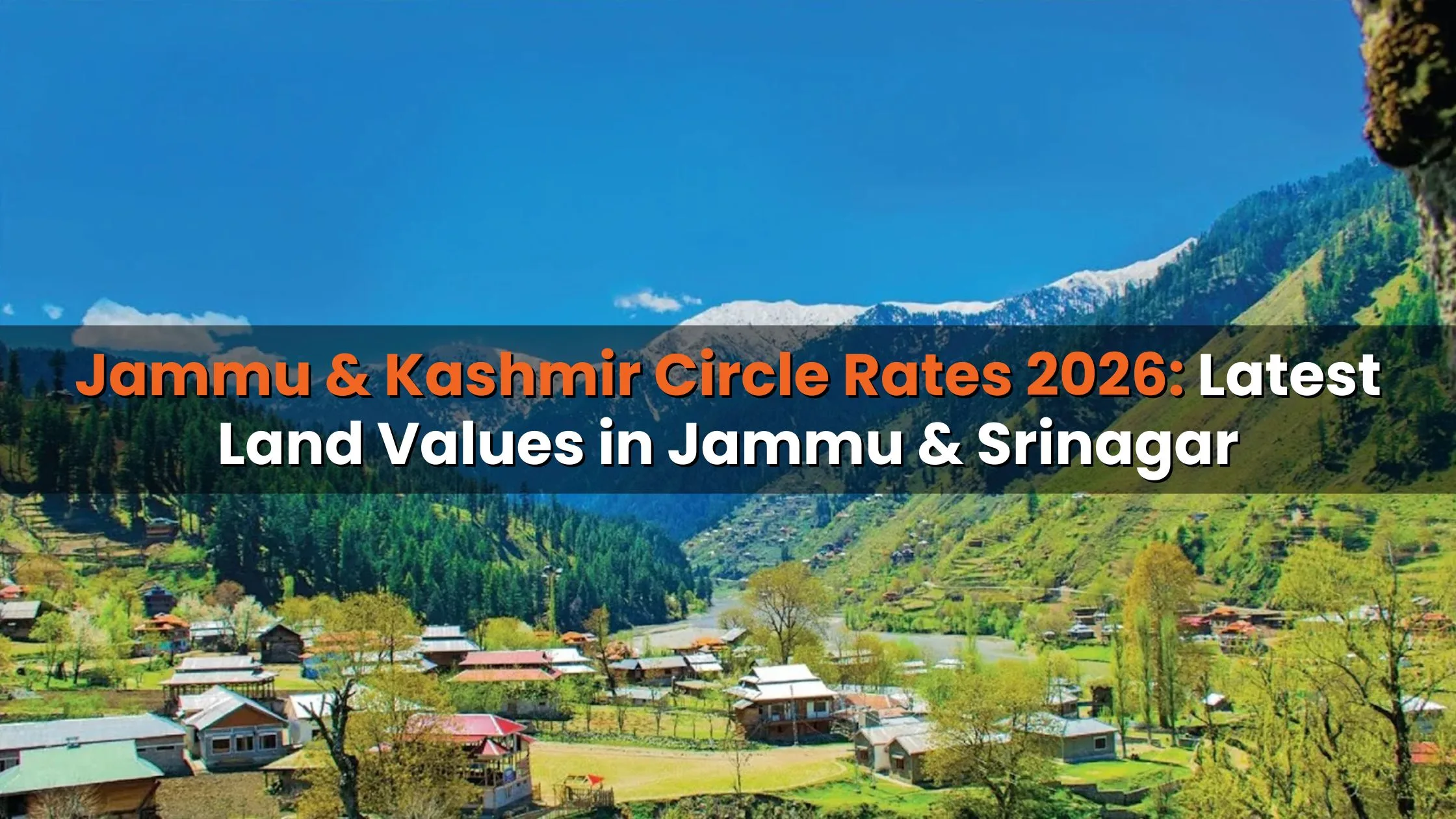
Circle Rates in Jammu & Kashmir are the minimum government-notified property values used for registration purposes. Also called Market Value Guidelines, these rates help:
- Prevent property undervaluation
- Ensure accurate stamp duty collection
- Provide a benchmark for buyers and sellers
For 2026, the J&K government revised circle rates across all districts, with most areas seeing a 10–15% increase due to urban growth, infrastructure projects, and rising property demand.
Factors That Affect Jammu & Kashmir Circle Rates
Several factors determine circle rates in J&K:
- Locality: Prime residential and commercial areas like Lal Chowk in Srinagar or Gandhi Nagar in Jammu have higher rates.
- Market Trends: Real estate demand and supply in a district influence rates. Market rates are generally higher than circle rates.
- Property Type: Commercial properties have higher circle rates than residential ones.
- Infrastructure: Roads, airports, railways, and urban development increase land value.
- Land Purpose: Conversion from residential to commercial or industrial use can raise circle rates.
Also Read: Shimla Circle Rates: Complete Guide for Buying and Selling Property
How Jammu & Kashmir Circle Rates Differ from Market Rates
While circle rates act as government benchmarks, market rates are actual transaction values determined by demand, supply, and location.
|
Aspect |
Circle Rates |
Market Rates |
|
Purpose |
Legal registration & taxation |
Real-time property sale/purchase |
|
Determined By |
J&K Revenue Department |
Buyers & sellers |
|
Typically |
Lower than market rates |
Often higher than circle rates |
|
Usage |
Stamp duty, registration fees |
Investment analysis, negotiations |
Jammu & Kashmir Circle Rates Across Key Localities
Jammu District (2026 Rates)
|
Area / Ward |
Residential (₹/Kanal) |
Commercial (₹/Kanal) |
|
Gandhi Nagar / Trikuta Nagar |
1.30 Cr – 1.70 Cr |
3.00 Cr – 5.00 Cr |
|
Channi Himmat |
1.05 Cr – 1.25 Cr |
2.00 Cr – 2.80 Cr |
|
Greater Kailash / Sainik Colony |
75 Lakh – 95 Lakh |
1.40 Cr – 2.10 Cr |
|
Sidhra / Nagrota Belt |
55 Lakh – 75 Lakh |
90 Lakh – 1.50 Cr |
|
Bahu / Jammu South (Outer) |
60 Lakh – 85 Lakh |
1.10 Cr – 1.80 Cr |
Jammu’s prime residential areas saw a 10% increase in 2026 to reflect market growth.
Srinagar District (2026 Rates)
|
Area / Ward |
Residential (₹/Kanal) |
Commercial (₹/Kanal) |
|
Rajbagh / Jawahar Nagar |
1.60 Cr – 2.10 Cr |
3.80 Cr – 6.50 Cr |
|
Lal Chowk / Residency Road |
2.00 Cr – 2.40 Cr |
5.00 Cr – 8.50 Cr |
|
Hyderpora / Pirbagh |
1.20 Cr – 1.55 Cr |
2.80 Cr – 4.50 Cr |
|
Qamarwari / Bemina |
80 Lakh – 1.10 Cr |
1.40 Cr – 2.00 Cr |
|
Habbak / Hazratbal Belt |
70 Lakh – 90 Lakh |
1.10 Cr – 1.60 Cr |
Srinagar’s commercial hubs like Lal Chowk remain the highest priced areas, while outskirts are gaining value due to the Ring Road project.
Budgam District (2026 Rates)
|
Area / Tehsil |
Residential (₹/Kanal) |
Commercial (₹/Kanal) |
|
Humhama (Airport Road) |
1.00 Cr – 1.35 Cr |
1.70 Cr – 3.10 Cr |
|
Ompora Housing Colony |
80 Lakh – 1.10 Cr |
1.40 Cr – 2.20 Cr |
|
Budgam Town Main Market |
65 Lakh – 90 Lakh |
1.10 Cr – 1.90 Cr |
|
Beerwah / Magam Town |
45 Lakh – 70 Lakh |
95 Lakh – 1.60 Cr |
Budgam is expanding rapidly, especially along airport and railway links, which impacts property values.
Baramulla District (2026 Rates)
|
Area / Town |
Residential (₹/Kanal) |
Commercial (₹/Kanal) |
|
Baramulla Town (Civil Lines) |
75 Lakh – 95 Lakh |
1.40 Cr – 2.30 Cr |
|
Sopore Main Town |
80 Lakh – 1.05 Cr |
1.60 Cr – 2.70 Cr |
|
Pattan (Highway Frontage) |
55 Lakh – 75 Lakh |
1.10 Cr – 1.80 Cr |
|
Tangmarg (Gateway to Gulmarg) |
55 Lakh – 80 Lakh |
1.25 Cr – 2.00 Cr |
Baramulla rates are influenced by NH-44 and its significance in the fruit trade industry.
How to Check Jammu & Kashmir Circle Rates Online
- Visit the J&K Revenue Department portal: https://jkrevenue.nic.in
- Navigate to the “Market Value / Circle Rate” section.
- Select your district and ward.
- Download or view the official PDF of rates.
- Note the residential and commercial rates for accurate calculation.
Offline Method to Find Jammu & Kashmir Circle Rates
- Visit the Tehsildar or Sub-Divisional Officer (SDO) office in your district.
- Request the latest market value / circle rate notification.
- Obtain Khasra-specific rates for your property.
- Keep a printed copy for registration purposes.
This is useful for areas where online records are not fully updated.
Also Read: Circle Rate Uttarakhand: Updated Dehradun & Haridwar Circle Rates Guide
Stamp Duty and Registration Charges in Jammu & Kashmir
Fee Structure (2026):
|
Buyer Type |
Stamp Duty |
Registration Fee |
Total |
|
Male |
7% |
1.2% |
8.2% |
|
Female |
3% |
1.2% |
4.2% |
|
Joint |
5% |
1.2% |
6.2% |
Worked Example:
Buying a 1 Kanal plot in Gandhi Nagar (₹1.50 Cr) as a female buyer:
- Stamp Duty = 3% of ₹1.50 Cr = ₹4.5 Lakh
- Registration Fee = 1.2% of ₹1.50 Cr = ₹1.8 Lakh
- Total Payable = ₹6.3 Lakh
Registering under a female family member helps reduce stamp duty liability.
Key Takeaways
- Circle rates are minimum government-notified values; market rates are typically higher.
- Rates vary by district, locality, and property type.
- Always check official J&K portals or Tehsil offices before purchase or sale.
- Use circle rates to calculate stamp duty and registration charges accurately.
- Prime areas like Lal Chowk (Srinagar) and Gandhi Nagar (Jammu) have the highest rates.
Conclusion
Understanding Circle Rates in Jammu & Kashmir is essential for legal, financial, and investment planning. With 2026 updates reflecting infrastructure growth and rising property demand, buyers and sellers must check rates for their specific districts and wards. Combining official rates, historical trends, and practical tips ensures informed property transactions while minimizing tax liability and legal risks.



Ans 1. Circle rates in Jammu & Kashmir are the minimum government-notified property values used for registration and taxation purposes. They act as benchmarks to prevent undervaluation, ensure proper stamp duty collection, and provide guidance to buyers and sellers.
Ans 2. Circle rates are official government-set values for legal and taxation purposes, while market rates reflect actual transaction prices based on demand, supply, and location. Typically, market rates are higher than circle rates in most districts.
Ans 3. Circle rates in J&K depend on locality, property type, infrastructure development, land purpose, and overall market trends. Prime areas and commercial hubs like Lal Chowk in Srinagar or Gandhi Nagar in Jammu have the highest rates.
Ans 4. . Users can select their district and ward to view or download the official PDF of residential and commercial rates.
Ans 5. Offline rates can be obtained by visiting the local Tehsildar or Sub-Divisional Officer (SDO) office. Homebuyers or sellers can request the latest market value notifications and Khasra-specific rates for accurate registration and stamp duty calculation.
Ans 6. Stamp duty ranges from 3% to 7% depending on the buyer’s gender, and registration fees are 1.2% of the property value. Combined charges vary accordingly; for example, a female buyer purchasing a 1 Kanal plot in Gandhi Nagar (₹1.5 Cr) would pay a total of ₹6.3 lakh.
Ans 7. Prime areas like Lal Chowk and Residency Road in Srinagar, Gandhi Nagar and Trikuta Nagar in Jammu, and commercial hubs in each district have the highest residential and commercial circle rates due to location, infrastructure, and market demand.
Ans 8. Checking circle rates ensures accurate calculation of stamp duty and registration fees, prevents legal disputes, and provides a benchmark for negotiations. It also helps buyers and sellers plan financials and comply with government regulations.