
✦ AI Summary
Table of Content
▲- What a Retirement Home Actually Offers That a Regular Apartment Doesn't
- The Three Ownership Models: Freehold, Leasehold, and Rental
- A Real Cost Comparison: Retirement Home vs Regular Apartment Plus Home Care
- The Resale and Exit Risk Almost Nobody Talks About
- The MoHUA Model Guidelines: A Real Regulatory Reference Point
- What Happens When Care Needs Change, or After the Resident Passes Away
- For NRIs Researching Options for a Parent
- A Decision Framework
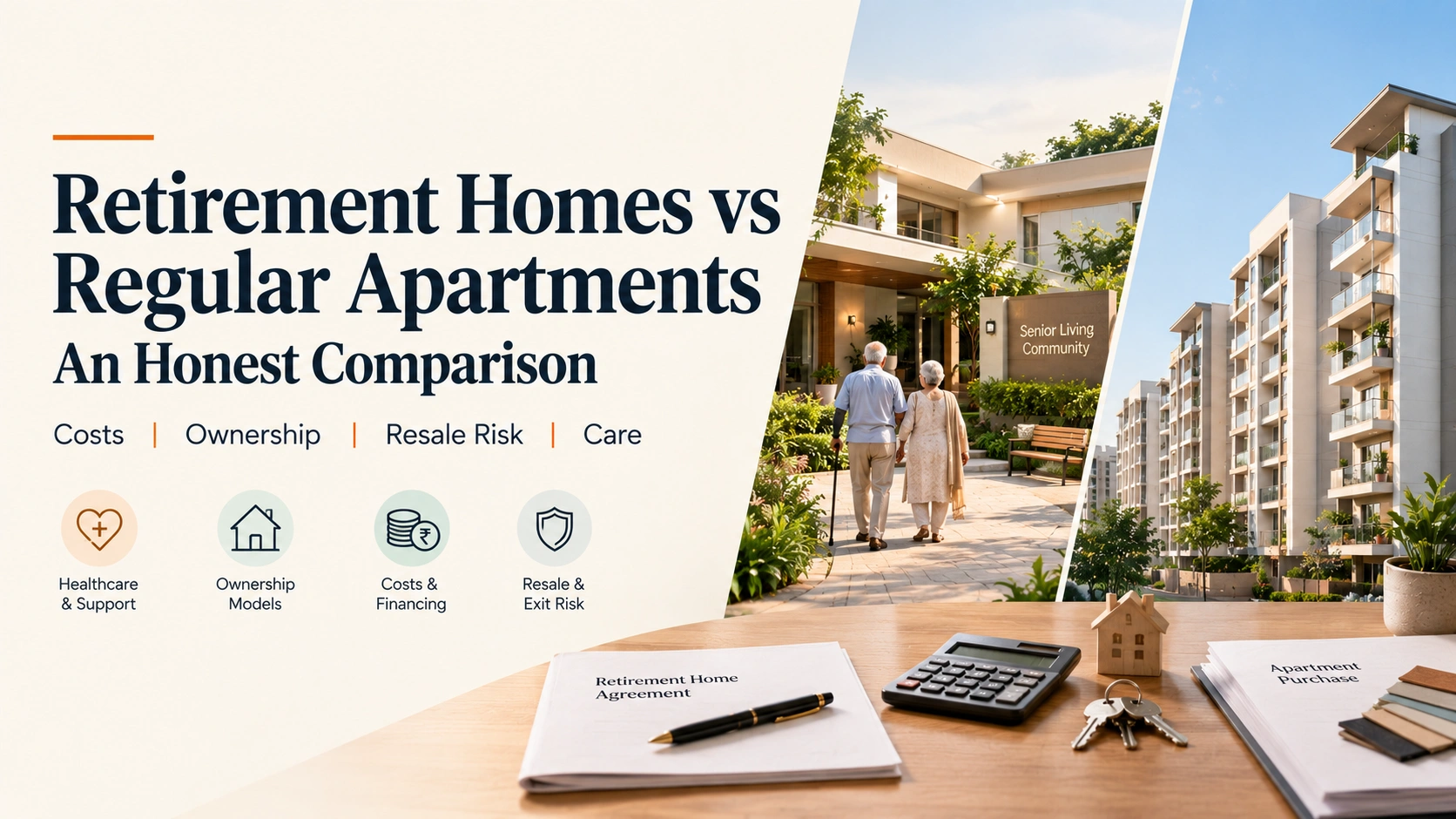
A meaningful share of what's currently written comparing retirement homes to regular apartments in India is published directly by senior-living operators, and it shows: cost breakdowns are often genuinely detailed, but resale risk, exit friction, and the honest financial trade-off against staying in a regular apartment with arranged home care are treated lightly or skipped entirely. That's not necessarily dishonest, an operator genuinely believes in their model, but it's not a neutral comparison either.
This guide tries to be that neutral comparison: what a purpose-built retirement home actually offers, the ownership structures involved (which are genuinely more complex than a standard apartment purchase), a real cost comparison against the regular-apartment-plus-care alternative, the resale and exit risk that deserves far more attention than it usually gets, and a decision framework tied to actual health and financial circumstances rather than a declared universal winner.
What a Retirement Home Actually Offers That a Regular Apartment Doesn't
Purpose-built retirement communities in India typically bundle several things a regular apartment doesn't: on-site or on-call medical support and emergency response systems, senior-friendly physical design (ramps, grab bars, anti-skid flooring, wider doorways), structured community and social activity, and services like housekeeping, meals, and physiotherapy either included or available on a plan. The genuine value proposition is reducing the daily-life friction and isolation risk that can accumulate for a senior living alone in a standard building not designed with ageing in mind.
A regular apartment offers none of this by default, but nothing stops a family from replicating much of it independently: hiring a caregiver or home nurse, arranging meal delivery, installing safety modifications, and building a social routine through community, family, or religious networks. The real question isn't whether a retirement home offers more, it generally does, but whether that bundled offering is worth its actual cost relative to assembling an equivalent (if less turnkey) set of supports independently.
The Three Ownership Models: Freehold, Leasehold, and Rental
This is where retirement homes get structurally more complicated than a standard apartment purchase, and it's worth understanding clearly before comparing costs.
Freehold (outright purchase): the buyer owns the unit outright, with full resale and inheritance rights, similar in structure to a standard apartment purchase, generally offering better long-term security and estate-planning clarity than the alternatives below.
Leasehold: typically running 10 to 30 years, offering a lower upfront cost than freehold purchase, bundled with service agreements for healthcare and maintenance, but without the same permanence; renewal terms, cost implications on renewal, and restrictions on resale or inheritance need to be clarified explicitly before signing, since these vary significantly by developer and aren't standardised across the industry.
Monthly rental/lease-with-service: no capital purchase at all, a recurring monthly fee that typically bundles accommodation with meals, housekeeping, security, and basic care, an increasingly popular model, reportedly growing faster than the purchase model, precisely because it preserves liquidity rather than locking up a large sum of capital.
A regular apartment, by contrast, essentially only involves two of these: freehold purchase or standard market rental, neither carrying the service-bundling, age-eligibility, or renewal complexity that leasehold and rental retirement-home models do. This added structural complexity is itself a real cost, in time, legal review, and long-term planning uncertainty, that a straightforward apartment purchase doesn't carry.
A Real Cost Comparison: Retirement Home vs Regular Apartment Plus Home Care
Retirement home costs in India in 2026 span an extremely wide range depending on city and model: purchase prices commonly run from roughly ₹26-50 lakh at the more accessible end to ₹1-3.5 crore or more for premium and luxury developments, while monthly rental/lease models start around ₹25,000 and can exceed ₹1.5 lakh for premium communities, generally excluding meals and higher-tier medical support, which are often billed separately.
For comparison, a regular apartment plus independently arranged home care might look like: the apartment's own cost (purchase or rent, whatever the family already has or is planning regardless of the retirement-home decision), plus a full-time or part-time caregiver (a genuinely wide range depending on qualification and hours, commonly a significant monthly cost in its own right in most Indian cities), plus any home modifications, plus meal arrangements if needed.
Neither model is unambiguously cheaper; the honest framing is that buying a retirement home trades liquidity and flexibility for a bundled, turnkey environment, while staying in a regular apartment with arranged care trades some convenience and structure for capital flexibility and the ability to adjust the care arrangement incrementally as needs actually evolve, rather than committing to one model upfront. Over a long horizon, the opportunity cost of capital matters too: money tied up in a retirement-home purchase isn't earning a return elsewhere, a real, quantifiable trade-off that pure cost comparisons often leave out.
The Resale and Exit Risk Almost Nobody Talks About
This is the section most current India-focused content treats lightly, and it deserves real weight. In more mature retirement-housing markets like the UK, where this pattern is well-documented by independent consumer-advocacy research, retirement flats face a genuinely difficult resale environment: a limited buyer pool due to age-eligibility restrictions, exit or transfer fees payable to the community's management company on resale (sometimes structured as a percentage per year of occupancy), average marketing times of 12 to 18 months, with some units taking three years or more to sell, and immediate value depreciation on resale, commonly cited around 20% or more below the original purchase price, partly because that original price reflected marketing and amenity costs that don't fully transfer to a resale buyer.
India's retirement-housing sector is younger and less standardised than the UK's, so these exact figures shouldn't be assumed to transplant directly. But the underlying structural drivers, age-restricted buyer eligibility, service-charge and transfer-fee structures that can deter buyers, and a genuinely smaller resale market than standard residential apartments, are real and directly relevant considerations for the Indian market too, and are worth asking any specific developer about explicitly: how resale is actually handled, whether the developer assists with it, what fees apply, and how long it typically takes in practice, rather than assuming resale will work the same way a standard apartment sale would.
A regular apartment, by contrast, sells into the ordinary residential market with no age-eligibility restriction on the buyer pool and no retirement-community-specific transfer fee, generally offering meaningfully better liquidity if circumstances require a sale.
The MoHUA Model Guidelines: A Real Regulatory Reference Point
India's Ministry of Housing and Urban Affairs has issued Model Guidelines for Development and Regulation of Retirement Homes, aimed specifically at protecting senior citizens' property rights and standardising how retirement homes are developed and operated. The guidelines address a genuinely practical set of concerns: a model tripartite agreement structure (between the developer, the resident, and, where applicable, an operating service provider), building design and safety standards specific to senior needs, and service standards for the living environment.
For a buyer, this is a concrete, checkable reference point, worth asking whether a specific development's agreement structure and service commitments align with these model guidelines, rather than relying solely on marketing material. This is a genuinely underused piece of due diligence in most consumer-facing comparison content, and directly parallels the kind of regulatory verification AquireAcres recommends in its property title verification checklist.
What Happens When Care Needs Change, or After the Resident Passes Away
This is worth clarifying explicitly before committing to any model, since the answer varies significantly by ownership structure. Under a freehold purchase, the unit passes to heirs in the ordinary course, similar to any other owned property. Under leasehold or rental/service models, terms vary considerably by operator and need to be confirmed in writing, what happens to the remaining lease term or any deposit if the resident needs to step up to assisted living or memory care, whether that's available within the same community or requires relocating entirely, and what refund or transfer provisions apply if the arrangement ends earlier than expected.
Many purpose-built communities offer a continuum, from independent living through assisted living to higher-acuity care, within the same campus, which can be a genuine advantage over a regular apartment (where escalating care needs generally require a separate, new arrangement entirely), but this continuum isn't universal, and confirming whether a specific community actually offers it, versus requiring relocation to a different facility as needs increase, is worth doing before assuming it as a given.
For NRIs Researching Options for a Parent
This is a large and specific segment of this audience, and a few considerations apply on top of everything above. NRIs can generally purchase residential property, including retirement-home units, under FEMA regulations without prior RBI approval, as explained in our NRI property investment guide.
Because the decision-maker often can't personally visit and evaluate multiple options before committing, the due-diligence burden shifts more heavily onto verifying the developer's legitimacy and licensing (confirming valid authorisation to operate elder-care and assisted-living services, and genuine healthcare tie-ups rather than marketed but unconfirmed partnerships), reviewing the actual written agreement and required property documents rather than relying on a sales call summary, and, where possible, having a trusted person locally visit and confirm conditions match what's been represented before finalising payment.
A Decision Framework
If the senior's primary need is community, structured activity, and reducing isolation, and the family has sufficient capital they're comfortable committing with reduced liquidity: a purpose-built retirement home, ideally one aligning with the MoHUA Model Guidelines and offering a genuine continuum of care, can meaningfully improve quality of life, provided the resale and exit terms have been reviewed honestly rather than assumed.
If flexibility and capital preservation matter more, or the senior's care needs are still evolving and hard to predict: a regular apartment with incrementally arranged home care preserves the ability to adjust the support level as needs actually change, without committing a large sum to a single ownership or leasehold structure upfront, and retains meaningfully better resale liquidity if circumstances change.
If the family is drawn to a retirement home mainly for its investment potential rather than its lifestyle and care value: this is worth reconsidering carefully, given the documented resale friction pattern in more mature markets and the genuinely narrower buyer pool retirement homes carry compared to standard residential property; a retirement home should generally be evaluated primarily as a lifestyle and care decision, not a real estate investment. If investment returns are the primary objective, the decision should be evaluated separately from the lifestyle and care benefits discussed above; our real estate investment framework for 2026 provides a broader way to assess capital appreciation, rental yield, liquidity and risk.
If the decision is being made for a parent from abroad: prioritise verifying the specific developer's legitimacy, licensing, and the actual written agreement terms over the persuasiveness of marketing material, and involve a trusted local visitor wherever possible before finalising.



Ans 1. It depends on the senior's actual needs. Retirement homes offer bundled medical support, senior-friendly design, and community, which a regular apartment doesn't provide by default, but nothing stops a family from arranging equivalent support independently. The honest answer is conditional on health status, family proximity, and how much the family values flexibility versus a turnkey environment.
Ans 2. Freehold means outright ownership with full resale rights, similar to a standard apartment. Leasehold typically runs 10-30 years with lower upfront cost but less permanence. Rental/lease-with-service models involve no capital purchase, just a recurring monthly fee, preserving liquidity but building no long-term asset.
Ans 3. Generally yes. Retirement homes typically have a smaller buyer pool due to age-eligibility restrictions, may carry exit or transfer fees, and, in more mature markets, have shown longer marketing times and immediate value depreciation on resale compared to standard residential property. Always ask a specific developer directly how resale is handled before committing.
Ans 4. It should generally be evaluated primarily as a lifestyle and care decision rather than an investment. The documented resale friction pattern for age-restricted housing in more mature markets suggests retirement homes are less liquid and less reliably appreciating than standard residential property.
Ans 5. A framework issued by India's Ministry of Housing and Urban Affairs to protect senior citizens' property rights and standardise retirement home development, covering a model tripartite agreement, building design standards, and service norms. It's worth asking a specific developer whether their agreement aligns with these guidelines.
Ans 6. Under freehold ownership, the unit passes to heirs normally. Under leasehold or rental models, terms vary by operator and should be confirmed in writing, including what happens to any remaining lease term or deposit, and whether the community offers a continuum into assisted living or requires relocating to a different facility.
Ans 7. Yes, generally, without prior RBI approval under FEMA, provided payment is routed through the correct NRE or NRO channels. Since the NRI often can't visit personally, verifying the developer's actual licensing and healthcare tie-ups, and reviewing the written agreement carefully, matters more than it would for a buyer who can visit directly.
Ans 8. Retirement home purchase prices commonly range from roughly ₹26 lakh to over ₹1-3.5 crore depending on city and tier, with monthly rental models starting around ₹25,000. Neither model is unambiguously cheaper than an apartment plus independently arranged home care; the real trade-off is liquidity and flexibility versus a bundled, turnkey environment.