
✦ AI Summary
Table of Content
▲- Why Has Haryana Approved a New Metro Land Acquisition Policy?
- What Does the New Policy Allow?
- NCRTC Projects That Will Benefit
- Land Requirement for NCRTC Projects
- Existing Land Acquisition Process vs Direct Purchase Policy
- Why NCRTC Requested the Policy
- Impact on Infrastructure Development in Haryana
- What Happens Next?
- Conclusion
The Haryana government has made a pretty significant move, to enhance regional transport infrastructure by approving a strategy that allows direct land acquisition from private owners for metro and rapid transit initiatives. The choice is expected to speed up land acquisition for key corridors tied to NCR Transport Corporations (NCRTC) projects, and in turn it should shorten the time line that usually slows down big infrastructure work.
The updated policy also kind of expands the existing governance framework used by Gurugram Metro Rail Limited (GMRL) and it will cover metro and rapid transit construction that is being carried out by NCR Transportation (NCRTC) and Haryana Mass Rapid Transport Authority (HMRTC). Industry experts seem to think this initiative can substantially improve project schedules, while also boosting connectivity across Haryana and the NCR.
Why Has Haryana Approved a New Metro Land Acquisition Policy?
Land acquisition is among the biggest obstacles when it comes to infrastructure development in India. The traditional procedures for taking land, plus compensating landowners under the Right to Fair Compensation and Transparency in Land Acquisition , Rehabilitation and Resettlement (RFCTLARR) Act 2013, can get complicated pretty fast due to long administrative routines.
So, as a fix for delays in the older process, Haryana has introduced a direct purchase scheme where government entities can negotiate directly with landowners for the purchase of land. The building of an RRTS corridor, which needs hundreds of hectares from many different private owners, can run into delays because acquisitions may become contested or slow. That, naturally, affects the entire progress of the project.
Key Objectives of the Policy
- Accelerate land acquisition for NCRTC projects
- Reduce project delays caused by lengthy acquisition procedures
- Improve transparency through structured negotiations
- Support metro and rapid rail infrastructure expansion
- Strengthen regional connectivity across NCR
The policy is expected to create a smoother pathway for acquiring land required for major transportation corridors.
Also Read: Change of Land Use (CLU) Process in Haryana: Fees and Online Application
What Does the New Policy Allow?
The approved framework enables private land and properties to be purchased through mutual negotiations with property owners rather than requiring the government to follow the full RFCTLARR acquisition process in every case. This gives infrastructure agencies the flexibility to move faster when landowners are willing to negotiate and transact voluntarily. The process will be managed through a District Land Purchase Committee headed by the Deputy Commissioner.
Structure of the Committee
The committee will include:
- Deputy Commissioner as Chairperson
- Senior officials from relevant departments
- Representatives from NCRTC
- Other designated government members
The committee will evaluate land requirements, negotiate compensation, and facilitate transparent transactions with landowners. This model is designed to balance infrastructure needs with fair compensation for property owners.
NCRTC Projects That Will Benefit
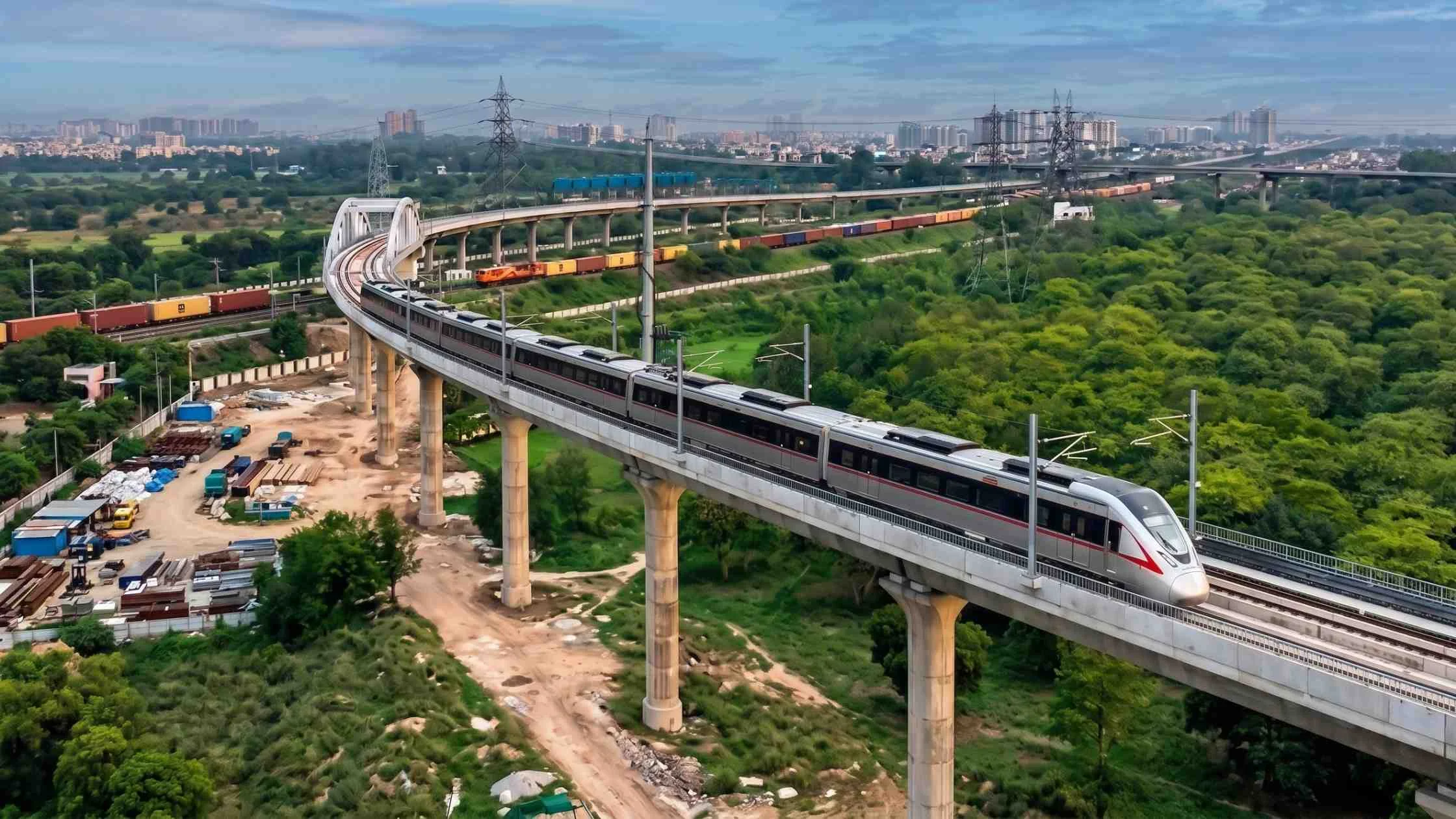
The approval comes at a crucial time as NCRTC advances planning and execution for two major Namo Bharat Regional Rapid Transit System (RRTS) corridors.
Delhi Gurugram Bawal RRTS Corridor
This corridor will connect Delhi to Gurugram and extend south to Bawal in the Mahendragarh district creating a high-speed regional transit connection across one of India's most economically productive corridors.
Key Highlights
- Total corridor length: 93.12 km
- Length within Haryana: 71.14 km
The importance of the corridor extends beyond transportation convenience; it handles over 40% of Delhi's commuting volume. The Gurugram - Delhi roadway is one of India's busiest routes, movement occurs between Delhi and Gurugram in both directions; freight and passenger traffic occurs through Gurugram and the rest of Haryana. RRTS provides an entirely new dimension to the travel experience of the 38% of India's workforce who live in the national capital, using this corridor.
Delhi Panipat Karnal RRTS Corridor
The second corridor extends north from Delhi through Panipat to Karnal connecting the capital to two of Haryana's most significant industrial cities and improving regional mobility across the northern NCR belt.
Key Highlights
- Total corridor length: 136.30 km
- Length within Haryana: 100.15 km
Panipat is one of the largest centres of textile and petrochemicals in India and has numerous manufacturing facilities with employees travelling to and from Delhi and many other towns and cities. Karnal is also an administrative centre and an agricultural market centre for northern Haryana.
Reliable fast rail transport from Delhi to both cities would help to promote development by extending the effective supply of skilled employees and by lowering the cost to industries that rely on the national highway corridor for transporting goods from one location to another.
Land Requirement for NCRTC Projects
Large-scale transit infrastructure requires substantial land resources.
According to NCRTC estimates, both RRTS corridors combined require:
|
Land Type |
Requirement |
|
Government Land |
202.98 hectares |
|
Private Land |
154 hectares |
|
Total Land Requirement |
356.98 hectares |
Securing this land efficiently is critical to maintaining project schedules and controlling development costs. The total 356.98 hectares required ,154 hectares is private land which needs to be acquired from individual owners, not just shifted from one government entity to another, easy enough in theory. That 154 hectares is spread across multiple parcels, multiple owners, multiple districts, and multiple land classifications. Under the standard RFCTLARR process, each parcel would need to move through the full procedural sequence, start to finish.
Also Read: How to View and Download Bhu Naksha from Jamabandi Haryana Portal
Existing Land Acquisition Process vs Direct Purchase Policy
|
Feature |
Traditional Acquisition |
Direct Purchase Policy |
|
Acquisition Method |
Legal acquisition process |
Mutual negotiation |
|
Approval Timeline |
Longer |
Faster |
|
Administrative Complexity |
High |
Moderate |
|
Stakeholder Engagement |
Limited |
Direct |
|
Compensation Discussions |
Fixed procedures |
Negotiated |
|
Project Delays |
Higher risk |
Reduced risk |
The direct purchase approach offers greater flexibility while helping infrastructure agencies acquire land more efficiently.
Why NCRTC Requested the Policy
Earlier this year, NCRTC approached the Haryana government seeking inclusion under the direct land purchase framework. The corporation highlighted concerns regarding delays associated with the RFCTLARR Act process. The government's response extending the GMRL framework to NCRTC and HMRTC addresses these concerns directly by creating a legally structured alternative to the standard process.
Challenges Faced Under Traditional Acquisition
- Lengthy procedural requirements
- Extended approval timelines
- Delayed project execution
- Increased construction costs
- Uncertainty in land availability
By adopting the direct purchase model, NCRTC expects to secure land faster and move projects toward the construction phase more efficiently.
Impact on Infrastructure Development in Haryana
The decision could have far-reaching implications beyond the NCRTC corridors.
Faster Project Execution
With quicker land procurement, infrastructure projects can move from planning to construction without prolonged delays.
Improved Regional Connectivity
The proposed RRTS corridors will strengthen links between Delhi and major Haryana cities, making daily travel faster and more convenient.
Economic Growth
Enhanced transportation infrastructure often attracts:
- Commercial investments
- Industrial development
- Residential projects
- Employment opportunities
Boost to Real Estate Markets
Areas located near future RRTS stations may witness increased demand from homebuyers and investors seeking improved connectivity.
What Happens Next?
The Detailed Project Reports (DPRs) for the two primary NCRTC corridors have been approved by the Haryana government and are now being reviewed by the Union government.
Key developments expected in the coming months include:
- Final approvals from the central government
- Land acquisition through negotiated purchases
- Corridor planning and design finalization
- Tender issuance for construction work
- Commencement of project execution
Officials have indicated that a construction tender for the Delhi Gurugram Bawal corridor could be floated in the near future.
Conclusion
Haryana's government approves direct land acquisition policy for NCRTC and HMRTC initiatives shows significant change in policy intended to expedite the advancement of transportation infrastructure. The government aims to minimize delays, enhance efficiency and facilitate the prompt implementation of essential metro and rapid rail projects by permitting land acquisition via mutual negotiations.
This shift is significant for the Delhi-Gurugram-Bawal and Delhi-Panipat-Karnal RRTS corridors expected to boost regional connectivity and keep economic growth going for a while. As land acquisition is becoming faster and more efficient , Haryana is getting ready to take a more prominent part in the rise of modern transport infrastructure across the National Capital Region.



Ans 1. The Haryana Cabinet has approved a policy allowing direct purchase of private land for metro and rapid transit projects through negotiated transactions with landowners, rather than requiring the full statutory acquisition process under the RFCTLARR Act 2013. The policy extends the framework already used by Gurugram Metro Rail Limited and makes it applicable to projects executed by NCRTC and Haryana Mass Rapid Transport Corporation Limited. The process will be managed by District Land Purchase Committees headed by Deputy Commissioners to ensure accountability and transparency while enabling faster land procurement for RRTS corridors.
Ans 2. The Haryana direct land purchase policy will primarily benefit two major Namo Bharat RRTS corridors being developed by NCRTC. The Delhi-Gurugram-Bawal RRTS corridor is 93.12 km in total length with 71.14 km within Haryana, connecting Delhi, Gurugram, and the Bawal industrial area. The Delhi-Panipat-Karnal RRTS corridor is 136.30 km in total with 100.15 km within Haryana, connecting Delhi to Panipat and Karnal. Together, both corridors require 356.98 hectares of land including 154 hectares of private land that the new policy will help acquire more efficiently.
Ans 3. The combined land requirement for both NCRTC RRTS corridors in Haryana is 356.98 hectares. This comprises 202.98 hectares of government land and 154 hectares of private land that must be acquired from individual owners. The private land component 154 hectares spread across multiple parcels and owners in different districts is what the new direct purchase policy is specifically designed to help acquire more efficiently through negotiated transactions rather than the standard statutory acquisition process.
Ans 4. The RFCTLARR Act 2013 is the standard statutory framework for land acquisition in India that involves mandatory multi-stage administrative processes, prescribed compensation formulas, social impact assessments, and consent requirements resulting in longer timelines particularly for large parcels with multiple owners. The new direct purchase policy allows private land to be acquired through mutual negotiation between the government (through District Land Purchase Committees) and willing landowners, structured as a commercial transaction with agreed compensation rather than a statutory acquisition. The direct purchase approach is faster for willing sellers while the RFCTLARR process remains available for situations where voluntary agreement isn't reached.
Ans 5. The Delhi-Gurugram-Bawal RRTS corridor is a proposed Namo Bharat Regional Rapid Transit System connection spanning 93.12 km, with 71.14 km within Haryana. It will connect Delhi to Gurugram, one of India's most congested business corridors and extend south to Bawal in Mahendragarh district, an emerging industrial area. The Detailed Project Report has received Haryana government approval and is under Union Government review. Officials have indicated that a construction tender for this corridor could be floated in the near term, suggesting active project advancement. The corridor is expected to significantly reduce commute times on the Delhi-Gurugram route and support industrial development in Bawal.
Ans 6. The District Land Purchase Committee established under Haryana's new metro land acquisition policy will be chaired by the Deputy Commissioner of each relevant district. The committee includes senior state government officials from relevant departments, NCRTC representatives with technical and financial project knowledge, and other designated government members. The committee will assess land requirements against project engineering specifications, facilitate and oversee negotiations with individual landowners, evaluate compensation proposals, and complete transactions with appropriate documentation. This structure provides the efficiency of direct negotiation while maintaining governmental oversight and accountability.
Ans 7. The Delhi-Panipat-Karnal RRTS corridor is a proposed 136.30 km Namo Bharat rapid transit connection, with 100.15 km within Haryana, linking Delhi to Panipat and Karnal in northern Haryana. Panipat is one of India's major textile and petrochemical manufacturing cities, while Karnal is an important agricultural market and administrative centre. The corridor would significantly improve regional mobility for industrial workforces commuting between these cities and Delhi, support economic development in both cities by expanding their effective labour catchment, and improve goods movement for industries using the northern NCR corridor. The DPR has been approved by the Haryana government and is under Union Government consideration.
Ans 8. NCRTC approached the Haryana government proactively seeking inclusion under the direct purchase framework after analysing the delays that the standard RFCTLARR acquisition process would likely create for RRTS project timelines. The corporation highlighted specific concerns including lengthy procedural requirements that extended timelines regardless of landowner cooperation, uncertainty in land availability timing that complicated contractor scheduling, increased costs from project delays, and the cascading effect on project finance when delays extended acquisition phases. By requesting the direct purchase alternative, NCRTC was seeking a mechanism to move land acquisition at a pace compatible with the project's construction readiness.
Ans 9. The RRTS corridors are expected to drive real estate price appreciation in areas near planned stations following the well-documented pattern of transit infrastructure's impact on property values. Station catchment areas typically see residential demand increase as commuting feasibility improves, attracting buyers who can now consider previously too-distant locations viable. Commercial development follows improved transit connectivity as businesses recognise expanded customer and workforce reach. Industrial areas like Bawal and Panipat that gain efficient Delhi connectivity may see stronger industrial real estate demand. The appreciation effect typically begins building in anticipation of corridor completion rather than only after operations start.
Ans 10. HMRTC stands for Haryana Mass Rapid Transport Corporation Limited, the state-level mass transit corporation responsible for metro and rapid transport projects within Haryana's jurisdiction. The new direct land purchase policy adopted by the Cabinet specifically includes HMRTC alongside NCRTC as an eligible entity under the framework. This means HMRTC's future transportation projects can also use the negotiated direct purchase mechanism for private land acquisition rather than relying solely on the standard statutory process. The inclusion creates a standardised approach to transit land acquisition across multiple agencies operating in Haryana.