
✦ AI Summary
Table of Content
▲- Vastu for Irregular Plot
- Why Plot Shape Matters in Vastu
- Common Irregular Plot Shapes and Their Effects
- Which Irregular Plot Shapes Are Considered Better?
- Best Vastu Remedies for Uneven Land Shapes
- Irregular Plot Shapes and Recommended Remedies
- Mistakes to Avoid with Irregular Plots
- Should You Buy an Irregular Plot?
- Benefits of Correcting an Irregular Plot
- Final Thoughts
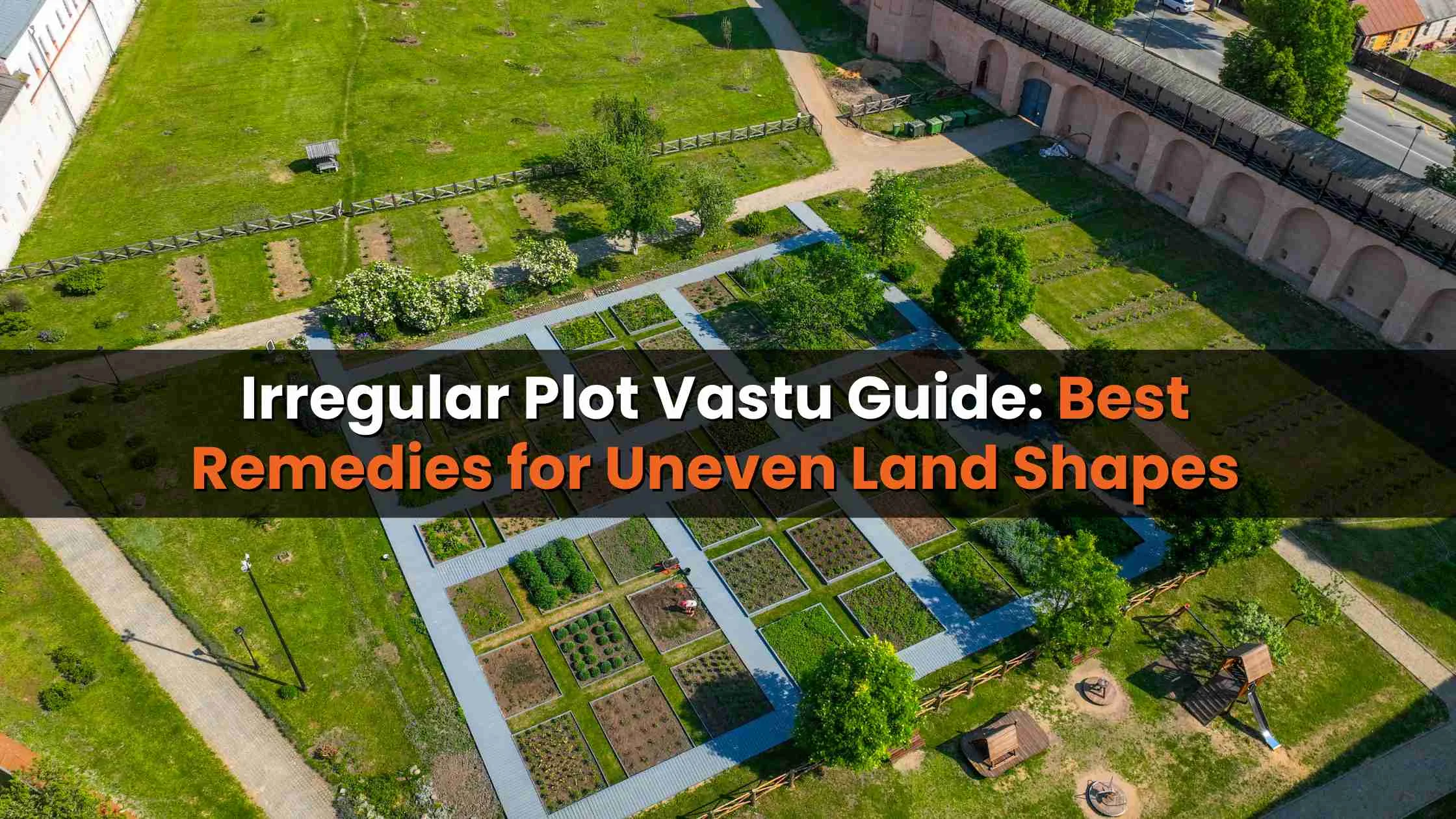
Buying a plot is one of the most important real estate decisions, and many buyers in India consider Vastu Shastra before making an investment. While square and rectangular plots are generally considered ideal, irregular plots are common in modern cities due to road layouts, land divisions, and urban planning constraints.
An irregular plot does not automatically make a property unsuitable. According to Vastu principles, certain uneven plot shapes can be corrected through proper planning, construction techniques, and Vastu remedies. Understanding the effects of irregular land shapes can help homeowners make informed decisions and reduce potential Vastu concerns.
Vastu for Irregular Plot
To understand the Vastu concerns around irregular plots, it helps to understand why plot shape matters in Vastu's framework in the first place rather than simply accepting that it does.
Vastu Shastra organises space around directional zones, each associated with specific elemental energies and life domains. The North is associated with prosperity and career. East with health and new beginnings. North-East with spiritual energy and positive life force. South-West with stability and permanence.
South-East with wealth and fire energy. Each of these zones needs to be present, balanced, and appropriately treated within a property for the energy associated with that domain to be properly expressed. An irregular plot is any land parcel that does not follow a perfect square or rectangular shape. These plots may have:
- Uneven boundaries
- Missing corners
- Extended corners
- Curved edges
- Non-parallel sides
- Triangular or L-shaped layouts
According to Vastu beliefs, plot shape influences the flow of positive energy within a property. Balanced shapes are believed to support stability, while irregular shapes may create energy imbalances if not properly managed.
Also Read: Should You Buy a Corner House? Pros and Cons Every Buyer Should Weigh
Why Plot Shape Matters in Vastu
In Vastu Shastra, the plot serves as the foundation of the entire property. The shape of the land is believed to influence:
- Financial growth
- Family harmony
- Health and well-being
- Career opportunities
- Mental peace
- Long-term prosperity
A properly balanced plot allows for better space planning and energy distribution, while highly irregular plots may require corrective measures.
Common Irregular Plot Shapes and Their Effects
L-Shaped Plot
L-shaped plots are probably the most common irregular shape encountered in Indian urban real estate, created by road junctions, land divisions from larger parcels, and the geometric reality of how streets and subdivisions develop. An L-shaped plot essentially creates a plot that is missing one corner, the corner that would complete the rectangle if the L were straightened.
Possible Vastu Concerns
- Missing directional corner
- Uneven energy distribution
- Delayed growth opportunities
Suggested Remedy
- Create a regular rectangular area using a compound wall.
- Use the extra portion for landscaping or open space.
Triangular Plot
Triangular plots are among the shapes that Vastu treats most cautiously, and for understandable geometric reasons. A triangular plot, by definition, has only three corners which means it is missing multiple directional reference points. The sharp angles that define a triangle's corners are also considered energetically problematic in Vastu, associated with conflict and tension rather than the stability of right-angle corners.
Possible Effects
- Financial instability
- Increased disputes
- Stress and uncertainty
Suggested Remedy
- Develop construction only within a rectangular section.
- Leave the remaining portion as a garden or open area.
T-Shaped Plot
T-shaped plots typically arise from road intersections and land divisions where a plot fronts on one road and extends back into another configuration. They're common in areas where residential lanes meet larger arterial roads, or where older land holdings have been subdivided in ways that created unusual shapes.
Possible Effects
- Decision-making challenges
- Family disagreements
- Business instability
Suggested Remedy
- Use landscaping barriers.
- Create a balanced internal plot layout.
Circular or Curved Plot
Circular or significantly curved plots are less common than the angular irregular shapes, but they appear in certain urban planning contexts and in properties along curved roads where the boundary follows the road's arc.
Possible Effects
- Lack of stability
- Difficulty maintaining balanced energy zones
Suggested Remedy
- Construct a rectangular compound wall within the plot boundary.
Which Irregular Plot Shapes Are Considered Better?
One of the most important nuances in irregular plot Vastu that buyers often miss is that extensions where a plot extends beyond the standard rectangle in a specific direction are assessed very differently depending on which direction the extension falls in.
Some extensions are traditionally considered beneficial:
- North extension
- North-East extension
- East extension
These directions are often associated with growth, prosperity, and positive energy in Vastu practices. However, proper site planning remains essential.
Best Vastu Remedies for Uneven Land Shapes
Vastu remedies for irregular plots range from the comprehensive (complete restructuring of the usable zone) to the targeted (specific treatments for specific problem areas). Here are the approaches that consistently appear across different Vastu traditions.
Regularize the Plot Shape
The most fundamental and most consistently recommended remedy for any irregular plot is to identify the largest coherent rectangular zone within the irregular shape and restrict the main construction to this area. Whatever falls outside this rectangular zone, the extension corners, the angled sections, the curved edges is treated as secondary outdoor space.
Benefits include:
- Better space utilization
- Improved layout planning
- Balanced directional zones
Use Compound Walls Strategically
Compound walls serve a dual function in irregular plot Vastu. They physically define the boundary of the main living zone, creating the geometric clarity that the land boundary lacks. And they provide a visual and energetic separation between the regular living environment and any irregular extensions.
This approach is commonly used for:
- L-shaped plots
- Triangular plots
- Extended corner plots
Develop Green Spaces
The sections of irregular plots that fall outside the main construction zone, the L-extension, the triangular corners, the curved edges need not be wasted. Converting these areas to garden, lawn, or landscaped spaces creates beneficial outdoor environments that contribute positively to the property's character.
Unused irregular sections can be converted into:
- Gardens
- Lawns
- Meditation spaces
- Landscape zones
This improves aesthetics while maintaining practical land use.
Maintain Open North and East Areas
According to Vastu principles:
- North zones should remain lighter and open.
- East zones should allow natural sunlight.
This can help improve overall balance within the property.
Keep the Plot Clean and Well Maintained
Neglected corners and unused spaces are often considered unfavorable.
Always:
- Remove debris regularly
- Maintain landscaping
- Ensure proper lighting
- Avoid water stagnation
Also Read: Corner Plot Vastu Rules Every Property Buyer Should Know
Irregular Plot Shapes and Recommended Remedies
|
Plot Shape |
Vastu Rating |
Possible Concern |
Recommended Remedy |
|
Square Plot |
Excellent |
None |
No correction needed |
|
Rectangular Plot |
Very Good |
Minimal |
Proper planning |
|
North-East Extended Plot |
Good |
Generally positive |
Maintain openness |
|
L-Shaped Plot |
Moderate |
Missing corner |
Regularize with boundary wall |
|
Triangular Plot |
Low |
Financial instability |
Build within rectangular section |
|
T-Shaped Plot |
Low |
Energy imbalance |
Internal plot correction |
|
Circular Plot |
Moderate |
Lack of directional balance |
Create rectangular construction zone |
|
South-West Extended Plot |
Low |
Stability concerns |
Isolate extension through landscaping |
Mistakes to Avoid with Irregular Plots
Many property owners make avoidable mistakes when dealing with uneven land shapes.
Avoid These Common Errors
- Constructing over every irregular corner
- Ignoring plot orientation
- Blocking North-East areas completely
- Leaving unused sections neglected
- Building without proper site planning
- Overlooking drainage and sunlight access
Proper planning often solves more issues than expensive corrections.
Should You Buy an Irregular Plot?
Many homebuyers make the decision to avoid irregular plots categorically after reading about Vastu concerns, passing on properties with good location, clear legal documentation, and attractive pricing because the shape doesn't conform to the square or rectangular ideal. This is often an overcorrection.
You may consider purchasing one if:
- The location is excellent.
- The price is attractive.
- The irregularity is manageable.
- Construction can be planned effectively.
- Legal documentation is clear.
Many premium residential and commercial projects are built on plots that are not perfectly square or rectangular. Smart design and proper planning often matter more than shape alone.
Benefits of Correcting an Irregular Plot
Once properly planned, an irregular plot can offer:
- Better property utilization
- Improved resale potential
- Enhanced visual appeal
- More efficient space management
- Reduced Vastu concerns
- Greater buyer confidence
Final Thoughts
Irregular plots are increasingly common in modern urban developments, but they do not have to become a barrier to property ownership. According to Vastu principles, square and rectangular plots remain the most preferred options, while shapes such as L-shaped, triangular, and T-shaped plots may require corrective measures. By using compound walls, creating regular construction zones, maintaining open spaces, and following practical planning strategies, homeowners can improve both functionality and Vastu balance.
The key is not simply avoiding irregular plots but understanding how to manage them effectively. With proper design, landscaping, and thoughtful development, even uneven land shapes can become comfortable, valuable, and attractive properties.



Ans 1. An irregular plot is not automatically bad in Vastu, it depends on the specific shape, the direction of any extensions or missing corners, and whether appropriate remedies can be applied. Square and rectangular plots are considered ideal because they allow complete directional zone planning, but many irregular plots can be effectively managed through compound walls, selective construction zones, and thoughtful landscaping. Plots with North-East or North extensions are generally considered favourable despite being irregular. The most challenging configurations are those with South-West extensions, missing South-West corners, or severe triangular shapes that leave too little space for a practical rectangular construction zone.
Ans 2. The primary Vastu remedy for an L-shaped plot is to establish a clear rectangular construction zone within the plot by using compound walls to separate the L extension from the main building area. The main home is constructed within the rectangular section, and the L extension is maintained as a garden, lawn, or landscaped outdoor space. This approach ensures that the living environment has complete directional definition while the additional land remains usable. The specific concern about an L-shaped plot depends on which corner is missing, a missing North-East corner requires more careful remediation than a missing South-East.
Ans 3. Yes, but with specific modifications. Vastu recommends building only within a rectangular section established within the triangular plot, leaving the angular portions as garden or open landscaped space. The main building should not incorporate the acute angles of the triangle into its structure, as sharp angular corners within a living space are considered energetically unfavourable. Compound walls can help define the rectangular construction zone within the triangle. The overall assessment of a triangular plot depends on the orientation of the triangle's apex, a triangle with the pointed end toward the North-East is considered somewhat more manageable than one pointing South-West.
Ans 4. Among irregular plots, a North-East extended plot is generally considered the most favourable in Vastu. The North-East direction is associated with positive life force, wisdom, and spiritual energy, and an extension in this direction is believed to amplify these beneficial qualities rather than create imbalance. North extended and East extended plots are also considered relatively favourable. The least favourable irregular configurations include South-West extensions, triangular plots with the apex pointing South or South-West, and plots with missing North-East corners.
Ans 5. A missing North-East corner is considered one of the more significant concerns in irregular plot Vastu. The North-East is the zone most strongly associated with positive life force, spiritual well being, mental clarity, and the overall quality of the household's energy environment. A plot that is missing its North-East corner whether through an L-shape, a cut corner, or a diagonal boundary is believed to reduce the household's access to these beneficial qualities. The remedy typically involves keeping the North-East area as open and light as possible, establishing the main construction in the remaining rectangular zone, and potentially adding a water feature or meditation space in the North-East area of the available plot to reinforce that directional zone's energy.
Ans 6. T-shaped plots are generally considered challenging in Vastu due to the directional ambiguity and decision-making difficulties associated with T-junction geometry. The T-shape creates a plot without clear geometric unity, and the extending arm of the T can be problematic depending on the direction it points. The recommended remedy is to create a clear rectangular internal layout for the main construction, use landscaping to separate the T extension from the primary building area, and establish a single clear directional orientation for the main entrance rather than allowing the T shape to create ambiguity about the property's primary facing direction.
Ans 7. Some Vastu corrections can be applied after construction is complete, but they are more limited than those available during planning and construction. Post-construction remedies for irregular plots include strategic landscaping to manage irregular sections, addition of compound walls or boundary elements to separate problematic extensions from the main living area, specific Vastu elements such as copper pyramids or yantra at affected directional points, and improving the maintenance, drainage, and overall condition of neglected irregular sections. The most effective approach is always to address plot shape concerns during the planning and design stage before construction begins, as structural remedies are more comprehensive than after-the-fact corrections.
Ans 8. Not necessarily. Irregular plots should be assessed on their specific characteristics rather than avoided categorically. Many excellent properties both residential and commercial are built on irregular plots that have been managed effectively through good planning. The factors that make an irregular plot worth considering despite its shape include an excellent location, an attractive price that reflects the irregularity, a manageable shape that can be corrected through compound walls and construction planning, adequate size to establish a proper rectangular construction zone, and clear legal documentation. The decision should weigh the plot's practical qualities alongside Vastu considerations rather than treating plot shape as the single determining factor.
Ans 9. Among all possible plot extensions, a North-East extension is considered the most auspicious in Vastu. This direction is associated with wisdom, positive life force, spiritual energy, and new beginnings, and an extension here is believed to amplify beneficial qualities rather than create imbalance. North extensions are associated with prosperity and career growth and are also considered favourable. East extensions bring additional morning light and health-positive energy. South-West extensions are considered the most problematic, associated with stability disruption and relationship difficulties. South extensions are moderately unfavourable. The specific effect also depends on how the extension is managed and maintained.
Ans 10. Compound walls are the primary practical tool for managing irregular plots in Vastu. They serve several functions simultaneously. They physically define a rectangular construction zone within an irregular boundary, ensuring the main living area has complete directional definition regardless of the overall plot's shape. They provide visual and energetic separation between the regular living environment and irregular plot extensions. They can isolate problematic extensions particularly South-West extensions from the main household energy. And they allow the irregular sections to be used beneficially as gardens or outdoor spaces rather than either being ignored or forcing irregular geometry into the construction design. The compound wall should ideally be higher in the South and South-West and lower or more open in the North and East.