
✦ AI Summary
Table of Content
▲- The Core Trade-Off in One Paragraph
- Rental Yield: The Actual Numbers
- Footfall vs Conversion: The Counterintuitive Finding
- The Hidden Cost of Mall Ownership: CAM Charges and Usable Area
- Lease Structures: Fixed Rent vs Revenue Share
- Vacancy Risk: What's in Your Control and What Isn't
- Liquidity and Exit: Which Is Easier to Sell?
- A Decision Framework by Investor Profile
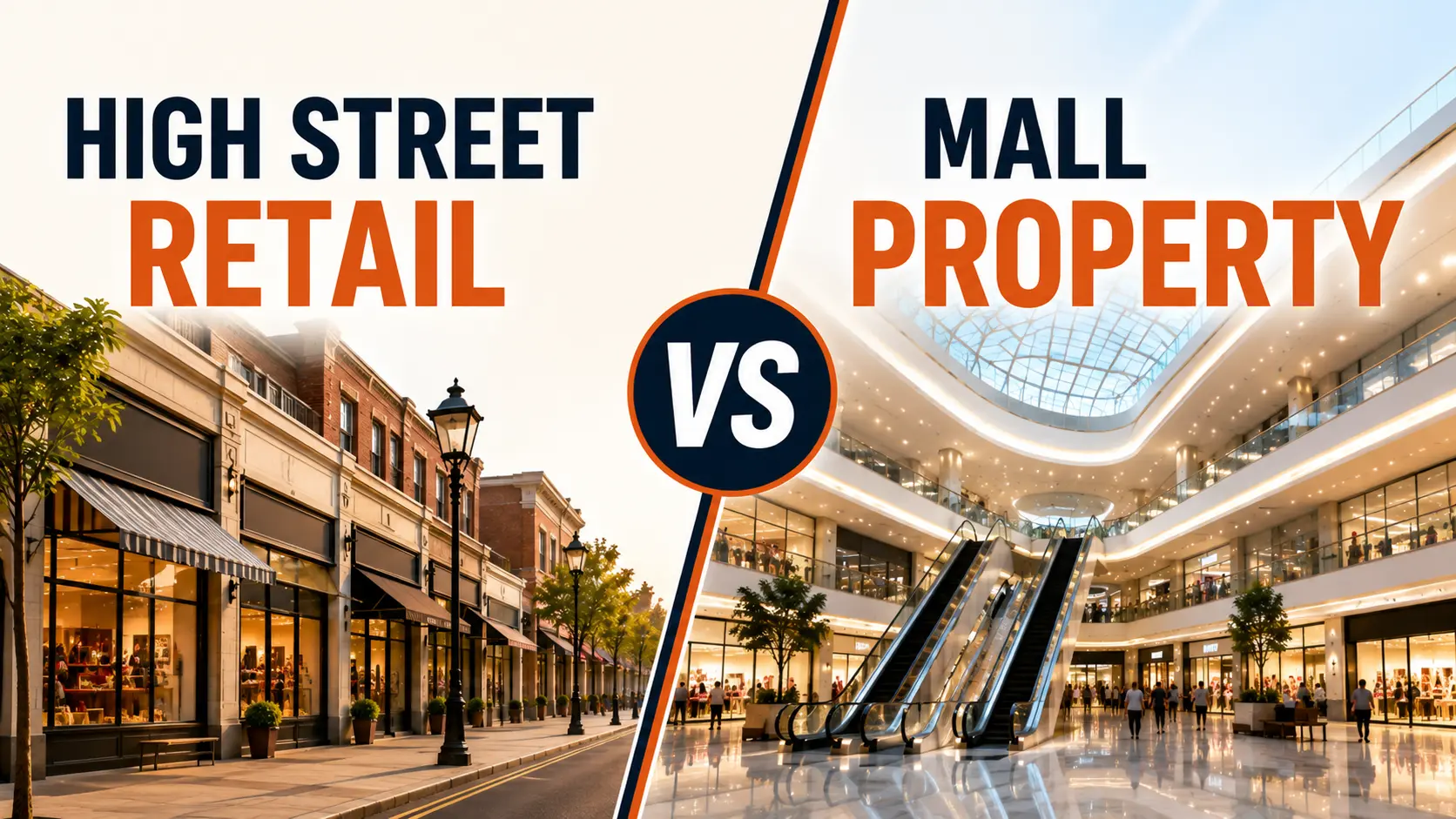
High street shops and mall units aren't just two flavours of the same investment; the economics work differently enough that the format you choose can matter as much as the location. Malls command higher headline rents, but a meaningful share of that gets absorbed by Common Area Maintenance charges and, increasingly, revenue-share arrangements that high street landlords rarely deal with. High street shops earn lower rent per square foot, but keep more of it, and, in a genuinely counterintuitive finding worth leading with, convert visiting footfall into actual sales at a noticeably higher rate than mall units do.
Neither format is universally better. This guide walks through the actual numbers, the hidden costs, and a decision framework tied to what kind of investor you are, building on our broader commercial property investment guide for readers earlier in that decision.
The Core Trade-Off in One Paragraph
Malls offer higher raw footfall, stronger tenant covenant quality, and a professionally managed environment, at the cost of higher and less predictable occupancy expenses, and a return that's partly tied to the mall's overall health rather than your specific unit alone. High street shops offer lower occupancy costs, more owner control, and often better conversion economics for the retailer inside, at the cost of a footfall ceiling and more dependence on your specific stretch of street staying relevant. Everything below unpacks what sits behind that trade-off.
Rental Yield: The Actual Numbers
Across recent 2026 data, well-located high street retail in Tier I cities typically delivers a rental yield in the 6% to 8.5% range depending on frontage, sector, and tenant quality, while premium mall assets can push slightly higher, commonly 7% to 9%, but with meaningfully more volatility around that figure. Notably, despite mall rents being higher in absolute terms, several market studies have found that high street shops in Tier I cities have shown stronger annual growth in rental yields over time than mall spaces, even though the headline rent per square foot remains lower. Mall rental growth has averaged closer to 6% annually over the last five years; high street growth in prominent metro locations has, in several recent years, outpaced that.
The takeaway: a mall unit's higher advertised rent doesn't automatically translate into a proportionally higher net yield once growth trajectory and occupancy costs, covered below, are factored in.
Footfall vs Conversion: The Counterintuitive Finding
This is worth understanding properly before comparing anything else, because it changes how "footfall" should actually be read as a metric.
Mall spaces typically see around 100 visitors a day per unit, considerably more than the 15 to 40 daily visitors a typical high street shop sees. But sales conversion rates, the share of visitors who actually buy something, run 3 to 4 times higher on high streets than in malls. A significant portion of mall footfall is browsing, window shopping, or simply passing through on the way to a food court or cinema, rather than arriving with specific purchase intent. High street footfall, by contrast, skews more toward people who came to that specific stretch for a specific reason.
For an investor, this matters because your tenant's actual revenue, and therefore their ability to pay rent reliably and renew their lease, depends on sales, not raw footfall. A tenant paying premium mall rent against a large footfall number that converts poorly can be in a genuinely more precarious position than a high street tenant paying less rent against a smaller but higher-converting customer base. This is a real factor in assessing tenant retention risk in either format, not just a curiosity about shopping behaviour.
The Hidden Cost of Mall Ownership: CAM Charges and Usable Area
This is the single most important number that headline mall rent figures don't show. Before investing in a commercial unit, buyers should also review the commercial property documents carefully.
Mall Common Area Maintenance charges are mandatory, not optional, and typically run ₹150 to 300 per square foot per month in metro markets, on top of base rent, with annual escalations commonly in the 5 to 8% range. On a 1,000 sq ft unit, that can add ₹25,000 to 50,000 in monthly cost that generates no revenue for the tenant and directly compresses what a landlord can realistically charge as rent while keeping the space commercially attractive. Over a typical 36-month lease period, that adds up to roughly ₹9 to 18 lakh in pure occupancy cost beyond rent, a figure that meaningfully changes the real economics of a mall unit compared to how it looks on a simple rent-per-square-foot basis.
CAM charges apply regardless of whether the unit is occupied or vacant, which matters directly to an investor-owner: a vacant mall unit still generates a maintenance cost obligation, unlike a vacant high street shop, which typically carries no equivalent mandatory charge.
Separately, a mall unit's chargeable or built-up area is often meaningfully larger than its actual usable carpet area, since common areas, corridors, and shared facilities are factored into what tenants are billed for. A 1,000 sq ft mall unit can, in some cases, translate to closer to 500 sq ft of genuinely usable retail space, a load factor that high street shops generally don't carry to the same degree, since a standalone shop's frontage and floor area are typically fully usable by the tenant.
Lease Structures: Fixed Rent vs Revenue Share
High street leases are typically straightforward: a fixed monthly rent, negotiated directly between landlord and tenant, with periodic escalation clauses. This gives an owner predictable income but ties the ceiling of that income to whatever was negotiated, regardless of how well the tenant's business performs.
Mall leases increasingly use a minimum-guarantee-plus-revenue-share structure: the tenant pays a base minimum rent, or a percentage of gross monthly revenue, whichever is higher. For example, a restaurant might pay ₹200 per sq ft as a minimum guarantee or 8% of gross revenue, whichever is greater. This model gives the landlord (and, in a leased-to-a-management-company structure, indirectly the unit owner) some upside if the tenant performs exceptionally well, but also means income can compress toward the minimum guarantee floor if the tenant underperforms, and doesn't offer the same simple predictability a fixed high street lease does.
For a passive investor evaluating either format, understanding which lease structure applies to a specific unit, and what the minimum guarantee floor actually is, matters more than the headline rent figure quoted during a sales pitch.
Vacancy Risk: What's in Your Control and What Isn't
Commercial property vacancy, in either format, can run considerably longer than typical residential vacancy, sometimes several months between tenants, generating property tax and maintenance costs with zero rental income in the meantime. Investors should therefore understand the risks of investing in commercial real estate before choosing between the two formats.
The nature of that risk differs by format, though. A high street shop's vacancy risk is largely tied to your specific location and your relationship with prospective tenants; it's a risk you can actively manage through pricing, tenant selection, and direct negotiation. A mall unit's vacancy risk is partly tied to factors entirely outside your control as an individual unit owner: the mall's overall occupancy health, whether the anchor tenant remains in place and continues drawing footfall, and the mall management's overall execution. A well-run mall with a stable anchor tenant can see strong occupancy across all its smaller units; a struggling mall can see vacancy cascade across many owners simultaneously, regardless of how good any individual unit's own location within the mall is.
Liquidity and Exit: Which Is Easier to Sell?
A standalone high street shop is generally easier to sell individually. Its value is tied primarily to its own location, frontage, and lease status, factors a buyer can evaluate directly and independently of anything else.
A mall unit's resale value is more entangled with the mall's overall trajectory as a project. A well-performing, high-occupancy mall can support strong resale values across its units; a mall experiencing rising vacancy or reputational decline can see individual unit values compress even for units with a currently paying tenant, since a prospective buyer is effectively also buying exposure to that mall's overall future. This is worth weighing seriously for any investor who anticipates needing to exit within a defined timeframe rather than holding indefinitely.
A Decision Framework by Investor Profile
If you want simpler, more predictable economics and are comfortable with more hands-on tenant management: a high street shop, in a genuinely strong catchment with dense daily-need footfall, generally offers better net-yield stability and easier eventual resale, based on the data above.
If you want access to stronger tenant brands, professional common-area management, and are comfortable with more variable income tied partly to factors outside your direct control: a mall unit, specifically in an established, high-occupancy Grade A development with a strong, stable anchor tenant, can offer a reasonable trade-off, provided you factor CAM charges and usable-area loss honestly into your yield calculation rather than relying on the headline rent figure alone.
If your capital is more limited and you want the lowest realistic occupancy-cost drag: high street retail generally has the edge, since CAM charges alone can meaningfully compress a mall unit's real yield in a way a comparably-priced high street shop doesn't experience.
If you specifically want a passive, pre-leased investment with an established tenant already in place: a pre-leased mall unit inside a strong-performing, high-occupancy mall can be a reasonable choice, provided you verify the mall's overall occupancy health and the specific lease's structure (fixed versus revenue-share, and where the minimum guarantee actually sits) before committing, rather than treating "pre-leased" alone as sufficient due diligence.




Ans 1. Neither is universally better. High street retail in Tier I cities has shown stronger annual rental yield growth in recent years despite lower headline rent, while premium malls can offer a slightly higher gross yield range (7% to 9% versus 6% to 8.5%) but with more volatility and higher hidden costs.
Ans 2. Because mall units carry mandatory CAM charges, commonly ₹150 to 300 per sq ft per month with annual escalation, plus, increasingly, revenue-share lease structures, both of which reduce net income in ways high street shops generally don't experience to the same degree.
Ans 3. Not necessarily. Malls see roughly 100 visitors a day per unit compared to 15 to 40 for a typical high street shop, but high street conversion rates run 3 to 4 times higher, meaning high street footfall converts to actual sales more reliably than mall footfall does.
Ans 4. Common Area Maintenance charges cover the upkeep of a mall's shared spaces and are mandatory regardless of whether your unit is occupied. In metro markets, they commonly run ₹150 to 300 per square foot per month, adding roughly ₹25,000 to 50,000 a month on a 1,000 sq ft unit.
Ans 5. The risk types differ. A high street shop's vacancy and performance risk is tied mainly to its specific location, which an owner can actively manage. A mall unit's risk is partly tied to the mall's overall occupancy health and anchor tenant stability, factors an individual unit owner can't directly control.
Ans 6. A standalone high street shop is generally easier to sell individually, since its value depends mainly on its own location and lease status. A mall unit's resale value is more tied to the mall's overall trajectory as a project.
Ans 7. A fixed-rent lease charges a set monthly amount regardless of tenant performance, common on high streets. A revenue-share lease, increasingly common in malls, charges either a minimum guaranteed rent or a percentage of the tenant's gross revenue, whichever is higher, which ties landlord income more directly to how well the tenant's business actually performs.
Ans 8. It can be, provided you verify the specific mall's overall occupancy health and the lease's actual structure, fixed rent versus revenue-share, and where the minimum guarantee sits, rather than assuming "pre-leased" alone is sufficient due diligence.