
✦ AI Summary
Table of Content
▲
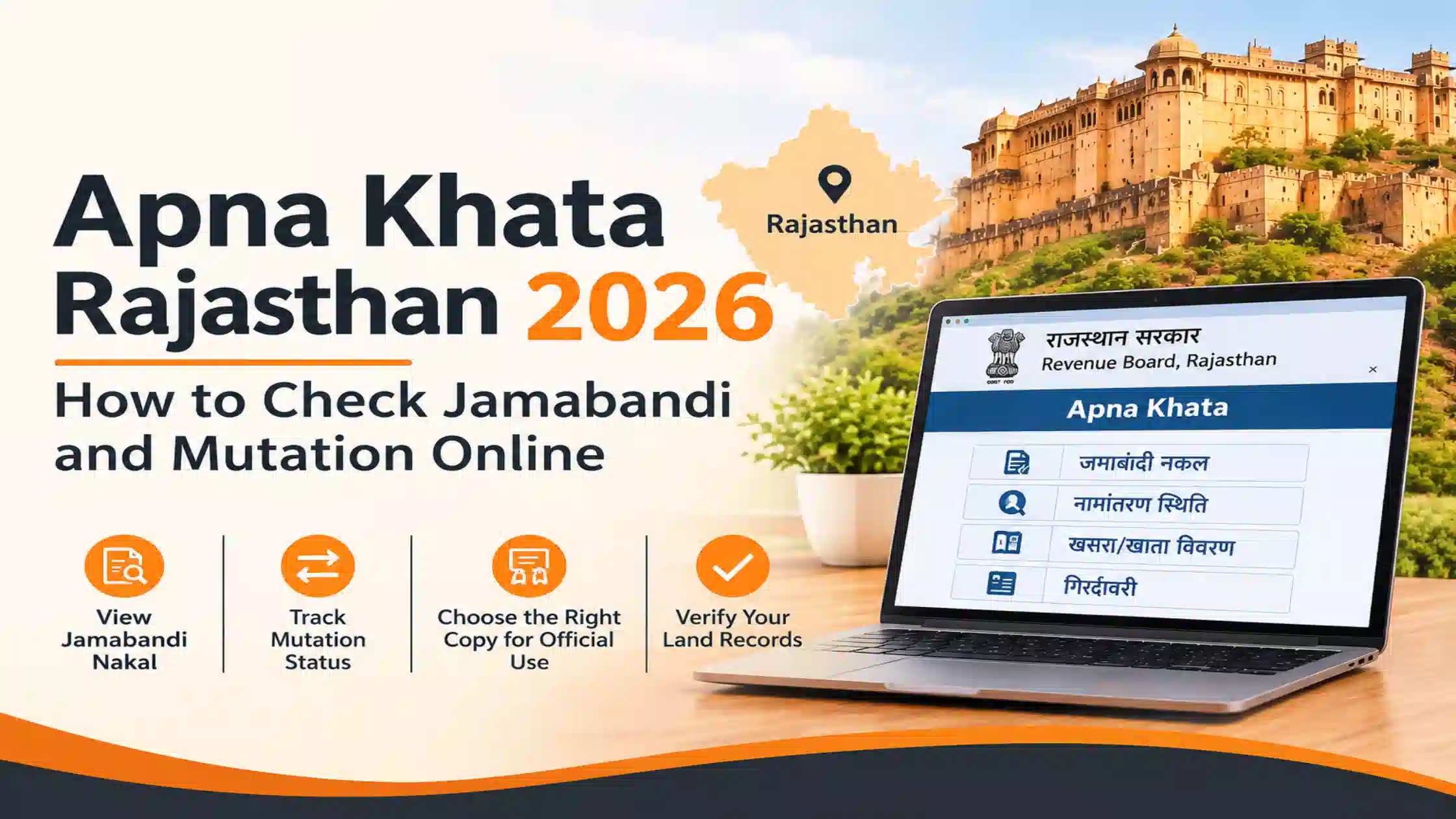
Apna Khata Rajasthan is the state’s public window on its land records, where anyone can view a jamabandi nakal and track a mutation without visiting the tehsil. Most people only need three things from it: the record, the mutation status, and the right kind of copy for a bank or registry office. This guide takes them in that order.
What is Apna Khata?
e-Dharti is the system in which revenue staff maintain jamabandi, mutations and maps; Apna Khata is the site and app through which the public reads them. The portal is run by the Board of Revenue, Rajasthan, in Ajmer. The site is reachable at apnakhata.rajasthan.gov.in and also at apnakhata.raj.nic.in. Stick to those two addresses. Look-alike sites that ask for payment before showing a record are best avoided.
How to check a jamabandi on Apna Khata
- Open the portal and choose the jamabandi nakal option. It appears as a “जमाबंदी नकल” title.
- Pick your district, then the tehsil, then the village.
- Search using the khasra number, account number or landowner name.
- Enter the OTP sent to your phone; the copy opens only after it.
- Download the PDF straight away. Saving it now beats searching again later.
Pro Tip: Use the exact revenue village name, as local names often do not match.
Free copy, e-signed copy or certified copy?
|
Copy |
Where |
Cost |
Use |
|
Informational nakal |
Apna Khata |
Free |
Your own checking only |
|
E-signed nakal |
Apna Khata or e-Mitra |
Guides put it at Rs 10 per jamabandi and Rs 20 for a map or mutation copy |
Often asked for by banks and registry offices |
|
Certified, stamped copy |
Patwari, Tehsildar or e-Mitra |
A small government fee |
Court cases and formal filings |
The catch is acceptance. Signed copies have been issued at e-Mitra and CSC centres and revenue offices since 2012. Some guides say banks take the e-signed copy, while others say banks and courts want the stamped certified copy. Ask your bank or the registry office which one it wants before paying for either.
How to check mutation (namantaran) status
Open the portal and use its mutation status option, then enter the details it asks for. Namantaran is the entry that amends the jamabandi after a registered deed, succession, mortgage or order, and it can be applied for online through Apna Khata or at the tehsil.
Registration and mutation are different steps. Registration records the property transaction, while mutation updates the relevant revenue entry. If you have bought land, check that your name appears on the jamabandi and that the mutation is not stuck at the patwari or tehsildar stage. For a wider explanation of the process, see our guide to property mutation, including the documents and steps involved.
The app and girdawari
An Apna Khata app is available on the Google Play Store. Girdawari, the crop inspection record, is also viewable for a khasra, and patwaris now record it through mobile apps. That helps if you are checking who is actually cultivating a field before you buy.
Common mistakes
- Wrong village or tehsil. Pick from the dropdown and match the spelling.
- Old khasra or khata numbers. Numbers can change after a sale or division, so confirm the latest one at the patwari office.
- Using the free copy for official work. It is a checking tool.
- Taking the seller’s word. Verify any nakal a seller gives you by opening the portal with them present and comparing every field.
- Not cross-checking. Portal data can lag, so visit the local patwari or tehsil office if names or areas do not match.
Before paying an advance for land, it is also worth reviewing this property title verification checklist for buyers in India. It covers checks that go beyond the revenue record, including ownership documents and potential encumbrances.
Four closing lines
Apna Khata Rajasthan gives you a quick, free look at the jamabandi and mutation status. Use the free copy for checking and a signed or certified copy for official work. Ask your bank which version it accepts before you pay for one. Verify the khasra number on the portal yourself, and never rely on a photocopy.








Ans 1. In Rajasthan, jamabandi is used as the Record of Rights. It lists the landholder, the khasra and the area.
Ans 2. Viewing the informational nakal is free. The certified stamped copy from the Patwari office carries a fee.
Ans 3. Yes. Namantaran can be applied for online through Apna Khata or at the tehsil. The exact process and documents depend on the case.
Ans 4. It is the plot identifier used in land records. Check the number against the relevant revenue documents before relying on a record for a transaction.
Ans 5. Open the portal in front of the seller and compare the khasra number, owner name and area against the paper copy. If there is a mismatch, seek clarification before proceeding.
Ans 6. The portal is run by the Board of Revenue, Rajasthan, in Ajmer.
Ans 7. An Apna Khata app is listed on the Google Play Store. Check the publisher details before installing an app or entering personal information.