
Table of Content
▲- Why the Bombay High Court Intervened
- Committee Mandate and Scope of Inspection
- Key Findings: Widespread Non-Compliance Across Sites
- AQI Monitoring Systems Exist, but Are Ineffective
- Improper Placement Undermines Monitoring Accuracy
- Enforcement Remains Reactive, Not Preventive
- Pollution Mitigation Measures Used Superficially
- Municipal Road Cleaning Adds to Dust Pollution
- Committee Recommendations to the High Court
- Implications for Mumbai’s Air Quality and Urban Development
- Conclusion
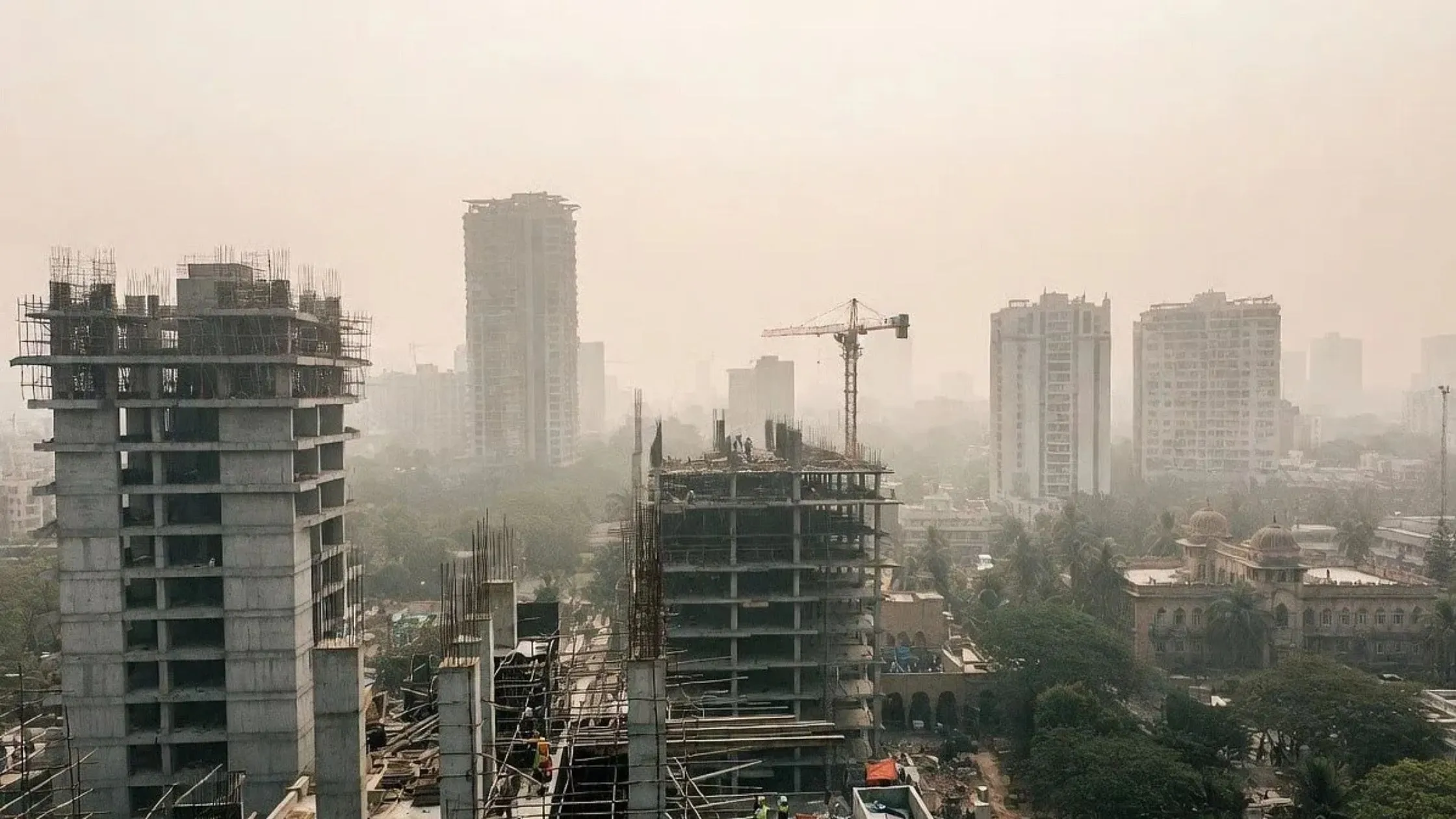
A High Court–appointed monitoring committee has found that most construction and infrastructure sites in Mumbai and Navi Mumbai are flouting air pollution norms, despite the presence of detailed guidelines and standard operating procedures issued by civic and pollution control authorities. The findings, submitted to the Bombay High Court, raise serious concerns about enforcement gaps at a time when the city continues to struggle with deteriorating air quality.
The five-member committee, formed following a suo motu public interest litigation (PIL) taken up by the High Court in late November, inspected 36 construction, demolition, industrial, and roadwork sites. Its conclusion was unequivocal: compliance with pollution control norms remains largely superficial, reactive, and inconsistent across the Mumbai Metropolitan Region.
Why the Bombay High Court Intervened
The High Court’s intervention came amid growing alarm over Mumbai’s worsening Air Quality Index (AQI). In November, pollution levels crossed the severe threshold in several parts of the city, with AQI readings exceeding 300 on multiple days. Senior advocates appearing before the court argued that although regulations to curb construction-related pollution exist, implementation on the ground remains weak.
The court noted that unchecked construction dust, debris movement, and inadequate monitoring were contributing significantly to the city’s air quality crisis. In response, it appointed an independent committee to assess whether construction sites were adhering to the pollution-control norms mandated by the Brihanmumbai Municipal Corporation (BMC) and the Maharashtra Pollution Control Board (MPCB).
Also Read: New Cabinet Norms Ease Building Plan Approvals on Private Land in Noida
Committee Mandate and Scope of Inspection
The committee was tasked with evaluating compliance across a representative sample of construction and infrastructure projects. Over multiple site visits in Mumbai and Navi Mumbai, the team assessed adherence to BMC’s comprehensive 29-point Standard Operating Procedures (SOPs), along with MPCB circulars governing air pollution mitigation.
These inspections covered private construction projects, demolition sites, roadwork zones, and industrial activity hubs. The findings, submitted to the High Court, indicate that flouting air pollution norms is not an isolated issue limited to a few errant developers, but a widespread systemic problem.
Key Findings: Widespread Non-Compliance Across Sites
One of the committee’s most serious observations was that the majority of inspected sites failed to fully comply with mandatory pollution-control measures. While some sites displayed equipment such as sprinklers, fogging machines, or smog guns, these were often deployed irregularly or only during inspections.
The report noted that compliance appeared more performative than functional. Measures intended to suppress dust were frequently inadequate, poorly maintained, or used only for short durations. In many cases, flouting air pollution norms was evident through uncovered construction material, dry debris handling, and uncontrolled vehicle movement within and around sites.
AQI Monitoring Systems Exist, but Are Ineffective
A major focus of the committee’s findings was the ineffective use of AQI monitoring devices at construction sites. While many sites had installed sensor-based monitors, these devices were not integrated with any official data systems operated by the BMC or MPCB.
As a result, AQI readings could only be accessed manually by physically visiting the site. There was no centralised, real-time mechanism to receive, store, or analyse pollution data. The committee highlighted that without continuous monitoring, authorities cannot proactively detect or address violations, allowing construction sites to continue flouting air pollution norms without immediate consequences.
Improper Placement Undermines Monitoring Accuracy
The committee also flagged serious flaws in how AQI sensors were installed. At several large sites spread over 8–10 acres, only a single sensor was placed at a corner or entry point. In high-rise projects involving buildings over 40 or 50 floors, sensors were often installed at ground level, failing to capture pollution levels at elevated construction zones.
Display boards showing AQI readings were frequently placed inside the premises, invisible to pedestrians or neighbouring residents. According to the committee, such placement defeats the purpose of transparency and public accountability, further enabling flouting air pollution norms.
Enforcement Remains Reactive, Not Preventive
Another critical observation was the reactive nature of civic enforcement. The committee found that inspections, stop-work notices, and show-cause actions tended to spike only after court hearings or sharp rises in AQI levels.
In several instances, inspection data provided to the committee showed enforcement activity occurring just days before scheduled site visits. This pattern, the report noted, suggests that monitoring efforts intensify only under scrutiny, rather than functioning as a consistent preventive mechanism against flouting air pollution norms.
Pollution Mitigation Measures Used Superficially
On-ground mitigation practices were found to be largely cosmetic. While water sprinklers and fogging systems were present at some sites, their usage was intermittent and insufficient to suppress dust emissions effectively. Smog guns were deployed selectively, often without assessing wind direction or dust concentration levels.
The committee also observed that vehicles transporting construction and demolition waste frequently failed to comply with covering and tracking requirements. Trucks carrying debris were seen moving uncovered, dispersing dust across arterial roads and residential areas, contributing further to flouting air pollution norms.
Municipal Road Cleaning Adds to Dust Pollution
Ironically, the committee noted that certain municipal road-cleaning activities were themselves contributing to air pollution. Manual and mechanical sweeping was often conducted without adequate wetting or containment measures, causing dust to re-enter the air rather than being suppressed.
In high-traffic zones, sweeping operations were observed spreading particulate matter, especially during dry conditions. This undermines broader pollution-control efforts and highlights the need for better coordination between departments tasked with enforcing norms and maintaining urban infrastructure.
Committee Recommendations to the High Court
Based on its findings, the committee recommended urgent systemic reforms. Chief among these was the integration of all AQI monitoring devices at construction sites with official civic and MPCB platforms, enabling real-time data tracking and centralised oversight.
The committee also stressed the need for guidelines on sensor placement, minimum coverage standards based on site size, and visibility of AQI displays to the public. It called for enforcement mechanisms that prioritise continuous monitoring over episodic action, warning that without structural changes, flouting air pollution norms would persist.
Also Read: India’s REIT Market Overtakes Hong Kong at ₹2.3 Lakh Cr GAV
Implications for Mumbai’s Air Quality and Urban Development
The High Court panel’s findings come at a time when Mumbai is witnessing sustained construction activity across residential, commercial, and infrastructure segments. Without strict enforcement, construction-related pollution threatens to offset gains made through other environmental measures.
For residents, prolonged exposure to construction dust increases respiratory risks. For developers, inconsistent enforcement creates uncertainty and reputational risk. For authorities, the report underscores the credibility gap between policy formulation and execution in tackling flouting air pollution norms.
Conclusion
The High Court committee’s report makes it clear that Mumbai’s air pollution challenge is not due to a lack of regulations, but a failure to enforce them consistently. While SOPs and guidelines exist on paper, their diluted implementation has allowed widespread flouting air pollution norms across construction and infrastructure sites.
As the city continues to expand vertically and horizontally, the need for proactive, technology-driven enforcement has never been more urgent. The High Court’s scrutiny may serve as a turning point but lasting improvement will depend on whether civic authorities translate oversight into sustained action on the ground.





Ans 1. The committee found that most construction, demolition, industrial, and roadwork sites were flouting air pollution norms, with measures often implemented superficially or only during inspections.
Ans 2. The committee was appointed to assess compliance with pollution-control norms after rising concerns about Mumbai’s worsening air quality and reports that construction activities were contributing significantly to pollution.
Ans 3. While many sites have AQI sensors, they are often poorly placed, not integrated with official civic or MPCB systems, and inaccessible to the public, reducing their effectiveness in preventing air pollution.
Ans 4. Enforcement is largely reactive. Inspections, notices, and actions tend to spike only after court hearings or high AQI levels, rather than being part of continuous preventive monitoring.
Ans 5. Water sprinklers, fogging machines, and smog guns were used intermittently and inadequately. Vehicles carrying construction debris often moved uncovered, spreading dust onto roads and residential areas.
Ans 6. Yes, certain municipal road-cleaning activities, like manual or mechanical sweeping without wetting, caused dust to re-enter the air, undermining pollution-control efforts.
Ans 7. The committee recommended integrating all AQI sensors with official platforms for real-time monitoring, improving sensor placement and visibility, and implementing continuous enforcement mechanisms rather than episodic inspections.
Ans 8. Prolonged exposure to construction dust increases respiratory risks and contributes to the city’s deteriorating air quality, affecting public health and overall urban livability.
Ans 9. Authorities need technology-driven enforcement, proper sensor integration, real-time monitoring, and consistent preventive inspections to ensure construction sites comply with pollution norms.
Ans 10. The findings highlight a gap between policy and execution. Without systemic enforcement reforms, construction activities may continue to worsen air quality despite regulatory frameworks already in place.