
Table of Content
▲- Why Delhi Is Revisiting Agricultural Land Circle Rates Now
- How High the Revised Agricultural Land Circle Rates Could Go
- Why Uniform Agricultural Land Circle Rates Are Being Replaced
- Villages and Land Parcels Likely to Be Impacted
- Stakeholder Consultations and Farmer's Demands
- Part of a Larger Property Valuation Overhaul
- Why Agricultural Land Was Taken Up First
- Industry View on Circle Rate Alignment
- Provision for Periodic Revisions Going Forward
- What Happens Next?
- Why This Revision Matters
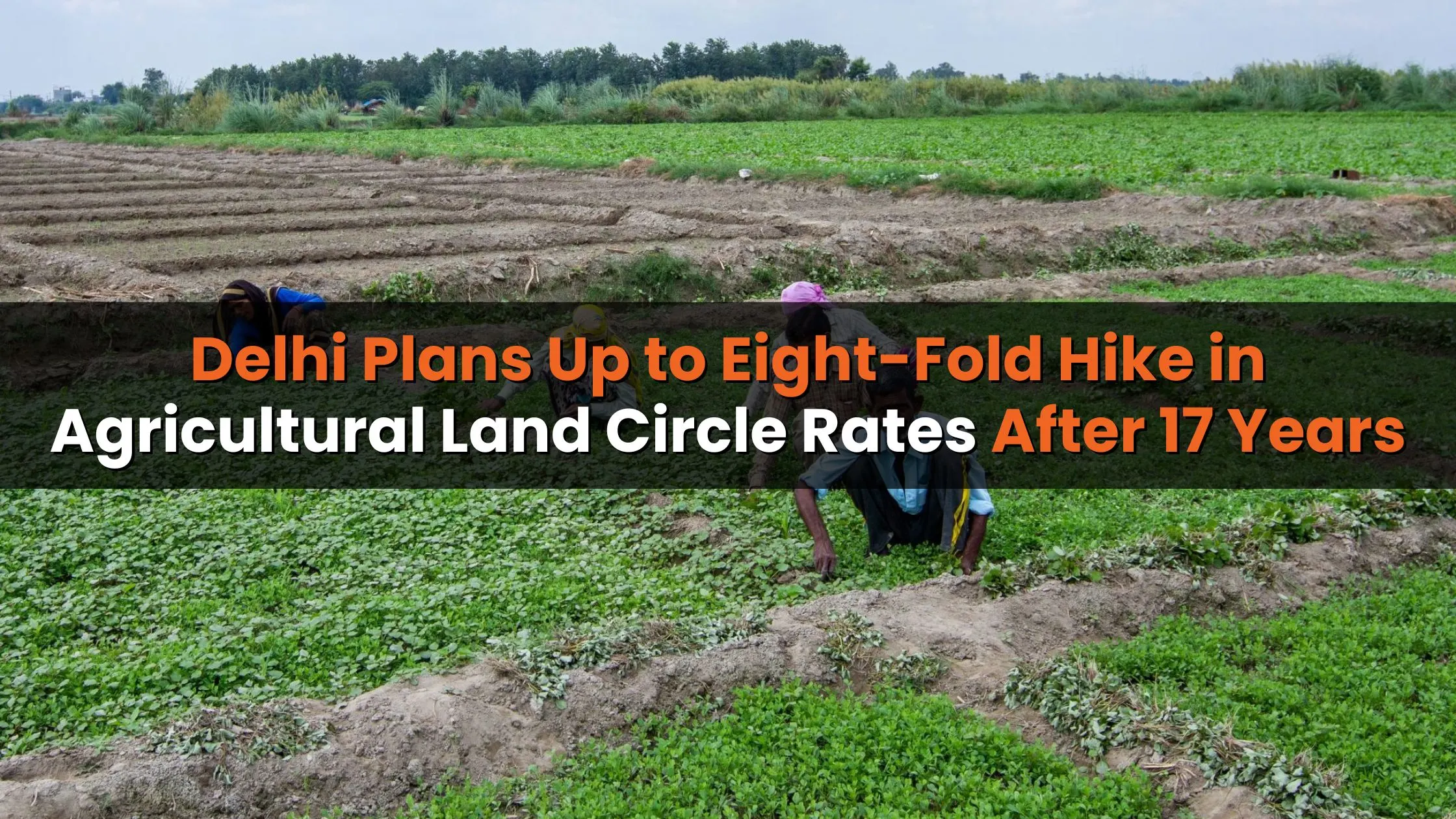
After remaining unchanged for nearly two decades, agricultural land circle rates in Delhi may soon see a sharp upward revision. The Delhi government is preparing draft proposals that indicate an increase of up to eight times in select locations, a move that could significantly alter land valuations across the Capital’s rural belt and bring official rates closer to prevailing market prices.
If approved, the revision would mark the first major update to agricultural land circle rates since 2008, ending a prolonged freeze despite rapid urbanisation, infrastructure expansion, and rising land demand in Delhi’s peripheral villages.
Why Delhi Is Revisiting Agricultural Land Circle Rates Now
Officials familiar with the development said the revision exercise was long overdue. While residential and commercial properties in Delhi have undergone periodic reviews, agricultural land circle rates remained static for 17 years, creating a wide gap between notified values and actual transaction prices.
Although the Delhi government announced plans to revise these rates in 2023, the proposal could not be implemented due to procedural and administrative hurdles. As a result, agricultural land continued to be registered at outdated rates, even as surrounding areas witnessed large-scale urban growth.
According to senior revenue department officials, this mismatch has led to consistent revenue loss for the government, as stamp duty and registration charges are calculated based on circle rates rather than real market values.
Also Read: DDA Karmayogi Awaas Yojana 2025: 1,168 Flats for Govt Employees, Apply Now
How High the Revised Agricultural Land Circle Rates Could Go
As per draft proposals under discussion, agricultural land circle rates could rise from the current uniform level of ₹53 lakh per acre to as much as ₹5 crore per acre in select locations. In percentage terms, this translates into an increase of up to eight times over existing rates.
Officials clarified that the proposal does not envisage a blanket hike across Delhi. Instead, revised agricultural land circle rates are likely to vary sharply depending on factors such as:
- Location and proximity to urbanised areas
- Road connectivity and infrastructure access
- Surrounding land use and development intensity
- Size and contiguity of farmland parcels
Areas that still retain large, contiguous tracts of agricultural land may see steeper revisions, while villages that have already transitioned into semi-urban or residential use could witness relatively moderated increases.
Why Uniform Agricultural Land Circle Rates Are Being Replaced
One of the key shortcomings of the existing system has been the uniform application of agricultural land circle rates across all villages, regardless of location or development potential. This blanket valuation failed to capture sharp price differences between villages on Delhi’s urban fringes and those closer to fully developed zones.
Officials noted that land transactions in many peripheral villages have been taking place at prices far above the notified rates, yet stamp duty continues to be paid on the outdated benchmark of ₹53 lakh per acre.
The proposed revision aims to correct this distortion by introducing location-sensitive valuation norms that better reflect market realities.
Villages and Land Parcels Likely to Be Impacted
According to revenue department estimates, more than 50,000 acres of land across over 200 villages in Delhi are still classified as agricultural. These include areas such as Tigipur, Khampur, Hamidpur, Jhangola, Bankner, Bhorgarh, Lampur, Bakhtawarpur, Dariyapur Kalan, Najafgarh, Bijwasan and Dhichau Kalan.
Many of these villages are located near expanding urban corridors, logistics hubs, expressways and industrial clusters, where land values have appreciated substantially over the years. Officials said revised agricultural land circle rates would better capture these locational advantages.
Stakeholder Consultations and Farmer's Demands
The proposal follows a series of consultations held over the past two months between the revenue department, farmers’ representatives, agricultural organisations and other stakeholders. During these discussions, farmers reportedly proposed agricultural land circle rates ranging from ₹5 crore to ₹8 crore per acre, depending on proximity to developed areas and infrastructure.
Stakeholders also emphasised the need for transparent and periodic revisions to prevent long valuation gaps in the future. Officials said the revenue department has studied circle rate frameworks in neighbouring states to develop a comparative and defensible methodology.
Suggestions from these consultations were invited until mid-October, after which the draft framework was refined.
Part of a Larger Property Valuation Overhaul
The revision of agricultural land circle rates is part of a broader exercise to overhaul property valuation norms in Delhi. A committee constituted under a government order dated October 28 has been tasked with examining existing circle rates notified in 2014 for residential, commercial and industrial properties.
The panel includes representatives from key civic and planning bodies such as the Municipal Corporation of Delhi, New Delhi Municipal Council, Delhi Development Authority, Public Works Department, Delhi State Industrial and Infrastructure Development Corporation and the Land and Building department.
However, officials indicated that agricultural land was prioritised separately due to the unusually long gap since the last revision, while residential and commercial rates are still under evaluation.
Why Agricultural Land Was Taken Up First
Officials involved in the process said revising agricultural land circle rates was relatively more urgent, as the gap between notified and transaction values was far wider compared to other property categories.
“Unlike residential and commercial properties, where revisions are still being studied in detail, agricultural land values have remained frozen despite significant market activity,” a senior official said. “This has resulted in persistent undervaluation and revenue leakage.”
The department is analysing transaction data from the past five years, location-wise trends and inputs received through public consultations to finalise the revised rates.
Industry View on Circle Rate Alignment
Real estate industry bodies have welcomed the broader effort to rationalise valuation norms, while cautioning that rates must remain realistic. Harsh Vardhan Bansal, president of NAREDCO Delhi, pointed out that multipliers applied to commercial and industrial properties in Delhi are already higher than those in neighbouring states.
“As an industry body, we are trying to present a realistic picture where circle rates are aligned with prevailing market prices,” he said. “If rates are too high and disconnected from demand, they can discourage investment, particularly in industrial and commercial zones.”
Provision for Periodic Revisions Going Forward
A notable feature of the proposal is a provision for periodic upward revisions of agricultural land circle rates at fixed intervals, rather than allowing long gaps between updates. Officials stated that this would help ensure notified values remain closer to market prices and reduce disputes during property registration.
“The idea is to bring predictability and transparency to the valuation process,” an official said. “Regular updates will prevent sharp corrections and minimise discrepancies.”
Also Read: Delhi-NCR AQI Crisis Highlights Demand for Clean-Air, Wellness-Focused Homes
What Happens Next?
Once finalised, the proposal will be placed before the competent authority for approval. While officials did not specify a timeline for implementation, they indicated that further consultations could be held before the revised agricultural land circle rates are formally notified.
If cleared, the move is expected to have a far-reaching impact on land transactions, stamp duty collections and long-term land valuation trends in Delhi’s rural and semi-urban areas.
Why This Revision Matters
The proposed hike in agricultural land circle rates marks a significant policy shift after years of stagnation. By aligning official valuations with market realities, the government aims to improve revenue transparency while addressing long-standing distortions in land pricing.
At the same time, the final outcome will depend on how carefully the rates are calibrated to balance farmer expectations, investor sentiment and overall market stability. As Delhi continues to urbanise, how agricultural land is valued will play a crucial role in shaping future development patterns across the Capital.


Ans 1. Agricultural land circle rates are the government-notified minimum values at which agricultural land can be registered in Delhi. They are used to calculate stamp duty, registration charges, and other government levies.
Ans 2. The rates have remained unchanged since 2008, despite rapid urbanisation and rising land demand. The revision aims to align official values with current market prices, reduce revenue loss, and reflect locational differences across villages.
Ans 3. Draft proposals indicate that rates may rise from ₹53 lakh per acre to up to ₹5 crore per acre in select locations, representing an increase of up to eight times over current values.
Ans 4. No. The increase will vary depending on factors like proximity to urbanised areas, infrastructure access, surrounding land use, and the size of farmland parcels. Villages closer to development corridors may see steeper hikes.
Ans 5. Over 200 villages with around 50,000 acres of agricultural land could be impacted. Key areas include Tigipur, Khampur, Hamidpur, Jhangola, Bankner, Bhorgarh, Lampur, Bakhtawarpur, Dariyapur Kalan, Najafgarh, Bijwasan, and Dhichau Kalan.
Ans 6. The revenue department consulted farmers, agricultural organisations, and other stakeholders over two months. Farmers suggested rates between ₹5 crore and ₹8 crore per acre depending on location, and emphasised the need for periodic revisions.
Ans 7. Yes. The proposal includes provisions for periodic upward revisions at fixed intervals to ensure rates remain close to market values and reduce future discrepancies.
Ans 8. Higher circle rates will affect stamp duty and registration charges, increase government revenue, and provide a more accurate reflection of land value for buyers and investors. It may also influence investment decisions in Delhi’s peripheral and semi-urban areas.
Ans 9. Yes. The government is reviewing circle rates for residential, commercial, and industrial properties. Agricultural land has been prioritised due to the long gap since its last update and significant undervaluation.
Ans 10. The draft framework will be finalised and placed before the competent authority for approval. Further consultations may occur before formal notification, though no specific timeline has been announced yet.