
✦ AI Summary
Table of Content
▲- Pune Real Estate Market Continues to Expand
- What's Driving Pune's Housing Sales Growth
- Why Has Unsold Inventory Crossed ₹92,000 Crore?
- Areas Driving Pune's Real Estate Growth
- Impact on Homebuyers
- What Does This Mean for Property Investors?
- Key Opportunities and Challenges
- Tips for Buyers Planning to Invest
- Conclusion
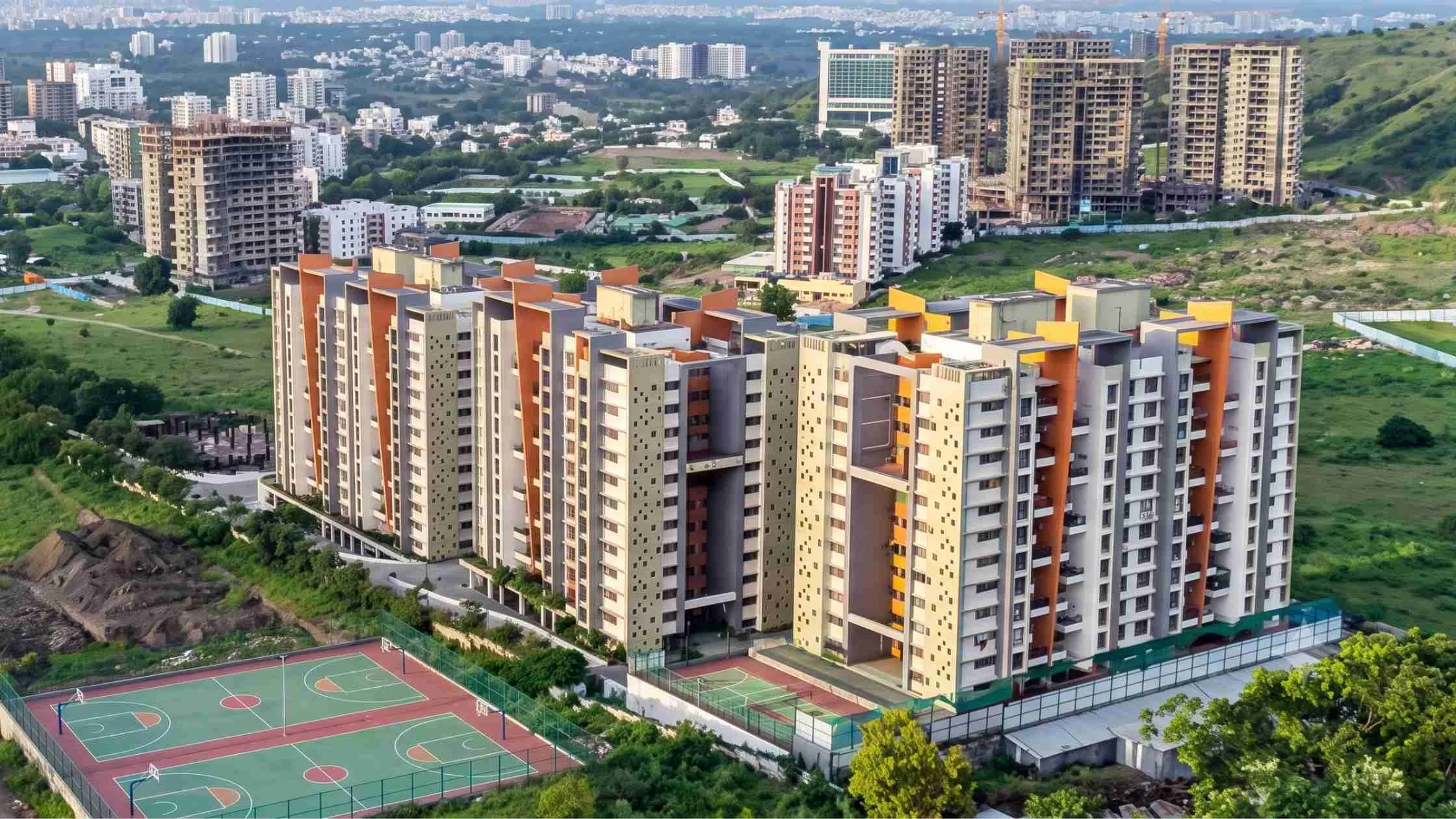
Pune's residential real estate market continues to show resilience despite rising inventory levels. Housing sales in the city recorded a 7% year-on-year growth, reflecting sustained demand from homebuyers. At the same time, the value of unsold residential inventory has climbed to a record ₹92,110 crore, raising questions about future supply, pricing trends, and investment opportunities.
While strong sales indicate healthy buyer confidence, the increasing stock of unsold homes highlights the need for developers to balance new launches with existing inventory. This article explains what is driving Pune's housing market, why unsold inventory is increasing, and what buyers and investors should expect in the coming months.
Pune Real Estate Market Continues to Expand
Pune's residential market recorded 7% year-on-year growth in housing sales, with buyer activity remaining consistent across multiple segments and micro-markets. Simultaneously, the value of unsold residential inventory in the city has reached ₹92,110 crore, a figure that reflects both the scale of developer activity and the pricing concentration in the premium segment.
Buyer confidence has remained stable despite property prices that have moved upward across most Pune locations over the past two years. The premium housing segment has outperformed several other categories, demand continues across both end-user and investor buyer profiles, and new project launches have maintained a steady pace.
Pune Housing Market at a Glance
|
Market Indicator |
Latest Status |
|
Housing Sales Growth |
7% Year-on-Year |
|
Unsold Inventory Value |
₹92,110 Crore |
|
Market Trend |
Positive Demand |
|
Premium Housing |
Strong Growth |
|
Buyer Sentiment |
Stable |
|
Investment Outlook |
Positive Long-Term |
The data reflects a growing market, although inventory management remains an important challenge.
Also Read: Shapoorji Pallonji Treetopia: Estate Plots from ₹1.51 Cr in Pune's Growth Corridor
What's Driving Pune's Housing Sales Growth
The 7% sales growth figure is meaningful not just as a number but as an indicator of the structural demand drivers that make Pune one of India's most consistently active residential markets. Understanding what's behind the growth helps assess how durable it is.
Employment concentration and stability
It is the bedrock of Pune's housing demand. The city sits at an unusual intersection of economic sectors, it's simultaneously a major IT and technology hub, one of India's most significant automobile manufacturing centres, a substantial pharmaceutical and biotech base, one of the country's most prominent education destinations, and a growing financial services location.
This sectoral diversity means Pune's employment base is more resilient to individual sector downturns than cities that depend on a single industry and housing demand that rests on diverse employment is more stable than demand from a single corporate driver.
Infrastructure investment
Pune's liveability and connectivity profile are improving in ways that directly support residential demand. The Pune Metro, now operational on initial routes with extensions progressing, has transformed commuting accessibility along its corridors. Ring road development, expressway improvements, and the long-anticipated Pune Airport expansion have each contributed to improving the practical case for living in various parts of the city.
Infrastructure improvement doesn't just support existing demand, it creates new demand by making previously less accessible locations viable residential addresses.
Premium lifestyle aspiration
The post-pandemic shift in housing preferences, toward more space, better amenities, wellness-integrated community design, and homes that function well for both living and working, has played out strongly in Pune, where the professional population has the income to act on these preferences. Premium and luxury segment performance has outpaced the affordable category in both volume and value terms.
Population inflow
Pune attracts professionals from across India drawn by its employment base, its educational institutions, and a quality of life proposition climate, cost relative to Mumbai, food, culture, relative space that compares favourably with most comparable tier-1 cities.
Why Has Unsold Inventory Crossed ₹92,000 Crore?
Although housing demand remains healthy, supply has increased at a faster pace in several locations.
Major reasons include:
- Continuous launch of new residential projects
- Growth in luxury housing supply
- Premium homes taking longer to sell
- Higher property prices in certain locations
- Buyers taking longer to make purchase decisions
The increase in inventory does not necessarily indicate weak demand but reflects an expanding housing market.
Areas Driving Pune's Real Estate Growth
Pune is not a homogeneous market. Buyer activity, price growth, and inventory absorption vary significantly across different parts of the city, and identifying where demand is strongest is essential for buyers and investors alike.
Hinjewadi remains Pune's most prominent IT employment corridor and continues to attract strong residential demand from technology professionals who value proximity to Rajiv Gandhi Infotech Park. The location has seen multiple premium project launches and maintains healthy absorption as IT sector employment continues to expand. The metro connectivity improvement to this area is expected to be a further demand catalyst.
Kharadi has evolved from a secondary IT location to one of Pune's most active premium residential corridors, driven by the Magarpatta City business district adjacency and the development of EON IT Park. The location's combination of employment proximity and improving social infrastructure has supported consistent buyer interest across multiple project launches.
Baner and Balewadi have maintained strong appeal among Pune's professional and upper-middle-income buyer segment, offering established social infrastructure, good road connectivity, and a lifestyle environment that appeals to the premium buyer profile. Property prices here have moved upward but continue to attract buyers willing to pay for the location quality.
Wakad and Tathawade offer relative pricing accessibility compared to Baner while maintaining good Hinjewadi and Pimpri-Chinchwad connectivity making them attractive for buyers who want Pune's western corridor advantages without the absolute price levels of more established locations.
Hadapsar is a southeastern location that has benefited from Magarpatta City's commercial development and provides access to the Solapur highway corridor. It has attracted both mid-segment and premium residential development.
Pimpri-Chinchwad represents the city's industrial and manufacturing employment base and has a consistently active residential market serving the large professional and skilled worker population employed in the area.
Impact on Homebuyers
For buyers, the combination of 7% sales growth and substantial unsold inventory creates a market environment with specific characteristics that are worth understanding before making a purchase decision.
The elevated inventory level gives buyers genuine leverage in negotiations and choices that a supply-constrained market wouldn't provide. When developers are sitting on unsold inventory, they're more motivated to offer competitive payment plans, early booking benefits, additional specification inclusions, and price consideration at the margin than they would be in a market where every unit sells the day it launches. This is a genuine buyer-side advantage that won't persist indefinitely as the market absorbs existing inventory.
The wider range of projects, configurations, and locations available simultaneously means buyers have access to a more comprehensive comparative picture than would be available if the market were thinner. This allows more rigorous due diligence and comparison across developers and locations before committing.
The sustained sales growth indicates that the market is not weakening, it's not a distressed buyer's market where sellers are desperate. But it's also not a frenzied seller's market where buyers need to rush. The current environment is one of balanced buyer advantage where careful evaluation and strategic timing produce better outcomes than either rushing or waiting indefinitely.
Developers may also introduce limited-period offers to accelerate sales of existing inventory.
What Does This Mean for Property Investors?
The combination of rising sales and increasing inventory creates both opportunities and risks.
Positive Signs
- Strong long-term demand
- Expanding employment base
- Infrastructure-led appreciation
- Growing rental market
- Premium housing demand
Points to Consider
- Compare project locations carefully.
- Evaluate developer credibility.
- Check future infrastructure plans.
- Focus on end-user demand rather than speculation.
Well-located projects are likely to continue performing better over the long term.
Also Read: Mumbai-Pune Expressway Incomplete Stretch Opens: How It Will Affect Housing Demand
Key Opportunities and Challenges
|
Opportunities |
Challenges |
|
Growing housing demand |
High unsold inventory |
|
Infrastructure development |
Rising construction costs |
|
Strong IT employment |
Longer sales cycle in luxury housing |
|
Better financing options |
Increased competition among developers |
|
Premium housing demand |
Inventory management |
The market remains fundamentally strong but requires careful planning by developers.
Tips for Buyers Planning to Invest
The market conditions described create a window of opportunity for well-prepared buyers, but the same conditions also create traps for buyers who don't do their homework. Here's the practical checklist that makes the difference.
Verify RERA registration on the Maharashtra RERA portal for every project you're seriously considering. Check the committed possession timeline, the filed project plans, and the project's progress update record.
Compare at least three to four projects across the micro-market you're targeting before booking. In the current inventory environment, this comparison will reveal genuine pricing and specification differences that you won't see if you go with the first project you visit.
Visit the project site in person rather than relying on show flat presentations. The site visit tells you about actual construction progress, the surrounding neighbourhood's current development state, road access quality, and the daily life character of the location.
Research the specific infrastructure confirmed for the area not announced or proposed, but specifically funded and either under construction or operational. Metro routes under construction with defined completion dates, road improvements with active contracts, and schools and hospitals with confirmed opening timelines are real; speculative future development is not a reliable basis for current pricing.
Check the developer's delivery record by researching their completed projects. Visit a completed project, speak with residents if possible, and confirm that what was promised and what was delivered align. This is the most direct evidence available for evaluating whether a developer's possession timeline commitment is credible.
Conclusion
Pune's residential market continues to demonstrate strong momentum, with housing sales growing by 7% despite unsold inventory exceeding ₹92,000 crore. While rising inventory presents challenges for developers, steady buyer demand, expanding infrastructure, and a robust employment ecosystem continue to support the city's long-term growth.
For homebuyers, the current market offers greater choice and attractive buying opportunities. Investors should focus on well-connected locations, trusted developers, and projects backed by genuine end-user demand to benefit from Pune's evolving real estate landscape.


Ans 1. The 7% sales growth and the high unsold inventory figure are not contradictory, they reflect different market dynamics operating simultaneously. Sales growth reflects genuine demand from Pune's expanding employment base, infrastructure improvements, and consistent homebuyer activity. The high inventory figure reflects the pace of new project launches, particularly in the premium and luxury segment, outrunning absorption rates. Premium units have slower sales velocity by nature and higher per-unit prices that inflate the aggregate inventory value significantly. The market is genuinely growing; developer supply activity has simply been running ahead of absorption in some segments.
Ans 2. Pune's unsold residential inventory has reached approximately ₹92,110 crore in value. This figure represents the aggregate value of all residential units that have been launched in registered projects but have not yet been sold. The substantial value reflects both the scale of Pune's residential development activity and the disproportionate contribution of premium and luxury segment units, which individually carry higher values and have longer atural sales cycles compared to mid-segment and affordable housing.
Ans 3. The strongest residential demand in Pune is concentrated in several established and emerging micro-markets. Hinjewadi and Wakad benefit from IT employment proximity, Kharadi has become a major premium residential corridor, Baner and Balewadi offer established lifestyle infrastructure, Hadapsar serves the Magarpatta and southeastern commercial zones, Pimpri-Chinchwad serves the industrial belt, and Tathawade and Balewadi offer value alternatives with good connectivity. Micro-markets with direct access to IT employment clusters and metro connectivity are consistently performing better than peripheral locations.
Ans 4. High unsold inventory creates a ceiling on aggressive price increases in the near term but doesn't necessarily mean prices will fall. Pune's market is supported by strong employment-backed demand and infrastructure investment that sustains underlying value. Developers in a high-inventory environment are more likely to offer payment plan flexibility, launch benefits, and negotiation room on price at the margin rather than reducing base prices significantly. Buyers may achieve better effective pricing through negotiation and launch benefits rather than through published price reductions. Sustained demand absorption is expected to gradually reduce the inventory overhang without requiring significant price correction.
Ans 5. Pune remains a fundamentally strong residential investment market in 2025-26, supported by diverse sector employment, consistent population inflow, ongoing infrastructure investment particularly the metro network expansion, and genuine long-term rental demand from a large professional population. Investment outcomes depend heavily on location, product selection, and developer credibility rather than the overall market trajectory. Well-located projects from credible RERA-compliant developers in corridors with improving infrastructure tend to outperform the market average. The current high inventory environment creates buying opportunities but also requires more careful product selection than in a supply-constrained market.
Ans 6. Premium housing demand in Pune is driven by the growing upper-income professional population employed in the city's IT, finance, and corporate sectors, the post-pandemic lifestyle preference shift toward larger homes with better amenities and community infrastructure, NRI investment interest in Pune's residential market, and the general improvement in purchasing power among Pune's professional class. Premium projects offering large configurations, comprehensive clubhouse amenities, smart home features, and sustainable design have found strong reception among buyers for whom quality is the primary consideration.
Ans 7. Pune is consistently ranked among India's top five residential markets by both volume and growth rate. Compared to Mumbai, Pune offers significantly better affordability for comparable property types, a major driver of demand migration from Mumbai. Compared to Bengaluru and Hyderabad, Pune has broadly comparable IT sector employment but with a more diversified economic base that includes automobiles, manufacturing, and education. Compared to NCR markets, Pune's market has historically been more end-user driven and less speculative, which has made it somewhat more stable through market cycles. The 7% sales growth figure places Pune among the better-performing residential markets in India currently.
Ans 8. Before buying in Pune, buyers should verify Maharashtra RERA registration and review the filed project details on the MahaRERA portal, conduct a physical site visit to assess actual construction progress and neighbourhood character, compare the asking price against recent registered transactions in comparable projects in the same location, understand the developer's delivery track record on previous projects, get the full cost breakdown including all charges beyond the base price, assess the quality and accessibility of social infrastructure in the immediate area, confirm infrastructure improvements that are actually underway rather than only announced, and obtain possession timeline commitments in writing with reference to the RERA filing.
Ans 9. The Pune Metro has had a measurable positive effect on residential demand and pricing in corridors served by operational routes, with the effect most pronounced within walkable distance of metro stations. Historical patterns from other Indian metro cities and from Pune's initial operational routes both confirm that residential properties near metro stations command premiums over comparable properties without transit access, and that demand in metro corridors improves upon route opening. As Pune Metro's Phase 2 and further extensions are completed, similar demand and price uplift effects are expected in the newly served corridors, making metro connectivity a key factor in location selection for both buyers and investors.
Ans 10. In a high-inventory environment, Pune developers have been offering more flexible payment plans to attract buyers and accelerate absorption. Common structures include construction-linked plans where payment is tied to construction milestones, subvention schemes where the developer services EMI interest during the construction period, time-bound early payment discounts, additional fitouts or specification upgrades included at the quoted price, and deferred possession payment schedules that reduce immediate financial burden. Buyers in the current market should ask specifically about what incentives are available and compare structures across multiple developers before booking, as the competitive environment creates genuine room for negotiating better terms.