
✦ AI Summary
Table of Content
▲- Mumbai performs ahead of Singapore
- Why are Mumbai luxury buyers becoming more selective?
- Redevelopment is changing Mumbai's luxury housing stock
- Infrastructure is adding another layer
- Mumbai's luxury rental market is also moving up
- Does the 1.4% rise mean Mumbai property prices will surge?
- What does this mean for homebuyers?
- What lies ahead for Mumbai luxury housing?
Mumbai's prime residential market continued to move higher in the first half of 2026, although the pace of growth has become more measured.
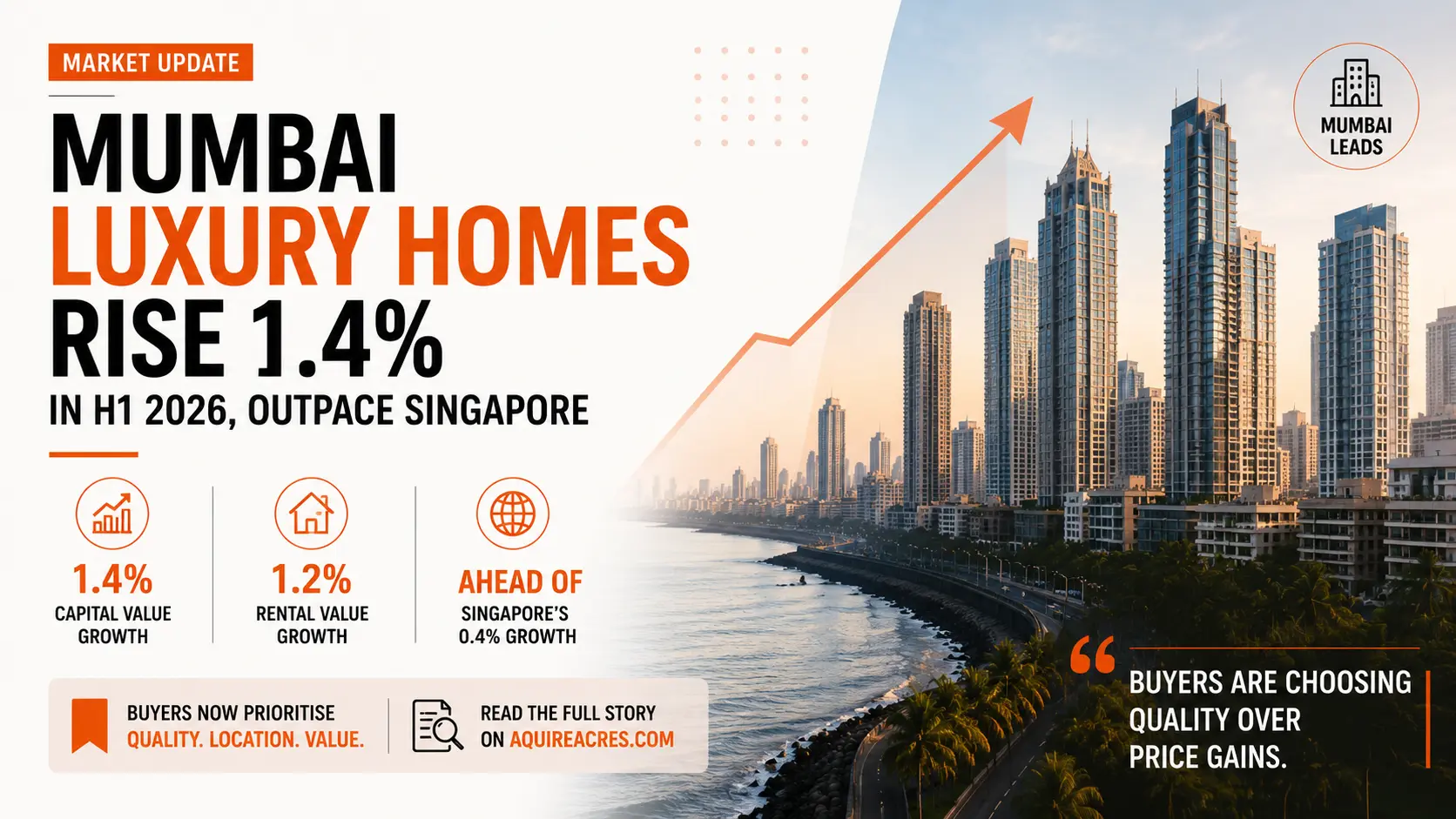
Capital values for prime homes in the city rose 1.4% between January and June 2026, ahead of Singapore's 0.4% increase, according to Savills' World Cities Prime Residential Index H1 2026.
Mumbai's prime rental values also increased 1.2% during the six-month period.
The more interesting part of the latest numbers, however, is not simply that prices increased. It is the change in what buyers are looking for.
After several years of strong appreciation, luxury buyers are becoming more selective. Location, construction quality, lifestyle offering and long-term value are increasingly influencing decisions rather than the expectation of another sharp price rise.
Mumbai performs ahead of Singapore
Mumbai's 1.4% capital-value growth placed it ahead of Singapore but behind some of the stronger-performing Asian markets.
Seoul recorded 4.1% growth while Kuala Lumpur rose 2%. Singapore, meanwhile, recorded a 0.4% increase.
Across the 30 cities tracked by Savills, average prime capital values increased 0.6% during H1 2026.
Mumbai therefore performed above the global average, even as the broader prime residential market entered a more moderate phase.
At around $1,130 per sq ft, Mumbai remains a competitive global prime residential market.
Mumbai prime residential market at a glance
|
Indicator |
H1 2026 |
|
Prime capital-value growth |
1.4% |
|
Prime rental-value growth |
1.2% |
|
Singapore capital-value growth |
0.4% |
|
Global prime capital-value growth |
0.6% |
|
Mumbai H2 2026 forecast |
0%–1.9% |
Savills expects Mumbai's prime capital values to grow between 0% and 1.9% in H2 2026. That suggests the market may continue to expand, but at a more measured pace.
Why are Mumbai luxury buyers becoming more selective?
This may be the biggest change taking place beneath the headline price numbers.
When prices are rising rapidly, buyers can sometimes focus heavily on future appreciation. In a more mature market, that approach becomes less straightforward.
Luxury buyers now appear to be paying greater attention to the property itself.
That includes the location, quality of construction, layout, amenities, privacy, surrounding neighbourhood and the broader lifestyle proposition.
The shift is particularly relevant in Mumbai because buyers are often paying a significant premium for a limited amount of space.
A luxury home therefore has to justify its price through more than just a prestigious pin code. That shift is visible in Mumbai's broader luxury housing market, where affluent buyers are increasingly looking for larger homes, privacy and stronger lifestyle offerings.
Savills has described the market as becoming more discerning following a period of strong capital appreciation.
Redevelopment is changing Mumbai's luxury housing stock
One reason Mumbai's residential market continues to attract attention is redevelopment. Mumbai is seeing redevelopment activity across several established neighbourhoods, with multiple locations emerging as redevelopment hotspots in 2026.
Vacant land is limited across many established parts of the city. Redevelopment allows older buildings and ageing housing stock to be replaced with newer residential developments without shifting the entire housing market towards peripheral locations.
The result is a change in the quality of housing available in established neighbourhoods.
Older buildings can make way for larger homes, modern amenities, better building systems and more organised residential environments.
This is also changing the benchmark against which buyers compare luxury properties.
A new development in an established location can command a premium not merely because it is new, but because it combines location with a newer product.
Infrastructure is adding another layer
Mumbai's luxury housing story is also increasingly connected to infrastructure.
Projects such as the Atal Setu, the Mumbai Coastal Road, and the expanding Metro network are changing travel patterns across the metropolitan region.
The opening and development of the Navi Mumbai International Airport is also expected to strengthen connectivity between Mumbai and Navi Mumbai and expand the residential catchment around the wider region.
The Mumbai-Nagpur Samruddhi Mahamarg adds another layer by improving connections with other parts of Maharashtra.
For property buyers, infrastructure matters because accessibility can influence both the usability and long-term appeal of a location. This has also strengthened interest in Mumbai's western suburbs, where improving connectivity is changing how buyers compare locations.
Mumbai's luxury rental market is also moving up
Prime residential rents increased 1.2% in H1 2026.
The rental market is important because not every affluent household wants to buy immediately, particularly when property prices are high.
Savills noted that globally, prime rents have continued to outperform capital values since mid-2022. Affordability constraints, economic uncertainty and delayed purchase decisions have supported rental demand.
For Mumbai, this creates an interesting dynamic.
A buyer who is unwilling to commit to a large purchase may remain in the rental market, while investors can continue to assess luxury housing partly through rental demand.
However, rental growth should not be viewed as a guarantee of investment returns.
Does the 1.4% rise mean Mumbai property prices will surge?
Not necessarily.
The first-half increase is positive, but Savills' H2 forecast points towards a more measured market.
That distinction matters.
Mumbai's luxury housing segment may continue to perform well, but buyers are likely to become increasingly selective about which properties deserve a premium.
A well-located home with strong construction quality and good access to infrastructure may perform differently from an expensive property that lacks those fundamentals.
The market is therefore becoming less about “Mumbai prices are rising” and more about “which Mumbai properties are worth paying a premium for?”
What does this mean for homebuyers?
For buyers, the latest numbers suggest that rushing purely because prices are rising may not be the best approach.
Instead, the focus should be on the property itself.
For a major property purchase, buyers should also complete a proper property document verification before committing funds. Before buying a luxury home, buyers should examine:
- Location and connectivity.
- Developer track record.
- Construction quality.
- Carpet area and layout efficiency.
- Building amenities.
- Redevelopment or construction history.
- RERA registration where applicable.
- Possession timeline.
- Maintenance and recurring costs.
- Resale and rental demand.
In Mumbai, where ticket sizes can be substantial, the difference between a good property and an overpriced one can become significant.
What lies ahead for Mumbai luxury housing?
Mumbai's prime residential market appears to be entering a more mature phase.
Prices are still moving upwards, rents remain supported, and redevelopment is refreshing the housing stock across established locations. Infrastructure is also widening the city's effective residential catchment.
But the market is no longer simply about buying first and asking questions later.
Luxury buyers are increasingly looking for a combination of location, quality, lifestyle and long-term value.
That may be a healthier direction for the market.
For Mumbai, the 1.4% rise in H1 2026 is a sign of resilience. The more important story may be that buyers are becoming more discerning about where they put their money.


Ans 1. Yes. Mumbai's prime residential capital values increased 1.4% in H1 2026, according to Savills. The city outperformed Singapore, where prime residential values increased 0.4% during the same period.
Ans 2. The market is still growing, but the pace is more measured. Savills forecasts capital-value growth of 0%–1.9% for Mumbai in H2 2026, suggesting a more moderate second half rather than another sharp price jump.
Ans 3. After several years of strong appreciation, buyers are placing greater importance on the actual quality of the property. Location, lifestyle, construction quality and long-term value are becoming more important in purchase decisions.
Ans 4. Yes. Prime residential rents increased 1.2% in H1 2026. Rental demand remains relevant because high property prices and affordability constraints can encourage some buyers to continue renting rather than purchasing immediately.
Ans 5. Redevelopment is an important part of Mumbai's residential transformation. It allows ageing housing stock to be replaced with newer, amenity-rich developments in established neighbourhoods where vacant land is limited.
Ans 6. Price growth alone should not be the deciding factor. Buyers should assess location, construction quality, developer credibility, connectivity, project approvals, maintenance costs and potential resale or rental demand before making a large investment.