
✦ AI Summary
Table of Content
▲- How to Choose Indoor Plants for Your Home
- Best Indoor Plants for Low-Light Areas
- Place Plants According to the Room
- Indoor Plants and Vastu
- Money Plant Placement: Vastu and Practical Considerations
- Are Indoor Plants Safe Around Pets and Children?
- Do Indoor Plants Really Purify the Air?
- Common Indoor Plant Placement Mistakes
- Indoor Plant Placement Guide
- How to Make Plants Work With Your Home Decor
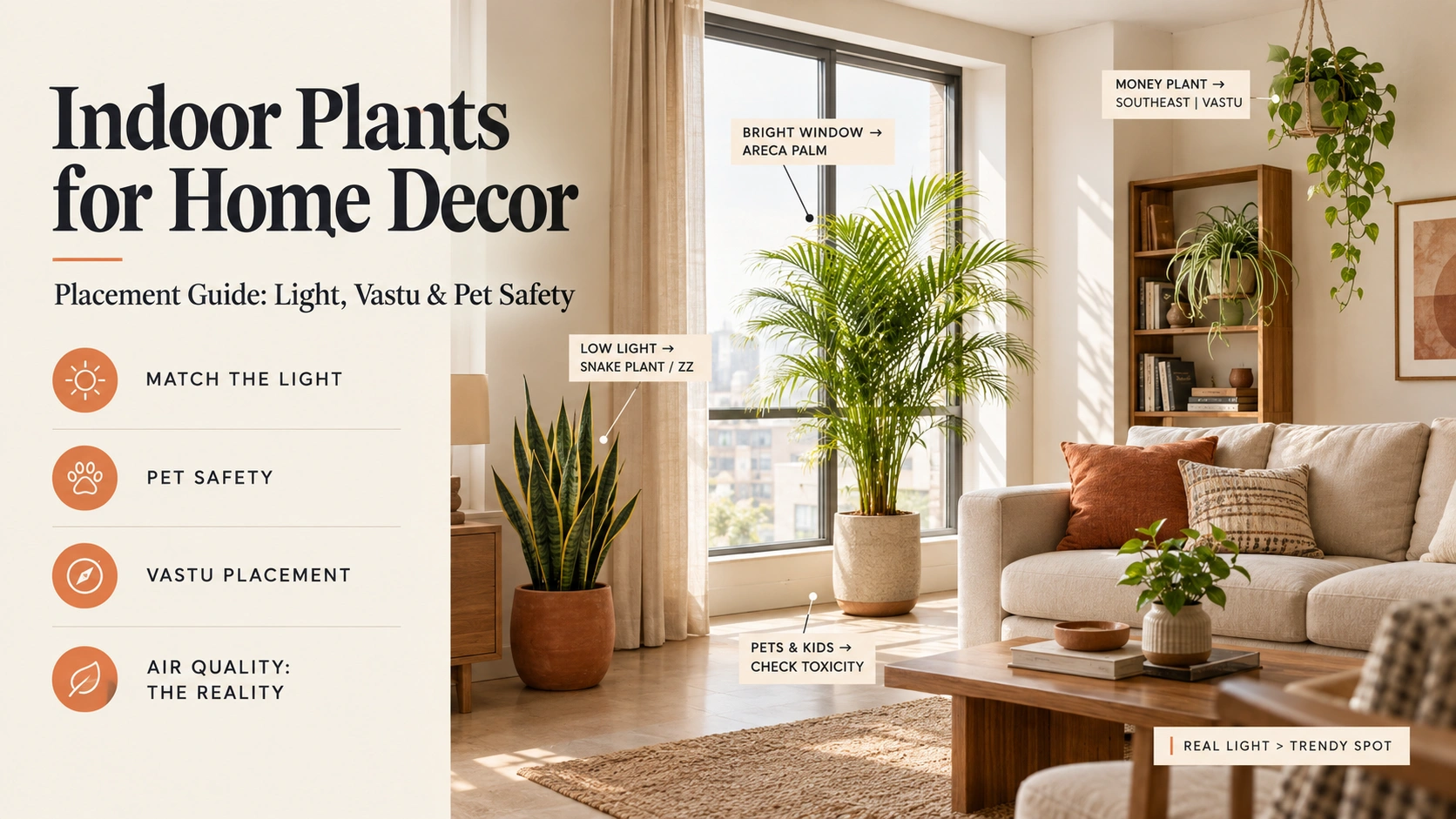
Indoor plants can make a home feel fresher, warmer and more inviting. But buying the right plant is only the first step. Where you keep it matters just as much. Light, room size, ventilation and maintenance all affect whether a plant will actually do well indoors.
Indian homes also come with their own set of conditions. A balcony can receive strong afternoon sun, an apartment corner may get very little daylight, and air-conditioning can make some spots unsuitable for certain plants. Vastu may also influence where a homeowner chooses to place a plant, but the basic growing conditions should come first.
How to Choose Indoor Plants for Your Home
Before buying a plant, look at the spot where you plan to keep it. A plant that works beautifully beside a bright window may struggle on a dark shelf across the room.
Keep these factors in mind:
- Natural light: Check whether the area gets direct sunlight, bright indirect light or very little daylight.
- Room size: A large plant can dominate a compact room, while a tiny plant may get lost in a spacious living area.
- Maintenance: Pick a plant that fits your routine. If you travel frequently, low-maintenance varieties may make more sense.
- Ventilation: Avoid places exposed to extreme heat, strong AC drafts or stagnant air.
- Household safety: If you have pets or young children, check whether the plant is safe if its leaves are chewed.
One of the easiest mistakes to make is choosing a plant because it looks good in a photograph and then putting it somewhere that does not suit its needs.
Best Indoor Plants for Low-Light Areas
Not every corner of an Indian home gets enough sunlight. North-facing rooms, hallways and areas far from windows can be challenging for many plants. Fortunately, some varieties are more tolerant of lower-light conditions.
1. Snake Plant
Snake plants are a practical choice for beginners. Their upright leaves work particularly well in narrow corners, beside furniture and near entryways.
They prefer bright indirect light but can tolerate lower-light conditions. Let the soil dry between watering, as constantly wet soil can cause problems with the roots.
2. ZZ Plant
ZZ plants suit homeowners who want greenery without having to water frequently. Their glossy leaves also fit easily into modern interiors.
They can tolerate lower light, although growth may slow down when the plant is kept in a very dark spot.
3. Aglaonema
Aglaonema is useful when you want a little more colour from your indoor greenery. Depending on the variety, its foliage can have silver, pink, red or patterned markings.
Keep it away from harsh direct sunlight, which can scorch the leaves. Allow the soil to dry somewhat before watering again.
4. Money Plant
Money plants are popular in Indian homes because they are easy to grow and can be trained along supports or displayed in hanging pots, shelves and planters.
If Vastu is part of your decision, placement may become another consideration. Our detailed guide to money plant Vastu placement covers commonly followed directions and the do's and don'ts associated with them.
5. Parlour Palm
A parlour palm can give a living room, bedroom or work-from-home area a softer look. It generally prefers indirect light and moderate watering.
For a smaller apartment, a compact plant is usually a better choice than a large palm that takes up valuable floor space.
Place Plants According to the Room
The most attractive corner is not automatically the best location for a plant. Think about sunlight, airflow, accessibility and how much space the pot will actually occupy.
Living Room
The living room is often the easiest place to introduce greenery because there is usually more floor and surface space.
A tall plant can fill an empty corner beside a sofa, while smaller varieties can sit on shelves, side tables or consoles.
There is no need to cover every available surface. Two or three well-placed plants can make a room feel more balanced than a collection of pots scattered everywhere.
If you are planning a wider makeover, these living room decor ideas can help you think about how plants fit with the rest of the room.
Bedroom
Keep bedroom greenery relatively simple. A small plant on a side table, dresser or near a suitable window can add some freshness without taking over the room.
Pay attention to light and watering. A decorative plant that stays in damp soil or receives almost no light will not remain healthy simply because it looks good in the bedroom.
Vastu recommendations for bedrooms can differ depending on the plant and the source. Consider them a traditional preference rather than a scientific rule.
Balcony
A balcony can be an excellent place for plants that need more natural light. However, direct afternoon sunlight can be intense, particularly during India's hotter months.
Spend a little time observing your balcony before deciding what to plant there. A spot that gets gentle morning sunlight may work for a plant that would struggle under several hours of harsh afternoon sun.
Work-From-Home Space
A small plant can soften a desk or home-office setup without taking away much working space.
Compact varieties work well on desks and shelves, while a taller plant can occupy an unused corner. Keep plants away from electrical equipment and make sure water cannot reach sockets, cables or other electronics.
Indoor Plants and Vastu
For many Indian households, plants are chosen for more than their appearance. Vastu beliefs can also influence the type of plant and the direction in which it is placed.
Traditional Vastu guidance associates certain plants and directions with ideas such as prosperity, harmony and positive energy. These are cultural and traditional beliefs, however, rather than scientifically established effects.
If you are specifically interested in plant choices based on Vastu, our guide to best Vastu plants for the home covers several commonly recommended options and their traditional placement.
There is still a practical rule worth following: a plant needs an environment in which it can grow.
Putting a plant in a supposedly favourable direction will not help much if that corner has no suitable light, poor airflow or excessive heat.
Money Plant Placement: Vastu and Practical Considerations
Money plants are particularly popular in Indian homes because they can be grown in soil or water and can adapt to a range of indoor settings.
Traditional Vastu guidance commonly recommends the southeast direction for a money plant. Some sources also mention east or north, while recommendations for bedrooms, bathrooms and other spaces vary.
If you want a more detailed breakdown, our guide to money plant Vastu placement covers commonly recommended directions, locations and mistakes to avoid.
From a plant-care perspective, light, drainage and watering are more important to the plant's survival than its direction.
A money plant kept in a dark corner and watered too often can develop problems regardless of which direction the pot faces.
Are Indoor Plants Safe Around Pets and Children?
This is worth checking before bringing any new plant into the house.
Some popular indoor plants, including money plant or pothos and philodendron, contain calcium oxalate crystals. Chewing them can cause irritation.
If you have pets or young children, keep potentially irritating plants on high shelves, in hanging planters or in places that are difficult to reach.
You can also look for plants generally regarded as safer options, such as spider plants, areca palms, parlour palms and peperomia.
Always identify a plant properly before bringing it into a home with pets or children. Common names can sometimes refer to different varieties with different characteristics.
Do Indoor Plants Really Purify the Air?
Indoor plants are often marketed as natural air purifiers, but the claim needs some context.
The widely cited NASA research on plants and indoor pollutants was conducted under controlled laboratory conditions. A normal home is very different, with doors opening, windows, ventilation systems and people constantly changing the airflow.
That does not make indoor plants useless. They can add greenery, improve the appearance of a room and make a space feel more pleasant.
They should not, however, be treated as a replacement for ventilation, air filtration or other measures used to improve indoor air quality.
For readers interested specifically in the relationship between plants and indoor air, AquireAcres also covers how indoor plants and moss walls are used to improve home air quality.
Common Indoor Plant Placement Mistakes
A few simple mistakes can make indoor plants harder to maintain.
Choosing a Plant Before Checking Light
A plant may look perfect in a nursery, but it will struggle if the location at home does not provide the light it needs.
Overwatering Low-Light Plants
Plants growing slowly in low light generally use less water. Giving them the same watering routine as plants kept in brighter locations can leave the soil constantly wet.
Blocking Walkways
Large floor plants should not interfere with movement around sofas, doors, balconies or passageways. Leave enough room to move around them comfortably.
Ignoring Pot Drainage
A decorative pot is not enough. Plants grown in soil need adequate drainage so excess water does not remain around the roots.
Keeping Too Many Plants Together
A large collection may look attractive initially, but overcrowding can make a room feel smaller and reduce airflow around the plants.
Ignoring Household Safety
Do not assume that a popular indoor plant is automatically safe for pets or children. Check before bringing it home.
Indoor Plant Placement Guide
|
Plant |
Light Preference |
Suitable Location |
Maintenance |
|
Snake Plant |
Low to bright indirect |
Bedroom, living room, hallway |
Low |
|
ZZ Plant |
Low to bright indirect |
Living room, office, bedroom |
Low |
|
Aglaonema |
Low to medium indirect |
Living room, bedroom |
Moderate |
|
Money Plant |
Medium indirect |
Living room, balcony, office |
Low |
|
Parlour Palm |
Medium indirect |
Living room, bedroom, office |
Moderate |
|
Spider Plant |
Bright indirect |
Living room, bedroom, balcony |
Low |
|
Areca Palm |
Bright indirect |
Living room, balcony |
Moderate |
|
Peperomia |
Medium indirect |
Desk, shelf, bedroom |
Low |
How to Make Plants Work With Your Home Decor
Plants should add to the room rather than compete with everything else in it.
In a minimalist interior, one larger plant in a simple planter can create more impact than several small pots.
In a traditional Indian interior, fuller foliage can work well with wooden furniture, warm-toned walls and textiles.
For contemporary apartments, hanging planters and slim plant stands are useful when floor space is limited.
The planter itself deserves some attention too. A pot that works with the furniture, flooring and wall colours can make even a simple plant feel like part of the overall design.
If you are working specifically on a living room makeover, our guide to budget home decor ideas under ₹50,000 also looks at how plants, lighting, walls and accessories can be brought together within a defined budget.







Ans 1. Snake plant, ZZ plant, aglaonema, heartleaf philodendron, money plant, and parlour palm all genuinely tolerate low light, including north-facing rooms.
Ans 2. No, money plant (pothos) is mildly toxic if chewed, causing mouth and throat irritation. If you have pets or small children, keep it hung well out of reach, or choose areca palm, spider plant, or peperomia instead.
Ans 3. The strong consensus across Vastu sources is the southeast corner. Secondary rules (bedroom placement, other acceptable directions) vary by source and are worth treating as less settled.
Ans 4. The often-cited NASA study was conducted in a sealed lab chamber, not a real, ventilated room; the effect doesn't reliably scale to a typical home with just a few plants. They're worth keeping for decor and mood, not as an air-purification strategy on their own.
Ans 5. Overwatering is the most common cause. Plants in low light grow slowly and need far less water than the same species would in a bright spot reduce watering frequency, not just amount.
Ans 6. Areca palm or parlour palm both work well decoratively in a living room corner and are safer choices around pets than money plant or philodendron.
Ans 7. Sources genuinely disagree here; some say it's fine placed away from the bed, others recommend avoiding the bedroom for this plant specifically. If Vastu matters to you, this is worth deciding based on which source you trust rather than assuming one universal rule.