
_1781854259.webp)
✦ AI Summary
Table of Content
▲- What is IGRS AP?
- What is an Encumbrance Certificate (EC)?
- Why is an Encumbrance Certificate Important?
- Who Should Check an Encumbrance Certificate?
- How to Search an Encumbrance Certificate Online Through IGRS AP
- Documents and Information Needed for EC Search
- IGRS AP Online EC Search vs Traditional Method
- Types of Transactions Reflected in an EC
- Benefits of Using IGRS AP for EC Verification
- Common Mistakes to Avoid During EC Search
- When is an Encumbrance Certificate Required?
- Challenges Property Buyers Should Still Monitor
- Conclusion
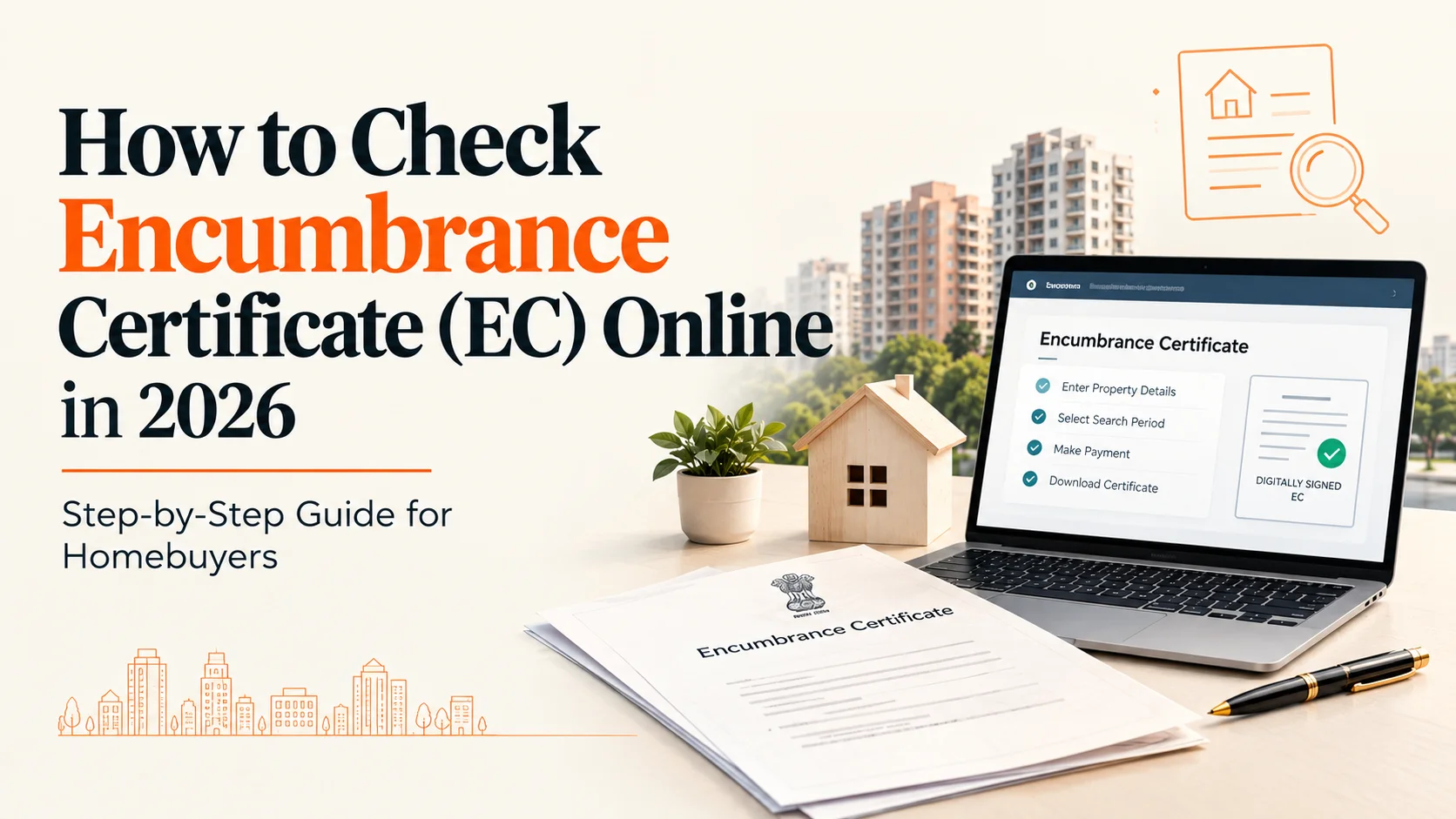
Buying property in Andhra Pradesh involves several factors to consider before making a decision aside from location and cost. One such factor is to review the Encumbrance Certificate (EC), on which most transactions are based, to determine whether any legal or monetary encumbrances exist against the real property being purchased. This certificate can potentially prevent future disputes over the ownership of the property being purchased.
To simplify access to property records, the Andhra Pradesh government provides online services through the IGRS AP portal. Today, citizens can search for, verify, and download Encumbrance Certificates online without repeatedly visiting sub-registrar offices. This guide explains how to search an Encumbrance Certificate online in Andhra Pradesh, its importance, required details, and common mistakes to avoid.
What is IGRS AP?
IGRS AP stands for the Integrated Grievance Redressal System and Registration Services portal managed by the Registration and Stamps Department of Andhra Pradesh. It centralises a wide range of property and civil registration services that previously required physical visits to government offices spread across the state.
The portal offers various property-related services digitally, including:
- Encumbrance Certificate search
- Property registration services
- Market value assistance
- Stamp duty information
- Document registration details
- Certified copy applications
- Marriage registration services
- Property transaction verification
The platform helps improve transparency, reduce paperwork, and simplify access to land and property records.
Also Read: CERSAI Search Online: How to Check if a Property is Already Mortgaged
What is an Encumbrance Certificate (EC)?
An Encumbrance Certificate (EC) is the official government document that records all registered financial and legal transactions associated with a specific property over a defined period. It's essentially the property's legal transaction history, maintained by the Registration Department, and it's the single most reliable way to verify whether a property carries any existing liabilities before you purchase it. The EC specifically reveals whether a property has any of the following attached to it:
- Outstanding loans
- Mortgages
- Legal disputes
- Sale transactions
- Gift deeds
- Lease agreements
- Partition deeds
If no liabilities exist, the EC reflects a clear ownership history.
Information Available in an EC
An Encumbrance Certificate generally contains:
- Property owner details
- Registered transaction records
- Sale deed information
- Mortgage records
- Property description
- Registration dates
- Document numbers
- Transaction value
This information helps buyers verify the property's legal status before making a purchase.
Why is an Encumbrance Certificate Important?
An EC is one of the most important documents required during property transactions, it's the single most accessible tool available to ordinary buyers for verifying a property's legal cleanliness before committing money.
Key Benefits
- Verifies legal ownership
- Confirms absence of liabilities
- Helps secure home loans
- Prevents fraudulent transactions
- Supports property due diligence
- Required for property mutation
- Assists during resale transactions
Buyers who skip EC verification relying purely on the seller's representations or the physical documents.The independent government verification an EC provides is precisely what protects against the situations where a seller's representations turn out to be incomplete or inaccurate.
Who Should Check an Encumbrance Certificate?
The EC is relevant to a broader range of people than just first-time property buyers. The categories of people who regularly need to check EC records include:
- Property buyers
- Existing property owners
- Home loan applicants
- Real estate investors
- Legal heirs
- Banks and financial institutions
- Property consultants
Checking an EC before completing any transaction significantly reduces legal risks.
How to Search an Encumbrance Certificate Online Through IGRS AP
The Andhra Pradesh government has made EC searches simple through the IGRS AP portal.
Step 1: Visit the IGRS AP Portal
Open the official Andhra Pradesh Registration and Stamps Department website and navigate to the Encumbrance Certificate section (https://registration.ec.ap.gov.in/ecSearch)
Step 2: Select EC Search Option
Choose the online Encumbrance Certificate search service available on the homepage.
Step 3: Enter Property Details
Provide the required information such as:
- District
- Sub-Registrar Office
- Village or locality
- Survey number
- Document number (if available)
Accurate information improves search results.
Step 4: Choose Search Period
Select the time period for which you want transaction records.
Most buyers prefer checking records covering:
- Last 10 years
- Last 20 years
- Complete ownership history
Step 5: Submit the Request
After entering the required details, submit the request through the portal.
Step 6: View Encumbrance Certificate
The system displays available transaction records related to the selected property. Users can view and download the certificate for future reference.
Documents and Information Needed for EC Search
Unlike full property registration, which requires extensive identity and ownership documentation, an EC search has relatively minimal information requirements.
Basic Details Required
- Property survey number
- Village name
- District details
- Registration document number (optional)
- Sub-Registrar Office details
Having these details accurately confirmed before you start the search rather than relying on what a seller or broker has told you verbally significantly improves both the speed and the reliability of your search results.
IGRS AP Online EC Search vs Traditional Method
|
Feature |
IGRS AP Online Search |
Traditional Office Visit |
|
Accessibility |
Available Anytime |
Office Hours Only |
|
Processing Time |
Instant |
Several Days |
|
Convenience |
High |
Moderate |
|
Transparency |
Excellent |
Limited |
|
Travel Requirement |
None |
Required |
|
Record Availability |
Digital |
Physical Files |
|
Cost Efficiency |
Better |
Additional Travel Costs |
|
Status Tracking |
Available |
Limited |
The online system has significantly improved citizen access to property records.
Also Read: Leasehold vs Freehold Property in India: Which is Safer to Buy?
Types of Transactions Reflected in an EC
Understanding what categories of transactions an EC captures helps you interpret what you're seeing when you review the results.
Common Transactions Included
- Property sale deeds
- Mortgage registrations
- Gift deeds
- Release deeds
- Lease agreements
- Settlement deeds
- Partition deeds
- Property transfers
Each of these entries in the EC establishes part of the property's continuous ownership history and the absence of unexpected entries (particularly unreleased mortgages or unresolved disputes) is what gives buyers confidence in the property's clean status.
Benefits of Using IGRS AP for EC Verification
The digital platform offers several advantages.
For Buyers
- Faster property verification
- Better due diligence
- Reduced fraud risk
- Instant record access
For Property Owners
- Easy access to ownership history
- Quick document retrieval
- Better record management
For Financial Institutions
- Efficient loan processing
- Reliable ownership verification
- Improved risk assessment
These benefits make online EC verification an essential part of modern property transactions.
Common Mistakes to Avoid During EC Search
Many users receive incorrect or incomplete results because of avoidable errors.
Entering Incorrect Survey Numbers
Even a small error in the survey number can produce inaccurate results.
Selecting the Wrong Sub-Registrar Office
Property records are maintained under specific registration jurisdictions.
Searching for a Short Time Period
Limited search periods may miss older liabilities or transactions.
Ignoring Ownership History
Buyers should verify multiple previous transactions rather than only the latest entry.
Not Cross-Checking Sale Documents
EC records should match details mentioned in registered sale deeds.
Avoiding these mistakes improves the reliability of verification.
When is an Encumbrance Certificate Required?
EC requirements arise in several specific situations beyond the obvious pre-purchase scenario.
Common Scenarios
- Property purchase
- Home loan approval
- Property resale
- Legal dispute resolution
- Property mutation
- Land ownership verification
- Property inheritance matters
Banks and housing finance companies often insist on recent EC records before approving loans.
Challenges Property Buyers Should Still Monitor
While an EC is extremely useful, it is not a complete substitute for comprehensive due diligence.
- Original title document verification through a property lawyer who can review the complete chain of ownership documents, not just the registered transaction summary the EC provides.
- Approved building plan confirmation to verify that any existing construction matches what was officially sanctioned by the relevant local authority.
- Property tax payment status verification, since unpaid taxes can create liabilities that aren't necessarily captured in the EC's registration-focused records.
- Land use permission verification to confirm the property's classification matches your intended use and that any required permissions for that use are in place.
- Court litigation record review, since not all forms of legal dispute necessarily appear as registered transactions in the EC, some litigation exists independently of the registration system.
- Physical site inspection to verify that the property you're purchasing matches its official description and that there are no visible issues, encroachments, boundary discrepancies, or structural concerns that documentation alone wouldn't reveal.
Combining these checks with an EC search provides stronger protection.
Conclusion
The IGRS Andhra Pradesh website has made the process of finding Encumbrance Certificates within Andhra Pradesh simpler than ever. The site provides immediate access to property transaction information, enabling potential buyers, investors, lenders and owners to verify ownership and assess any possible liabilities they may have before making a purchase.
Wherever you are purchasing a parcel of land, applying for a mortgage on a home, or reviewing your family history about property ownership, be sure to always complete an EC search before signing on the dotted line. A complete EC Search, in combination with an appropriate legal verification, will help provide you with a secure and legally compliant property transaction that is free of encumbrances.




Ans 1. IGRS AP stands for the Integrated Grievance Redressal System and Registration Services portal managed by the Andhra Pradesh Registration and Stamps Department. It provides digital access to Encumbrance Certificate search and download, property registration services, market value information, stamp duty calculation assistance, document registration details, certified copy applications, and property transaction verification. For property buyers specifically, the portal's most important feature is the ability to search and download Encumbrance Certificates online, allowing independent verification of a property's legal and financial transaction history without visiting the Sub-Registrar Office in person.
Ans 2. To search an Encumbrance Certificate online through IGRS AP, visit the official Andhra Pradesh Registration and Stamps Department portal and navigate to the EC search section. Select the online EC search option and enter the property details including district, Sub-Registrar Office, village or locality, and survey number. Choose your desired search time period typically 10 to 20 years or complete ownership history for thorough verification. Submit the request. The system displays available transaction records for the property which you can view and download. Accurate entry of the survey number and correct selection of the Sub-Registrar Office jurisdiction are essential for reliable results.
Ans 3. An Encumbrance Certificate (EC) is an official document that records all registered financial and legal transactions associated with a property over a specified period including sale deeds, mortgages, gift deeds, lease agreements, and partition deeds. It's important because it independently verifies, through government records, whether a property carries any existing loans, legal disputes, or other claims that would transfer to a new owner upon purchase. Checking the EC before any property purchase helps confirm clear ownership, prevents inheriting undisclosed liabilities, supports home loan approval, and protects against fraudulent property transactions.
Ans 4. To search an Encumbrance Certificate on IGRS AP, you need the property's survey number, the village name where it's located, the district, the Sub-Registrar Office jurisdiction details, and optionally the registration document number if available from previous transaction records. Unlike full property registration, EC search doesn't require extensive identity or ownership documentation, just accurate property identification details. Verify these details against the official property documents, sale deed, previous EC, or revenue records rather than relying on what a seller has told you verbally, since accuracy in these inputs directly determines the reliability of your search results.
Ans 5. Most thorough buyers search Encumbrance Certificate records covering at least the last 10 to 20 years, with some choosing to search the complete available ownership history when accessible through the IGRS AP portal. A longer search period provides more comprehensive verification because mortgages or disputes registered many years ago but never formally released remain valid encumbrances even if they're old. Searching only a short recent period like the last 2 or 3 years risks missing older but still legally relevant liabilities. For high-value property transactions, requesting the complete available ownership history search provides the strongest due diligence.
Ans 6. An Encumbrance Certificate in Andhra Pradesh shows registered property transactions including sale deeds documenting ownership transfers, mortgage registrations showing secured loans against the property, gift deeds recording non-sale transfers, release deeds showing discharge of previous mortgages, lease agreements that have been formally registered, settlement deeds, and partition deeds dividing jointly held property among co-owners. Each entry includes the registration date, document number, and transaction value where applicable. Reviewing the complete chain of these transactions helps establish the property's full ownership history and confirms whether any unresolved liabilities remain attached to it.
Ans 7. Yes, it's strongly advisable to independently obtain your own Encumbrance Certificate even if the seller has provided one, because an EC document can be altered, an older EC might not reflect very recent transactions, and independently obtaining the document through the official IGRS AP portal ensures you're seeing the actual current government record rather than potentially outdated or modified documentation. Banks financing the purchase will also typically require their own recently generated EC as part of loan processing rather than accepting documents provided by either party to the transaction. Independent verification through the official portal is a fundamental due diligence practice that protects your interests.
Ans 8. Encumbrance Certificate searches through the IGRS AP online portal are typically instant or near-instant for properties with digitised records, the search results display immediately after submission for most areas where digital records are complete. This is dramatically faster than the traditional process of visiting a Sub-Registrar Office in person, which could take several days due to manual record retrieval from physical files. For properties with older records that haven't been fully digitised, there may be some delay, but the overall online process remains significantly faster than the traditional office-based method.
Ans 9. Yes, banks and housing finance companies in Andhra Pradesh routinely use and require Encumbrance Certificates obtained through IGRS AP as part of their loan processing and due diligence for home loan applications. The EC helps banks verify that the property being mortgaged doesn't already carry undisclosed liabilities that would compete with their security interest. Most lenders require a recently generated EC; typically within the preceding few months as standard documentation before approving and disbursing a home loan. The digital accessibility of IGRS AP has made this verification step faster for both banks and borrowers compared to the traditional office-based process.
Ans 10. If your Encumbrance Certificate search reveals information that doesn't match what the seller has represented, a different owner name, an unreleased mortgage the seller didn't disclose, or a different property description; you should not proceed with the transaction until the discrepancy is fully explained and resolved. Request clarification and supporting documentation from the seller addressing the specific discrepancy. Consult a property lawyer to assess the legal significance of what the EC has revealed. If the discrepancy involves an undisclosed mortgage or legal dispute, this is a serious red flag that requires resolution typically through the seller clearing the liability before any payment or commitment should be made.