

✦ AI Summary
Table of Content
▲- What Is CERSAI and Why Does It Exist?
- Key Terms You Should Know Before You Search
- Three Types of CERSAI Searches
- How to Do a CERSAI Search Online: Step by Step
- How to Read Your CERSAI Search Result
- CERSAI Search vs. Encumbrance Certificate: What's the Difference?
- What to Do if the Property Has an Active CERSAI Entry
- CERSAI Search: Full Feature Overview
- Limitations of CERSAI: What It Cannot Tell You
- Conclusion
CERSAI, the Central Registry of Securitisation Asset Reconstruction and Security Interest, is India's government backed, centralized database that holds records about mortgages along with other security interests tied to properties across most of the country. A homebuyer can actually do a quick check online , under five minutes, and the fee is just ₹10. Honestly, whether you’re buying an apartment in Delhi NCR, a plot of land in Pune, or a commercial unit in Bengaluru, you really should not skip a CERSAI verification before the sale deed is finalized. It's the one step that separates an informed buyer from an expensive legal disaster.
This guide walks you through everything, what is CERSAI, how to search it, what the result means, and what to do if the property you want is already mortgaged.
What Is CERSAI and Why Does It Exist?
Before CERSAI came into existence, a fairly common fraud in India went like this: a property owner would get certified copies of their title deed and approach multiple banks simultaneously, securing loans from all of them against the same property. Each bank thought it was the only lender. None of them could verify otherwise.
CERSAI was set up under the SARFAESI Act, 2002 and sort of formally launched in 2011, to stop exactly that. It acts like a centralized online database where each bank, NBFC and housing finance company has to register any security interest they hold on a borrower’s property, within 30 days of the loan being sanctioned.
|
Full Form |
Central Registry of Securitisation, Asset Reconstruction and Security Interest |
|---|---|
|
Established Under |
SARFAESI Act, 2002 |
|
Licensed Under |
Section 8, Companies Act, 2013 |
|
Launched |
2011 |
|
Governing Body |
Ministry of Finance, India |
|
Endorsed By |
RBI and SEBI |
|
Records As of 2024 |
45+ crore (movable + immovable assets) |
Also Read: Step-by-Step Guide to Check Bhulekh Land Records in Bihar
Key Terms You Should Know Before You Search
|
Term |
What It Means |
|---|---|
|
Security Interest |
Legal claim a lender holds over a mortgaged property |
|
Immovable Property |
Land, flats, houses, commercial units |
|
Encumbrance |
Any outstanding financial or legal claim on a property |
|
Asset-Based Search |
Search using the property's physical details |
|
Debtor-Based Search |
Search using the borrower's name or PAN |
|
Satisfaction of Charge |
CERSAI entry updated after full loan repayment |
|
NOC |
No Objection Certificate issued by a bank after loan closure |
Three Types of CERSAI Searches
|
Search Type |
Who Uses It |
What It Finds |
|---|---|---|
|
Asset-Based Search |
Homebuyers, investors |
Mortgage or lien on a specific property |
|
Debtor-Based Search |
Buyers vetting a seller or builder |
All properties mortgaged by a person or company |
|
AOR-Based Search |
Authorised institutional entities only |
Security interests on assignment of receivables |
For individual property buyers, Asset-Based Search is the relevant option. It's available on the public portal, no login or registration required.
How to Do a CERSAI Search Online: Step by Step
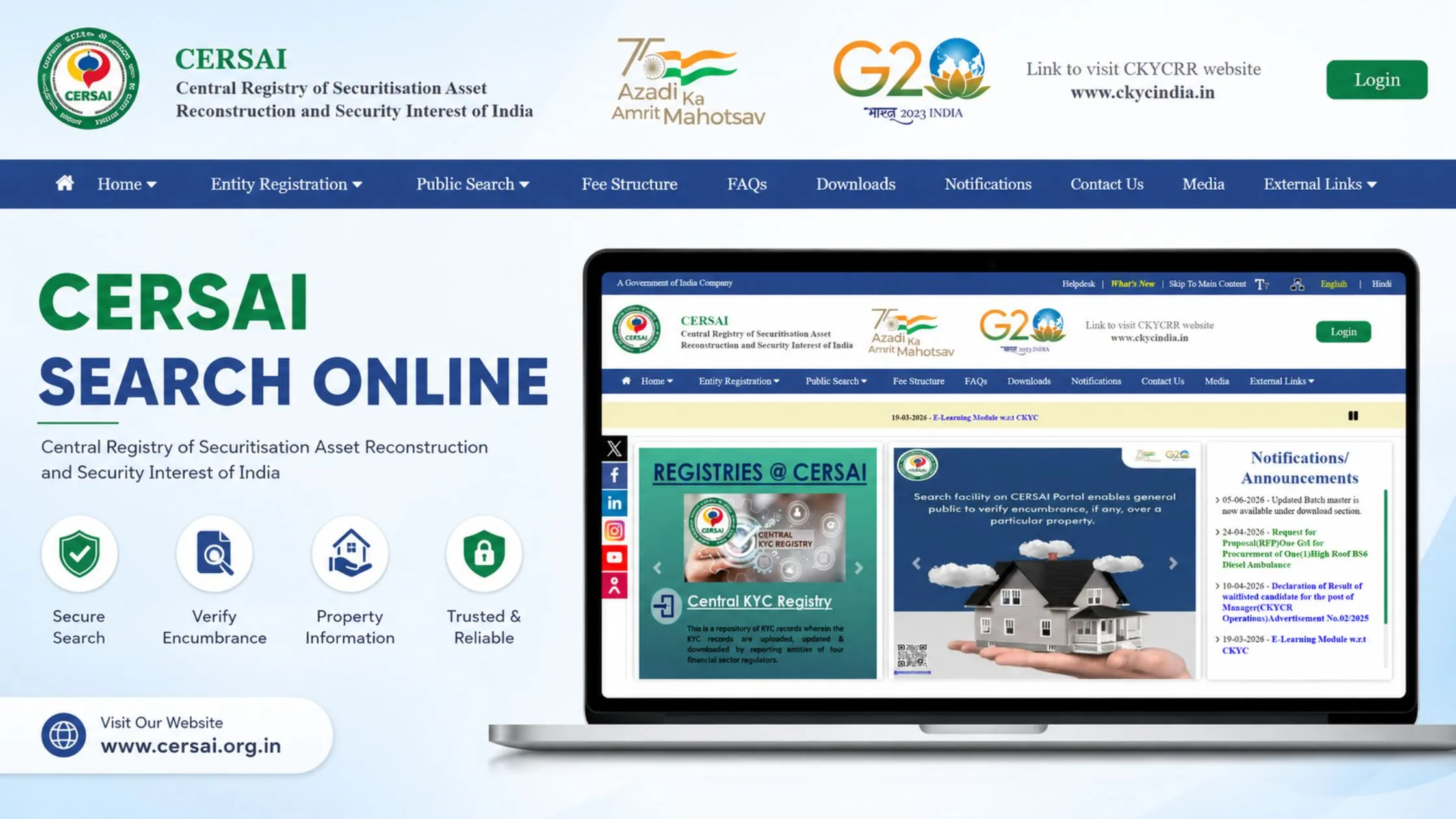
Step 1: Visit the Official CERSAI Portal
Go to cersai.org.in. Do not use third-party websites that mimic the portal's interface.
Step 2: Click Public Search
On the homepage, click the Public Search tab. This is accessible to everyone, no credentials needed.
Step 3: Select Asset-Based Search
Choose Asset-Based Search to proceed with a property-specific mortgage check.
Step 4: Choose Immovable Property as Asset Category
For land, flats, houses, or commercial units, select Immovable Property from the asset type dropdown.
Step 5: Enter Property Details
Fill in all fields accurately:
- Plot / House / Flat number
- Survey number or Khasra number
- Project name (if applicable)
- State, city, and PIN code
Step 6: Complete CAPTCHA and Pay ₹10
Complete the CAPTCHA verification, then pay the ₹10 search fee via any digital payment mode. This is the only cost for a public search, no hidden charges.
Step 7: View the Result
CERSAI processes the query instantly and displays the mortgage status on screen. Download or save the result for your records.
Also Read: Leasehold vs Freehold Property in India: Which is Safer to Buy?
How to Read Your CERSAI Search Result
|
Field in Result |
What It Means |
|---|---|
|
Lender's Name |
Bank or NBFC holding the mortgage |
|
Loan Amount Registered |
Value of secured loan against the property |
|
Date of Registration |
When the security interest was created |
|
Security Interest Status |
Active = mortgage ongoing / Satisfied = loan cleared |
No Record Found: No registered institutional mortgage exists on that property in CERSAI's database. This is positive, but must still be cross-verified with an Encumbrance Certificate.
Active Entry Found: Do not proceed with the purchase until the loan is fully settled and the CERSAI record is updated to Satisfied.
CERSAI Search vs. Encumbrance Certificate: What's the Difference?
Both are important. Neither alone is sufficient. Here's how they complement each other:
|
Parameter |
CERSAI Search |
Encumbrance Certificate (EC) |
|---|---|---|
|
Covers |
Mortgages and security interests |
All registered transactions, sales, mortgages, liens |
|
Issued By |
Central Registry (CERSAI) |
State Sub-Registrar's office |
|
Geographic Scope |
Pan-India, centralised |
State-specific |
|
Cost |
₹10 per search |
Varies by state |
|
Available Online |
Yes, instantly |
Yes, via Bhulekh / Bhoomi portals |
|
Best For |
Detecting active bank loans |
Complete transaction history |
Best Practice: Always run both a CERSAI search for mortgage status and an EC for the full transactional history. Together, they give you the most complete legal picture before any purchase.
What to Do if the Property Has an Active CERSAI Entry
Finding an active mortgage doesn't automatically mean the deal is off. But it does mean you need to handle the next steps carefully:
- Ask the seller for the outstanding loan amount and confirm it matches what CERSAI shows.
- Negotiate a structured sale where the loan is repaid from sale proceeds at the time of registration.
- Obtain the bank's NOC / Loan Closure Letter after the outstanding amount is fully cleared.
- Run a fresh CERSAI search to confirm the entry now shows Satisfied before proceeding.
- Complete property registration only after the CERSAI record is officially updated.
Note: Under RERA 2016, developers are legally required to disclose any mortgage on project land before selling units. If a builder has mortgaged the land without disclosing it, you can report the violation directly to the respective State RERA Authority.
CERSAI Search: Full Feature Overview
|
Feature |
Available? |
|---|---|
|
Public search without login |
Yes |
|
Asset-based (property) search |
Yes |
|
Debtor-based (borrower) search |
Yes |
|
Instant result display |
Yes |
|
Downloadable search report |
Yes |
|
Search fee |
₹10 per search |
|
Available 24×7 |
Yes |
|
Mobile-friendly access |
Yes |
Limitations of CERSAI: What It Cannot Tell You
CERSAI is powerful but not exhaustive. Keep these gaps in mind:
- Informal or private mortgages between individuals are not captured
- Equitable mortgages (deposit of title deeds without formal registration) may have a short data lag
- Pre-2011 transactions created before CERSAI launched may not appear
- State-level Sub-Registrar records do not automatically sync with CERSAI
This is why a CERSAI search must always be paired with an Encumbrance Certificate, a legal title search, and ideally a review by a qualified property lawyer before any high-value transaction.
Conclusion
The Central Registry of Securitisation, Asset Reconstruction and Security Interest has made one of the most important property due diligence checks in India accessible to everyone, for ₹10 and five minutes of your time. A CERSAI result, verified alongside an Encumbrance Certificate and a legal title search, is the foundation of any safe property purchase.
Whether you're a first-time buyer, a seasoned investor or a legal professional, skip this check and you're taking a risk that simply isn't worth taking. The official portal is cersai.org.in, use it before every transaction, without exception.






Ans 1. CERSAI is India's centralised registry under the SARFAESI Act, 2002 that records all security interests, mortgages and liens, created over properties by banks and financial institutions. It lets any buyer verify whether a property is already pledged as loan collateral before purchasing it.
Ans 2. Visit cersai.org.in → click 'Public Search' → select 'Asset-Based Search' → choose 'Immovable Property' → enter property details (plot number, survey number, state, city, PIN) → complete CAPTCHA → pay ₹10 → view result instantly.
Ans 3. Not entirely free, but nearly so. A nominal fee of ₹10 per search is charged via digital payment. No login or registration is required for a public asset-based or debtor-based search.
Ans 4. It means no registered institutional mortgage exists on that property in CERSAI's database. This is a positive indicator but must be cross-verified with an Encumbrance Certificate, as informal or pre-2011 mortgages may not appear.
Ans 5. Yes. The Public Search feature on the CERSAI homepage is fully accessible without any login or registration for both asset-based and debtor-based searches.
Ans 6. Asset-based search finds mortgages using a property's physical details (address, survey number). Debtor-based search finds all properties mortgaged by a specific individual or company using their name or PAN, particularly useful when vetting a builder's financial liabilities.
Ans 7. Do not proceed until the seller repays the outstanding loan, the bank issues a No Objection Certificate, and the CERSAI record is updated to 'Satisfied.' Run a fresh CERSAI search to confirm the clearance before completing the property registration.
Ans 8. No. CERSAI only captures registered institutional mortgages. For a complete check, always pair it with an Encumbrance Certificate from the Sub-Registrar's office and a legal title search by a qualified property lawyer.
Ans 9. Yes. Under RERA 2016, developers must disclose any mortgage or charge on project land before selling units to buyers. Failure to disclose is a reportable violation to the respective State RERA Authority.
Ans 10. Lenders are mandated by RBI to register any new security interest with CERSAI within 30 days of its creation. Delays beyond this attract significant monetary penalties under Section 27 of the SARFAESI Act.