
✦ AI Summary
Table of Content
▲- Understanding Bengaluru's Commercial Growth Shift
- Airport Led Development Is Changing the Landscape
- Infrastructure Projects Are Supporting Commercial Expansion
- Growing Office Demand Is Fueling Commercial Growth
- Aerospace and Industrial Investments Are Creating Jobs
- Commercial Opportunities in North Bengaluru
- North Bengaluru vs South Bengaluru Commercial Growth
- Why Investors Are Paying Attention
- Emerging Commercial Hotspots in North Bengaluru
- Challenges North Bengaluru Must Address
- Future Outlook
- Final Thoughts
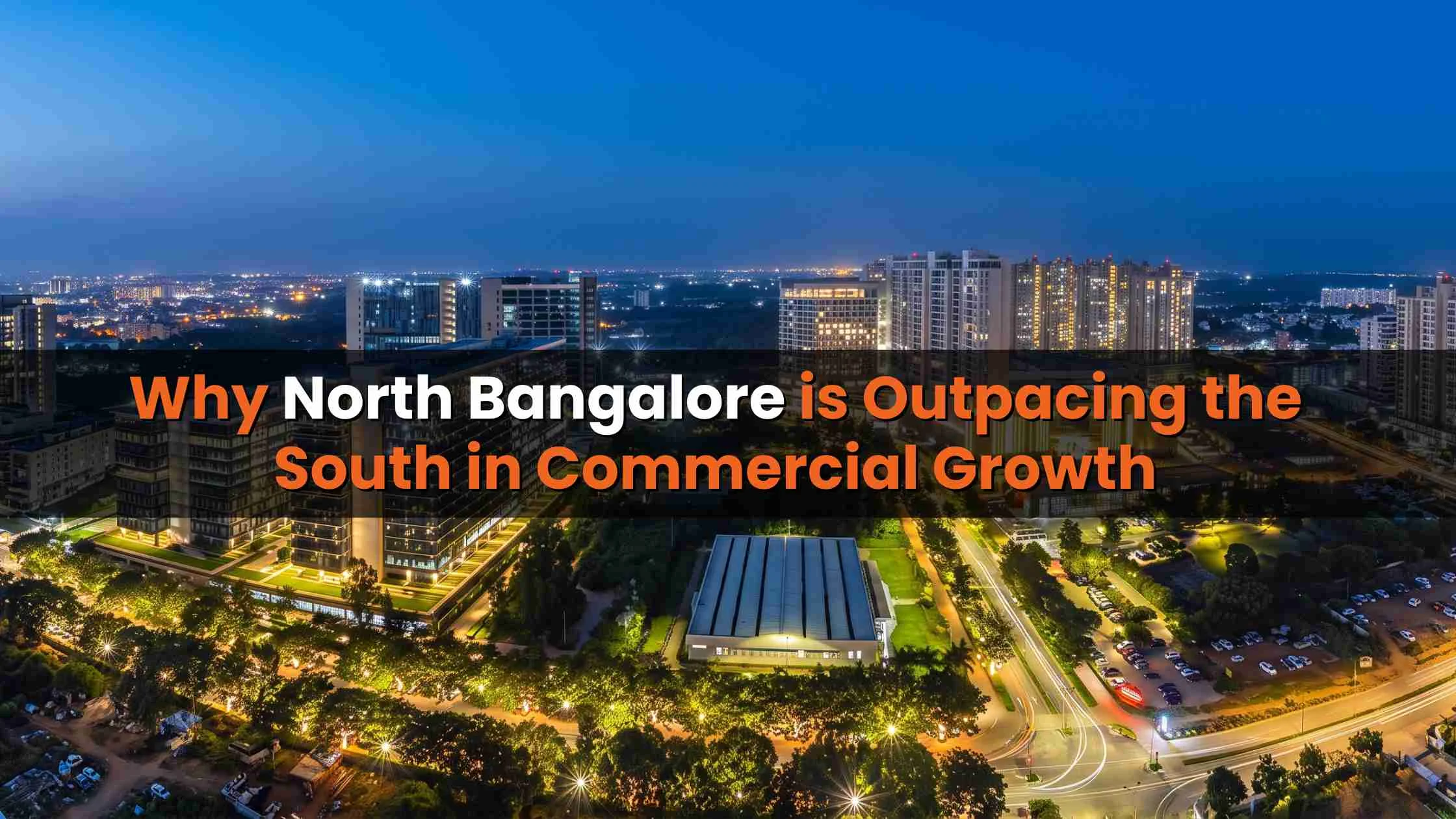
Bengaluru has long been India's technology and innovation capital, attracting multinational corporations, startups, Global Capability Centers (GCCs), and institutional investors. While South Bengaluru has historically enjoyed strong residential and commercial demand, recent years have witnessed a major shift in the city's growth story. North Bengaluru has emerged as the fastest-growing commercial corridor, driven by infrastructure expansion, airport-led development, corporate investments, and large-scale business districts.
North Bengaluru is rapidly changing from Hebbal and Yelahanka to Devanahalli and the Airport Corridor. Companies are now looking for better connectivity as well as modern office spaces and infrastructure in this area. Recent reports related to the industry and market analysis prove that airport connectivity, metro expansion, demand for office space, and industrial investments are the reason behind the rapid growth of North Bengaluru.
Understanding Bengaluru's Commercial Growth Shift
In the past, South Bengaluru used to be in the advantage of the already present residential areas, educational establishments, and commercial activities, however today infrastructure development, availability of large land lots, accessibility, and possibilities for further development have a bigger impact on commercial development than before. North Bengaluru meets all these criteria.
Key Factors Driving Commercial Growth
- Kempegowda International Airport influence
- Metro and transport infrastructure expansion
- Growth of technology and business parks
- Rising GCC and corporate office demand
- Industrial and aerospace investments
- Availability of large development parcels
- Strong government-backed infrastructure projects
These factors have created a business ecosystem that continues to attract developers, investors, and occupiers.
Also Read: Puravankara to Develop ₹1000 Crore Residential Project in Bengaluru's Sarjapur
Airport Led Development Is Changing the Landscape
The single biggest structural advantage North Bengaluru holds over the south is its proximity to Kempegowda International Airport. Large international airports tend to function as genuine economic catalysts wherever they're built, and Bengaluru's airport corridor is a textbook example of that pattern playing out.
Why the Airport Matters
Large airports often become economic catalysts. The airport corridor has encouraged:
- Corporate office development
- Logistics and warehousing hubs
- Hospitality projects
- Aerospace and manufacturing investments
- Commercial business parks
The areas stretching from Hebbal to Devanahalli have experienced substantial employment generation and commercial activity due to airport-led growth. This has created a self-sustaining cycle of jobs, commercial demand, and real estate appreciation.
Infrastructure Projects Are Supporting Commercial Expansion
Infrastructure has become the single biggest driver of Bengaluru's next chapter of growth, and North Bengaluru is currently benefiting from a genuinely unusual number of major projects progressing at the same time.
Major Infrastructure Projects
- Airport Metro Connectivity
- Namma Metro Phase 2B
- Satellite Town Ring Road (STRR)
- Peripheral Ring Road proposals
- NH 44 corridor upgrades
- Bengaluru Suburban Rail Project
- Devanahalli multimodal transport hub
Enhanced mobility throughout this corridor decreases travel time, boosts the daily operational effectiveness of companies, and provides businesses with an absolutely strong justification for choosing North Bengaluru instead of other overcrowded and land-constrained locations in the city.
Growing Office Demand Is Fueling Commercial Growth
Office demand remains one of the strongest indicators of commercial real estate performance.
Industry experts note that North Bengaluru is transitioning from a future-growth region into an active commercial and office market. Corporate occupiers are increasingly evaluating locations around Hebbal, Yelahanka, and Airport Road for expansion.
Reasons Companies Prefer North Bengaluru
- Better connectivity to the airport
- Availability of Grade A office spaces
- Modern commercial developments
- Reduced congestion compared to older business districts
- Easier access for global clients and executives
This growing office ecosystem is drawing in both established domestic businesses and international companies setting up or expanding their Indian operations.
Aerospace and Industrial Investments Are Creating Jobs
Unlike many of Bengaluru's older commercial districts, which lean heavily on IT and IT-enabled services, North Bengaluru benefits from a genuinely diversified employment base spanning multiple industries.
Key Employment Generators
- Aerospace parks
- Manufacturing facilities
- Logistics centers
- Technology parks
- Research and innovation hubs
- Industrial corridors
The Karnataka government's focus on Devanahalli and surrounding areas as investment destinations has accelerated industrial growth. The Special Investment Region initiative is expected to further strengthen economic activity in the region.
Commercial Opportunities in North Bengaluru
North Bengaluru's commercial story isn't limited to corporate office towers anymore, the range of commercial asset classes seeing genuine demand has broadened considerably.
High Demand Asset Classes
- Premium office spaces
- Co-working centers
- Retail high streets
- Business parks
- Logistics hubs
- Mixed-use developments
- Hospitality projects
As employment increases, supporting commercial assets also witness strong demand from businesses and consumers.
North Bengaluru vs South Bengaluru Commercial Growth
|
Factor |
North Bengaluru |
South Bengaluru |
|
Airport Connectivity |
Excellent |
Moderate |
|
Infrastructure Pipeline |
Very Strong |
Mature |
|
Availability of Land |
High |
Limited |
|
Office Expansion Potential |
Very High |
Moderate |
|
Industrial Growth |
Strong |
Limited |
|
Commercial Development Activity |
Rapid |
Stable |
|
Investment Potential |
Very High |
Moderate |
|
Future Appreciation Outlook |
Excellent |
Stable |
The comparison highlights why many developers and investors now consider North Bengaluru the city's most promising commercial growth corridor.
Also Read: South Bengaluru Real Estate Gains Momentum Amid Airport Proposal and Infrastructure Push
Why Investors Are Paying Attention
Commercial investors generally gravitate toward locations where infrastructure investment and employment growth converge, and North Bengaluru currently checks that box more clearly than almost anywhere else in the city.
Benefits for Investors
- Strong rental demand
- Higher appreciation potential
- Expanding corporate presence
- Infrastructure-driven value creation
- Diverse investment opportunities
- Long-term commercial growth
As new business districts emerge, early investors often benefit from capital appreciation and rising occupancy levels.
Emerging Commercial Hotspots in North Bengaluru
Several micro-markets are driving most of North Bengaluru's commercial growth story right now.
Key Growth Locations
Hebbal
A well-established commercial node with excellent connectivity and premium office developments, effectively functioning as the gateway into North Bengaluru for both residents and businesses.
Yelahanka
Rapidly growing on the back of infrastructure improvements and an increasing corporate presence, offering a more balanced mix of residential livability and commercial opportunity.
Bagalur
Benefiting significantly from industrial and aerospace-linked investment, positioning it as an emerging hub for logistics and manufacturing-adjacent commercial activity.
Devanahalli
The largest long-term growth opportunity due to airport expansion, business parks, logistics hubs, and planned transport infrastructure.
Airport Corridor
One of the most actively developing commercial belts anywhere in Bengaluru today, tying together all of the above micro-markets into a single, connected growth zone.
Challenges North Bengaluru Must Address
Despite its strong overall trajectory, the region isn't without genuine growing pains that will need continued attention.
Areas of Focus
- Timely infrastructure execution
- Traffic management
- Public transport integration
- Sustainable urban planning
- Affordable housing supply for workforce demand
Addressing these challenges will be important for maintaining long-term growth momentum.
Future Outlook
North Bengaluru's commercial growth story looks far from finished. With airport expansion, metro connectivity, industrial investment, business park development, and government-backed infrastructure projects all progressing at the same time, the region is steadily becoming one of India's genuinely important commercial corridors, not just a Bengaluru-specific trend.
Industry observers increasingly view North Bengaluru as a future-ready business destination capable of continuing to attract multinational companies, GCCs, institutional investors, and commercial developers for years to come, rather than a short-term growth spike tied to a single project or announcement.
Final Thoughts
North Bengaluru has moved a long way from being a peripheral growth zone into becoming the city's most dynamic commercial market. Airport-led development, large-scale infrastructure investment, rising office demand, industrial and aerospace growth, and genuinely strong connectivity have collectively pushed the region ahead of several of Bengaluru's more traditional commercial hubs.
Considering the high growth rates, improved accessibility and bright future prospects, North Bengaluru seems to be a great place for expansion plans of any business, development projects and investments. North Bengaluru is likely to remain an integral part of the overall progress of the city in the future.




Ans 1. North Bengaluru is growing faster due to its proximity to Kempegowda International Airport, availability of large land parcels, rapid infrastructure development, and rising demand from corporate occupiers and GCCs.
Ans 2. The airport acts as an economic catalyst, driving corporate office development, logistics hubs, hospitality projects, and aerospace investment across the surrounding corridor.
Ans 3. Hebbal, Yelahanka, Bagalur, Devanahalli, and the broader Airport Corridor are the key micro-markets driving commercial growth in North Bengaluru.
Ans 4. Key projects include the Airport Metro Blue Line, Namma Metro Phase 2B, the Satellite Town Ring Road (STRR), Peripheral Ring Road proposals, NH 44 upgrades, and the Bengaluru Suburban Rail Project.
Ans 5. Yes, North Bengaluru is considered a strong investment destination due to rising office demand, industrial growth, infrastructure development, and higher long-term appreciation potential compared to more mature southern markets.
Ans 6. Aerospace, manufacturing, logistics, technology, and research and innovation sectors are collectively driving a diversified employment base across North Bengaluru.
Ans 7. North Bengaluru offers significantly higher office expansion potential due to greater land availability and a stronger infrastructure pipeline, while South Bengaluru's commercial market remains more mature and stable.
Ans 8. It is a government-backed initiative aimed at strengthening industrial and economic activity in and around Devanahalli, supporting long-term commercial and industrial growth in the region.
Ans 9. Companies prefer North Bengaluru for its better airport connectivity, availability of Grade A office space, modern commercial developments, and reduced congestion compared to older business districts.
Ans 10. Premium office spaces, co-working centers, retail high streets, business parks, logistics hubs, mixed-use developments, and hospitality projects are all seeing strong demand across the corridor.