
✦ AI Summary
Table of Content
▲- Why Registrations Get Rejected in Andhra Pradesh
- Section 22A: Prohibited Property, the Most Common and Final Rejection Reason
- Stamp Duty and Market Value Shortfall
- Document and Identity Mismatches
- Jurisdiction and Timeline Errors
- Denial of Execution and Authority Issues
- What Happens When a Document Is Rejected
- How to Appeal a Rejection
- A Pre-Registration Checklist
A property registration in Andhra Pradesh can be rejected for several distinct reasons, and they are not all equally serious. Some, a document mismatch or a stale Encumbrance Certificate, are fixable on the spot with the right paperwork. Others, most notably a Section 22A prohibited-property flag, are structurally fatal: the IGRS AP system blocks the deed automatically, with no discretion available to the Sub-Registrar to override it.
Knowing which category you're dealing with, and checking for the fatal ones before you pay any advance, is the difference between a minor delay and a transaction that can't legally proceed at all. This guide walks through every real rejection category in the IGRS AP system, what causes each one, and what to do about it.
Why Registrations Get Rejected in Andhra Pradesh
Under the Registration Act, 1908, a Sub-Registrar isn't a rubber stamp. The office can and does refuse a document for several defined reasons, and when it does, the reasons must be recorded in writing, and any party to the document can request a free copy of those reasons. In Andhra Pradesh, this framework operates through the IGRS AP CARD (Computer-aided Administration of Registration Department) system, which for certain categories, most importantly prohibited property, enforces the rejection automatically at the system level rather than leaving it to the Sub-Registrar's judgment on the day.
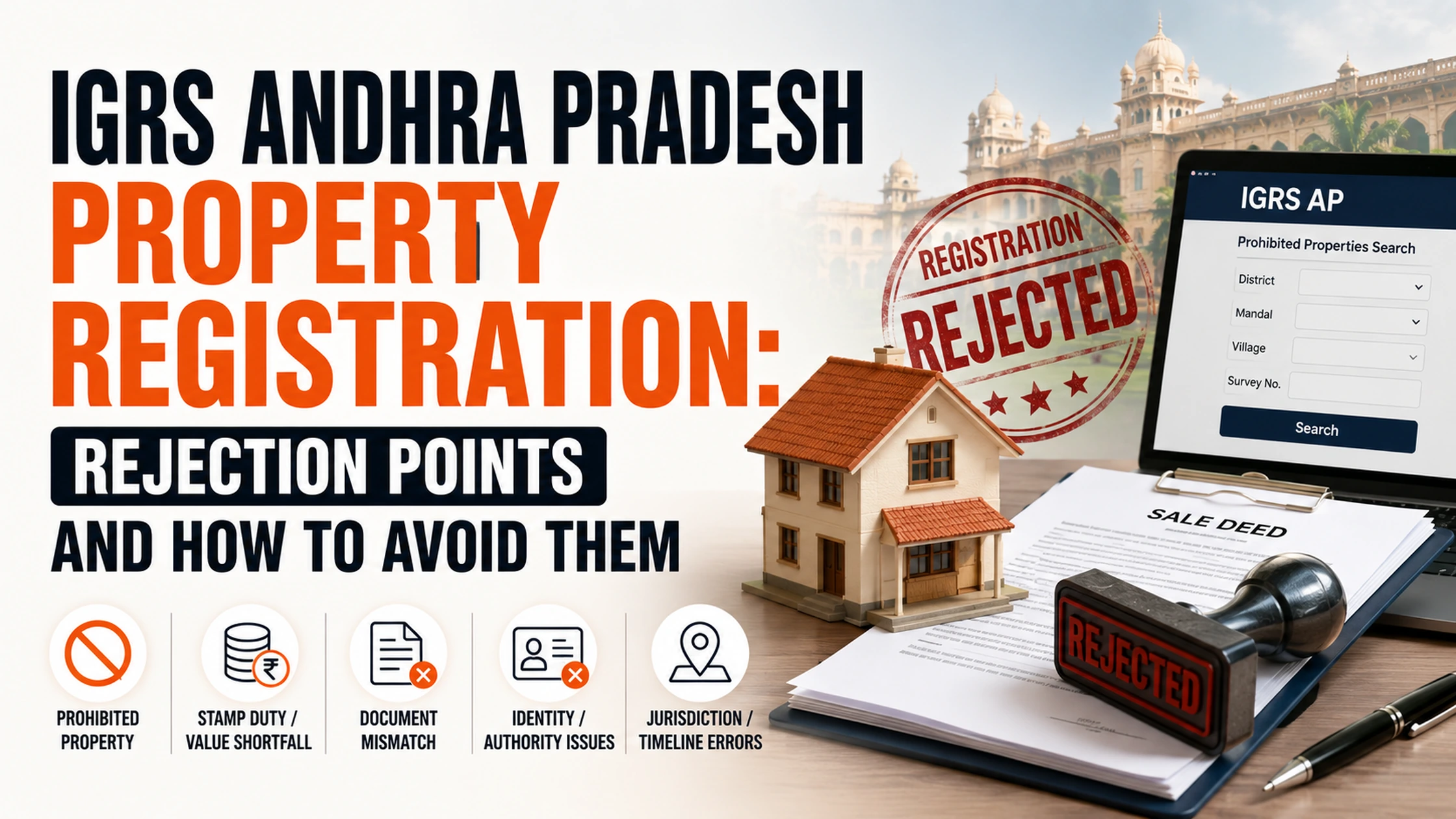
Broadly, rejections in AP fall into five categories: prohibited property, stamp duty or valuation shortfall, document and identity mismatches, jurisdiction and timeline errors, and denial of execution or authority issues. Each has a different cause and a different remedy.
Section 22A: Prohibited Property, the Most Common and Final Rejection Reason
Section 22A of the Registration Act, 1908, as applied in Andhra Pradesh, empowers the state government to prohibit registration of land considered "opposed to public policy." Once a survey number is flagged on the prohibited list, the IGRS AP system blocks the deed at the computer level the moment it's submitted. There is no workaround at the counter, and no bank will lend against a Section 22A-flagged parcel either, since it's treated as non-marketable title.
The Categories of Prohibited Land
AP groups prohibited land into five distinct clauses:
- Assigned land given to landless poor individuals for farming or housing, generally non-transferable under the 1977 Act.
- Government-owned land, where private individuals are barred from registering any transaction.
- Endowment and Wakf properties, belonging to religious or charitable trusts and Wakf boards.
- Ceiling surplus land, arising from land reform proceedings.
- Court-attached or disputed land, or land otherwise notified by the government as prohibited.
How to Check Before You Pay Any Advance
This check is free and takes minutes: on the IGRS AP portal at registration.ap.gov.in, use the Prohibited Properties search, select Urban or Rural, then District, Mandal, and Village, and enter the survey number. If the survey number appears, the land cannot be registered under its current status. This is worth doing before any advance payment or agreement is signed, not just before the registration appointment, since discovering a prohibited flag after money has changed hands is a far harder problem to unwind. A clean Encumbrance Certificate does not substitute for this check; EC and prohibited-property status are separate systems, and a property can show a clean EC while still being flagged under Section 22A.
The 2026 Reforms That May Free Up Wrongly Listed Land
A significant number of genuine private patta lands were historically flagged incorrectly, due to data errors in the underlying land records system, and the AP government's 2026 land reform initiative has begun correcting this. New guidelines now require authorities to subdivide a flagged survey number so only the specifically disputed portion remains prohibited, rather than freezing an entire survey number over a partial dispute. Separately, five categories have been identified as eligible for removal from the prohibited list: land granted to serving or retired defence personnel, land allotted to freedom fighters, land recognised under political-victim compensation schemes, assignments made before 18 June 1954, and genuine private land wrongly marked in error. If you believe your property has been wrongly listed, this is worth pursuing actively rather than assuming the flag is permanent.
Stamp Duty and Market Value Shortfall
Stamp duty in AP is calculated on whichever is higher: the price actually agreed between the parties, or the government's official guideline value for that area, searchable on the IGRS AP portal's Market Value Search. Paying duty based on a lower agreed price than the guideline value doesn't reduce your liability; the Sub-Registrar can reject the registration outright, or refer the matter for a formal valuation inquiry, if the declared value appears to fall short of the guideline figure. This risk has become more live recently: AP raised its urban land guideline values significantly from February 2026, specifically to close the gap between official rates and actual market prices, which means transactions priced using older assumptions about guideline values are now more likely to trigger a shortfall than they would have a year earlier.
Undervaluation vs Understamping
These two terms are often used interchangeably but carry different legal consequences. Undervaluation means the duty has been correctly calculated and paid on the value declared in the document, but the declared value itself is suspected to be below true market value. Understamping means the duty actually paid falls short of what the declared value itself required, a straightforward fiscal shortfall regardless of whether the declared value is accurate. Where a Sub-Registrar suspects undervaluation specifically, the correct process isn't an outright refusal at the counter; it's a reference to the Collector under Section 47-A for a formal valuation inquiry, with the deficient duty recovered following that determination. Registration and the valuation dispute are meant to proceed as separate stages, though in practice this distinction isn't always cleanly applied at every SRO.
Document and Identity Mismatches
This category covers the largest number of preventable, fixable rejections and delays:
- Aadhaar and PAN address mismatches, particularly where a party's residence address on these documents doesn't match the property address or each other.
- An Encumbrance Certificate older than the SRO's accepted freshness window, commonly expected to be recent, within the weeks immediately before registration.
- A society or association NOC that's unsigned, or where the flat or unit number doesn't exactly match the sale deed.
- An unregistered or non-notarised Power of Attorney, where the person presenting the document isn't the owner directly.
- A witness without valid Aadhaar or PAN, since witnesses undergo the same identity verification as the parties themselves.
These are almost always fixable by correcting the specific document before the appointment, rather than fatal to the transaction itself, but they can cost a lost registration slot and, in a chain transaction with a seller under time pressure, real practical cost.
Jurisdiction and Timeline Errors
A document presented to the wrong Sub-Registrar's office, one covering a different survey number, mandal, or district than where the property is actually located, will be rejected on jurisdictional grounds; stamp duty paid in the wrong SRO's jurisdiction is not easily refunded, so this is worth confirming before payment, not after. Separately, under the Registration Act, a document generally must be presented for registration within four months of its execution date; missing this window can mean losing legal protection for the transaction and complications with any linked home loan, independent of anything else being in order.
Denial of Execution and Authority Issues
If the person presenting a document isn't legally entitled to do so, for example, a Power of Attorney that doesn't specifically authorise registration of that particular document, or a signatory who denies having executed the document at all, the Sub-Registrar is required to refuse registration. This is treated differently, and has a different appeal route, than a simple documentation defect, since it goes to whether a valid transaction exists at all rather than whether the paperwork is complete.
What Happens When a Document Is Rejected
Under Section 71 of the Registration Act, when a Sub-Registrar refuses to register a document, the refusal must be recorded in writing, and the reasons endorsed on the document itself as "Registration refused." Any party executing or claiming under the document can request a free copy of those recorded reasons. Once a document has been endorsed this way, no registering officer can accept it again for registration unless a higher authority specifically directs otherwise, so understanding the exact ground of refusal matters immediately, not eventually.
How to Appeal a Rejection
The correct remedy depends on the specific ground of refusal:
- If the refusal is on any ground other than denial of execution or lack of jurisdiction (a document defect, a valuation dispute, and similar), the aggrieved party can appeal to the District Registrar under Section 72, within 30 days of the refusal order.
- If the refusal is specifically on the ground of denial of execution, someone disputing having signed the document, the correct route is instead an application under Section 73, not a Section 72 appeal; courts have noted these two provisions are easy to confuse, and the substance of what happened, not the label on the filing, determines which applies.
- If the District Registrar also refuses, under Section 72 or Section 76, the final remedy is a civil suit under Section 77, filed within 30 days of that refusal, seeking a decree directing the document to be registered.
Notably, failing to file a suit under Section 77, or having that suit dismissed, doesn't automatically forfeit every other remedy available on the underlying unregistered document; other legal avenues may still exist depending on the specific facts.
A Pre-Registration Checklist
Before booking your IGRS AP registration slot:
- Search the property's survey number on the Section 22A prohibited-properties tool, free, on registration.ap.gov.in.
- Check the current guideline value for the area on the Market Value Search, and confirm your declared price meets or exceeds it.
- Pull a fresh Encumbrance Certificate, within the SRO's accepted window, not an older one from earlier in the transaction.
- Confirm Aadhaar and PAN addresses for every party and witness, and resolve any mismatch before the appointment.
- Verify any society or association NOC matches the sale deed's unit details exactly.
- Confirm you're presenting at the correct SRO for the property's actual location.
- Confirm the document is being presented within four months of its execution date.






Ans 1. A Section 22A prohibited-property flag is the most consequential rejection reason, since the IGRS AP system blocks the deed automatically with no Sub-Registrar discretion to override it. Document and identity mismatches are more common overall but are usually fixable.
Ans 2. Search the survey number on registration.ap.gov.in's Prohibited Properties tool, selecting Urban or Rural, then District, Mandal, and Village. This check is free and should be done before paying any advance, not just before the registration appointment.
Ans 3. No. Encumbrance status and Section 22A prohibited status are separate systems. A property can show a clean EC while still being flagged as prohibited, so both checks are necessary.
Ans 4. The Sub-Registrar can reject the registration or refer the matter to the Collector under Section 47-A for a formal valuation inquiry. Stamp duty is always calculated on whichever is higher: your declared price or the official guideline value.
Ans 5. Yes. If refused on grounds other than denial of execution, you can appeal to the District Registrar under Section 72 within 30 days. If the refusal was specifically on denial of execution, the correct route is an application under Section 73 instead. If the District Registrar also refuses, a civil suit under Section 77 is the final remedy.
Ans 6. Aadhaar and PAN address mismatches, an outdated Encumbrance Certificate, an unsigned or mismatched society NOC, an unregistered Power of Attorney, and a witness lacking valid identity documents are the most common fixable causes of delay.
Ans 7. Yes, generally four months from the date of execution under the Registration Act. Missing this window can affect the transaction's legal protection and complicate any linked home loan.