
✦ AI Summary
Table of Content
▲
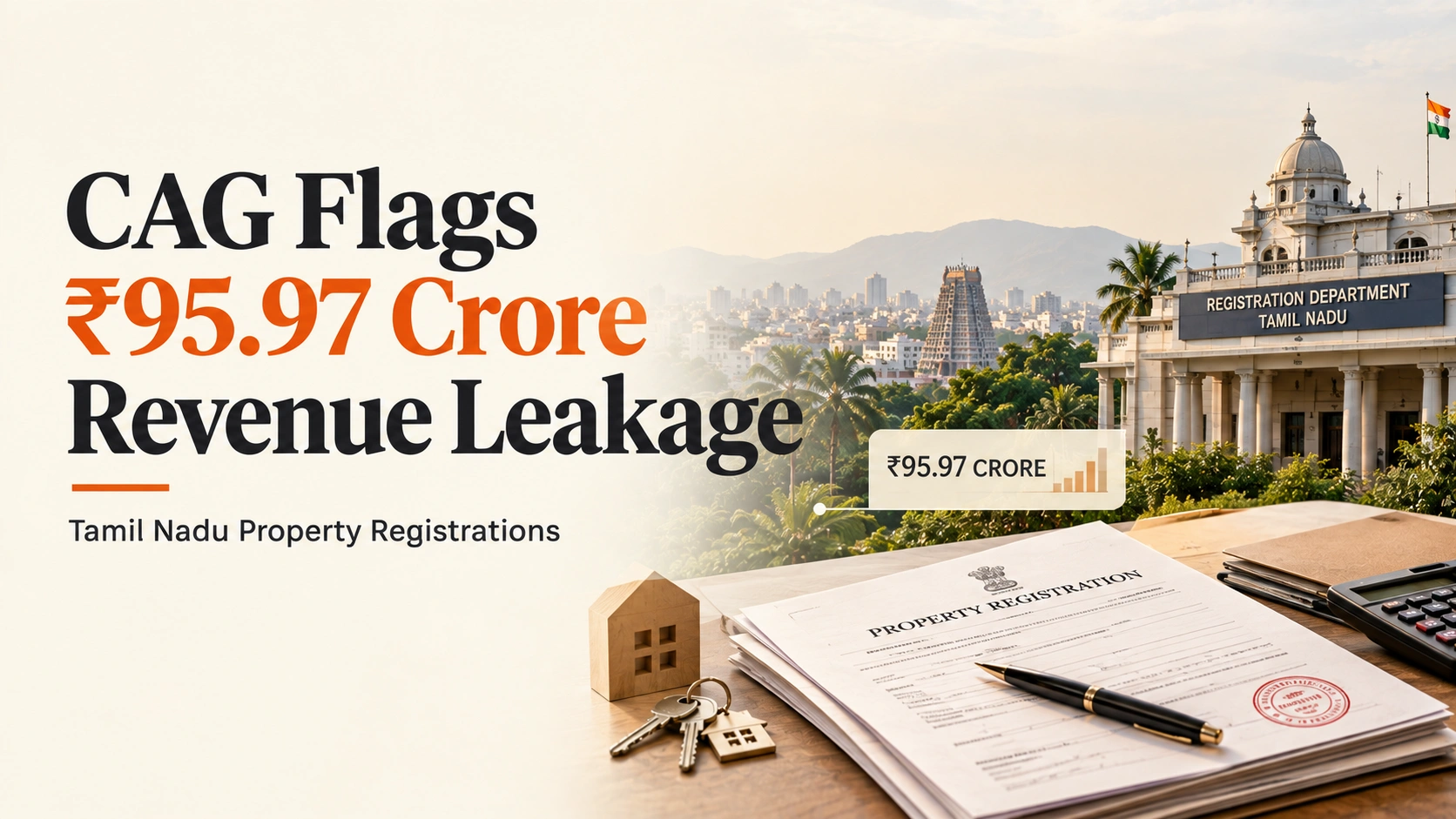
A compliance audit of Tamil Nadu’s registration department has found potential revenue leakage of ₹95.97 crore across 967 cases, with the irregularities ranging from property undervaluation to incorrect classification of documents.
The findings relate to the financial year ended March 2024. The Comptroller and Auditor General of India (CAG) examined records from 114 of the department’s 647 auditable offices and found several instances where stamp duty and registration fees may not have been collected in full.
The audit also pointed to a wider problem: a sizeable backlog of internal audits and unresolved audit observations within the department.
Misclassification accounted for most of the amount
The largest chunk of the potential revenue loss came not from undervaluation, but from misclassification of property transactions.
The audit identified 605 such cases involving ₹85.84 crore. Another 63 cases related specifically to undervaluation, with an estimated revenue impact of ₹1.07 crore.
These figures came from the records examined by the CAG and should not be read as a measure of the total amount potentially lost across every registration office in the state.
Tamil Nadu collected ₹19,013.35 crore in stamp duty and registration fees in 2023-24. Against that backdrop, even relatively small gaps in individual transactions can add up when they occur across a large registration network.
The CAG found that officials did not always sufficiently compare information available across different documents. Sale deeds, memoranda of understanding, Form 26AS records, project approvals and technical assessments can sometimes tell different parts of the same transaction story.
That cross-check becomes particularly important in high-value property deals.
Four land transactions showed a ₹71.16 crore valuation gap
One set of transactions examined in the audit involved about 14.945 acres of land in Venpedu and Vayallanallur.
The properties were registered for a combined value of about ₹78.66 crore. However, earlier memoranda of understanding indicated substantially higher transaction values.
The CAG estimated the undervaluation in these four transactions at ₹71.16 crore. The resulting short collection of stamp duty and other charges was estimated at around ₹7.83 crore.
Cases like these show why the amount written in a final sale document cannot always be viewed in isolation. Earlier agreements and related financial records may provide important clues about the actual value involved in a transaction.
For homebuyers, sellers and investors, the cost of registration is therefore something to calculate before the deal is finalised, rather than after the documents reach the registration office. Buyers can also check the latest stamp duty and registration charges in Tamil Nadu before estimating the total cost of a property transaction.
Power of attorney transactions raised another concern
The audit also examined transactions involving powers of attorney.
At Ambattur and Thamal, three powers of attorney were registered without consideration. However, records available through Form 26AS and later sale deeds indicated transactions worth ₹100.08 crore.
The CAG estimated a revenue shortfall of ₹4.99 crore in these cases.
One of the transactions at Ambattur was particularly notable. While the power of attorney showed no consideration, Form 26AS records reflected a transaction value of about ₹89.02 crore.
A power of attorney does not automatically mean that a property sale has taken place. But when such documents are followed by sale transactions, the records need to be read together. That is where gaps in scrutiny can become significant.
Other cases involved guideline values and property classification
The audit found several other examples where the department had either applied the wrong value or classified a transaction incorrectly.
In a demerger-related transaction involving Wimco and ITC in Thiruvottiyur, the CAG estimated a revenue loss of about ₹2.72 crore. Around ₹1.69 crore had been recovered later, and disciplinary action was initiated.
In Chennai South, incorrect classification of documents connected with possession resulted in an estimated short collection of around ₹1.6 crore.
The audit also identified cases involving incorrect guideline values, lease surrender transactions and differences in comparable property values.
At Sangagiri, for instance, the use of an incorrect guideline value resulted in an estimated revenue loss of ₹47.21 lakh.
There were also cases where information about an existing building was allegedly not properly reflected while determining the value of the transaction.
Internal audit backlog adds another layer
The CAG's concerns extend beyond individual property registrations.
As of March 31, 2024, 5,428 internal audits were pending in the registration department. There were also 61,109 outstanding audit paragraphs involving ₹323.7 crore.
The audit further noted that the department's audit committee did not hold a meeting during 2023-24.
That backlog matters because an internal audit system is supposed to identify mistakes and revenue leakages before they become long-running issues. If observations remain unresolved for years, the effectiveness of that system is naturally reduced.
The ₹95.97 crore figure itself also needs to be read in context. CAG examined only 114 of the 647 auditable offices. The cases identified during the exercise were described as illustrative, so the audit does not establish that ₹95.97 crore represents the total revenue leakage across Tamil Nadu's registration department.
What property buyers should take from the report
For someone buying a house or land, the CAG findings offer a fairly practical lesson.
The registration process is not simply about paying stamp duty and signing the sale deed. Before reaching that stage, buyers should check the ownership history, previous deeds, land classification, guideline value and any restrictions attached to the property.
The documents supplied by a seller should also make sense when compared with government records. A mismatch in the property description, area, ownership or transaction value deserves attention before money changes hands.
A property title verification checklist can help buyers work through these records instead of relying on a single document.



Ans 1. The CAG audit flagged potential revenue leakage of ₹95.97 crore across 967 cases identified during its test check of Tamil Nadu’s registration offices.
Ans 2. CAG test-checked 114 of the 647 auditable offices in the registration department for the audit relating to the year ended March 2024.
Ans 3. The audit identified issues including misclassification, property undervaluation, incorrect guideline values, suppressed transaction details and inadequate correlation of supporting documents.
Ans 4. Tamil Nadu collected ₹19,013.35 crore in stamp duty and registration fees during 2023-24, according to the CAG findings reported by ET Realty.
Ans 5. Misclassification accounted for the largest share, with 605 cases involving ₹85.84 crore.
Ans 6. Three powers of attorney were registered without consideration even though Form 26AS and subsequent sale deeds indicated transactions worth ₹100.08 crore. The audit estimated a ₹4.99 crore shortfall.
Ans 7. Buyers should verify ownership records, previous deeds, encumbrance details, applicable guideline values, property classification and supporting approvals before signing and registering the sale deed.
Ans 8. Not necessarily. The figure comes from CAG's test check of 114 offices. The report said the identified cases were illustrative, leaving potential issues in the remaining 533 auditable units outside the test check.