
✦ AI Summary
Table of Content
▲- What Is a 3kW Solar System?
- How Much Roof Space Is Required for a 3kW Solar System?
- How Many Solar Panels Are Needed for a 3kW Solar System?
- How Much Electricity Does a 3kW Solar System Generate?
- Factors That Affect Roof Space Requirements
- Is a 3kW Solar System Enough for Your Home?
- Benefits of Installing a 3kW Rooftop Solar System
- Estimated Roof Space Based on Panel Wattage
- Tips Before Installing a 3kW Solar System
- Common Mistakes to Avoid
- Future of Residential Rooftop Solar in India
- Conclusion
Installing rooftop solar is one of the smartest ways to reduce electricity bills while making your home more energy-efficient. Among the various residential solar options available in India, a 3kW solar system remains one of the most popular choices because it offers an ideal balance between installation cost, electricity generation, and long-term savings.
Many homeowners want to know how much roof space will be needed to install their 3kW residential solar system. The answer to this question depends on several factors, including what type of solar panels will be chosen, how efficient the chosen panels are, what the roof design looks like, and how much shadow-free area will be available. With the advancements of the new high efficiency solar panels, the amount of roof space required to install a residential solar electric system has decreased significantly compared to older systems.
This guide will provide you with information about how much roof area your 3kW solar electric system will require, how many solar panels will be needed, the estimated amount of electricity your panels will produce, the factors that will affect installing your system, as well as giving you some helpful hints on how to plan for your rooftop solar project.
What Is a 3kW Solar System?
A 3kW residential rooftop solar power system produces roughly 3 kilowatts (kW) of electricity during peak sun hours. Sunlight generates usable electrical energy from PV modules. The systems typically used for residential applications are located on moderate-sized roofs.
A 3kW system is generally suitable for:
- Small to medium-sized families
- Independent houses
- Villas
- 2BHK and many 3 BHK homes
- Homeowners looking to reduce monthly electricity bills
Depending on where you are located and how much sunlight you actually get, a correctly installed 3kW system can make electricity that covers a good chunk of a home’s daily power use.
Also Read: Cost and Space Requirements for Installing a Home Elevator
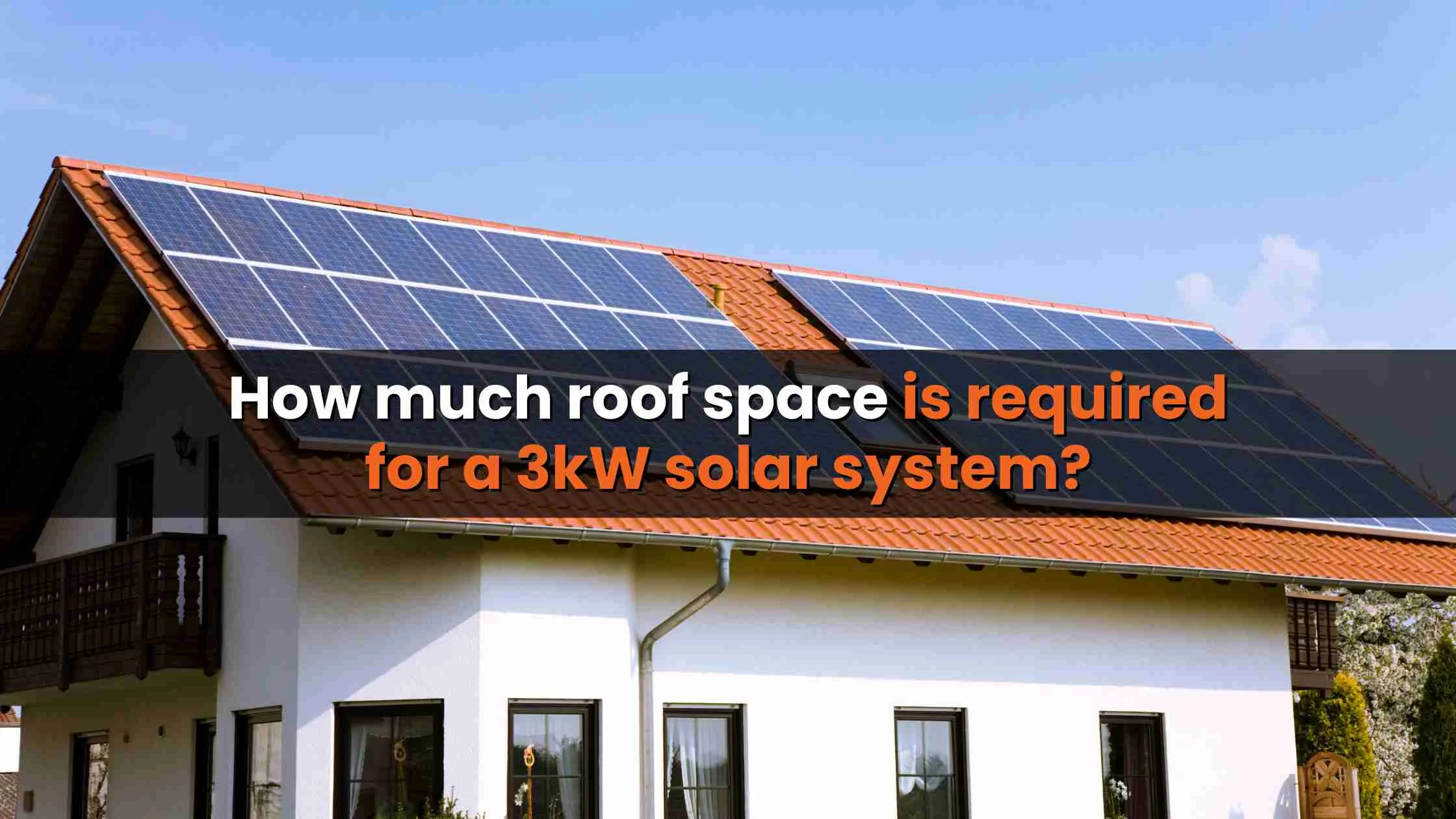
How Much Roof Space Is Required for a 3kW Solar System?
The roof area you need for installation depends most on the efficiency plus the wattage of the solar panels. Usually, if you go with a 3 kW rooftop solar set up using high-efficiency Mono PERC or TOPCon, you might need around 180 - 220 square feet of space that is basically shadow-free. But if the panels are older or watt rating is lower, then you could end up needing something like 250 - 280 square feet.
Approximate Roof Space Requirement
|
Solar Panel Type |
Roof Space Required |
|
High-efficiency Mono PERC / TOPCon |
180–220 sq. ft. |
|
Standard Polycrystalline Panels |
220–280 sq. ft. |
Besides the panels themselves, installers also leave small gaps between modules for mounting structures, airflow, maintenance access, and safety.
How Many Solar Panels Are Needed for a 3kW Solar System?
The quantity of panels can only be specified by the watt of each panel. Typically, residential installations made with present-day solar panels will use a higher capacity panel to achieve the desired capacity with fewer modules than before.
Approximate Number of Panels
|
Panel Wattage |
Number of Panels |
|
330W |
9–10 Panels |
|
400W |
8 Panels |
|
450W |
7 Panels |
|
540W |
6 Panels |
|
550W |
6 Panels |
Most new home setups across India are going with 540W or 550W high-efficiency panels, they tend to eat less roof space while still giving very good output, performance stays strong overall.
How Much Electricity Does a 3kW Solar System Generate?
Power generation depends on:
- Daily sunshine hours
- Geographic location
- Weather conditions
- Roof orientation
- Panel efficiency
- Maintenance
A usual production from a solar system rated at 3 kW, operating under average Indian weather conditions, is approximately 12-15 kWh/day or approximately 360-450 kWh/month, per year, approximately 4300-5000 kWh/year depending on site location and seasonal variances.
Estimated Electricity Generation
|
Time Period |
Estimated Generation |
|
Per Day |
12–15 units |
|
Per Month |
360–450 units |
|
Per Year |
4,300–5,000 units |
This output is sufficient to offset a substantial portion of electricity usage for households with moderate energy consumption, helping reduce dependence on the power grid over the long term.
Factors That Affect Roof Space Requirements
Not every 3kW solar installation requires the same amount of roof space. Several practical factors influence the final layout and the number of panels installed.
1. Solar Panel Efficiency
Higher-efficiency solar panels generate more electricity using less space. Modern 540W to 550W Mono PERC or TOPCon panels require fewer modules than older 330W or 400W panels.
2. Roof Design
The shape of your roof directly affects installation.
Common roof types include:
- Flat RCC roofs
- Sloped roofs
- Terrace roofs
- Metal sheet roofs
Flat concrete rooftops are generally the easiest for installing residential solar systems.
3. Shadow-Free Area
Solar panels should receive direct sunlight for most of the day.
Avoid placing panels near:
- Water tanks
- Trees
- Mobile towers
- Lift rooms
- Adjacent buildings
- Chimneys
Even partial shading can reduce overall system performance.
4. Panel Orientation
For most locations in India, solar panels perform best when facing south with an appropriate tilt angle. Proper orientation helps maximise annual electricity generation.
Is a 3kW Solar System Enough for Your Home?
In India, a 3kW solar rooftop system is ideal for many homes, but you need to determine the appropriate size of your solar system according to monthly electricity usage instead of the number of bedrooms.
The average household consumes between 300 – 400 units of electricity each month, so a 3kW solar system should meet the needs of most homes within this level of consumption. If your home uses significantly more than this amount of electricity on a monthly basis, you should consider installing a larger solar system (4kW or 5kW) to meet your energy requirements.
A 3kW System Is Ideal For
- Small to medium-sized families
- 2BHK and efficient 3BHK homes
- Homes with moderate daytime electricity use
- Houses with 180–220 sq. ft. of shadow-free roof space
- Homeowners looking to reduce electricity bills
If your home uses multiple air conditioners throughout the day or consumes over 500 units monthly, a larger system may offer better long-term savings.
Benefits of Installing a 3kW Rooftop Solar System
A 3kW rooftop solar panel in India is due to the many advantages of using solar panels, including how effective they are at making use of roof space as well as providing economic and practical value over the life of the solar panels system.
Major Benefits
- Lower monthly electricity expenses
- Reduced dependence on grid power
- Clean and renewable energy
- Increased property value
- Low maintenance requirements
- Long panel lifespan of 25 years or more
- Eligibility for government subsidies (subject to prevailing rules)
- Environment-friendly energy generation
With proper installation and maintenance, a residential solar system can deliver consistent performance for decades.
Estimated Roof Space Based on Panel Wattage
|
Solar Panel Wattage |
Approximate Panels Needed |
Roof Space Required |
|
330W |
9–10 Panels |
250–280 sq. ft. |
|
400W |
8 Panels |
220–250 sq. ft. |
|
450W |
7 Panels |
200–230 sq. ft. |
|
540W |
6 Panels |
180–220 sq. ft. |
|
550W |
6 Panels |
180–220 sq. ft. |
Choosing higher-capacity panels allows homeowners to install the same system using less rooftop space.
Also Read: On-Grid vs Off-Grid Solar Systems Which Is Best for Homes with Frequent Power Cuts
Tips Before Installing a 3kW Solar System
Proper planning helps maximize the return on your investment.
Things to Check
- Measure available shadow-free roof area.
- Review your last 12 months of electricity bills.
- Select BIS-certified solar panels.
- Choose an MNRE-approved installer where applicable.
- Compare on-grid, off-grid, and hybrid systems.
- Check subsidy eligibility before installation.
- Ensure proper net metering approval.
- Verify product warranties and after-sales support.
A professional site survey can determine the ideal system size and panel placement for your home.
Common Mistakes to Avoid
Many homeowners focus only on panel price and overlook factors that affect long-term performance.
- Ignoring shading during the site assessment is the most consequential mistake. An installer who doesn't do a thorough shadow analysis and simply places panels on the largest open area of your roof will produce a system whose actual output falls short of projections every day with shading impact.
- Choosing low-wattage panels to save on upfront cost often backfires on constrained rooftops. The cost saving on the panel unit itself may be offset by the need for more panels, more mounting hardware, and more installation labour, while consuming more of your limited roof space.
- Not sizing the system based on actual consumption is common among buyers who guess at what they need rather than reviewing their bills. A system that's too small for your consumption will disappoint; a system that's too large for your roof space and actual usage may not deliver the expected returns on the additional capacity.
- Choosing an installer based purely on lowest quoted price without verifying panel quality, certification, and after-sales support sets up problems. The solar panels will be on your roof for 25 years; the installer's quality of workmanship and availability for warranty support matters across that entire period.
- Not accounting for future electricity needs when sizing the system. If you're planning to buy an electric vehicle, add an air conditioner, or expand your family in the next few years, the additional load should ideally be factored into system sizing from the start rather than requiring a second installation.
Taking time to evaluate these factors can improve both energy generation and financial savings.
Future of Residential Rooftop Solar in India
India's rooftop solar market is growing rapidly due to rising electricity tariffs, government support, and increasing awareness of renewable energy. High-efficiency solar panels, smart monitoring systems, and improved financing options are making solar more accessible to homeowners.
The practical implication for homeowners planning ahead: the space required for a given capacity is likely to continue decreasing. If roof space is the primary constraint preventing a solar installation today, the industry's trajectory is in your favour both in terms of the panels already available and the direction technology is heading.
For homes with limited available roof area, the answer isn't necessarily to wait, it may be to install a smaller system now with high-efficiency panels that can be supplemented later as panel efficiency improves, or to evaluate hybrid systems that use battery storage to extend the utility of limited generation capacity.
As technology continues to improve, future systems are expected to require even less roof space while generating higher output, making rooftop solar practical for a wider range of homes.
Conclusion
A standard-size residential roof (3 kW) will generally use up between 180-220 sq ft of shadow-free roof space with today’s higher output solar panels. So a standard residential solar will be suitable if your household uses 300-400 kWh/month and you will realise considerable energy savings when using solar instead of traditional utility power.
Homeowners need to have calculated their monthly electricity usage prior to installing solar panels, measured their rooftop space capacity for solar panel installations, become familiar with the efficiency of the selected solar panels, and understand how many kWh of electricity will need to be generated going forward.
By selecting the right size solar energy system, having the system installed by an experienced and qualified installer, and by taking advantage of the many different types of government incentives available to today’s solar energy users, homeowners can maximize their long-term savings.




_1792151285.webp)
Ans 1. A 3kW rooftop solar system installed with modern high-efficiency Mono PERC or TOPCon panels (540W to 550W) requires approximately 180 to 220 square feet of usable, shadow-free roof space. Older lower-wattage panels of 330W to 400W require more space between 220 and 280 square feet for the same 3kW capacity. The specific requirement depends on the panel wattage chosen, roof type, mounting configuration, and clearances left for maintenance and airflow between modules.
Ans 2. The number of panels required depends on the wattage of each panel. With 550W panels, six panels are sufficient for a 3kW system. With 540W panels, six panels also work. Older 400W panels require eight panels, 450W panels require seven, and 330W panels need nine to ten modules. Modern residential installations in India typically use 540W or 550W panels, making six panels the standard configuration for a 3kW system today.
Ans 3. Under typical Indian conditions across most parts of the country, a 3kW rooftop solar system generates approximately 12 to 15 units of electricity per day. This translates to roughly 360 to 450 units per month and between 4,300 and 5,000 units annually. Actual generation varies based on geographic location, local sunshine hours, panel orientation, seasonal weather patterns, and how consistently the panels are kept clean of dust accumulation.
Ans 4. A 3kW system is well-suited for a 2BHK home with standard appliance usage and for many 3BHK homes with moderate electricity consumption. The key determinant is your monthly electricity consumption rather than the number of bedrooms. A 3kW system generating 360 to 450 units per month is a good match for households consuming approximately 300 to 400 units monthly. Households with higher consumption, particularly those running multiple air conditioners should evaluate 4kW or 5kW systems.
Ans 5. Mono PERC and TOPCon panels in the 540W to 550W range offer the best combination of high efficiency and reduced roof space requirement for residential installations in India. TOPCon panels are the newer generation technology and offer slightly higher efficiency than standard Mono PERC, making them particularly useful for space-constrained installations. Both types are available from multiple manufacturers in India and are supported under government subsidy schemes for eligible residential systems.
Ans 6. Roof orientation doesn't change the physical panel space requirement but directly affects the system's electricity generation. South-facing panels at the correct tilt angle for the installation's latitude generate the maximum annual output from a given panel configuration. East or west-facing installations generate approximately 10 to 20% less annually compared to a south-facing setup of the same capacity. For space-constrained installations, this means a south-facing arrangement of the available area should always be prioritised over spreading panels across different orientations.
Ans 7. All three system types use the same solar panel configuration for a given 3kW capacity, so roof space requirements are identical. The difference is in what happens to the electricity generated. An on-grid system connects to the utility grid and allows net metering, where excess generation is credited against grid consumption. An off-grid system uses battery storage for complete grid independence. A hybrid system combines grid connection with battery backup. For most urban Indian households with reliable grid supply, an on-grid system with net metering offers the best financial returns.
Ans 8. Shading is one of the most significant factors affecting solar system performance. Even partial shading on a small portion of a panel can disproportionately reduce output depending on system configuration. Common shading sources on Indian rooftops include water tanks, TV antennas, parapets, adjacent structures, and trees. A thorough shadow analysis tracking shade patterns at different times of day and across seasons, should be part of every professional site survey. The shadow-free area available on your roof, not the total roof area, is the relevant measure for installation planning.
Ans 9. The cost of a 3kW rooftop solar system in India varies based on panel brand and efficiency, inverter type, mounting structure, installation complexity, and location. As a general range, systems from reputable brands with quality panels typically cost between ₹1.5 lakh and ₹2.5 lakh including installation before any government subsidies. Eligible residential installations may qualify for subsidy under the PM Surya Ghar Muft Bijli Yojana, which can meaningfully reduce the net cost. Getting three detailed quotes from certified installers using comparable specifications gives the most accurate cost picture for your specific situation.
Ans 10. Government subsidies for residential rooftop solar are available under the PM Surya Ghar Muft Bijli Yojana. Subsidy eligibility and amounts depend on the system capacity, the applicant's state of residence, and whether the installation meets the scheme's requirements including use of an approved vendor and system. The subsidy structure under the scheme has defined amounts for different capacity ranges. Before purchasing, verify current subsidy details directly on the official PM Surya Ghar portal and confirm that both your chosen installer and the panels they supply are eligible under the scheme's approved vendor and equipment lists.